
Israel and Hezbollah Agree to Renewed Ceasefire as Violence Delays US-Iran Talks
A fragile truce took effect in Lebanon on Friday after a deadly exchange of fire between Israel and Hezbollah forced the postponement of US-Iran diplomatic talks in Switzerland.
By Factlen Editorial Team
- Israeli Defense Establishment
- Argues that severe retaliatory strikes are necessary to protect soldiers and maintain a secure buffer zone, regardless of broader US diplomatic timelines.
- Lebanese & Regional Observers
- Focuses on the heavy civilian toll of the bombardments and accuses Israel of violating the ceasefire terms to sabotage the regional peace deal.
- US Mediators
- Prioritizes the survival of the US-Iran MoU, expressing deep frustration with both Israeli military actions and Iranian diplomatic delays.
- Iranian Leadership
- Conditions further diplomatic engagement on the immediate cessation of Israeli operations in Lebanon, demanding tangible proof of de-escalation.
What's not represented
- · Civilians displaced from southern Lebanon and northern Israel
- · European Union diplomatic mediators
Why this matters
The immediate survival of the landmark US-Iran peace framework—which impacts global energy markets and regional security—now hinges entirely on whether this localized ceasefire between Israel and Hezbollah can hold.
Key points
- A renewed ceasefire between Israel and Hezbollah took effect at 4:00 p.m. Friday.
- The truce follows a violent flare-up that killed four Israeli soldiers and at least 47 people in Lebanon.
- The violence forced the postponement of US-Iran diplomatic talks in Switzerland.
- President Trump and VP JD Vance expressed frustration with Israeli hardliners over the strikes.
- Iran refused to send its delegation to Geneva until the military operations in Lebanon ceased.
- Reports indicate immediate violations of the ceasefire shortly after the 4:00 p.m. deadline.
A renewed ceasefire between Israel and Hezbollah went into effect at 4:00 p.m. local time on Friday, attempting to halt a violent 24-hour flare-up that threatened to derail the newly signed peace framework between the United States and Iran.[1][2]
The truce, brokered by US and Qatari mediators with input from Tehran, follows the deadliest exchange of fire since the broader US-Iran memorandum of understanding (MoU) was signed earlier this week. The violence erupted overnight when a Hezbollah attack on an Israeli tank in the Lebanese village of Kfar Tebnit killed four Israeli soldiers, including a battalion commander.[1][5]
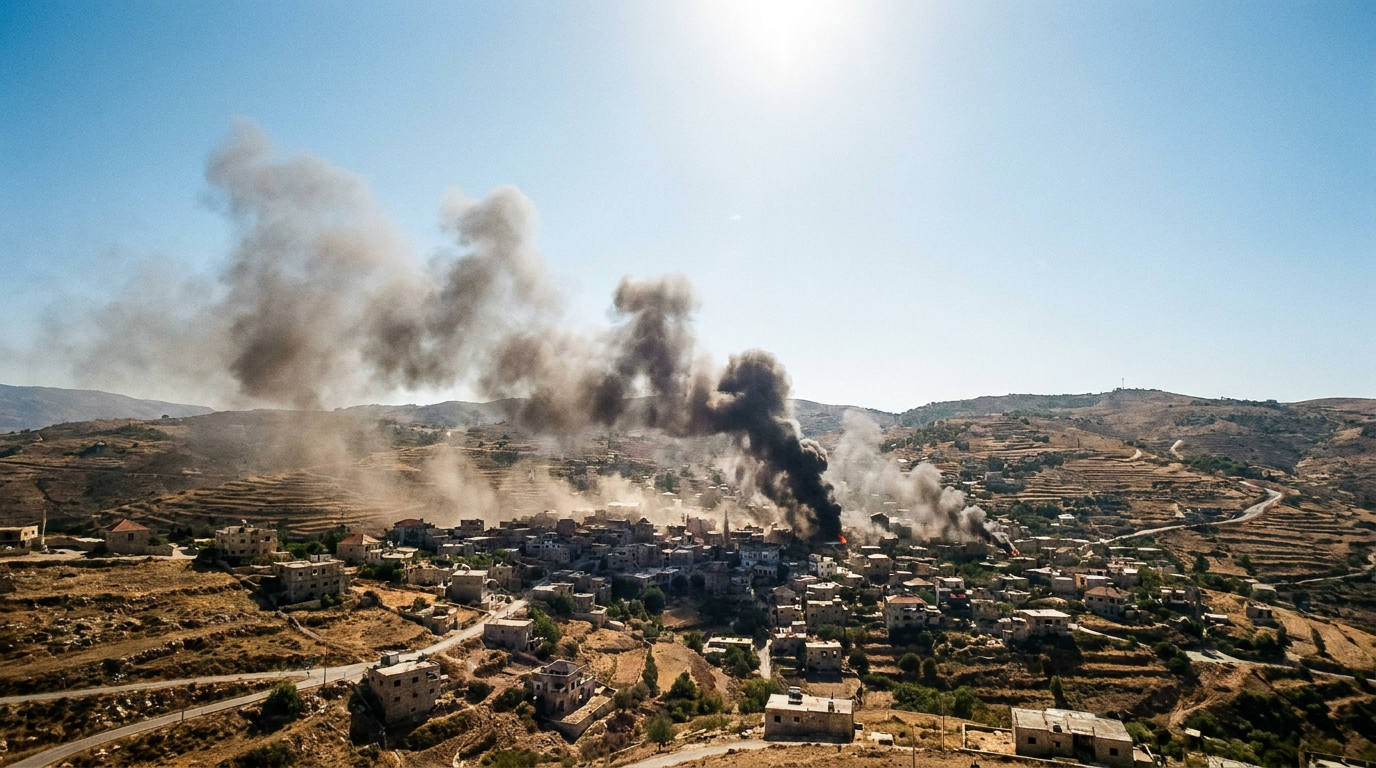
In response, the Israel Defense Forces (IDF) launched a massive wave of retaliatory airstrikes across southern Lebanon and the Bekaa Valley. The Israeli military reported striking more than 80 Hezbollah command centers and launch sites. Lebanese health officials stated that the bombardments killed at least 47 people, including women and children, and wounded 97 others.[2][4]

The sudden escalation had immediate geopolitical consequences. Planned technical talks between the US and Iran, scheduled to begin Friday at the Bürgenstock resort in Switzerland, were abruptly postponed. The talks were meant to initiate a 60-day negotiation window regarding Iran's nuclear program and the unfreezing of assets.[3][8]
Dozens of White House officials and advance staff were already in Switzerland preparing for the arrival of Vice President JD Vance, who is leading the US delegation. However, Iranian officials delayed their departure, insisting that Israeli military operations in Lebanon had to cease before diplomatic negotiations could proceed.[3][7]

Dozens of White House officials and advance staff were already in Switzerland preparing for the arrival of Vice President JD Vance, who is leading the US delegation.
The delay sparked visible frustration in Washington. President Donald Trump, who signed the 14-point MoU with Iran on Wednesday, took to social media to demand a "complete ceasefire on all fronts, including Lebanon, Hezbollah, and Israel." Vice President Vance issued an unusually sharp rebuke of Israeli hardline ministers who had criticized the Iran deal, urging them not to attack their "only powerful ally."[1][5]
Israeli Prime Minister Benjamin Netanyahu defended the military's actions, stating that Israel would "exact a very heavy price from Hezbollah" for the deaths of its soldiers and would maintain its six-mile buffer zone inside southern Lebanon for "as long as required."[1][6]
Despite the 4:00 p.m. ceasefire deadline, the situation on the ground remained highly volatile. Lebanese state media reported that Israel struck southern Lebanon at least 16 times shortly after the truce was supposed to begin, while warning sirens for hostile aircraft sounded in the northern Israeli town of Zar'it.[4][6]

How we got here
Wednesday
President Trump and Iran sign a 14-point memorandum of understanding to end hostilities.
Thursday Night
Hezbollah attacks an Israeli tank in Kfar Tebnit, killing four soldiers.
Friday Morning
Israel launches massive retaliatory airstrikes across southern and eastern Lebanon.
Friday Afternoon
Planned US-Iran technical talks in Switzerland are officially postponed.
Friday 4:00 PM
A renewed US-brokered ceasefire between Israel and Hezbollah officially goes into effect.
Viewpoints in depth
Israeli Defense Establishment
Maintains that military deterrence cannot be paused for diplomatic optics.
For Israel's military and political leadership, the deaths of four soldiers in a Hezbollah tank attack demanded an overwhelming response, regardless of the diplomatic schedule in Switzerland. Prime Minister Benjamin Netanyahu and hardline cabinet ministers argue that the IDF must maintain its six-mile buffer zone inside Lebanon to ensure the safety of northern Israeli residents. From this perspective, the US-Iran MoU is a separate bilateral issue, and Israel cannot be expected to absorb casualties without retaliating simply to facilitate Washington's negotiation timeline.
Lebanese & Regional Observers
Views the Israeli strikes as a disproportionate escalation meant to sabotage peace efforts.
Regional commentators and Lebanese officials point to the massive civilian toll—at least 47 dead and nearly 100 wounded in a single day—as evidence that Israel's response was disproportionate. Observers aligned with this view, frequently amplified by regional networks like Al Jazeera, argue that hardline elements within the Israeli government are deliberately escalating the conflict in Lebanon to collapse the broader US-Iran peace framework, which they have publicly opposed. Reports of Israeli strikes continuing past the 4:00 p.m. ceasefire deadline are cited as proof of this intent.
US Mediators
Focused entirely on preserving the fragile 60-day window for a permanent nuclear accord.
The US administration is visibly frustrated by the actions of both its allies and adversaries. For Washington, the localized violence in Lebanon is an unwanted distraction that threatens a historic, macro-level geopolitical realignment. Vice President JD Vance's sharp public criticism of Israeli cabinet ministers reflects a growing intolerance for actions that undermine the US-brokered MoU. The US priority is forcing a freeze on all kinetic activity so that the technical talks regarding Iran's nuclear program and the unfreezing of assets can finally begin in Switzerland.
What we don't know
- Whether the renewed 4:00 p.m. ceasefire will hold through the weekend despite early reports of violations.
- When the postponed US-Iran talks in Switzerland will be officially rescheduled.
- How the US will enforce the cessation of hostilities if either Israel or Hezbollah continues to exchange fire.
Key terms
- Memorandum of Understanding (MoU)
- A preliminary 14-point framework agreement signed by the US and Iran that opens a 60-day window to negotiate a permanent nuclear accord.
- Buffer Zone
- A six-mile strip of territory in southern Lebanon that the Israeli military is occupying to prevent Hezbollah attacks on northern Israel.
- Bürgenstock Resort
- A secure, isolated mountain resort in Switzerland chosen as the neutral venue for technical negotiations between US and Iranian diplomats.
Frequently asked
Why were the US-Iran talks postponed?
The talks in Switzerland were delayed because Iran refused to send its delegation while Israel was conducting heavy airstrikes against Hezbollah in Lebanon.
What triggered the latest violence?
The flare-up began when Hezbollah attacked an Israeli tank in southern Lebanon, killing four soldiers. Israel responded with massive airstrikes across the country.
Are Israel and Hezbollah part of the US-Iran deal?
Neither Israel nor Hezbollah directly signed the US-Iran memorandum of understanding, but the agreement calls for a cessation of hostilities on all regional fronts.
Is the ceasefire holding?
The truce is extremely fragile. Despite a 4:00 p.m. deadline, Lebanese media reported multiple Israeli strikes, and sirens sounded in northern Israel shortly after the ceasefire was supposed to begin.
Sources
Source coverage
8 outlets
4 viewpoints surfaced








[1]The Washington PostIsraeli Defense Establishment
Israel and Hezbollah agree to renewed ceasefire after deadly flare-up
Read on The Washington Post →[2]CBS NewsUS Mediators
Israel and Hezbollah reach ceasefire agreement to end fighting in Lebanon
Read on CBS News →[3]The GuardianIranian Leadership
US-Iran talks in Switzerland cancelled amid deadly Israel-Hezbollah clashes
Read on The Guardian →[4]Al JazeeraLebanese & Regional Observers
Israel continues attacks on Lebanon despite agreeing to ceasefire
Read on Al Jazeera →[5]The HinduLebanese & Regional Observers
Israel and Hezbollah agree on Lebanon ceasefire: U.S. official
Read on The Hindu →[6]The Jerusalem PostIsraeli Defense Establishment
Israel, Hezbollah agree to ceasefire starting on Friday, Israel to remain in Lebanon
Read on The Jerusalem Post →[7]Iran InternationalIranian Leadership
Israel, Hezbollah agree to renewed Lebanon ceasefire - Reuters
Read on Iran International →[8]Fox NewsUS Mediators
Israel–Hezbollah ceasefire becomes first test of Trump Iran framework after talks delay
Read on Fox News →
More in news politics
See all 5 stories →

Every angle. Every day.
Get news politics stories with full source coverage and perspective breakdowns delivered to your inbox.