
How Women's Wrestling Became the NCAA's Fastest-Growing Championship Sport
Following explosive grassroots growth, women's wrestling crowned its first official NCAA champions in 2026, cementing a new pipeline for female athletes and Olympic hopefuls.
By Factlen Editorial Team
- Collegiate Athletes & Coaches
- View the NCAA championship as the ultimate validation of their dedication and a victory for equal athletic opportunity.
- Athletic Directors
- View women's wrestling as a highly efficient tool for enrollment growth and Title IX compliance.
- Olympic Development Officials
- View the NCAA system as the premier training ground for future international and Olympic medalists.
- Grassroots Advocates
- Focus on the explosive youth growth and the cultural shift of overcoming historical gender barriers in combat sports.
What's not represented
- · Men's collegiate wrestling programs adjusting to shared resources
Why this matters
The NCAA's adoption of women's wrestling opens up millions of dollars in scholarships and institutional support for female athletes. Because the college format mirrors Olympic rules, this collegiate boom is directly strengthening the United States' roster for the 2028 Los Angeles Games.
Key points
- Women's wrestling held its first official NCAA Championship in March 2026.
- It is currently the fastest-growing high school sport in the United States.
- Small Division II and III schools drove the initial collegiate boom.
- The sport uses Olympic freestyle rules, creating a direct pipeline for Team USA.
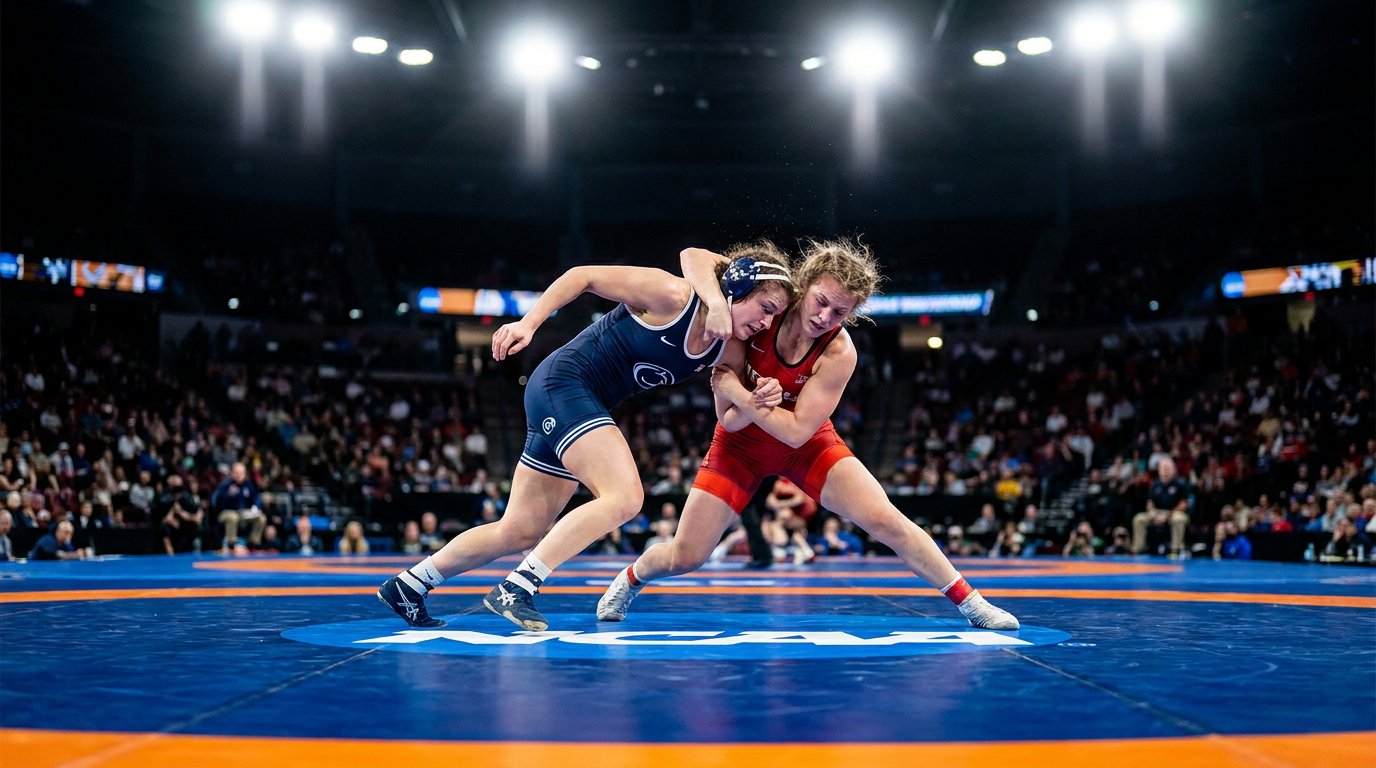
In March 2026, the Xtream Arena in Coralville, Iowa, hosted a milestone decades in the making: the first official NCAA Women's Wrestling Championships. For the hundreds of athletes stepping onto the mats, the tournament represented the culmination of a long, grassroots battle for institutional recognition. The atmosphere was electric, with packed stands and roaring crowds watching competitors from across the country vie for the first official national titles in the sport's history.[1]
The road to Coralville began when women's wrestling was designated an "emerging sport" by the NCAA in 2020. That status provided a runway for programs to build rosters and secure funding, with the promise that once 40 schools sponsored varsity teams, the sport could petition for full championship status. The sport shattered that threshold, officially becoming the NCAA's 91st championship sport in January 2025 and setting the stage for the inaugural 2026 tournament.[1][5]
This collegiate milestone is the direct result of an unprecedented boom at the high school level. Women's wrestling is currently the fastest-growing high school sport in the United States. In 1994, barely 800 girls wrestled in high school nationwide. Today, that number has surged past 87,000, outpacing the growth rates of traditional staples like basketball and track.[2][6]

Surprisingly, the most explosive period of growth occurred in the wake of the COVID-19 pandemic. As students returned to athletics, participation numbers skyrocketed, prompting state athletic associations to rapidly sanction the sport. Today, 46 states host official girls' state wrestling championships, creating a massive, hungry talent pool looking for opportunities to compete at the next level.[6]
To meet that demand, colleges have rapidly expanded their athletic offerings. As of the 2025–2026 season, 113 NCAA programs sponsor women's wrestling. However, unlike many collegiate sports where massive Division I universities dictate the landscape, the women's wrestling boom was built from the bottom up.[2][4]
Small and mid-sized Division II and Division III schools served as the engine for the sport's collegiate expansion. For enrollment-conscious institutions, adding a women's wrestling team is a highly attractive proposition. The sport requires relatively low overhead—mats, uniforms, and a practice space—while drawing in dozens of dedicated, tuition-paying student-athletes. Trailblazing programs like McKendree University and North Central College capitalized on this dynamic early, building powerhouse rosters that dominated the emerging sport era.[4]
Small and mid-sized Division II and Division III schools served as the engine for the sport's collegiate expansion.
Now, the Division I giants are waking up to the sport's potential. The University of Iowa became the first Power Five school to field a team, drawing massive crowds and immediate national attention. The Ivy League is also entering the fray, with Columbia University announcing a new varsity program backed by a $10 million endowment. As more Division I schools add the sport, the competition for top recruits is intensifying.[1][4]
Because the sport is still in its infancy at the NCAA level, the 2026 championships featured a unified bracket. Athletes from Division I, II, and III schools all competed against one another for the inaugural titles. This created unique David-versus-Goliath matchups, where wrestlers from small liberal arts colleges found themselves squaring off against athletes from massive state universities.[1]

The inaugural season produced dominant new stars, none brighter than Lehigh University sophomore Audrey Jimenez. Jimenez was awarded the 2026 Anthony-Maroulis Trophy as the nation's best women's college wrestler after posting a flawless 21-0 record. Remarkably, she finished the season with a 100 percent bonus rate—meaning every single one of her victories came by pin, technical fall, or forfeit, without a single match going to a standard decision.[3]
Beyond the college campus, the NCAA's adoption of women's wrestling has massive implications for the international stage. Unlike men's collegiate wrestling, which uses a uniquely American ruleset known as "folkstyle," women's college wrestling utilizes "freestyle" rules. Freestyle is the exact same style contested at the World Championships and the Olympic Games.[4]
This ruleset alignment transforms the NCAA into a direct, high-level training pipeline for Team USA. Every collegiate match serves as preparation for the international stage. The overlap is already evident: Iowa's Kennedy Blades won a silver medal at the 2024 Paris Olympics while still competing as a college athlete. With the 2028 Summer Olympics in Los Angeles approaching, the collegiate ranks are actively developing America's next generation of medalists.[1][4]

The rise of women's wrestling also represents a broader cultural shift in combat sports. For decades, wrestling was viewed as a male-only domain, and female athletes often faced stigma or were forced to compete on boys' teams. Today, dedicated women's programs are fostering environments that build extreme mental and physical resilience, proving that the grueling demands of the mat are entirely gender-neutral.[6][7]
As the sport looks toward the 2026–2027 season, the momentum shows no signs of slowing. With more Division I programs slated to launch and high school participation continuing to climb, the talent pool will only grow deeper. The first chapter of NCAA women's wrestling has been written, but the sport is just beginning to realize its full potential on the American athletic landscape.[4][7]
How we got here
1994
Only about 800 girls wrestle at the high school level nationwide.
2020
The NCAA officially designates women's wrestling as an "emerging sport."
2024
Iowa's Kennedy Blades wins an Olympic silver medal while still competing as a college athlete.
Jan 2025
Women's wrestling officially becomes the NCAA's 91st championship sport.
Mar 2026
The inaugural NCAA Women's Wrestling Championships are held in Coralville, Iowa.
Viewpoints in depth
Collegiate Athletes & Coaches
Viewing the NCAA championship as the ultimate validation of their dedication.
For the athletes and coaches who built the sport during its 'emerging' phase, the official NCAA championship status is a hard-won victory. They emphasize that female wrestlers now have the same institutional backing, scholarship opportunities, and national visibility as their male counterparts. Coaches note that the unified championship format—where Division I, II, and III schools currently compete together—has fostered a tight-knit, highly competitive community that celebrates the sport's pioneers regardless of school size.
Athletic Directors & Administrators
Viewing women's wrestling as a highly efficient tool for enrollment and campus growth.
From an administrative perspective, women's wrestling is an ideal addition to an athletic department. Administrators at small and mid-sized colleges highlight the sport's low overhead costs and high return on investment. Because the high school talent pool is expanding so rapidly, colleges can quickly recruit full rosters of dedicated student-athletes, boosting overall enrollment and tuition revenue while simultaneously advancing Title IX compliance and expanding athletic opportunities for women.
Olympic Development Officials
Viewing the NCAA system as the premier training ground for future Olympic medalists.
USA Wrestling and Olympic development officials are thrilled by the NCAA's adoption of freestyle rules for women's competition. They argue that this alignment gives American women a distinct advantage on the global stage. Instead of having to learn a new style after college, female athletes spend four years refining the exact techniques required for Olympic gold. Officials view the expanding NCAA landscape as a critical asset for Team USA heading into the 2028 Los Angeles Games.
What we don't know
- When the NCAA will officially split the women's wrestling championships into separate Division I, II, and III tournaments.
- How quickly other major Power Five conferences will follow the Big Ten and Ivy League in adding varsity programs.
Key terms
- Freestyle wrestling
- An international style of amateur wrestling used in the Olympics, where wrestlers are permitted to use their legs for both offense and defense.
- Emerging Sport Status
- An NCAA designation that helps grow women's sports by providing a pathway to official championship status once 40 schools sponsor varsity teams.
- Bonus rate
- A wrestling statistic measuring the percentage of a wrestler's wins that come by fall (pin), technical fall, or forfeit, rather than a standard points decision.
- Anthony-Maroulis Trophy
- An annual award presented to the nation's best women's college wrestler, named after four-time national champions Victoria Anthony and Helen Maroulis.
Frequently asked
What style of wrestling do college women compete in?
Women's college wrestling uses freestyle rules, which is the exact same style used in the Olympics. This differs from men's college wrestling, which uses a uniquely American style called folkstyle.
When did women's wrestling become an official NCAA championship sport?
It officially became the NCAA's 91st championship sport in January 2025, with the first national championship tournament held in March 2026 in Coralville, Iowa.
Which colleges have women's wrestling teams?
Over 113 NCAA schools currently sponsor the sport. While smaller Division II and III schools pioneered the movement, major Division I programs like Iowa and Columbia are now fielding teams.
Sources
Source coverage
7 outlets
4 viewpoints surfaced






[1]Associated PressCollegiate Athletes & Coaches
Women's college wrestling achieves major milestone with first NCAA championships
Read on Associated Press →[2]National Wrestling Coaches AssociationOlympic Development Officials
Growing Women's Wrestling: Facts & Resources
Read on National Wrestling Coaches Association →[3]USA WrestlingCollegiate Athletes & Coaches
Lehigh's Audrey Jimenez selected as recipient of the 2026 USA Wrestling Anthony-Maroulis Trophy
Read on USA Wrestling →[4]RallyFuelAthletic Directors
Women's Wrestling Just Crowned Its First NCAA Champion, and the Sport Is Only Getting Started
Read on RallyFuel →[5]NCSA College RecruitingAthletic Directors
Women's Wrestling is Now a Championship Sport
Read on NCSA College Recruiting →[6]Marshall IndependentGrassroots Advocates
Girls' wrestling now fastest-growing sport in the country
Read on Marshall Independent →[7]Factlen Editorial TeamGrassroots Advocates
Synthesis by Factlen editorial team
Read on Factlen Editorial Team →
More in sports
See all 6 stories →Olympic Inclusion
How Cricket is Rewiring Itself for the LA28 Olympics
5 sources

Sports Tech
How 'Super Spikes' Are Rewriting Track and Field History
7 sources
Knicks Championship
Millions Pack NYC's Canyon of Heroes for Knicks' First Championship Parade in 53 Years
6 sources
WTA Tour
Donna Vekic Completes 'Lucky Loser' Cinderella Run to Win Queen's Club Title
6 sources
Every angle. Every day.
Get sports stories with full source coverage and perspective breakdowns delivered to your inbox.