
How 'Super Spikes' Are Rewriting Track and Field History
The combination of resilient PEBA foams and stiff carbon plates has fundamentally altered running biomechanics, shattering world records while introducing new injury risks.
By Factlen Editorial Team
- Biomechanics & Innovation
- Focuses on the material science and mechanical efficiency that allows athletes to push the boundaries of human speed.
- Athletics Heritage & Regulation
- Concerned with maintaining a level playing field, regulating stack heights, and preserving the historical context of world records.
- Athlete Health & Safety
- Highlights the altered gait mechanics and the rise in specific bone stress injuries associated with stiff-plated shoes.
What's not represented
- · Grassroots athletes unable to afford premium spikes
- · Historical record holders whose times are being eclipsed
Why this matters
Super spikes have fundamentally altered the biomechanics of running, leading to a wave of shattered world records across all distances. Understanding this technology explains why today's track times are dropping so rapidly and highlights the new physical demands placed on athletes' bodies.
Key points
- Modern 'super spikes' combine highly resilient PEBA foams with stiff carbon or nylon plates to maximize energy return.
- A 2025 biomechanics study predicted Usain Bolt's 100m world record would drop from 9.58s to 9.42s with modern footwear.
- Carbon plates do not act as springs; they act as levers that save energy at the toe joint and distribute force across the foam.
- World Athletics has capped track spike stack heights at 20 millimeters to regulate the mechanical advantage.
- Sports medicine researchers have linked the altered biomechanics of plated shoes to an increase in midfoot bone stress injuries.
Track and field is currently undergoing a technological revolution that has fundamentally altered the sport's landscape. Since the turn of the decade, distance and sprint records that stood for generations have been systematically dismantled by a new wave of athletes. The primary catalyst for this era of shattered records is not a sudden, inexplicable leap in human genetics, nor is it a radical new training methodology. Instead, the culprit is a fundamental redesign of the footwear athletes wear on the oval. Enter the 'super spike,' a piece of equipment that has forced biomechanists, coaches, and sporting regulators to rethink the physical limits of human speed.[2][7]
The impact of this footwear technology is so profound that scientists are now mathematically recalculating the sport's most legendary historical performances. In late 2025, a research team led by biomechanist Wouter Hoogkamer at the University of Massachusetts Amherst published a study predicting what Usain Bolt's untouchable 2009 world record of 9.58 seconds in the 100-meter dash would look like with modern spikes. By analyzing the mechanical advantages of current carbon-plated shoes and applying them to Bolt's stride data, the researchers arrived at a staggering conclusion: Bolt would have crossed the finish line in 9.42 seconds. That 0.16-second deduction represents an eternity in elite sprinting, highlighting just how much time is currently being shaved off by equipment alone.[1]
Bolt himself, speaking ahead of the 2025 World Athletics Championships in Tokyo, did not dispute the researchers' math. The eight-time Olympic champion noted that contemporaries who continued racing into the super-spike era, such as Shelly-Ann Fraser-Pryce, saw immediate and noticeable time drops. 'I probably would have run way faster with them too,' Bolt conceded to reporters. When the fastest human in recorded history openly acknowledges that a pair of shoes could effortlessly shave nearly two-tenths of a second off a 100-meter sprint, the underlying engineering of that footwear warrants a rigorous scientific examination.[1][7]

To understand the mechanics of the super spike, one must first look at its direct predecessor: the marathon 'super shoe.' Introduced to the road racing world in the late 2010s, these shoes revolutionized the marathon by combining massive stack heights of ultra-bouncy foam with rigid carbon-fiber plates. Translating that exact formula to the track, however, required significant structural adaptation. Track spikes must be substantially lighter, more aggressive, and capable of gripping a synthetic rubber oval at much higher speeds and through tighter corners. A towering 40-millimeter road shoe would be dangerously unstable during a 200-meter sprint.[3]
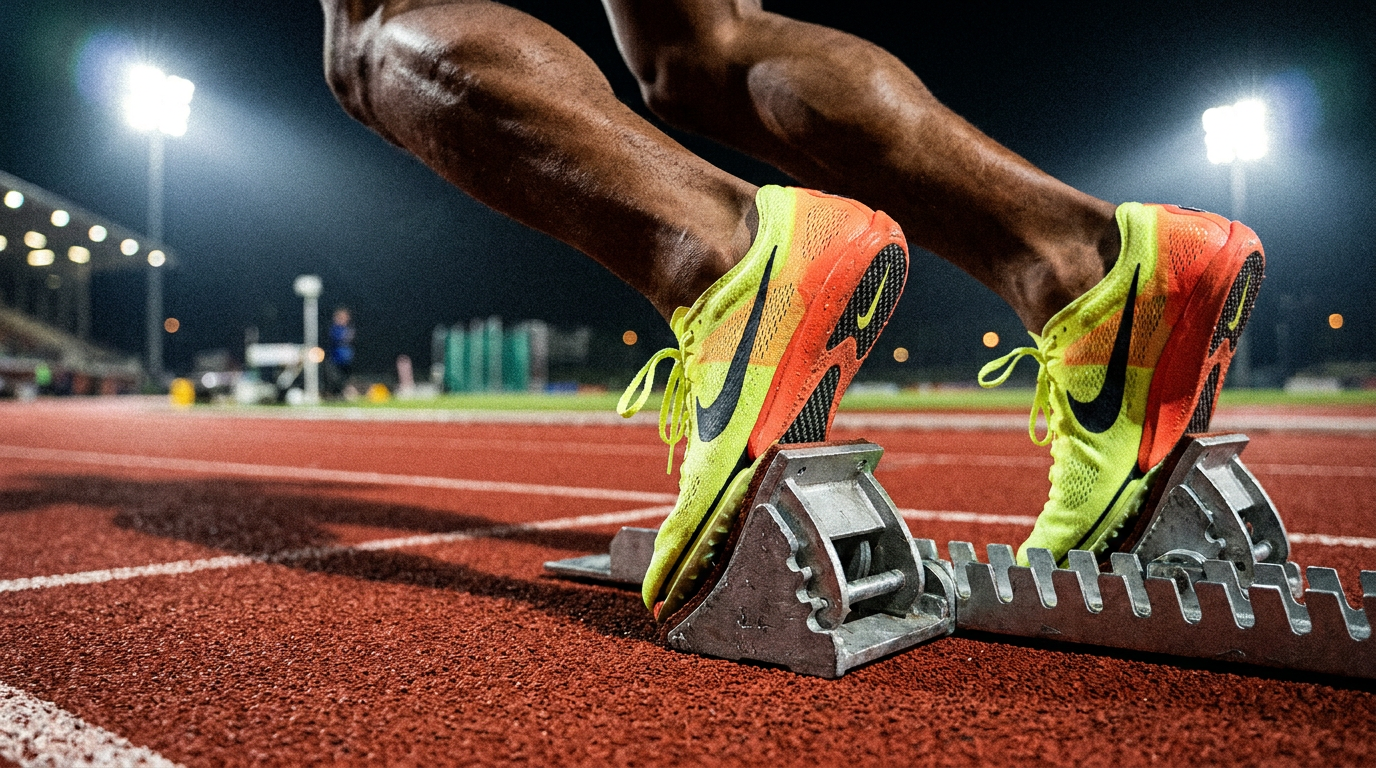
By strict biomechanical definition, a modern super spike combines lightweight, compliant, and highly resilient foams with a stiff plate made of carbon fiber, nylon, or fiberglass. While traditional track spikes relied on a very thin layer of hard EVA foam merely to protect the athlete's foot from the metal pins striking the track, the new generation uses the midsole as an active, energy-returning engine for propulsion. The shoe is no longer just a protective layer of grip; it is a dynamic mechanical system designed to optimize the runner's kinetic output.[3][4]
The secret to this propulsive engine lies primarily in the foam itself. Advanced compounds, most notably polyether block amide (PEBA), are highly compliant, meaning they squish down easily and smoothly under the immense force of a runner's footstrike. Crucially, they are also incredibly resilient. Traditional EVA foams dissipate a significant amount of the runner's kinetic energy as heat upon impact. In contrast, modern super foams can return upwards of 85 percent of that mechanical energy. This means the athlete's muscles do not have to work nearly as hard to maintain a given pace, significantly delaying the onset of metabolic fatigue.[4][5]
If the foam is the engine, why do these shoes universally include a rigid carbon-fiber or Pebax plate? When Nike's original Vaporfly debuted, popular media quickly dubbed the curved plates 'springs,' assuming they acted like tiny trampolines under the foot. Biomechanists have since largely debunked this simplistic notion. The actual amount of mechanical energy stored and released by the physical bending of a carbon plate is minuscule, particularly in the context of the massive ground reaction forces generated during a sprint. The plate is not a spring; its true function is far more sophisticated.[3][5]

If the foam is the engine, why do these shoes universally include a rigid carbon-fiber or Pebax plate?
Instead of a spring, biomechanics researchers view the embedded plate as a lever and a stiffening device. One of its primary benefits is providing longitudinal bending stiffness. During the push-off phase of a running stride, the metatarsophalangeal (MTP) joint—the base of the big toe—bends significantly. This bending absorbs a measurable amount of mechanical energy but returns almost none of it to the runner. A stiff plate limits this toe flexion, saving a small but crucial amount of energy that would otherwise be wasted at the joint, redirecting that force back into the ground.[3][4]
Furthermore, the stiff plate fundamentally alters how the human foot interacts with the highly compliant super foam. Biomechanist Rodger Kram has famously likened the carbon plate to a snowshoe. Just as a snowshoe distributes a person's body weight across a wider area of soft snow to prevent them from sinking, the rigid plate allows the runner's foot to apply force to a much larger volume of the super foam simultaneously. Without the plate, the foot would simply sink unevenly into the plush material, creating a mushy, unstable ride that would bleed energy.[5][7]
This precise combination of compliant foam and a stiffening plate allows athletes to operate at a more efficient place on their muscles' force-length and force-velocity curves. However, the sheer mechanical advantage provided by these shoes eventually forced the sport's international governing body, World Athletics, to intervene. To prevent track spikes from turning into the towering platform shoes seen in road marathons, regulators realized they needed to implement strict parameters to preserve the integrity of track events and ensure that athletic ability, rather than footwear engineering, remained the primary determinant of race outcomes.[2][5]
As a result, World Athletics mandated that as of November 2024, all track spikes—regardless of whether they are used for a 100-meter sprint or a 10,000-meter race—must have a maximum stack height of 20 millimeters. Previously, distance spikes were allowed to be up to 25 millimeters thick. This strict regulation forces shoe manufacturers into a tight corner: they must engineer incredibly dense, highly responsive foams that can deliver the coveted 'super' energy-return effect without violating the strict thickness parameters set by the governing body.[2][7]

Despite the undeniable performance benefits and shattered records, the transition to super spikes has not been entirely seamless for athletes' bodies. The biomechanics of running in highly compliant, stiff-plated shoes are fundamentally different from running in traditional, minimalist spikes. Controlled laboratory studies have shown that high-stack, plated shoes can increase a runner's vertical oscillation—meaning they bounce higher with each step—and reduce overall hip stability. This is particularly problematic when athletes are navigating the tight, high-speed curves of an indoor or outdoor track, placing novel strains on the lower body.[6][7]
This altered running economy has introduced new and concerning injury profiles to the sport. Sports medicine researchers and orthopedic specialists have documented a troubling rise in specific bone stress injuries among runners using carbon-plated footwear. Notably, there has been an increase in stress fractures to the navicular bone in the midfoot, including among elite junior track and field athletes. These injuries, which are notoriously slow to heal and sometimes require surgical intervention, highlight the physical toll that this new technology can exact on a runner's skeletal system.[6]
The broader track and field community remains philosophically divided on the implications of the super spike era. Purists argue that comparing modern times to those set in the 1990s or 2000s is no longer a valid metric of human athletic progression, suggesting the shoes provide an unfair technological doping effect. Yet, technological evolution is a constant in the history of the sport. The transition from heavy cinder tracks to bouncy synthetic surfaces in the 1960s, and the introduction of flexible fiberglass pole vault poles, similarly rewrote the record books in their respective eras.[7]
Ultimately, super spikes represent a permanent and irreversible paradigm shift in running biomechanics. As the 2026 track season unfolds, the focus among elite coaches and athletes has shifted away from debating the fairness of the shoes. Instead, the mandate is now about understanding how to train the human body to maximize the mechanical potential of PEBA foams and carbon plates, while simultaneously mitigating the unique injury risks they present. The record books have already been rewritten; now, the science of human performance is racing to catch up.[6][7]
How we got here
2017
Nike introduces the Vaporfly 4% road shoe, debuting the modern foam-and-plate concept.
2019
The first prototype 'super spikes' appear on the track, sparking an arms race among shoe brands.
Nov 2024
World Athletics enforces a strict 20mm maximum stack height for all track spikes.
Sep 2025
A UMass Amherst study predicts Usain Bolt would have run 9.42s in modern super spikes.
Viewpoints in depth
Biomechanics Researchers
Focusing on energy return and the mechanical interaction between foam and plate.
Biomechanists emphasize that the magic of super spikes lies not in a 'spring' effect, but in energy conservation. By utilizing highly resilient PEBA foams, the shoes minimize the kinetic energy lost as heat during footstrike. The rigid carbon or Pebax plate acts as a stiffening lever, preventing energy waste at the metatarsophalangeal (MTP) joint and distributing the runner's force evenly across the compliant foam. This allows the athlete's muscles to operate more efficiently, delaying fatigue without requiring a higher metabolic output.
Sports Medicine Professionals
Raising concerns about new injury profiles and altered running kinematics.
Orthopedic specialists point out that the human foot did not evolve to run on highly compliant, stiff-plated platforms. The increased vertical oscillation and altered ground-contact times shift the mechanical load up the kinetic chain, reducing hip stability and placing novel stress on the midfoot. This has led to a documented rise in navicular bone stress injuries, particularly among younger athletes whose skeletal structures are still adapting to the extreme forces generated during track events.
Sporting Regulators
Balancing technological advancement with the integrity of the sport.
Organizations like World Athletics face the difficult task of embracing innovation while preventing footwear from becoming the primary determinant of a race. By capping spike stack heights at 20 millimeters, regulators aim to limit the amount of 'super foam' an athlete can leverage. This ensures that while runners benefit from modern material science, the sport remains a fundamental test of human physiology rather than an engineering arms race.
What we don't know
- The exact percentage of performance enhancement that varies based on an individual athlete's weight, footstrike, and running mechanics.
- The long-term epidemiological data on whether super spikes definitively cause higher overall injury rates compared to traditional spikes.
Key terms
- PEBA (Polyether block amide)
- A highly compliant and resilient synthetic foam used in modern running shoes that returns a high percentage of kinetic energy.
- Stack height
- The total thickness of the shoe's sole, measured from the bottom of the foot to the ground.
- Metatarsophalangeal (MTP) joint
- The joint at the base of the big toe, which bends during the push-off phase of running and can waste energy without a stiff plate.
- Longitudinal bending stiffness
- The resistance of a shoe to bending end-to-end, usually increased by adding a carbon fiber or Pebax plate.
Frequently asked
What makes a track spike a 'super spike'?
It combines a lightweight, highly resilient foam (like PEBA) with a stiff embedded plate made of carbon fiber or nylon, designed to return maximum energy to the runner.
Do carbon plates act like springs?
No. Biomechanists have shown the plate acts more like a lever and a stiffening device, saving energy at the toe joint and allowing the foot to apply force evenly across the foam.
Are super spikes legal in competition?
Yes, provided they meet World Athletics regulations, which currently mandate a maximum sole thickness (stack height) of 20 millimeters for all track events.
Can super spikes cause injuries?
While they improve performance, the altered biomechanics and increased stiffness have been linked by sports medicine researchers to a rise in specific bone stress injuries, such as in the navicular bone.
Sources
Source coverage
7 outlets
3 viewpoints surfaced







[1]The GuardianAthletics Heritage & Regulation
Study predicts Usain Bolt would have run 100m in 9.42sec in super spikes
Read on The Guardian →[2]Runner's WorldAthletics Heritage & Regulation
What are super spikes? The track shoes rewriting the record books
Read on Runner's World →[3]OutsideBiomechanics & Innovation
The Science Behind Track’s New 'Super Spikes'
Read on Outside →[4]Sports MedicineBiomechanics & Innovation
The Biomechanics of Modern Track Spikes
Read on Sports Medicine →[5]Running WritingsBiomechanics & Innovation
The biomechanics of super spikes and carbon fiber plates
Read on Running Writings →[6]Mass General BrighamAthlete Health & Safety
Bone stress injuries in runners using carbon-fiber plate footwear
Read on Mass General Brigham →[7]Factlen Editorial TeamBiomechanics & Innovation
Synthesis by Factlen editorial team
Read on Factlen Editorial Team →
More in sports
See all 6 stories →Viral Fame
New Zealand's Viral Defender Tim Payne Signs With Paraguayan Giants Club Olimpia
7 sources

Women's Soccer
The 2026 Watershed: How NWSL Expansion and USL Realignment Are Reshaping US Women's Soccer
7 sources

Knicks Championship
New York Knicks Celebrate 2026 NBA Championship as Rivals Study Their Roster Blueprint
6 sources

Olympic Inclusion
How Cricket is Rewiring Itself for the LA28 Olympics
5 sources

Every angle. Every day.
Get sports stories with full source coverage and perspective breakdowns delivered to your inbox.