
How South Korea Solved Its Food Waste Crisis and Hit a 98% Recycling Rate
By combining smart-bin technology with strict "pay-as-you-throw" financial incentives, South Korea has transformed a massive environmental liability into renewable energy and agricultural feed.
By Factlen Editorial Team
- Environmental Policymakers
- Focus on the legislative milestones, landfill bans, and methane reduction achieved through nationwide mandates.
- Urban Residents
- Experience the system as a daily household chore, motivated by pay-as-you-throw financial incentives to reduce waste volume.
- Waste Management Operators
- Manage the industrial logistics of converting thousands of tons of organic matter into biogas and feed, while battling contamination.
What's not represented
- · Restaurant Owners
- · Agricultural Feed Buyers
Why this matters
Food waste is one of the world's largest sources of methane emissions, yet most countries still dump it into landfills. South Korea's proven, nationwide system demonstrates that with the right mix of technology and financial incentives, almost all organic waste can be transformed into renewable energy and agricultural resources.
Key points
- South Korea recycles 98% of its food waste, up from just 2% in 1995.
- A 2005 landfill ban and a 2013 mandatory separation policy drove the transformation.
- Residents pay for disposal by weight, incentivizing them to reduce waste volume.
- Waste is processed into renewable biogas, agricultural compost, and livestock feed.
- The system successfully powers thousands of homes and supports local agriculture.
Across the globe, households and restaurants discard an estimated 1.05 billion tonnes of edible food every year. When this organic matter is dumped into traditional landfills, it decomposes without oxygen, releasing methane—a greenhouse gas significantly more potent than carbon dioxide in the short term. For most developed nations, food waste remains an intractable environmental and logistical crisis. In the United States, for instance, roughly 60 percent of food scraps end up in landfills, with only a tiny fraction diverted to compost or energy production. Yet, one densely populated nation has effectively solved this problem, transforming a massive liability into a nationwide resource.[1][4]
South Korea currently recycles an astonishing 98 percent of its food waste. Every day, the country generates approximately 15,000 tons of sticky, pungent food scraps from residential kitchens, school cafeterias, and commercial restaurants. Instead of burying this organic material, South Korea operates a highly choreographed, nationwide logistics network that intercepts almost every discarded meal. Through a combination of strict government mandates, financial incentives, and advanced industrial processing, these scraps are systematically converted into renewable biogas, agricultural compost, and livestock feed.[1][3]
This near-total recycling rate is not the result of a sudden technological miracle, but rather a decades-long policy evolution. In 1995, South Korea recycled a mere 2 percent of its food waste. As a mountainous country with limited usable land and a rapidly urbanizing population, it simply ran out of space for sprawling landfills. The government realized that voluntary environmentalism would not be enough to shift the habits of 50 million citizens. They needed to make waste disposal a direct financial calculation for every household.[1][5]
The first major legislative strike came in 2005, when the South Korean government officially banned the dumping of raw food waste into landfills. This forced municipalities to begin building the infrastructure required for mass organic recycling. However, the true behavioral shift occurred in 2013, when the government introduced a mandatory nationwide separation policy coupled with a "Pay-As-You-Throw" (PAYT) financial model. Under this system, throwing away food was no longer free; residents had to pay for every kilogram of waste they generated.[2][5]

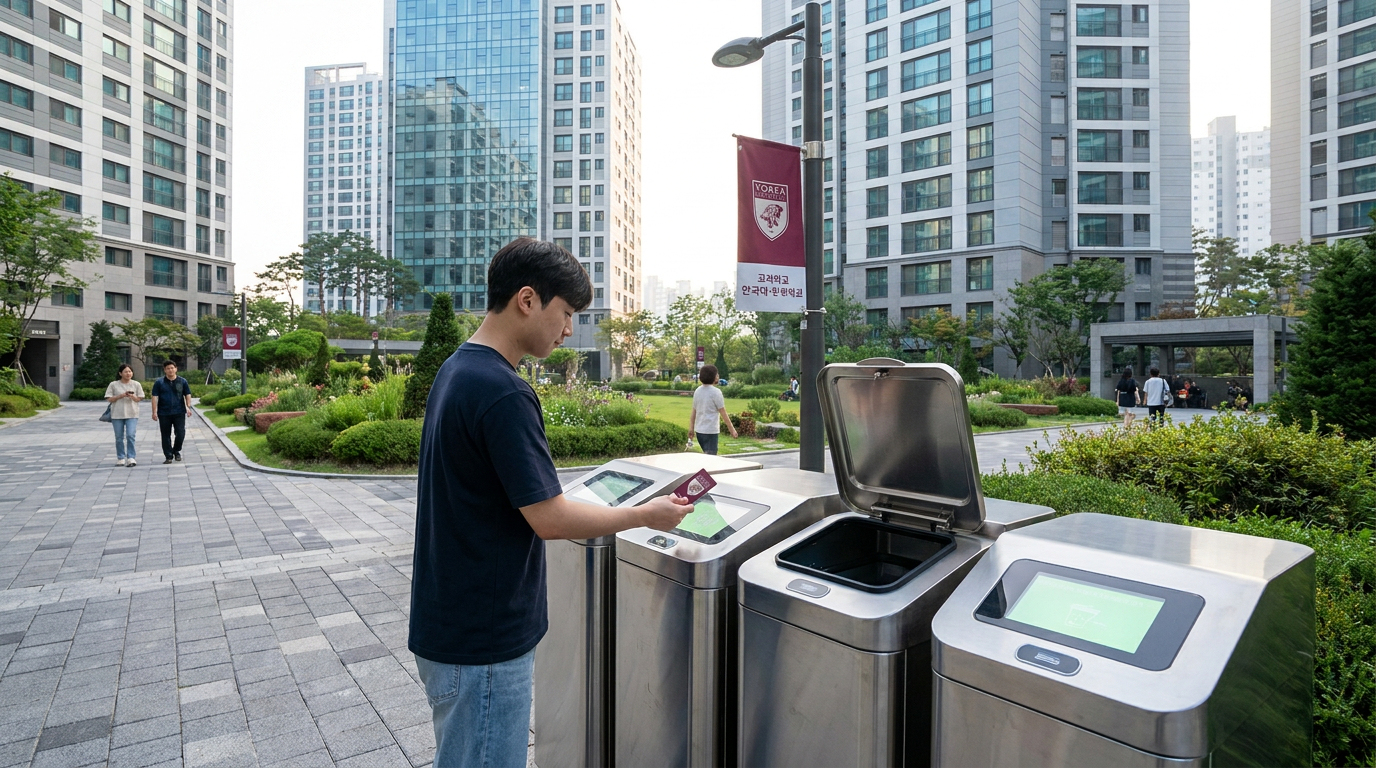
For the average citizen living in a modern Seoul high-rise, the recycling process begins at a high-tech communal disposal station. Residents carry their food scraps to a designated electronic smart bin equipped with a Radio Frequency Identification (RFID) scanner. By tapping a registered resident card or scanning a smartphone app, the lid unlocks. Once the waste is deposited, the bin's internal scale precisely weighs the organic matter and automatically bills the household's monthly account.[2][3]
This weight-based billing system has triggered a fascinating behavioral shift across the country. Because residents are charged by the gram, there is a strong financial incentive to make the waste as light as possible. South Korean cuisine is famously rich in soups, stews, and fermented vegetables, meaning food scraps carry a high water content. To lower their monthly disposal fees, many households now meticulously drain and squeeze the moisture out of their leftovers before taking them to the smart bin, or utilize home dehydrating machines.[3]
In older neighborhoods, single-family homes, or rural areas where RFID smart bins are not yet installed, the system relies on a low-tech but equally effective alternative. Residents are required by law to purchase specific, government-issued biodegradable bags from local convenience stores or supermarkets. These bags, which cost the equivalent of a few cents each, serve as a prepaid tax on waste. If a citizen attempts to bypass the system by hiding food scraps in regular municipal trash, they face steep fines and strict enforcement.[1][2]

Residents are required by law to purchase specific, government-issued biodegradable bags from local convenience stores or supermarkets.
Once the waste is collected by municipal fleets—often starting their routes as early as 5:00 a.m. to avoid urban traffic—it is transported to one of roughly 300 specialized processing facilities scattered across the country. The Daejeon Bioenergy Center, located about two hours south of Seoul, is a prime example of this industrial scale. The facility spans the size of two football fields and processes more than 400 tons of food waste every single day, handling roughly half of the entire output for a city of 1.5 million people.[1][6]
Upon arrival at these processing plants, the raw waste is dumped into massive subterranean storage tanks. The first and most crucial step in the transformation process is mechanical sorting and grinding. Massive industrial shredders break down the organic matter while automated screens and magnetic separators work to remove non-food impurities. Despite strict household sorting rules, the incoming sludge often contains accidental contaminants like plastic cutlery, stray packaging, and metal bottle caps, which must be aggressively filtered out to protect the downstream machinery.[3]
After the impurities are removed, the organic slurry undergoes a rigorous drying and pressing phase. The goal is to separate the solid biomass from the liquid effluent. The extracted liquid is not discarded; instead, it is pumped into massive anaerobic digesters. Inside these oxygen-free tanks, specialized bacteria break down the organic liquids, releasing methane-rich biogas. At the Daejeon facility alone, this captured biogas is scrubbed and burned to generate enough renewable green electricity to power approximately 20,000 local households.[1][6]

The remaining solid biomass, now significantly reduced in volume and moisture, is sterilized at high temperatures to kill off any harmful pathogens. A large portion of this dried material is then heavily processed and sold as a nutrient-dense supplement for animal feed, primarily distributed to domestic duck and chicken farms. By utilizing recycled food waste to feed livestock, South Korea reduces its reliance on imported agricultural feed, saving money and preserving global farmland that would otherwise be cleared for crop production.[2][3]
The solid waste that is not suitable for animal feed is routed into industrial composting streams. It is mixed with wood chips and other organic bulking agents, then left to cure for several weeks. The resulting nutrient-rich fertilizer is distributed to local farms and urban agricultural projects, returning essential nitrogen and phosphorus back to the soil. This closed-loop system ensures that the caloric and chemical value of uneaten food is entirely recaptured, rather than left to rot in a landfill.[3][6]
The results of this comprehensive infrastructure are evident in the data. Before the implementation of the Pay-As-You-Throw system, the average South Korean generated significantly more waste. Today, the average household generates roughly 33 kilograms of food waste per person annually—less than half of the global average of 79 kilograms per capita. The combination of financial penalties and seamless infrastructure has successfully decoupled economic growth from waste generation.[4]

Despite its overwhelming success, the South Korean model is not without its operational friction. Sorting food waste correctly requires constant public education. Under the national guidelines, soft items that animals can digest—like fruit peels, leftover rice, and vegetables—are permitted. However, hard organic materials like beef bones, clam shells, peach pits, and onion skins must be thrown in the regular trash. When confused residents toss the wrong items into the food bins, it can severely damage the grinding equipment at the processing plants, sometimes requiring months of expensive repairs.[1]
Furthermore, while recycling 98 percent of food waste is a monumental environmental victory, experts caution that it is only the second-best solution. The ultimate goal of sustainable food policy is source reduction—preventing the waste from being generated in the first place. Processing thousands of tons of heavy, wet food scraps still requires massive amounts of energy, trucking logistics, and industrial maintenance. South Korea's next frontier is encouraging restaurants and households to simply cook and serve less excess food, ensuring that the country's impressive recycling plants eventually have less work to do.[1][7]
How we got here
1995
South Korea introduces a volume-based waste fee system, beginning the shift toward holding citizens financially accountable for trash.
2005
The government officially bans the dumping of raw food waste into traditional landfills.
2013
A mandatory nationwide separation policy and the Pay-As-You-Throw (PAYT) system are implemented.
2022
Data confirms the national food waste recycling rate has successfully reached 98 percent.
Viewpoints in depth
Environmental Policymakers
Focus on the legislative milestones, landfill bans, and methane reduction achieved through nationwide mandates.
For government officials and environmental planners, the success of the system validates the use of aggressive, top-down mandates to force behavioral change. By banning food waste from landfills in 2005 and implementing the mandatory Pay-As-You-Throw system in 2013, policymakers successfully decoupled urban population growth from landfill expansion. They point to the massive reduction in methane emissions—a potent greenhouse gas—as proof that strict financial penalties are necessary to solve national ecological crises.
Urban Residents
Experience the system as a daily household chore, motivated by pay-as-you-throw financial incentives to reduce waste volume.
For the average citizen, food waste recycling is a deeply ingrained daily habit driven by financial pragmatism. Because they are charged by the gram, residents are highly motivated to squeeze excess water out of their leftovers before disposal. While the system requires extra effort in the kitchen, the widespread availability of RFID smart bins and cheap biodegradable bags has made compliance relatively seamless, turning an environmental mandate into a routine household chore.
Waste Management Operators
Manage the industrial logistics of converting thousands of tons of organic matter into biogas and feed, while battling contamination.
Facility operators view the system through the lens of industrial efficiency and mechanical vulnerability. While they successfully process thousands of tons of waste daily into valuable biogas and feed, their primary challenge is contamination. When residents mistakenly throw hard items like bones, shells, or plastic cutlery into the food bins, it can cause catastrophic breakdowns in the grinding machinery, leading to expensive repairs and operational bottlenecks.
What we don't know
- Whether the biogas production infrastructure can scale efficiently to match seasonal fluctuations in food waste volume.
- How easily this highly centralized, densely-populated urban model can be exported to sprawling, suburban nations like the United States.
Key terms
- Pay-As-You-Throw (PAYT)
- A pricing model where residents are charged for waste disposal based on the exact weight or volume of the trash they generate.
- Anaerobic Digestion
- A biological process where microorganisms break down organic matter in the absence of oxygen, producing biogas.
- Biogas
- A renewable energy source, primarily composed of methane, generated from the decomposition of organic waste.
- RFID Smart Bin
- An electronic waste receptacle that uses Radio Frequency Identification to identify users, weigh their deposits, and automatically bill their accounts.
- Source Reduction
- The environmental strategy of preventing waste from being created in the first place, rather than managing it after it is generated.
Frequently asked
How do South Korean residents pay for food waste disposal?
Residents either use an RFID smart bin that weighs the waste and charges their monthly account, or they purchase government-issued biodegradable bags from local stores.
What happens if you put regular trash in the food waste bin?
Mixing regular trash with food waste is illegal and carries steep fines. At the processing level, non-organic items like plastic or metal can severely damage the grinding machinery.
What is the recycled food waste used for?
The liquid extracted from the waste is converted into biogas to generate electricity, while the solid matter is sterilized and turned into animal feed or agricultural compost.
Can all food scraps be recycled in this system?
No. Hard organic materials that animals cannot easily digest—such as beef bones, clam shells, peach pits, and onion skins—must be thrown in the regular trash.
Sources
Source coverage
7 outlets
3 viewpoints surfaced







[1]The Washington PostEnvironmental Policymakers
South Korea recycles 98% of its food waste. What can it teach the world?
Read on The Washington Post →[2]Korea Economic Institute of AmericaUrban Residents
South Korea’s Food Waste Management System
Read on Korea Economic Institute of America →[3]BioEnergy ConsultWaste Management Operators
How Food Waste Recycling Works in South Korea
Read on BioEnergy Consult →[4]Envac GroupUrban Residents
South Korea's Successful Efforts to Tackle Food Waste
Read on Envac Group →[5]ResearchGateEnvironmental Policymakers
Waste Management Acts and Policies in South Korea
Read on ResearchGate →[6]PetersonWaste Management Operators
South Korea's Comprehensive Approach to Food Waste Management
Read on Peterson →[7]Factlen Editorial TeamEnvironmental Policymakers
Synthesis by Factlen editorial team
Read on Factlen Editorial Team →
Every angle. Every day.
Get world stories with full source coverage and perspective breakdowns delivered to your inbox.