
How Open-Source Intelligence is Empowering Civil Society and Redefining Global Accountability
Once the exclusive domain of nation-states, intelligence gathering has been democratized by citizen investigators using public data to expose corruption, track disinformation, and build legal cases for war crimes.
By Factlen Editorial Team
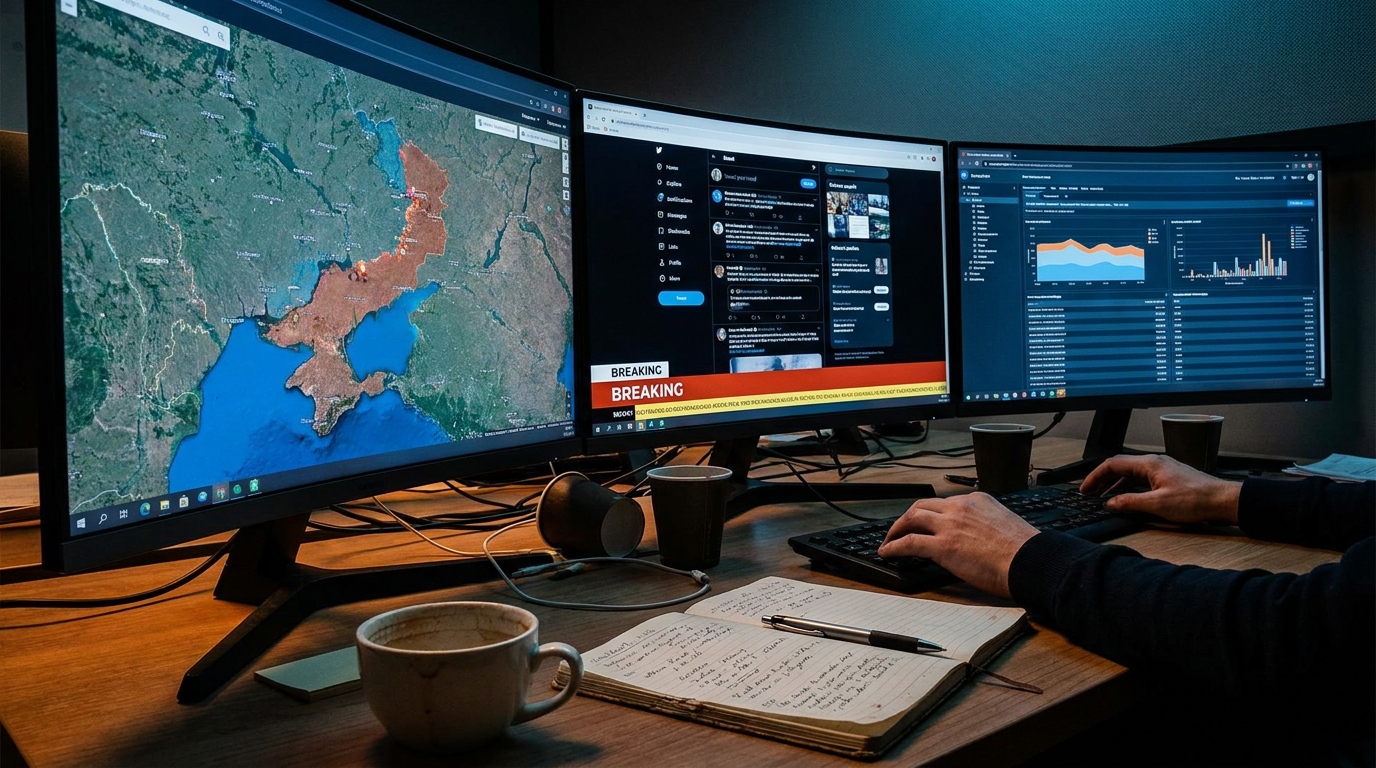
- Citizen Investigators
- View OSINT as a democratizing force that empowers civil society to bypass state narratives and uncover the truth independently.
- Legal & Judicial Frameworks
- Focus on standardizing OSINT methodologies to ensure digital evidence meets the strict chain-of-custody requirements of international courts.
- Academic & Institutional Skeptics
- Warn that OSINT is vulnerable to adversarial disinformation, requires elite technical skills, and is increasingly dominated by expensive commercial tools.
What's not represented
- · Commercial satellite providers
- · Defense attorneys challenging OSINT evidence
Why this matters
The democratization of intelligence means that human rights abuses, environmental crimes, and state-sponsored disinformation can no longer be easily hidden. Citizens now possess the tools to independently verify facts and hold powerful institutions legally accountable.
Key points
- Open-Source Intelligence (OSINT) allows citizens to uncover state secrets using publicly available data.
- Investigative groups are now building legally admissible cases for international war crimes tribunals.
- Techniques like geolocation and chronolocation strip away the plausible deniability of perpetrators.
- Civil society uses OSINT to track environmental crimes and combat state-sponsored disinformation.
- Challenges include the rising cost of commercial tools, adversarial deepfakes, and investigator trauma.
For decades, the collection and analysis of intelligence was the exclusive domain of nation-states. Behind classified walls, government agencies monopolized the satellites, the signal intercepts, and the global networks required to understand geopolitical shifts. Today, that monopoly has fractured. Armed with laptops, internet connections, and rigorous methodologies, a decentralized network of citizen journalists, human rights defenders, and academic researchers is uncovering state secrets and documenting atrocities in real-time. This practice, known as Open-Source Intelligence (OSINT), has evolved from a niche hobby into a formidable pillar of global accountability.[8]
OSINT relies on publicly available information—satellite imagery, social media posts, corporate registries, shipping data, and grey literature—to piece together complex narratives. By cross-referencing these digital breadcrumbs, investigators can verify events that authoritarian regimes or corporate actors attempt to conceal. The sheer volume of data generated by modern digital life means that almost every significant event leaves a trace. The challenge is no longer finding the information, but sifting through the noise to extract verifiable, actionable evidence.[2][8]
The most profound shift in the OSINT landscape is its transition from journalistic reporting to legal accountability. Organizations that began by publishing news scoops are now building cases for international tribunals. Investigative collectives have realized that their meticulous documentation of conflict zones holds immense value for prosecutors who lack physical access to the ground. This evolution demands a rigorous chain of custody, ensuring that digital evidence is archived and analyzed in ways that meet strict judicial standards.[1][5]
A watershed moment for open-source evidence occurred in August 2017, when the International Criminal Court (ICC) issued an arrest warrant for Libyan commander Mahmoud al-Werfalli, accusing him of 33 murders. For the first time in the court's history, the warrant relied almost entirely on evidence gathered from social media posts. Videos uploaded by perpetrators and bystanders were geolocated, chronolocated, and verified by independent researchers, proving that digital forensics could meet the high evidentiary bar required for international war crimes prosecution.[1]

This legal integration has accelerated rapidly during recent global conflicts. In late 2022, the investigative group Bellingcat partnered with the Global Legal Action Network (GLAN) to launch the Justice and Accountability Unit. This initiative was designed specifically to conduct OSINT investigations that comply with the strict evidentiary standards of English courts. By focusing on publicly available information from conflict zones, the unit aims to make its findings legally sound for future national and international criminal proceedings, bridging the gap between citizen journalism and formal justice.[5]
The methodology behind these investigations is painstaking. When a video of a potential human rights violation surfaces, OSINT practitioners do not take it at face value. They employ geolocation—matching landmarks, terrain features, and street layouts in the video to satellite imagery from platforms like Google Earth. They use chronolocation, analyzing shadow lengths and weather data to determine the exact time the footage was captured. By layering these techniques, investigators can definitively prove where and when an event occurred, stripping away the plausible deniability often relied upon by perpetrators.[1][8]
Beyond conflict zones, OSINT is increasingly deployed to protect democratic integrity and track environmental crimes. Civil society organizations use these techniques to uncover hidden networks of corruption, trace illicit financial flows, and expose illegal logging or mining operations. By turning the tools of intelligence gathering toward public interest issues, these groups empower vulnerable communities and provide watchdogs with the hard data needed to challenge powerful interests and demand transparency.[4]
Beyond conflict zones, OSINT is increasingly deployed to protect democratic integrity and track environmental crimes.
A prime example of this civic application is the fight against digital disinformation. Initiatives like the African Digital Democracy Observatory (ADDO)—a coalition of 15 organizations spearheaded by Code for Africa—leverage OSINT to track coordinated inauthentic behavior and information manipulation. By equipping local researchers with digital forensic skills, these programs build resilience against state-sponsored propaganda and hate speech, proving that open-source techniques are as vital for protecting elections as they are for documenting physical conflicts.[3]

Institutional actors have also recognized the immense value of open-source data. A study by the World Customs Organization (WCO) highlighted the cost-effectiveness and accessibility of OSINT compared to traditional classified intelligence. For customs and border enforcement, publicly available data provides timely insights into smuggling routes, illicit trade networks, and sanctions evasion. The low barrier to entry allows agencies to supplement their traditional human intelligence networks with real-time digital monitoring, creating a more comprehensive threat landscape.[6]
However, academic researchers caution against viewing OSINT as a utopian democratization of intelligence. A 2025 study from Leiden University argues that while the explosion of open-source data is reshaping the landscape, it does not inherently democratize the practice. Effective OSINT requires high levels of digital literacy, specialized training, and an understanding of complex analytical frameworks. The researchers note that the field is evolving into a specialized community of practice, one that still demands rigorous expertise to navigate the sheer volume of available data.[2]
One of the most significant vulnerabilities in the OSINT ecosystem is the threat of adversarial intoxication. As state actors and malicious entities become aware of how open-source investigators operate, they increasingly attempt to "poison the well." This involves deliberately planting false information, manipulating digital records, or deploying AI-generated synthetic media to deceive analysts. Verifying the authenticity of the source material has thus become an arms race between investigators and those seeking to obscure the truth.[2][8]
Furthermore, the assumption that OSINT is universally accessible masks a growing resource divide. While basic tools like Google Earth and reverse image searches are free, the sector has rapidly commercialized. Advanced capabilities—such as high-resolution, high-frequency satellite imagery, specialized data-mining software, and facial recognition databases—are prohibitively expensive. This creates a disparity where well-funded organizations and state agencies can leverage cutting-edge OSINT, while grassroots civil society groups are priced out of the most effective tools.[2][6]

The psychological toll on practitioners is another critical, often overlooked challenge. OSINT investigators frequently spend hours analyzing graphic, unfiltered footage of violence, destruction, and human suffering. Unlike traditional journalists or soldiers who may deploy to a conflict zone and eventually return home, digital investigators are immersed in a constant stream of trauma from their desks. Organizations are increasingly recognizing the need for robust mental health support to mitigate the vicarious trauma inherent in this line of work.[8]
As OSINT continues to mature, its ultimate impact will depend on the standardization of its methodologies. Legal practitioners are currently navigating the varying thresholds for admissibility across different jurisdictions. For instance, the evidentiary principles of English courts, which demand an exceptionally high standard of proof, differ from the Continental European systems that underpin institutions like the ICC. Harmonizing these standards will be crucial for ensuring that open-source evidence can be universally applied in the pursuit of justice.[5]
Despite these challenges, the rise of Open-Source Intelligence represents a fundamental shift in the balance of power. It ensures that human rights abuses, environmental degradation, and state-sponsored disinformation can no longer easily hide in the shadows. By transforming the internet from a chaotic repository of data into a structured archive of evidence, OSINT practitioners are forging a new paradigm of accountability—one where the truth is not dictated by those in power, but verified by the public.[7][8]
How we got here
2014
Bellingcat is founded, popularizing the use of citizen journalism and OSINT to investigate conflict zones.
Aug 2017
The International Criminal Court issues an arrest warrant for Mahmoud al-Werfalli based almost entirely on social media evidence.
Oct 2018
OSINT investigators successfully identify the GRU officers responsible for the Skripal poisoning in the UK.
Late 2022
Bellingcat and GLAN launch the Justice and Accountability Unit to ensure OSINT meets strict legal evidentiary standards.
2025
Academic research highlights the maturation of OSINT into a specialized community of practice, noting the growing need for advanced digital literacy.
Viewpoints in depth
Citizen Investigators
View OSINT as a democratizing force that empowers civil society to bypass state narratives and uncover the truth independently.
For investigative journalists and civil society watchdogs, OSINT is the ultimate equalizer. By leveraging tools that are largely accessible to the public, these groups can bypass official government narratives and independently verify facts on the ground. Organizations like Code for Africa and Bellingcat argue that this transparency is essential for holding power accountable, whether that means exposing a coordinated disinformation campaign or proving that a specific military unit was responsible for a civilian massacre. To them, the internet is not just a communication tool, but the largest crime scene in history, waiting to be analyzed.
Legal & Judicial Frameworks
Focus on standardizing OSINT methodologies to ensure digital evidence meets the strict chain-of-custody requirements of international courts.
Legal professionals and human rights lawyers view OSINT through the lens of admissibility. While a geolocated video might be enough for a news article, securing a conviction in an international tribunal requires a rigorous, documented chain of custody. Initiatives like the Justice and Accountability Unit focus on archiving digital evidence before it can be deleted by social media platforms and ensuring that the analytical methods used can withstand cross-examination. Their primary concern is harmonizing the varying evidentiary thresholds across different legal systems to ensure that open-source data translates into tangible justice.
Academic & Institutional Skeptics
Warn that OSINT is vulnerable to adversarial disinformation, requires elite technical skills, and is increasingly dominated by expensive commercial tools.
Researchers and institutional intelligence professionals caution against the romanticized view of OSINT as a purely democratic tool. They point out that as the field matures, the barrier to entry is rising. High-resolution satellite imagery and advanced data-mining software are prohibitively expensive for grassroots organizations, creating a new elite within the open-source community. Furthermore, these skeptics warn of 'adversarial intoxication'—the deliberate injection of sophisticated deepfakes and false data by state actors designed specifically to mislead open-source investigators and poison the well of public evidence.
What we don't know
- How international courts will consistently rule on the admissibility of AI-enhanced or synthetic media in the future.
- Whether grassroots organizations will be able to afford the increasingly expensive commercial satellite and data-mining tools required for advanced OSINT.
- The long-term psychological impact on a generation of digital investigators exposed to continuous graphic conflict footage.
Key terms
- Open-Source Intelligence (OSINT)
- Intelligence derived from data and information that is available to the general public, rather than gathered through clandestine means.
- Geolocation
- The process of determining the exact real-world geographic location of an object or event depicted in a photograph or video.
- Chronolocation
- The technique of determining the exact time and date a piece of media was captured, often by analyzing shadow lengths, weather patterns, and historical data.
- Adversarial Intoxication
- The deliberate planting of false or misleading information into public domains by state or non-state actors to deceive open-source investigators.
- Coordinated Inauthentic Behavior (CIB)
- The use of multiple fake accounts or automated networks to artificially amplify a specific narrative or piece of disinformation online.
Frequently asked
What exactly is Open-Source Intelligence (OSINT)?
OSINT is the practice of collecting, analyzing, and verifying information from publicly available sources—such as social media, satellite imagery, and public databases—to generate actionable intelligence.
Can social media posts be used in international courts?
Yes. If properly archived, geolocated, and verified to establish a clear chain of custody, social media evidence has been successfully used to issue arrest warrants by the International Criminal Court.
How do investigators prove where a video was filmed?
They use a technique called geolocation, which involves matching distinct visual landmarks in the video—such as mountain ridges, street layouts, or unique buildings—with high-resolution satellite imagery.
What are the main risks of relying on OSINT?
Key risks include information overload, the psychological toll on investigators viewing graphic content, and 'adversarial intoxication,' where malicious actors deliberately plant fake data or deepfakes to mislead analysts.
Sources
Source coverage
8 outlets
3 viewpoints surfaced








[1]Reuters InstituteCitizen Investigators
From breaking news to collecting evidence: Bellingcat's evolution
Read on Reuters Institute →[2]Cambridge University PressAcademic & Institutional Skeptics
The rise of open-source intelligence
Read on Cambridge University Press →[3]Code for AfricaCitizen Investigators
Equipping researchers and journalists with open-source intelligence (OSINT)
Read on Code for Africa →[4]Justice for ProsperityLegal & Judicial Frameworks
Protecting democracy and the rights of vulnerable groups through OSINT
Read on Justice for Prosperity →[5]Institute for War and Peace ReportingLegal & Judicial Frameworks
Making Open Source Evidence Admissible
Read on Institute for War and Peace Reporting →[6]World Customs OrganizationAcademic & Institutional Skeptics
Open-Source Intelligence (OSINT) Study Report
Read on World Customs Organization →[7]The GuardianCitizen Investigators
Our security rests in the hands of open source intelligence
Read on The Guardian →[8]Factlen Editorial Team
Synthesis by Factlen editorial team
Read on Factlen Editorial Team →
Every angle. Every day.
Get defense security stories with full source coverage and perspective breakdowns delivered to your inbox.