
How AI Video Generation is Democratizing Indie Filmmaking in 2026
Advanced text-to-video models have evolved from novelty experiments into production-ready tools, allowing independent creators to produce studio-quality visuals on a fraction of traditional budgets.
By Factlen Editorial Team
- Independent Filmmakers
- View AI as a democratizing force that removes budget barriers, allowing them to compete with major studios on pure storytelling and imagination.
- AI Platform Developers
- Focus on pushing the technical boundaries of video generation, prioritizing temporal consistency, physics simulation, and higher resolutions.
- Festival Curators
- Emphasize that AI is merely an instrument, evaluating films based on human creativity, narrative structure, and emotional resonance.
- Labor & Ethics Advocates
- Support the technology's use provided there are strict guardrails, royalty structures, and consent frameworks for the human talent training the models.
What's not represented
- · Traditional VFX Artists
- · Major Studio Executives
Why this matters
For decades, visual storytelling was gatekept by the immense cost of cameras, crews, and visual effects. The maturation of AI video tools means that a creator's ability to share a compelling story is now limited by their imagination and taste, rather than their access to capital.
Key points
- AI video generation has matured from short, glitchy clips to broadcast-quality 4K sequences with accurate physics.
- Indie filmmakers use AI primarily for pre-visualization, proof-of-concept trailers, and complex visual effects.
- The workflow has shifted from standalone clip generators to comprehensive 'film-first' platforms that manage the entire narrative pipeline.
- Dedicated AI film festivals are providing creators with global platforms, significant prize money, and distribution deals.
- Despite the technology's power, human taste, pacing, and editorial judgment remain the most critical factors in successful storytelling.
For most of the early generative AI era, text-to-video models were viewed by the film industry as a fascinating novelty. Early outputs were characterized by melting faces, physics-defying artifacts, and a maximum duration of just a few seconds. But by mid-2026, the gap between "AI-generated video" and "production-ready video" has definitively closed. The same attention mechanisms that made still-image generation consistent have been successfully extended to the time dimension, resulting in tools that produce physically coherent, multi-second scenes with natural camera movement and broadcast-ready resolution.[2][5]
This technological leap is fundamentally reshaping independent filmmaking. Historically, indie creators have been defined by their constraints—smaller budgets, limited crew capacity, and uneven access to production support force hard compromises on screen. Today, advanced diffusion models and neural rendering engines are removing those friction points, allowing a filmmaker working from a laptop to generate sweeping establishing shots, complex visual effects, and period-accurate production design that would have previously required a multimillion-dollar studio budget.[3][4]
The 2026 software landscape is dominated by a "Big Five" of video generation models, each serving a distinct role in the creator's toolkit. Runway, currently on its Gen-4.5 architecture, remains the industry standard for professional control. Its "Motion Brush" feature—which allows directors to literally paint movement paths onto specific elements within a frame—provides the granular temporal consistency required for serious narrative work. For filmmakers who need precise control over how a scene unfolds, Runway is often the foundational tool.[2][6]
When cinematic aesthetics and camera simulation are the priority, creators frequently turn to Luma Dream Machine. Luma has built a reputation for its exceptional handling of virtual cinematography, producing smooth dolly shots, natural depth-of-field transitions, and a color science that feels instantly grade-ready. While it operates at a higher cost per generation than some competitors, its ability to simulate real-world optics makes it a favorite for high-end proof-of-concept trailers and atmospheric B-roll.[2]

For longer narrative sequences, Kuaishou's Kling 3.0 has emerged as a disruptive force. While early AI video was limited to brief 4-second bursts, Kling can generate continuous sequences lasting up to five minutes while maintaining subject consistency across different camera angles. This breakthrough in character continuity solves one of the most persistent headaches for AI filmmakers, and it does so at roughly 40% of the cost per second of its premium competitors, making it dominant for high-volume production.[2][6]
At the absolute high end of the fidelity spectrum sit OpenAI's Sora and Google's Veo 3.1. Sora continues to represent the ceiling for photorealism and physics simulation, though its lack of a public API and higher price point keep it largely in the realm of premium commercial work. Veo 3.1, meanwhile, has become the benchmark for native 4K output. It generates broadcast-quality 3840x2160 video with accurate light refraction, fabric physics, and—crucially—synchronized native audio, allowing its outputs to integrate seamlessly with live-action footage.[2][5]
At the absolute high end of the fidelity spectrum sit OpenAI's Sora and Google's Veo 3.1.
Despite the power of these generation models, the most significant workflow shift in 2026 isn't about the clips themselves—it's about the pipeline. A new category of "film-first" platforms, such as mStudio and Multic, has emerged to wrap raw video generation inside a complete narrative structure. Rather than forcing creators to generate isolated clips and stitch them together in traditional editing software, these platforms offer an end-to-end environment: script breakdown, storyboard generation, animatic sequencing, video rendering, and audio syncing all happen in one unified workspace.[6]
This structured approach drastically reduces iteration time. If a director needs to change a character's blocking in scene four, they can regenerate that specific shot within the context of the timeline, rather than starting from scratch. For independent studios and agencies, this pipeline coverage is what turns AI from a toy into a reliable production mechanism, cutting overall editing and post-production time by up to a factor of three.[4][6]
Crucially, the most successful independent filmmakers are not using AI to replace the entire filmmaking process. Instead, they deploy it strategically to reduce friction in pre-production and development. AI is heavily used for pre-visualization—translating script beats into highly detailed shot lists and animatics before a single real camera rolls. It is also the ultimate tool for "proof-of-concept" work, allowing directors to pitch feature films or series by showing investors a fully realized, studio-quality teaser trailer created entirely on a $100 monthly software budget.[3][6]

As the technology has matured, so has the ecosystem celebrating it. AI film festivals have evolved from niche internet communities into major international events. The Runway AI Film Festival (AIFF), now in its fourth year, hosts gala screenings in New York and Los Angeles, offering over $135,000 in prize pools across multiple creative tracks. Similarly, the AI International Film Festival runs monthly showcases, while the AI Film & Ads Awards holds events in Cannes and Venice, placing synthetic media on the same geographic stage as traditional cinema.[7][8]
These festivals are proving that AI-generated visuals can carry genuine emotional weight and narrative depth. Winning projects are securing real distribution deals and launching careers. The evaluation criteria at these events consistently emphasize human creativity at the core—judges are looking for clear narrative structure, compelling characters, and unique visual storytelling, treating AI simply as the enabling instrument rather than the author.[7][8]

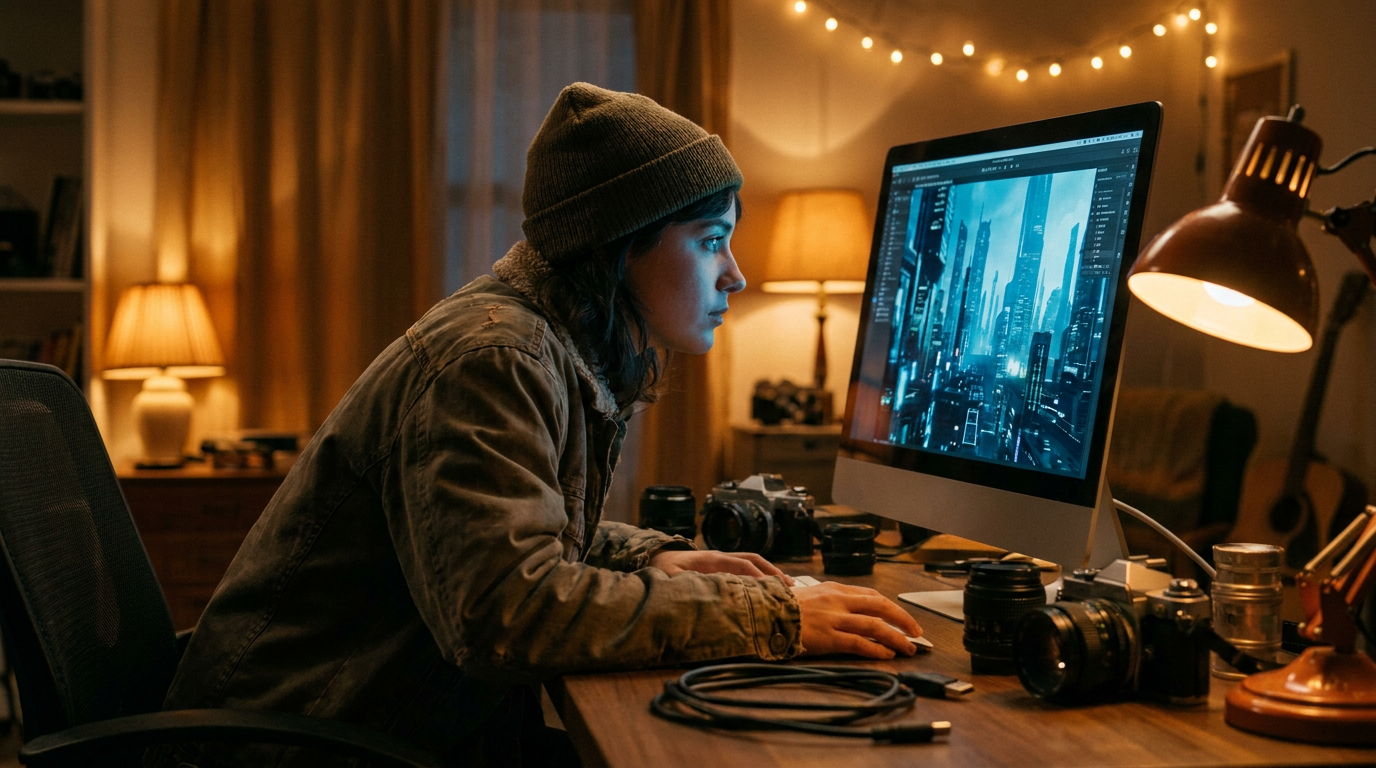
This highlights the ultimate truth of the 2026 AI filmmaking landscape: the technology does not replace taste. An AI model can generate a photorealistic 4K shot of a cyberpunk city, but it cannot decide how long to hold that shot to build tension, nor can it understand the subtext of a scene. As the barrier to creating beautiful images drops to zero, the premium on actual storytelling, pacing, and editorial judgment has never been higher.[1][3]
The integration of these tools has not been without friction, particularly regarding labor and ethics. The industry has had to navigate complex questions about synthetic performances and training data. However, landmark agreements, such as the 2026 SAG-AFTRA framework establishing royalty structures for AI voice clones and digital likenesses, are creating a sustainable path forward. These guardrails ensure that as independent creators gain superpowers, the human talent that informs these models is fairly compensated.[4]
Ultimately, the democratization of video generation is doing for cinema what digital audio workstations did for music in the 2000s. It is dismantling the financial barriers that have historically kept diverse, niche, or highly experimental stories off the screen. By empowering a new generation of creators with the tools of tomorrow, AI is not ending the art of filmmaking—it is vastly expanding the number of people who get to participate in it.[1][3][7]
How we got here
Early 2024
AI video is largely limited to 4-second, low-resolution clips with significant visual artifacts.
Mid 2025
Models achieve temporal consistency, allowing for stable 10-to-15 second generations.
Early 2026
Kling 3.0 breaks the duration barrier, generating continuous sequences up to five minutes long.
Spring 2026
Google's Veo 3.1 introduces native 4K generation with synchronized audio, meeting broadcast standards.
June 2026
Major AI film festivals in New York, LA, and Cannes showcase fully AI-generated narrative shorts competing for million-dollar prize pools.
Viewpoints in depth
Independent Filmmakers
Creators who view AI as the ultimate democratizing tool for visual storytelling.
For independent directors and producers, AI video generation is the great equalizer. Historically, a script set in a futuristic sci-fi metropolis or a sprawling historical epic was immediately discarded by indie studios because the production design and VFX costs were insurmountable. Today, these creators argue that AI removes the financial gatekeeping of cinema. By utilizing tools like Runway and Luma, they can generate studio-quality establishing shots and complex environments for the cost of a monthly software subscription. They emphasize that AI doesn't write the story or direct the actors; it simply acts as an infinitely scalable art department, allowing them to compete with major studios on the strength of their ideas rather than the size of their bank accounts.
AI Platform Developers
The engineers and researchers pushing the technical limits of generative video models.
The teams building these models—at companies like OpenAI, Google DeepMind, and Runway—are focused on solving the remaining technical hurdles of synthetic media. Their primary goals are achieving perfect temporal consistency, extending generation length, and simulating real-world physics with absolute accuracy. They view the current ecosystem as a transitional phase toward 'real-time generation,' where live AI directors could dynamically compose shots or render entire interactive environments on the fly. For these developers, the focus is on building the most robust, high-fidelity engine possible, leaving the narrative application entirely up to the end user.
Labor & Ethics Advocates
Industry groups focused on protecting human talent and establishing fair compensation frameworks.
While acknowledging the creative potential of AI, labor advocates and unions like SAG-AFTRA remain hyper-focused on the ethical sourcing of training data and the protection of human performers. They argue that the democratization of filmmaking cannot come at the expense of the working-class artists whose prior work trained these very models. This camp champions the recent 2026 agreements that established strict royalty structures and consent requirements for synthetic performances and voice cloning. Their goal is not to ban AI tools, but to ensure they are integrated into the industry in a way that creates a sustainable, compensated hybrid workflow for human crews and actors.
What we don't know
- How traditional streaming platforms (like Netflix or Hulu) will label or algorithmically treat fully AI-generated narrative content.
- Whether the cost of high-end API generation will drop enough to make feature-length AI films economically viable for solo creators.
- How copyright law will ultimately treat AI-generated characters that closely resemble, but do not exactly copy, existing intellectual property.
Key terms
- Temporal Consistency
- The ability of an AI video model to keep characters, objects, and backgrounds looking exactly the same from one frame to the next without flickering or morphing.
- Diffusion Model
- The underlying machine learning architecture used by most AI video generators, which creates images and video by gradually removing digital noise to reveal a coherent picture.
- Pre-visualization (Pre-vis)
- The process of creating rough, preliminary versions of complex scenes before actual filming begins, heavily accelerated by AI tools to plan camera angles and lighting.
- Motion Brush
- A feature in tools like Runway that allows users to paint over specific parts of a static image and dictate exactly which direction and how fast those elements should move.
Frequently asked
Can AI generate a full movie from a single prompt?
No. While models can generate continuous sequences up to five minutes, professional AI filmmaking requires a multi-step pipeline of scripting, storyboarding, generating individual shots, and manual editing.
How much does an AI filmmaking software stack cost?
In 2026, an independent filmmaker can access a complete suite of professional AI tools—covering image generation, video rendering, and editing—for roughly $50 to $200 per month.
Are AI-generated films accepted in traditional film festivals?
While some traditional festivals remain cautious, a massive parallel circuit of dedicated AI film festivals (like the Runway AIFF and AI International Film Festival) has emerged, offering significant prize money and distribution opportunities.
Does AI video include sound?
Most models focus purely on visuals, requiring creators to add sound design in post-production. However, cutting-edge models like Google's Veo 3.1 now generate synchronized native audio alongside the video.
Sources
Source coverage
8 outlets
4 viewpoints surfaced








[1]Factlen Editorial Team
Synthesis by Factlen editorial team
Read on Factlen Editorial Team →[2]NextFutureAI Platform Developers
Best AI Video Generator in 2026: Top Tools Tested & Compared
Read on NextFuture →[3]FrameoIndependent Filmmakers
AI Filmmaking for Independent Creators: 2026 Guide
Read on Frameo →[4]DigenLabor & Ethics Advocates
Top AI Video Creator Tools for 2026: Future of Content
Read on Digen →[5]AI MagicxAI Platform Developers
4K AI Video Generation in 2026: A Complete Guide to Broadcast-Quality Output
Read on AI Magicx →[6]mStudioIndependent Filmmakers
AI movie maker comparison — 9 tools ranked
Read on mStudio →[7]RunwayFestival Curators
Runway AI Film Festival 2026
Read on Runway →[8]FilmFreewayFestival Curators
AI International Film Festival
Read on FilmFreeway →

Every angle. Every day.
Get ai stories with full source coverage and perspective breakdowns delivered to your inbox.