
Global Women's Soccer Trial Achieves 65% Reduction in ACL Injuries Through New Biomechanical Protocols
A three-year joint study by FIFPRO and leading European clubs has successfully reduced anterior cruciate ligament (ACL) tears by 65% using female-specific footwear and cycle-synced training regimens.
By Factlen Editorial Team
- Sports Medical Researchers
- Focus on the biomechanical data, anatomical differences, and the clinical success of moving away from male-centric sports science.
- Players & Union Advocates
- Emphasize player welfare, relief at the results, and frustration that it took decades to address female-specific needs.
- Equipment Manufacturers
- Highlight the R&D shift toward female-specific tooling and the commitment to making these boots the global standard.
- Club Management
- Focus on squad availability, the financial benefits of fewer injuries, and protecting investments in star players.
What's not represented
- · Grassroots coaches who must implement these protocols without elite sports science budgets
- · Youth academy directors
Why this matters
For years, female athletes have suffered career-threatening knee injuries at rates far higher than men, largely because they were forced to play in gear and systems designed for male bodies. This breakthrough proves that tailored sports science can solve one of the most devastating problems in women's sports, protecting players' careers and long-term health.
Key points
- A three-year trial by FIFPRO and European clubs reduced female ACL injuries by 65%.
- The protocol replaces male-centric boots with female-specific designs featuring shorter, conical studs.
- Training loads were dynamically adjusted based on players' menstrual cycles to account for ligament laxity.
- Overall lower-limb soft tissue injuries also dropped by 40% during the trial.
- Major manufacturers plan to make the female-specific boots the global standard by late 2026.
For the better part of a decade, women's soccer has been haunted by a quiet epidemic. Anterior cruciate ligament (ACL) tears have routinely sidelined the sport's brightest stars, robbing tournaments of generational talents and cutting promising careers short. But a landmark announcement in Geneva this weekend signals that the tide has finally turned.[1][3]
FIFPRO, the global players' union, alongside the European Club Association (ECA), unveiled the final results of a three-year biomechanical trial known as 'Project ACL.' The findings, simultaneously published in the British Journal of Sports Medicine, are staggering: participating clubs saw a 65% reduction in non-contact ACL injuries over two seasons.[5][6]
The breakthrough stems from a fundamental shift in how the sport treats the female body. Historically, sports science in soccer operated on a 'shrink it and pink it' philosophy, where boots and training regimens designed for men were simply scaled down for women. This trial discarded that approach entirely, building a protocol from the ground up based on female anatomy.[2][3]

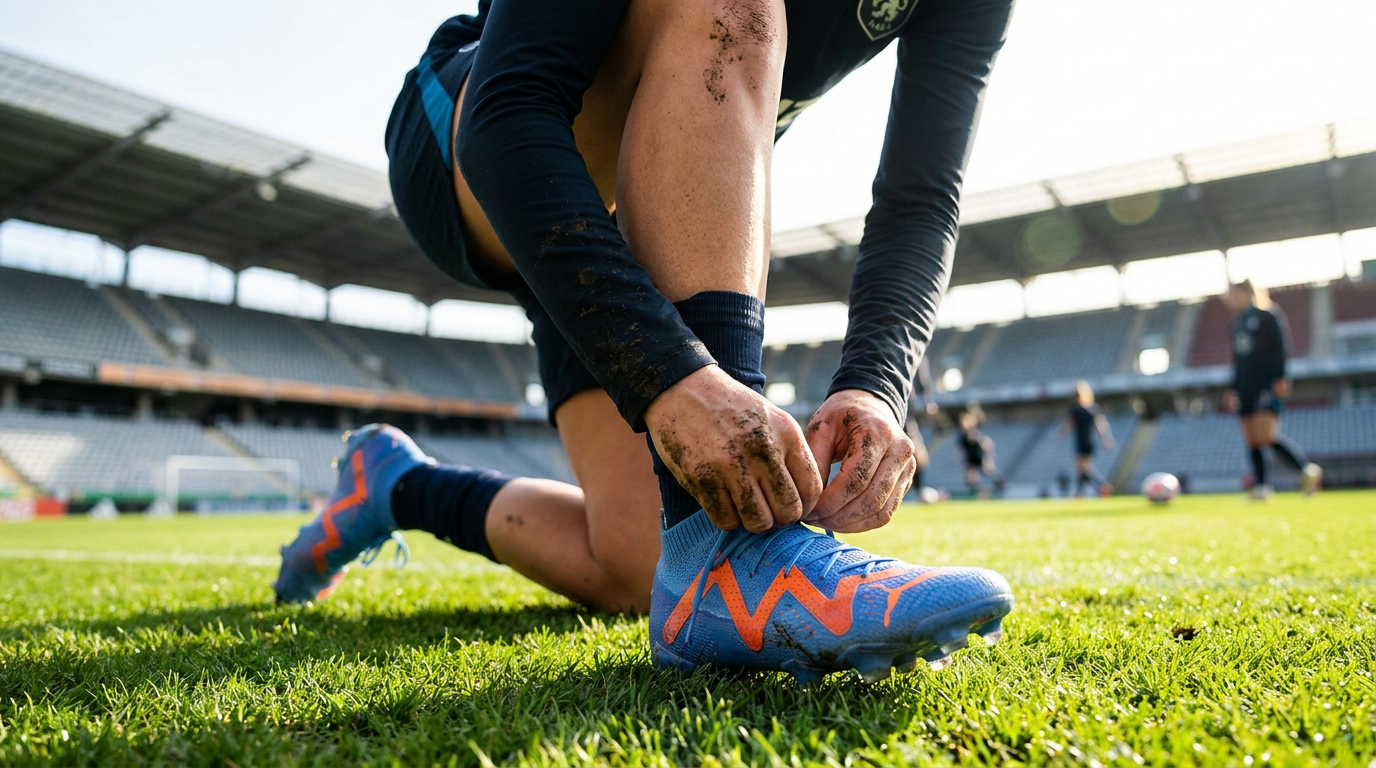
The first major intervention focused on footwear. Research demonstrated that traditional bladed studs, designed to support the heavier mass and different center of gravity of male players, created too much rotational traction for women. When a female player planted her foot to pivot, the boot stayed locked in the turf, transferring the rotational force directly to the knee joint.[1][6]
To combat this, the 24 participating clubs—spanning the English Women's Super League, Spain's Liga F, Germany's Frauen-Bundesliga, and the NWSL—mandated the use of newly engineered boots. These models feature shorter, conical studs that allow the foot to release from the grass more easily during high-speed directional changes, drastically reducing the torque on the ACL.[4][7]
The second, and perhaps more revolutionary, intervention involved physiological tracking. The trial implemented training loads that were dynamically synced to each player's menstrual cycle. Sports scientists have long known that hormonal fluctuations, particularly spikes in relaxin and estrogen during the ovulatory and luteal phases, can increase ligament laxity—essentially making the joints looser and more prone to hyper-extension.[5][6]

Under the new protocol, clubs adjusted their weekly regimens. During high-risk hormonal windows, players were rotated out of heavy deceleration drills and plyometrics, focusing instead on straight-line speed, tactical walkthroughs, or upper-body conditioning. The adjustments were subtle enough not to disrupt match preparation, but targeted enough to protect vulnerable joints.[2][8]
Under the new protocol, clubs adjusted their weekly regimens.
The results exceeded all expectations. Not only did catastrophic knee injuries plummet by 65%, but the clubs also reported a 40% drop in overall lower-limb soft tissue injuries, including hamstring and calf strains. The holistic approach to female biomechanics yielded a healthier, more resilient player pool across the board.[1][6]
For the players, the data brings a profound sense of relief mixed with lingering frustration. Union representatives noted that female athletes had been complaining about ill-fitting boots and grueling, unsynced schedules for years. The success of Project ACL is viewed as a vindication of their long-standing demands for bespoke medical care.[3][5]

The ripple effects are already reshaping the sporting goods industry. Major manufacturers, who partnered with FIFPRO for the trial, have committed to retooling their assembly lines. By the end of 2026, female-specific stud configurations and wider toe boxes will become the default standard for women's boots, rather than a niche specialty item.[2][7]
Club management boards are also celebrating the financial implications. As transfer fees and wages in the women's game continue to break records, protecting those investments has become a paramount concern. Having star players available for a full 30-game season rather than spending nine months in the rehabilitation room dramatically improves a club's return on investment.[4][8]
The next challenge is democratization. While elite clubs have the resources to monitor hormonal cycles and provide custom footwear, the vast majority of ACL injuries occur at the grassroots and youth academy levels, where bad biomechanical habits often take root. FIFPRO is now lobbying UEFA and FIFA to subsidize these boots for youth leagues.[1][5]
Medical experts emphasize that while the 65% reduction is a monumental victory, the risk of ACL tears can never be reduced to zero in a high-impact contact sport. Collisions, awkward landings, and sheer bad luck will always play a role. However, eliminating the preventable, non-contact injuries changes the landscape of the sport entirely.[3][6]

The success of the soccer trial is also catching the attention of other sports. Basketball and rugby federations have reached out to the research team, eager to see if similar footwear and cycle-syncing protocols could curb the injury rates in their own female leagues.[2][5]
Ultimately, the legacy of this trial extends far beyond the pitch. It represents a definitive end to the era of treating female athletes as an afterthought in sports science. By finally listening to the specific needs of the female body, the sport has unlocked a safer, more sustainable future for its players.[3][8]
How we got here
2022–2023
A wave of high-profile ACL tears sidelines dozens of the world's top female players ahead of major tournaments.
April 2024
FIFPRO and medical partners launch 'Project ACL' to study female-specific biomechanical risk factors.
August 2024
24 elite clubs across Europe and the US begin implementing the new footwear and cycle-synced training protocols.
June 2026
Final peer-reviewed results are published, revealing a 65% reduction in non-contact ACL injuries.
Viewpoints in depth
Sports Medical Researchers
Advocates for treating female athletes based on their unique physiology rather than scaling down male protocols.
For decades, sports science treated women as 'small men,' applying male biomechanical data to female bodies. Researchers argue that this trial proves the catastrophic failure of that approach. By acknowledging anatomical differences—such as pelvic alignment and hormonal impacts on ligament stiffness—scientists were able to engineer targeted solutions. They view this 65% reduction not just as a win for soccer, but as a proof-of-concept that will revolutionize sports medicine across all female athletics.
Players & Union Advocates
Focused on player welfare, relief at the results, and frustration over the years of preventable injuries.
While players are celebrating the breakthrough, union representatives are quick to point out that athletes have been sounding the alarm for years. Female players frequently complained about foot pain from ill-fitting boots and the grueling nature of unsynced training loads, only to be dismissed. For the union, these results are a vindication of their demands and a mandate that player welfare must be driven by player feedback, ensuring no future generation has to play in equipment that actively endangers them.
Club Management
Focused on the financial and competitive advantages of keeping star players healthy.
From a boardroom perspective, the ACL epidemic was a financial crisis as much as a medical one. With transfer fees and salaries in the women's game skyrocketing, losing a marquee signing for nine months to a preventable injury was devastating to a club's return on investment. Managers and sporting directors view these new protocols as essential risk management, noting that the 40% drop in overall soft-tissue injuries directly correlates to more consistent performances and higher league finishes.
What we don't know
- How quickly these specialized boots will become affordable and accessible for amateur and youth players.
- Whether similar cycle-syncing protocols will yield identical results in other high-impact sports like basketball or rugby.
- The long-term impact of these protocols on career longevity for players who start using them in their teenage years.
Key terms
- Anterior Cruciate Ligament (ACL)
- A crucial ligament in the center of the knee that stabilizes the joint, notoriously prone to tearing during sudden stops or changes in direction.
- Rotational Traction
- The amount of grip a boot's studs have on the grass when a player pivots; too much traction can trap the foot and twist the knee.
- Ligament Laxity
- The looseness or flexibility of ligaments, which can naturally increase due to hormonal changes during certain phases of the menstrual cycle.
- Conical Studs
- Round, cone-shaped cleats on the bottom of football boots that allow for easier pivoting compared to long, bladed studs.
Frequently asked
Why are women more prone to ACL injuries than men?
Women have different pelvic alignment (a wider Q-angle) and experience hormonal fluctuations that affect ligament stiffness, making them more vulnerable when wearing boots designed for male biomechanics.
What makes the new soccer boots different?
The new boots feature shorter, conical (round) studs that reduce rotational grip on the turf, allowing the foot to pivot safely without transferring dangerous torque to the knee.
Will amateur players be able to buy these boots?
Yes. Major sporting goods manufacturers have committed to releasing these female-specific boot designs to the mass market by the end of 2026.
Sources
Source coverage
8 outlets
4 viewpoints surfaced








[1]BBC SportPlayers & Union Advocates
Women's football: New boot and training protocols reduce ACL injuries by 65%
Read on BBC Sport →[2]ESPNEquipment Manufacturers
FIFPRO study shows massive drop in ACL tears with female-specific gear
Read on ESPN →[3]The AthleticSports Medical Researchers
How a three-year biomechanics trial finally curbed the women's soccer ACL epidemic
Read on The Athletic →[4]MarcaClub Management
Liga F clubs see drastic drop in knee injuries following new medical protocols
Read on Marca →[5]FIFPROPlayers & Union Advocates
Project ACL: Final Report on Biomechanical Interventions in Women's Football
Read on FIFPRO →[6]British Journal of Sports MedicineSports Medical Researchers
Efficacy of female-specific footwear and cycle-synced training on ACL injury rates in elite football
Read on British Journal of Sports Medicine →[7]KickerClub Management
Meilenstein in der Frauen-Bundesliga: 65 Prozent weniger Kreuzbandrisse
Read on Kicker →[8]L'EquipeClub Management
Baisse historique des ruptures des ligaments croisés chez les joueuses
Read on L'Equipe →

More in sports
See all 14 stories →Athlete Longevity
The 'Dual-Track' Era: How College and Elite Gymnastics Merged to Extend Athletes' Careers
6 sources

Grass Court Tennis
Francisco Cerundolo Makes History With Marathon Comeback to Win Queen's Club Title
6 sources

Knicks Title
New York Knicks Celebrate First NBA Championship in 53 Years with Historic City Parade
8 sources

Franchise Valuations
How Women's Sports Franchises Became Billion-Dollar Assets in 2026
6 sources

Every angle. Every day.
Get sports stories with full source coverage and perspective breakdowns delivered to your inbox.