
Explicit Ratings vs. Implicit Signals: How Algorithms Actually Rank What You See
Recommendation engines have quietly shifted away from five-star ratings, relying instead on passive behavioral data to map what users actually want to consume.
By Factlen Editorial Team
- Implicit Behavioral Analysts
- Believe that actions speak louder than words, relying on passive data to map true taste and solve data sparsity.
- Explicit Data Advocates
- Argue that algorithms should respect direct user intent and stated preferences to maintain trust.
What's not represented
- · Privacy Advocates
- · Independent Content Creators
Why this matters
Every digital platform you use—from streaming services to social media—curates your reality based on these algorithmic choices. Understanding the difference between explicit and implicit feedback empowers you to take back control of your digital diet and train your feeds to serve you better.
Key points
- Explicit feedback provides clear intent but suffers from massive data sparsity.
- Users often display 'aspirational bias,' rating documentaries highly while binge-watching reality TV.
- Implicit feedback captures true behavior through watch time and skip rates, but can be noisy.
- Modern recommendation engines use hybrid models, blending explicit intent with implicit reality.
Every time you open a streaming app, a silent mathematical debate has already taken place behind the screen. The platform must instantly decide which movie, song, or product to place at the top of your feed. To make that decision, recommendation engines rely on a constant stream of user data. But the industry is fundamentally divided on which type of data actually tells the truth about what you want to see.
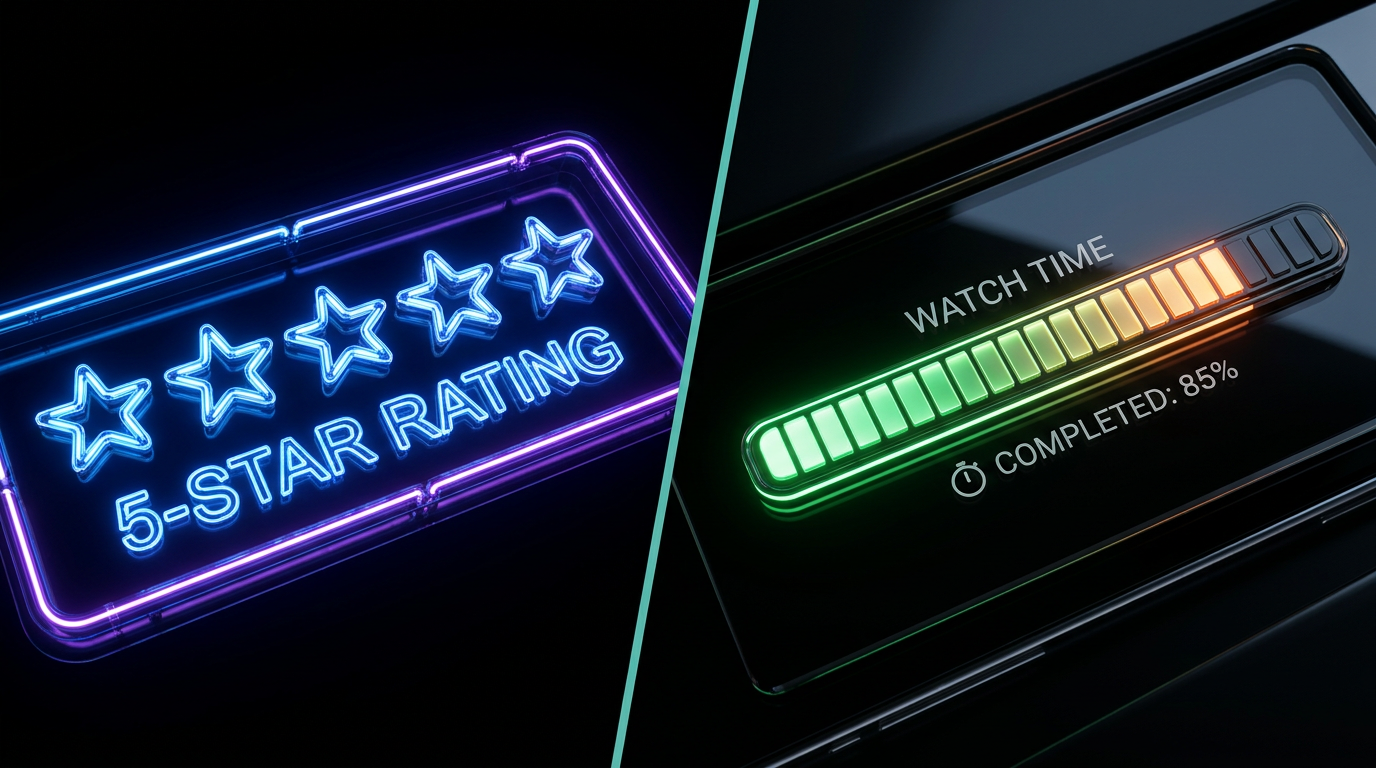
The debate centers on two rival methodologies: explicit feedback and implicit feedback. Explicit feedback is what you consciously tell the algorithm—the five-star ratings, the written reviews, and the thumbs-up buttons. Implicit feedback is what your behavior reveals—your watch time, your skip rates, and the exact second you abandon a video.[2]
For the first decade of the modern internet, explicit feedback was the gold standard. The logic was straightforward: if a system wants to know what you like, it should simply ask you. Explicit data provides an unambiguous signal of intent. A five-star rating is a definitive endorsement, and a one-star rating is a clear rejection, leaving very little room for algorithmic misinterpretation.[2]
However, data scientists soon discovered a fatal flaw in explicit feedback: data sparsity. The vast majority of internet users are passive consumers. They will happily watch ten hours of video, but they will rarely take the two seconds required to leave a rating. This leaves recommendation matrices mostly empty, making it mathematically difficult to suggest new content to quiet users.[2]

Beyond sparsity, explicit ratings suffer from a psychological phenomenon known as aspirational bias. Users frequently rate content based on the person they want to be, rather than the person they actually are. A user might give a prestigious, award-winning historical documentary five stars, while giving a trashy reality television show two stars.[4][5]
Yet, when engineers look at the backend data, they often find that the same user abandoned the documentary after twelve minutes, but binge-watched six consecutive episodes of the reality show. If an algorithm optimizes strictly for explicit five-star ratings, it will fill the user's feed with dense documentaries that they will never actually click on, ultimately driving them away from the platform.[4][5]
This exact realization prompted Netflix to fundamentally overhaul its ranking system in 2017. The streaming giant completely eliminated its classic five-star rating scale, replacing it with a simplified thumbs-up or thumbs-down binary. By reducing the cognitive friction of deciding between three or four stars, Netflix reported an astounding 200 percent increase in user rating activity.[4][5][6]

This exact realization prompted Netflix to fundamentally overhaul its ranking system in 2017.
But the thumbs were only half the story. Behind the scenes, Netflix and other platforms began shifting the actual weight of their algorithms toward implicit feedback. Implicit signals solve the sparsity problem instantly. You do not need to convince a user to leave a review; every single action they take—hovering over a thumbnail, adding an item to a cart, or turning up the volume—is automatically logged as a data point.[2]
The abundance of implicit data allows algorithms to scale massively, but it introduces a new problem: ambiguity. Implicit signals are inherently noisy. If a user lets a movie play to the end, did they love it, or did they simply fall asleep on the couch? If a user clicks on a YouTube video, is it because they are genuinely interested, or because they were tricked by a misleading thumbnail?[2]
To solve this ambiguity, modern platforms have developed highly sophisticated hybrid models that weigh specific behaviors against each other. Spotify, for example, uses a masterclass in implicit signal weighting. If a user skips a recommended track within the first five seconds, Spotify's algorithm logs that as a severe negative signal—often weighted more heavily than a manual dislike.[3]
Conversely, if a Spotify user listens to a track all the way through, and then immediately hits the replay button, the algorithm registers a massive positive signal. The platform then uses explicit actions—like a user taking the time to manually add a song to a specific playlist—to calibrate and verify the assumptions made by the implicit behavioral data.[3]

When designing a system today, engineers must weigh these trade-offs carefully. Explicit feedback fits well when precision, safety, and user trust are paramount. In high-stakes environments like medical information retrieval, financial advice, or high-value e-commerce purchases, algorithms must rely on verified, intentional user input rather than guessing based on passive clicks.[2][7]
Implicit feedback, on the other hand, fits well when volume, continuous discovery, and frictionless consumption are the primary goals. For short-form video feeds or continuous music streaming, interrupting the user to ask for a rating destroys the experience. In these environments, behavioral tracking is the only viable way to build a responsive taste profile.[2][7]
Ultimately, the most powerful ranking algorithms no longer choose between what you say and what you do. They use your explicit ratings to understand your aspirations, and your implicit behaviors to map your reality—blending the two to keep you scrolling just a little bit longer.[7]
How we got here
Early 2000s
E-commerce platforms pioneer the 5-star explicit rating system to build user trust and gather data.
2009
Netflix launches its famous million-dollar prize to improve its collaborative filtering algorithm.
2017
Netflix officially retires the 5-star rating system in favor of a binary thumbs up/down model.
2020s
Streaming platforms shift heavily toward implicit behavioral signals like watch time and skip rates to power feeds.
Viewpoints in depth
Explicit Feedback (Ratings & Reviews)
Direct user input that provides high-signal, unambiguous intent.
For: Unambiguous intent, clear positive/negative signals, and builds user trust through transparency. Against: Extreme data sparsity (most users never rate), high friction, and vulnerability to 'aspirational bias' where users rate what they want to be seen liking rather than what they actually consume. Evidence: Netflix found users rated award-winning documentaries highly but spent their actual time watching low-rated comedies.
Implicit Feedback (Behavior & Watch Time)
Passive behavioral data that captures what users actually do, not what they say.
For: Massive data abundance, zero user friction, captures true behavioral preferences, and solves the 'cold start' sparsity problem. Against: Highly noisy and ambiguous—a click could mean genuine interest, a misleading thumbnail, or an accidental tap. Evidence: Spotify uses completion rates and repeat listens as strong positive signals, while treating a skip within the first five seconds as a definitive negative, bypassing the need for users to manually dislike a track.
What we don't know
- How heavily platforms weigh passive scroll speed versus active clicks in their proprietary black-box models.
- Whether the shift entirely to implicit feedback traps users in 'filter bubbles' more aggressively than explicit choices.
Key terms
- Explicit Feedback
- Direct, intentional input from a user, such as a 5-star rating, a written review, or a thumbs-up.
- Implicit Feedback
- Passive data inferred from a user's behavior, such as watch time, click-through rates, or scroll depth.
- Aspirational Bias
- The tendency for users to rate high-brow or educational content highly because they want to be the kind of person who likes it, even if their actual viewing habits differ.
- Data Sparsity
- A common problem in recommendation engines where the vast majority of users never leave explicit ratings, leaving the system with too little data to make accurate predictions.
- Collaborative Filtering
- A recommendation method that suggests items based on the preferences and behaviors of similar users.
Frequently asked
Why did Netflix get rid of the 5-star rating system?
Netflix found that 5-star ratings suffered from 'aspirational bias'—users rated documentaries highly but actually spent their time watching comedies. Switching to a thumbs up/down system increased user rating activity by 200%.
What counts as an implicit signal on Spotify?
Implicit signals include passive behaviors like listening session length, whether you finish a track, and repeat listens. Skipping a song within the first five seconds is treated as a strong negative signal.
Which type of feedback is better for algorithms?
Neither is perfect on its own. Explicit feedback is highly accurate but too sparse, while implicit feedback is abundant but noisy. Modern recommendation engines use a hybrid approach to balance both.
Sources
Source coverage
7 outlets
2 viewpoints surfaced







[1]IBMExplicit Data Advocates
What is collaborative filtering?
Read on IBM →[2]MilvusImplicit Behavioral Analysts
Implicit and explicit feedback in recommendation systems
Read on Milvus →[3]Music TomorrowImplicit Behavioral Analysts
The Goals and Rewards of Spotify's Recommendation Algorithms
Read on Music Tomorrow →[4]The OutlineImplicit Behavioral Analysts
Netflix is replacing stars with thumbs
Read on The Outline →[5]ColliderExplicit Data Advocates
Netflix Changing Rating System from Stars to Thumbs Up/Down
Read on Collider →[6]Radio TimesExplicit Data Advocates
Netflix has done away with its classic star ratings
Read on Radio Times →[7]Factlen Editorial TeamImplicit Behavioral Analysts
Synthesis by Factlen editorial team
Read on Factlen Editorial Team →

More in meta
See all 6 stories →Open Science
The End of Publication Bias: How 'Registered Reports' Are Fixing the Scientific Method
7 sources

AI Weather Tech
The End of the Supercomputer Bottleneck: How AI is Rewiring Weather Forecasting
7 sources

Digital Security
The End of Passwords: A Beginner's Guide to How Passkeys Actually Work
7 sources

Information Diet
RSS vs. Algorithmic Feeds: The 2026 Guide to Reclaiming Your Attention
8 sources

Every angle. Every day.
Get meta stories with full source coverage and perspective breakdowns delivered to your inbox.