
RSS vs. Algorithmic Feeds: The 2026 Guide to Reclaiming Your Attention
As algorithmic fatigue drives a 34% surge in RSS adoption, users are weighing the trade-offs between engagement-optimized timelines and chronological control.
By Factlen Editorial Team
- Digital Minimalists
- Privacy advocates and mental health professionals advocating for chronological control.
- Hybrid Curators
- Power users blending chronological feeds with on-device AI summarization.
- Algorithmic Optimizers
- Platforms and casual users who prioritize discovery and frictionless entertainment.
What's not represented
- · Independent publishers who rely on algorithmic virality for traffic.
- · Advertisers who depend on the granular targeting capabilities of algorithmic feeds.
Why this matters
The mechanism you use to consume information dictates what you learn, how you feel, and who profits from your attention. Choosing the right feed architecture is the highest-leverage decision you can make for your digital well-being.
Key points
- RSS reader adoption grew 34% year-over-year in 2026 as users seek alternatives to algorithmic feeds.
- Algorithmic feeds optimize for engagement and time-on-site, often amplifying emotionally activating content.
- RSS provides a chronological, pull-based feed where users only see content from sources they explicitly select.
- Chronological feeds reduce cognitive load and doomscrolling but require manual curation and lack serendipitous discovery.
- Modern 2026 RSS readers use AI to cluster duplicate stories and summarize text, managing volume without sacrificing control.
- Privacy-conscious users favor RSS because it prevents platforms from building behavioral profiles based on reading habits.
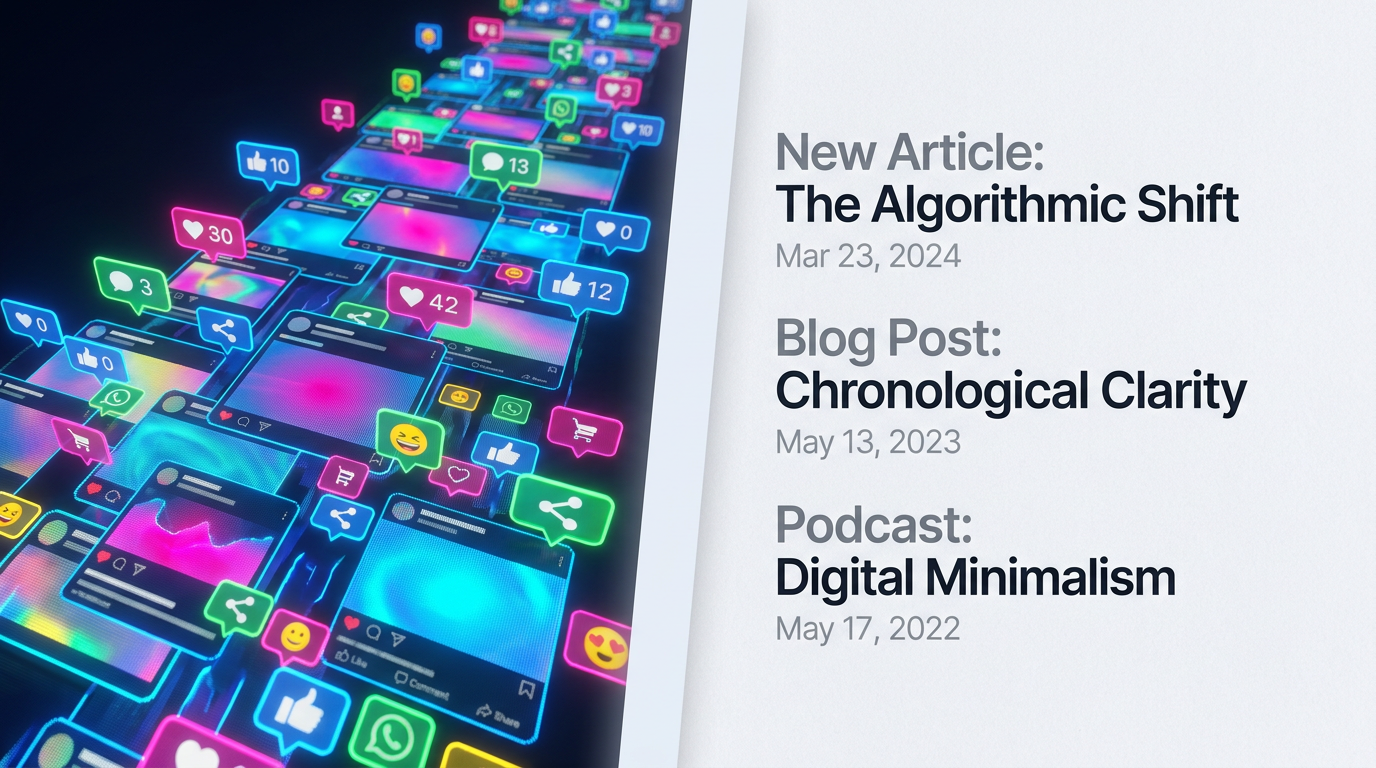
For the better part of a decade, the algorithmic feed has been the undisputed king of the internet. From Facebook to X to TikTok, platforms trained billions of users to expect an endless, frictionless stream of content optimized specifically for their engagement. But in 2026, a quiet rebellion is reaching critical mass. Driven by cognitive fatigue and privacy concerns, a growing cohort of professionals and digital minimalists are abandoning the "For You" page and returning to a technology many assumed was dead: Really Simple Syndication, or RSS.[1][6]
The shift is measurable. RSS reader adoption has climbed 34% year-over-year in 2026, marking the protocol's most significant resurgence since the demise of Google Reader over a decade ago. This migration is not merely a nostalgic retreat; it represents a fundamental rethinking of how we consume information. Users are increasingly viewing their attention as a finite resource and are actively seeking tools that offer chronological control over algorithmic manipulation.[1][3]
To understand the trade-offs, one must first understand the mechanics of the modern algorithmic feed. Every major social platform utilizes engagement-optimization systems powered by machine learning. These algorithms track dwell time, click-through rates, and interaction history to predict what will keep a user scrolling. As researchers note, these systems are highly efficient at content discovery but are fundamentally extractive. The platform's goal is not necessarily to inform the user, but to maximize the time spent viewing advertisements.[8]
This engagement-first architecture has documented cognitive costs. Algorithms inherently prioritize content that generates strong emotional responses, often amplifying outrage, anxiety, or comparison because those emotions drive the highest interaction rates. Mental health professionals observe that this constant exposure to emotionally activating content alters dopamine pathways, fostering dependency and contributing to digital fatigue. The habit of sustained attention is eroded by a feed where the next dopamine hit is always one swipe away.[5][6]

RSS offers a diametrically opposed architecture. It is a "pull-based" open protocol where the user explicitly subscribes to specific websites, blogs, or newsletters. The RSS reader then aggregates these updates into a single, chronological list. There is no algorithm guessing what you want to see, no hidden tracking of your reading habits, and no injection of viral content from sources you do not follow. You see exactly what you asked for, in the order it was published.[4][7]
It is a "pull-based" open protocol where the user explicitly subscribes to specific websites, blogs, or newsletters.
The primary benefit of RSS is intentionality. Because chronological feeds treat all posts equally, they do not reward sensationalism over substance. A measured, 3,000-word economic analysis receives the same visual weight as a brief status update. This predictable structure removes the addictive unpredictability of algorithmic feeds, allowing users to engage with content deliberately and then, crucially, stop reading when they reach the end of their queue.[5][7]
However, the RSS model carries its own distinct trade-offs, primarily regarding discovery and volume. Algorithmic feeds excel at serendipity—surfacing a brilliant creator you never knew existed. RSS, by contrast, is a closed loop. If you do not manually find and subscribe to a source, you will never see its content. Furthermore, without an algorithm filtering the noise, following too many active sources can quickly lead to "unread anxiety," where users open their reader to find hundreds of pending articles, transforming a leisure activity into a stressful chore.[2][4]
Many users initially attempted to solve this control problem by migrating to email newsletters, which saw explosive growth through platforms like Substack. But by 2026, the inbox has become its own battleground. With the average office worker receiving over 120 emails daily, newsletters often get buried in promotional tabs or contribute to inbox bankruptcy. Email also lacks the consistent reading interface and organizational tools that a dedicated feed reader provides.[4]

This is where the 2026 generation of RSS readers has evolved to bridge the gap. Recognizing that pure chronological feeds can be overwhelming, modern platforms have integrated artificial intelligence not to manipulate engagement, but to manage volume. Readers like Brief Digest and Inoreader now use on-device AI to cluster duplicate news stories—merging twenty reports on the same event into a single item—and generate bulleted summaries. This allows users to scan broad topics quickly while maintaining strict control over their source list.[2][4]
Privacy has also become a major differentiator in the feed debate. While algorithmic platforms build comprehensive behavioral profiles based on every pause and click, modern RSS readers are increasingly adopting zero-knowledge architectures. Tools like Spark News Reader fetch feeds directly to the user's device without transmitting reading habits back to a central server. For users concerned about data harvesting, this represents the only truly private way to consume digital media.[3]

Ultimately, the choice between algorithmic feeds and RSS comes down to what a user values most: convenience or control. Algorithmic feeds fit well when a user wants passive entertainment, serendipitous discovery, and a frictionless experience that requires zero setup. They are the digital equivalent of turning on the television to see what is broadcasting.[7][8]
RSS fits well when a user views information consumption as a deliberate act. It is designed for researchers, professionals, and digital minimalists who want to curate a high-signal information diet, protect their mental bandwidth, and reclaim their attention from engagement-optimized machines. In 2026, as the internet grows increasingly noisy, the ability to quietly bring order to that chaos has never been more valuable.[1][7]
How we got here
2002
RSS 2.0 is released, establishing the open standard for syndicating web content.
2011–2016
Major social networks transition from chronological timelines to algorithmic feeds to maximize engagement.
2013
Google shuts down Google Reader, leading to a decade-long decline in mainstream RSS usage.
2020–2024
Rising awareness of "doomscrolling" and algorithmic fatigue drives users toward curated email newsletters.
2026
RSS adoption surges 34% as users seek to escape inbox clutter and reclaim chronological control over their media diets.
Viewpoints in depth
Algorithmic Optimizers
Platforms and casual users who prioritize discovery and frictionless entertainment.
This perspective argues that algorithms provide a superior user experience by doing the heavy lifting of content curation. Proponents point out that the internet contains too much information for any human to manually sift through, and machine learning models are highly effective at surfacing relevant, entertaining, or serendipitous content that users would never find on their own. For casual consumption, the friction of manually finding and subscribing to RSS feeds is seen as an outdated hurdle.
Digital Minimalists
Privacy advocates and mental health professionals advocating for chronological control.
This camp views algorithmic feeds as fundamentally exploitative, designed to hijack dopamine pathways and maximize ad revenue at the expense of user well-being. They argue that chronological, pull-based systems like RSS are essential for maintaining cognitive autonomy. By forcing users to explicitly choose their sources and presenting them without engagement-based ranking, minimalists believe RSS protects mental health, reduces polarization, and prevents the "doomscrolling" behavior encouraged by endless feeds.
Hybrid Curators
Power users blending chronological feeds with on-device AI summarization.
Rather than rejecting algorithms entirely, this growing group of professionals uses AI strictly as a utility rather than a behavioral manipulator. They rely on RSS for strict source control and chronological delivery, but deploy local AI models to cluster duplicate stories, extract key data points, and summarize long texts. This perspective believes the ideal 2026 workflow marries the privacy and intentionality of RSS with the processing power of modern AI, solving the traditional RSS problem of "unread anxiety."
What we don't know
- Whether the resurgence of RSS will remain a niche movement among professionals or achieve mainstream consumer adoption.
- How major social platforms will adapt their algorithms if user fatigue continues to drive engagement downward.
- The long-term impact of AI-summarized news on the financial viability of the independent publishers who supply the RSS feeds.
Key terms
- RSS (Really Simple Syndication)
- An open web protocol that allows users to subscribe to websites and receive new content automatically in a standardized format.
- Algorithmic Feed
- A timeline of content curated by machine learning models designed to predict and display what will keep a user engaged the longest.
- Chronological Feed
- A timeline that displays content strictly in the order it was published, from newest to oldest, without predictive ranking.
- Pull-Based Media
- A system where the user explicitly requests or 'pulls' information from a source, rather than having it 'pushed' to them by an algorithm or sender.
- Zero-Knowledge Architecture
- A privacy framework where the service provider cannot see, track, or store the user's data or reading habits.
Frequently asked
What is the main difference between RSS and an algorithmic feed?
An algorithmic feed uses machine learning to guess what will keep you engaged, often prioritizing emotional content. RSS is a chronological list of only the specific sources you have explicitly chosen to follow, with no hidden ranking.
Why are people returning to RSS in 2026?
Users are experiencing cognitive fatigue from engagement-optimized social media and inbox clutter from newsletters. RSS offers a private, distraction-free way to consume information on the user's own terms.
Do RSS readers use AI?
Many modern RSS readers in 2026 use AI as a utility to cluster duplicate stories and summarize text, helping users manage large volumes of news without manipulating the order of the feed.
Are RSS readers free?
Many excellent RSS readers offer robust free tiers or are entirely open-source, though power-user features like AI summarization and advanced filtering usually require a paid subscription.
Sources
Source coverage
8 outlets
3 viewpoints surfaced








[1]FeedSpotHybrid Curators
5 Best RSS Readers Reviewed: Are RSS readers still relevant in 2026?
Read on FeedSpot →[2]Brief DigestHybrid Curators
Looking for the best RSS readers in 2026?
Read on Brief Digest →[3]VPN Tier ListsDigital Minimalists
Why RSS Readers Matter More Than Ever in 2026
Read on VPN Tier Lists →[4]ReadlessHybrid Curators
RSS Feeds vs Email Newsletters: Which Method Should You Choose?
Read on Readless →[5]Trio Well-BeingDigital Minimalists
Understanding Social Media Algorithms and Mental Health
Read on Trio Well-Being →[6]The BiligDigital Minimalists
What the Algorithm Has Done to Attention
Read on The Bilig →[7]Sure SpaceDigital Minimalists
Chronological feed vs algorithmic feed mental health focus
Read on Sure Space →[8]GrokipediaAlgorithmic Optimizers
Social Media and Content Feeds
Read on Grokipedia →
More in meta
See all 6 stories →Open Science
The End of Publication Bias: How 'Registered Reports' Are Fixing the Scientific Method
7 sources

AI Weather Tech
The End of the Supercomputer Bottleneck: How AI is Rewiring Weather Forecasting
7 sources
Recommendation Engines
Explicit Ratings vs. Implicit Signals: How Algorithms Actually Rank What You See
7 sources
Digital Security
The End of Passwords: A Beginner's Guide to How Passkeys Actually Work
7 sources

Every angle. Every day.
Get meta stories with full source coverage and perspective breakdowns delivered to your inbox.