
The Dopamine Fasting Myth: How Your Brain's Reward System Actually Works
The viral internet trend of 'dopamine fasting' claims you can reset your brain by avoiding all pleasure. Neuroscientists say that is biologically impossible—here is what dopamine actually does, and how to truly break compulsive habits.
By Factlen Editorial Team
- Neuroscience Consensus
- Argues that dopamine is a prediction error signal, not a pleasure toxin, and cannot be 'fasted' from.
- Clinical Psychology
- Focuses on the original intent of the protocol as a cognitive behavioral therapy tool for habit modification.
- Factlen Synthesis
- Synthesizes the clinical origins and the neuroscientific reality to debunk the viral internet trend.
What's not represented
- · Individuals recovering from clinical behavioral addictions
- · Technology designers engineering variable-reward systems
Why this matters
Millions of people are attempting extreme sensory deprivation to cure their digital burnout, based on a fundamental misunderstanding of brain chemistry. Understanding how dopamine actually works—as a learning signal rather than a pleasure toxin—shifts the focus from punishing yourself to effectively breaking compulsive habits.
Key points
- The viral 'dopamine fasting' trend claims that avoiding all pleasure can reset the brain's neurochemistry.
- Neuroscientists state this is biologically impossible, as dopamine is a fundamental neurotransmitter required for movement and motivation.
- The term was originally coined in 2019 as a catchy metaphor for a cognitive behavioral therapy technique, not a literal fast.
- Dopamine does not signal pleasure; it signals 'Reward Prediction Error,' firing when an outcome is more surprising or better than expected.
- Digital platforms exploit this prediction error by delivering unpredictable rewards, keeping users in a constant state of seeking.
- Breaking compulsions requires sustained habit modification and targeted abstinence, not a weekend of sensory deprivation.
The internet is exhausted. In response to a culture of infinite scrolling, algorithmic feeds, and constant notifications, a radical wellness trend has taken hold: the "dopamine fast."[6]
The rules of the viral version are severe. Practitioners lock away their screens, avoid highly palatable food, abstain from music, and sometimes even shun eye contact and conversation. The promised reward for this monastic sensory deprivation is a biological "reset." By starving the brain of stimulation, the theory goes, you can heal your burned-out dopamine receptors and make ordinary life feel pleasurable again.[1][6]
It sounds entirely logical to a society feeling the burnout of the digital age. There is only one problem: according to neuroscientists, the underlying biology is complete nonsense. You cannot "fast" from a naturally occurring neurotransmitter, and dopamine is not the pleasure-inducing toxin the internet has made it out to be.[1][3]
To understand how the science became so distorted, you have to trace the trend back to its source. The term "Dopamine Fasting 2.0" was popularized in 2019 by Dr. Cameron Sepah, a California-based psychiatrist. Sepah was looking for a framework to help his Silicon Valley clients manage compulsive behaviors like emotional eating and excessive screen time.[2][3]
Sepah's original protocol was never about sensory deprivation, nor was it literally about dopamine. It was a catchy, marketable metaphor for a well-established psychological technique called Exposure and Response Prevention (ERP), a form of cognitive behavioral therapy. The goal was simply to identify specific behavioral triggers and practice sitting with the discomfort of not acting on them.[2][6]

"Dopamine is just a mechanism that explains how addictions can become reinforced, and makes for a catchy title," Sepah explained, explicitly warning that the title was not meant to be taken literally. But the internet stripped away the clinical nuance. Wellness influencers hijacked the metaphor, transforming a targeted psychological therapy into a biological bio-hack aimed at "resetting" brain chemistry over a weekend.[2][3]
Neuroscientists view this viral iteration with exasperation. "You can't fast from a naturally occurring brain chemical," explains Dr. Peter Grinspoon of Harvard Medical School. Dopamine is not a foreign substance that builds up in the bloodstream; it is a fundamental neurotransmitter required for the brain to function.[1][2]
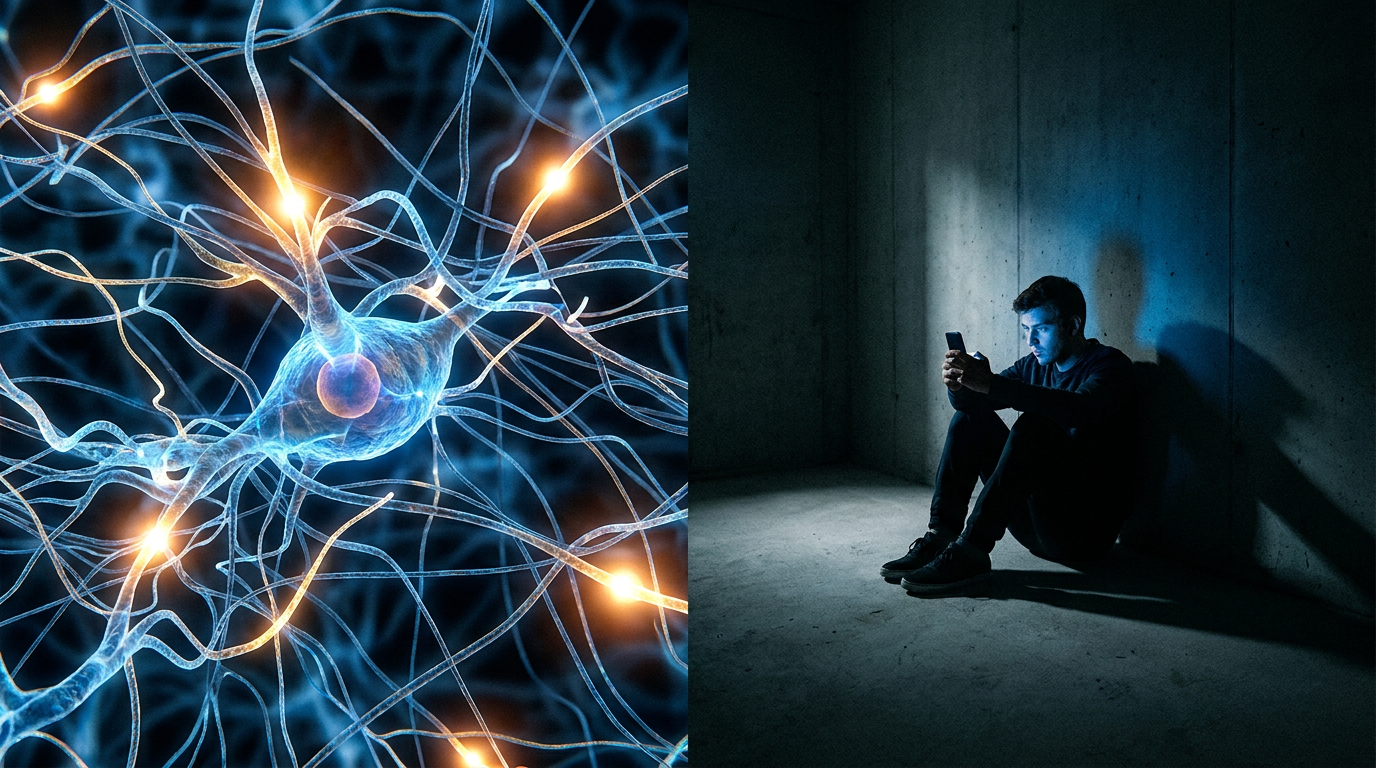
If you were to actually deplete your brain of dopamine, you would not achieve a state of zen-like focus. You would lose the ability to initiate movement or summon the will to act. Severe dopamine depletion is the primary mechanism behind Parkinson's disease, characterized by tremors, rigidity, and a profound difficulty in executing voluntary movements. In animal models, rats completely deprived of dopamine will starve to death even if food is placed inches away from them, simply because they lack the motivation to move toward it.[1][3]
If you were to actually deplete your brain of dopamine, you would not achieve a state of zen-like focus.
Furthermore, the brain's neurochemical systems are highly resilient and designed to maintain homeostasis. If you temporarily deprive yourself of external stimulation, your brain does not simply stop producing dopamine. It adjusts. A weekend retreat in the woods might lower your cortisol levels and provide psychological relief, but it does not meaningfully "reset" your dopamine receptor density.[1][6]
The fundamental flaw in the dopamine fasting myth is the widespread misunderstanding of what dopamine actually does. Pop culture has labeled it the "pleasure chemical," a reward juice squeezed out by the brain whenever we eat sugar or get a social media "like." But modern neuroscience has revealed a much more sophisticated mechanism.[3][5]
The true function of dopamine was unlocked in the 1990s by neuroscientist Wolfram Schultz during a series of groundbreaking experiments with monkeys. Schultz was monitoring the electrical activity of dopamine neurons while monkeys learned to associate a light cue with a squirt of apple juice. What he discovered fundamentally changed our understanding of learning and motivation.[4]
Schultz found that dopamine neurons do not fire in response to the reward itself. Instead, they fire in response to surprise. This mechanism is known as "Reward Prediction Error." The dopamine system is essentially a prediction engine, constantly calculating the difference between what the brain expects to happen and what actually occurs.[4][5]

When an outcome is better than expected—say, you find a twenty-dollar bill in an old coat—dopamine neurons fire a rapid burst of action potentials. This positive prediction error acts as a teaching signal, telling the brain, "Whatever you just did to get this, remember it and do it again." It strengthens the synaptic connections that led to the unexpected reward.[4][6]
Conversely, if an outcome is exactly as expected, the dopamine neurons maintain their baseline firing rate. There is no burst, because there is no new information to learn; the brain's model of the world is already accurate. And if an outcome is worse than expected, the dopamine neurons briefly pause their firing. This negative prediction error weakens the neural pathways, teaching the brain to avoid that specific action in the future.[4][5]
Understanding Reward Prediction Error explains why modern technology feels so compulsive. Social media algorithms and slot machines are engineered to exploit this exact mechanism. They deliver rewards on a "variable ratio schedule"—meaning you never know exactly when you will see a highly engaging post or win a payout.[5][6]
Because the reward is unpredictable, the brain can never fully adapt to it. Every time you pull to refresh your feed and see something novel, it generates a micro-burst of positive prediction error. The dopamine system continuously signals that there is something new to learn, keeping you locked in a cycle of seeking and scrolling, long after the actual pleasure of the activity has faded. You are not addicted to the pleasure; you are trapped by the prediction error.[5][6]

So, if a weekend of sensory deprivation cannot fix this, what can? The answer lies in the unglamorous reality of sustained habit modification. Breaking a compulsive loop requires weakening the neural pathways that have been reinforced by years of positive prediction errors.[1][6]
This brings us back to the original, evidence-based intent of Dr. Sepah's protocol. The most effective way to break a digital compulsion is not to avoid all pleasure, but to practice targeted abstinence from the specific problematic behavior. By repeatedly exposing yourself to the trigger—like the urge to check your phone—and consciously choosing not to act on it, you engage the principles of neuroplasticity.[2][6]
Over time, circuits that fire together wire together, but circuits that are ignored eventually prune themselves. It takes weeks or months of consistent behavioral change to meaningfully alter these pathways, not a 48-hour fast in a dark room. The dopamine fast may be a myth, but the capacity of the human brain to unlearn its own compulsions is very real.[1][6]
How we got here
1990s
Neuroscientist Wolfram Schultz discovers that dopamine neurons fire in response to reward prediction errors, not the rewards themselves.
2016
The term 'dopamine fasting' first begins circulating in niche online self-help and productivity forums.
2019
Psychiatrist Dr. Cameron Sepah publishes 'Dopamine Fasting 2.0' as a catchy metaphor for a cognitive behavioral therapy protocol.
Late 2019
The concept goes viral in Silicon Valley, morphing from a targeted therapy into a literal sensory deprivation trend.
2020–2026
Neuroscientists and medical professionals push back, clarifying the biological impossibility of 'fasting' from a neurotransmitter.
Viewpoints in depth
Neuroscience Consensus
Argues that dopamine is a fundamental neurotransmitter that cannot be 'reset' through sensory deprivation.
Neuroscientists emphasize that dopamine is required for movement and motivation, not a 'pleasure toxin' that builds up in the brain. They point to the mechanism of Reward Prediction Error, demonstrating that dopamine signals surprise and learning rather than subjective enjoyment. From this biological perspective, the idea of 'resetting' receptors through a weekend of sensory deprivation is physiological nonsense.
Clinical Psychology
Focuses on the behavioral utility of the original concept, separate from its biological inaccuracies.
Psychologists and therapists argue that while the 'dopamine' label was a poorly chosen metaphor, the underlying practice of Exposure and Response Prevention (ERP) is highly effective. By taking structured breaks from compulsive triggers, individuals can practice sitting with discomfort and gradually weaken maladaptive habits, regardless of the exact neurochemical mechanism at play.
What we don't know
- The exact threshold at which digital overstimulation begins to alter long-term receptor density in healthy individuals.
- How individual genetic differences in dopamine receptor subtypes affect susceptibility to digital compulsions.
Key terms
- Dopamine
- A neurotransmitter involved in motivation, movement, and learning, often mistakenly labeled the brain's 'pleasure chemical'.
- Reward Prediction Error (RPE)
- The difference between the reward you expected and the reward you actually received, which drives how the brain learns and forms habits.
- Exposure and Response Prevention (ERP)
- A psychological therapy where a person is exposed to a trigger but actively refrains from their usual compulsive response.
- Hebbian Plasticity
- A neuroscientific principle often summarized as 'neurons that fire together, wire together,' explaining how neural pathways are strengthened or weakened.
Frequently asked
Can I reset my dopamine receptors by taking a weekend off my phone?
No. Neuroscientists confirm that a complex neurochemical system cannot be 'reset' in a few days. However, taking a break can still be emotionally beneficial for breaking compulsive behavioral loops.
Is dopamine the chemical that makes us feel pleasure?
No. Dopamine is primarily a signal for motivation, wanting, and learning. It drives you to seek out rewards, rather than generating the subjective feeling of pleasure itself.
What was the original meaning of a dopamine fast?
Coined by a psychiatrist in 2019, it was originally a catchy metaphor for a cognitive behavioral therapy technique aimed at reducing specific impulsive behaviors, not a literal biological fast.
Sources
Source coverage
6 outlets
3 viewpoints surfaced





[1]The ScientistNeuroscience Consensus
Debunking the Dopamine Detox Trend
Read on The Scientist →[2]Harvard HealthClinical Psychology
Dopamine fasting: Misunderstanding science spawns a maladaptive fad
Read on Harvard Health →[3]Business InsiderClinical Psychology
Silicon Valley's 'dopamine fasting' trend is based on a misunderstanding of how the brain works, neuroscientists say
Read on Business Insider →[4]BrainFactsNeuroscience Consensus
Discovering Dopamine's Role in Reward Prediction Error
Read on BrainFacts →[5]Psychology TodayNeuroscience Consensus
How Dopamine Drives Behavior and Reward Prediction Error
Read on Psychology Today →[6]Factlen Editorial TeamFactlen Synthesis
Synthesis by Factlen editorial team
Read on Factlen Editorial Team →

Every angle. Every day.
Get meta stories with full source coverage and perspective breakdowns delivered to your inbox.