
LEO vs. GEO Satellite Internet: The 2026 Trade-Off Analysis for Starlink, Viasat, and Project Kuiper
As Amazon Leo and Viasat's terabit-class satellites enter the 2026 market, rural internet users face a definitive choice between low-latency responsiveness and budget-friendly capacity.
By Factlen Editorial Team
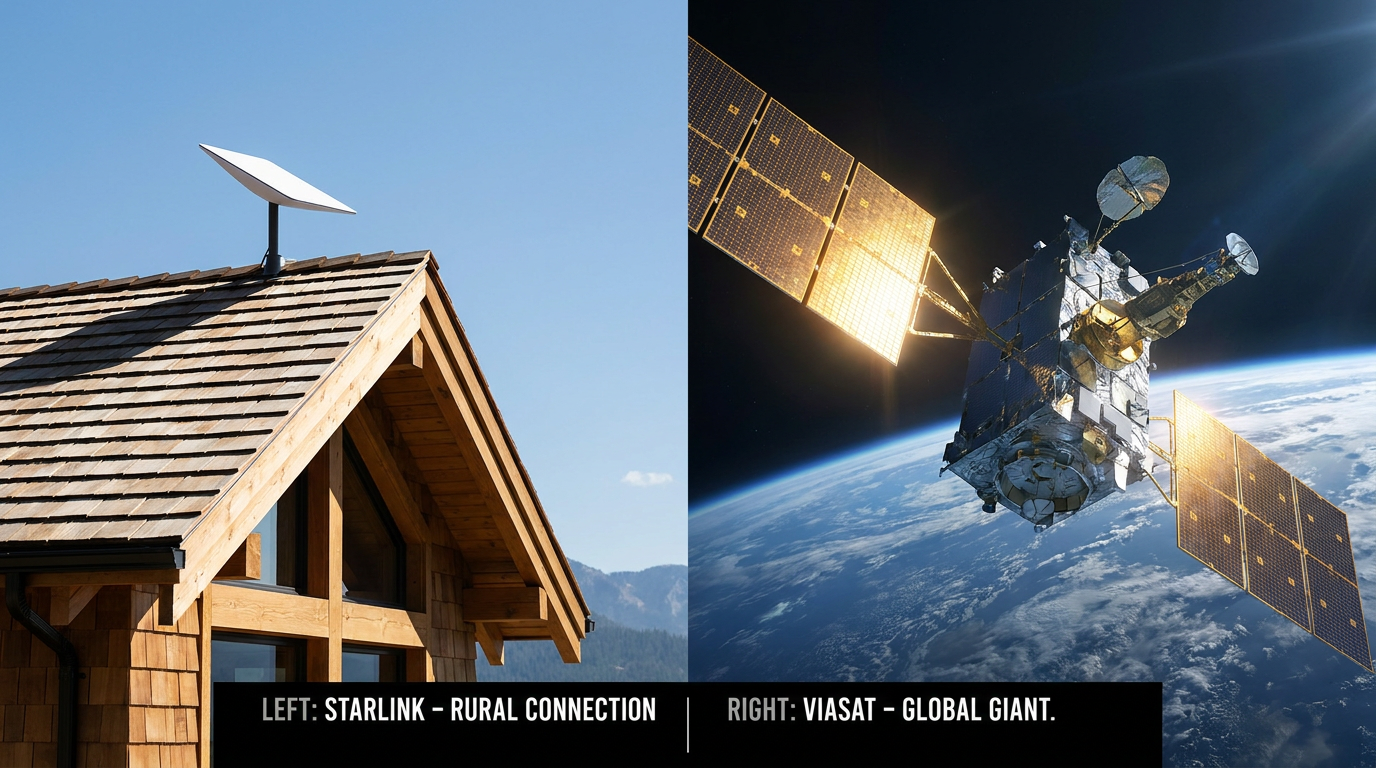
- Low-Latency Advocates
- Prioritize fiber-like responsiveness for real-time applications.
- Value & Capacity Prioritizers
- Focus on lower entry costs and massive regional throughput.
- Enterprise & Mobility Users
- Seek multi-orbit integration for aviation, maritime, and corporate networks.
What's not represented
- · Terrestrial 5G Providers
- · Rural Municipal Broadband Advocates
Why this matters
Choosing the wrong satellite architecture can result in either overpaying by hundreds of dollars a year or being stuck with an internet connection that drops every Zoom call. Understanding this physical trade-off ensures remote workers and rural families invest in the right tool for their digital lifestyle.
Key points
- LEO systems like Starlink and Amazon Leo offer 25-60ms latency, making them ideal for video calls and gaming.
- GEO systems like Viasat operate much higher in orbit, resulting in 600-700ms latency but offering massive regional capacity.
- Amazon Leo is targeting a mid-2026 commercial launch in five countries, bringing new competition to Starlink.
- Viasat's new ViaSat-3 F3 satellite launched in April 2026, delivering 1 Tbps of capacity to the Asia-Pacific region.
- GEO providers maintain a significant advantage in entry-level pricing, with plans starting around $40-$50 per month.
The satellite internet landscape of 2026 has evolved from a market of last resort into a fiercely competitive multi-orbit race. For millions of rural residents, digital nomads, and enterprise customers, the choice is no longer just about getting a signal, but choosing the right orbital physics for their specific needs. The launch of Viasat's ultra-high-capacity ViaSat-3 F3 satellite in April 2026, combined with the mid-2026 commercial rollout of Amazon Leo—formerly Project Kuiper—has created a definitive showdown. Consumers must now weigh the low-latency performance of Low Earth Orbit (LEO) constellations like SpaceX's Starlink and Amazon Leo against the massive, targeted capacity and lower entry costs of Geostationary Earth Orbit (GEO) providers like Viasat.[4][7]
The fundamental trade-off between these services is dictated entirely by altitude. GEO satellites, such as the newly deployed ViaSat-3 series, operate at a staggering 35,786 kilometers above the equator. At this height, a satellite matches the Earth's rotation, remaining fixed over a single region to blanket it with continuous coverage. In contrast, LEO constellations operate between 340 and 600 kilometers above the surface. Because they are so close, their coverage footprints are small, requiring thousands of rapidly moving satellites and complex ground antennas that constantly track them across the sky to maintain a seamless connection.[3][6]
This altitude difference creates the most critical metric in the 2026 trade-off analysis: latency. The speed of light is a hard physical limit. A signal traveling to a GEO satellite and back must cover over 71,000 kilometers, resulting in an inescapable round-trip latency of 600 to 700 milliseconds. LEO systems, operating roughly one-sixtieth of that distance, slash this delay to between 25 and 60 milliseconds. This 15-fold difference in responsiveness is the dividing line between an internet connection that feels like a sluggish dial-up relic and one that mimics a modern terrestrial fiber line.[1][3]

When examining the case for LEO systems, the primary advantage is this fiber-like latency. Starlink, which currently operates over 10,000 active satellites, routinely delivers download speeds of 50 to 220 Mbps. Amazon Leo is entering the market with promises of up to 400 Mbps for consumer dishes and native integration with Amazon Web Services. The evidence for LEO's superiority in real-time applications is overwhelming; independent testing consistently shows that only LEO connections can support seamless Zoom calls, competitive online gaming, and responsive remote desktop work without the awkward freezing and talking-over-each-other that plagues GEO connections.[2][6]
Amazon Leo's entry in mid-2026 is actively reshaping this LEO landscape. With over 300 satellites deployed following an aggressive launch cadence, Amazon is targeting commercial service in the United States, United Kingdom, Canada, France, and Germany. The evidence from early enterprise testing shows Amazon Leo achieving speeds up to 1.2 Gbps for commercial terminals. This introduces genuine price and performance competition to Starlink, potentially driving down the high hardware costs that have historically gated access to low-latency satellite broadband.[2][7]
Amazon Leo's entry in mid-2026 is actively reshaping this LEO landscape.
Conversely, the argument against LEO centers heavily on cost and network congestion. Starlink's standard residential plan commands a premium at $120 per month, plus an upfront hardware cost of $299 for the phased-array antenna. Furthermore, because LEO satellites have smaller capacity footprints, dense suburban areas can experience significant speed degradation during peak evening hours. Users in highly subscribed regions often see their 150 Mbps speeds sag to 50 Mbps when their local cell becomes congested, and power users face deprioritization after crossing a one-terabyte monthly threshold.[1][6]
The case for GEO systems like Viasat rests on proven reliability, massive regional throughput, and budget-friendly entry points. Rather than launching thousands of small nodes, Viasat focuses on engineering colossal, ultra-high-capacity satellites. The ViaSat-3 F3, launched aboard a Falcon Heavy, is designed to deliver over one terabit per second of throughput to the Asia-Pacific region alone. By utilizing advanced beam-forming technology, GEO providers can dynamically steer bandwidth to high-demand hotspots. For consumers, this translates to entry-level plans starting around $40 to $50 per month, making it a highly accessible option for households that cannot justify LEO's premium pricing.[4][5]

The case against GEO remains its inherent physical limitations and restrictive data policies. While Viasat can deliver impressive raw download speeds—often exceeding 100 Mbps on newer plans—the 600-millisecond latency makes real-time interaction painful. Additionally, the economics of GEO bandwidth often necessitate strict data caps. While marketed as 'unlimited,' many GEO plans aggressively throttle speeds to a crawl once a user consumes their monthly allowance of 40 to 150 gigabytes, making large game downloads or continuous 4K streaming a logistical challenge.[1][3]
Ultimately, the 2026 market offers distinct tools for distinct jobs. LEO systems fit well when a household relies on real-time interactive applications, such as remote work, video conferencing, and online gaming. They are the definitive choice for users who have the budget for higher upfront costs and demand an experience indistinguishable from terrestrial broadband. LEO does not fit when a user is on a strict monthly budget or lives in a densely populated area where terrestrial 5G or fiber is already available, as the congestion and cost outweigh the benefits.[6][8]
On the other hand, GEO systems fit well when users have lighter internet needs, prioritize a lower monthly bill, and primarily use their connection for asynchronous tasks. If a household's internet diet consists of web browsing, email, and streaming video—where an initial few seconds of buffering completely masks the high latency—Viasat provides a highly stable and cost-effective lifeline. GEO does not fit when a user needs to actively participate in daily video meetings, play competitive multiplayer games, or frequently upload large files to cloud servers.[1][8]

The enterprise and mobility sectors are also driving this multi-orbit evolution. Airlines like Delta and JetBlue have already signed on to use Amazon Leo for in-flight Wi-Fi, while Viasat's GEO network continues to dominate maritime and aviation connectivity with its established global footprint. For these commercial users, the trade-off analysis often results in a hybrid approach. Network architects are increasingly utilizing LEO for low-latency passenger applications—such as live sports streaming and Wi-Fi calling—and reserving GEO for secure, high-capacity operational data that keeps the aircraft or vessel running smoothly.[2][4]
The digital divide is closing faster than ever before, driven by billions of dollars in private aerospace investment. The 2026 satellite internet market proves that space-based connectivity is no longer a last-resort compromise, but a robust ecosystem of highly tailored solutions. Consumers are no longer forced to accept a single, flawed paradigm. Whether a user prioritizes the instant responsiveness of a low-orbit constellation or the cost-effective, massive throughput of a geostationary giant, the tools to stay connected from anywhere on Earth have never been more accessible or powerful.[8]
How we got here
May 2023
Viasat launches the first ViaSat-3 satellite to cover the Americas.
Nov 2025
Amazon permanently rebrands Project Kuiper to Amazon Leo.
Apr 2026
Viasat successfully launches the ViaSat-3 F3 satellite to deliver 1 Tbps capacity to the Asia-Pacific region.
Mid-2026
Amazon Leo targets commercial broadband service launch in five countries.
Viewpoints in depth
Low-Latency Advocates
Prioritize fiber-like responsiveness for real-time applications.
This camp argues that latency is the only metric that truly matters for the modern internet. Because remote work, video conferencing, and online gaming require instant data transmission, they view LEO constellations like Starlink and Amazon Leo as the only viable replacements for terrestrial broadband. They point to the 25-60ms round-trip times as evidence that the physics of low-Earth orbit fundamentally solve the historical limitations of satellite internet, even if it requires a higher monthly premium.
Value & Capacity Prioritizers
Focus on lower entry costs and massive regional throughput.
Advocates for GEO systems emphasize that not every household needs to play competitive online games or host daily Zoom meetings. They argue that Viasat's approach of launching single, terabit-class satellites is a more efficient way to deliver bulk bandwidth to a region. By offering lower monthly entry prices, GEO providers serve as a crucial, budget-friendly lifeline for rural users whose primary internet diet consists of web browsing and streaming video, where initial buffering easily masks high latency.
Enterprise & Mobility Users
Seek multi-orbit integration for aviation, maritime, and corporate networks.
Commercial users view the LEO vs. GEO debate not as a binary choice, but as a hybrid opportunity. Airlines and maritime operators are increasingly integrating both architectures—using LEO networks like Amazon Leo for low-latency passenger Wi-Fi, while relying on the massive, secure capacity of GEO satellites like ViaSat-3 for critical operational data. This perspective values native cloud integration, such as Amazon Leo's direct link to AWS, and the ability to dynamically steer bandwidth to high-demand commercial hotspots.
What we don't know
- The exact consumer pricing tiers for Amazon Leo when it fully launches in mid-2026.
- How Starlink will adjust its pricing or data caps in response to Amazon Leo's entry.
- Whether Viasat will introduce new consumer plans specifically utilizing the expanded capacity of the ViaSat-3 constellation.
Key terms
- LEO (Low Earth Orbit)
- An orbit relatively close to Earth's surface (typically 300 to 600 km), allowing for rapid signal transmission and low latency.
- GEO (Geostationary Earth Orbit)
- A high-altitude orbit (approx. 35,786 km) where a satellite matches Earth's rotation, remaining fixed over one region to provide massive, continuous coverage.
- Latency
- The time delay between sending a data signal and receiving a response, critical for real-time applications like video calls and gaming.
- Throughput Capacity
- The maximum amount of data a satellite can transmit per second, often measured in terabits per second (Tbps) for modern GEO satellites.
- Phased-Array Antenna
- A flat, electronically steered dish used by LEO customers that tracks rapidly moving satellites without physically moving.
Frequently asked
Is satellite internet fast enough for Zoom and gaming?
Yes, but only if you use a Low Earth Orbit (LEO) provider like Starlink or Amazon Leo. Their 25-60ms latency supports real-time interaction, whereas GEO providers have too much lag.
Why is Starlink more expensive than Viasat?
Starlink requires a complex phased-array antenna to track moving satellites, resulting in higher upfront hardware costs, and charges a premium for its low-latency, high-speed performance.
When will Amazon Leo be available to consumers?
Amazon Leo is targeting a commercial service launch in the US, UK, Canada, France, and Germany by mid-2026, though initial rollouts may focus heavily on enterprise customers.
Sources
Source coverage
8 outlets
3 viewpoints surfaced








[1]CNETValue & Capacity Prioritizers
Starlink vs. Viasat: Which Satellite Internet Provider is Best?
Read on CNET →[2]EngadgetLow-Latency Advocates
Amazon Leo (formerly Project Kuiper) will launch mid-2026
Read on Engadget →[3]Orbital RadarLow-Latency Advocates
Satellite Internet Speeds & Latency Compared: LEO vs GEO
Read on Orbital Radar →[4]ViasatValue & Capacity Prioritizers
Viasat Confirms Successful Launch and Initial Signal Acquisition of ViaSat-3 F3
Read on Viasat →[5]India TodayValue & Capacity Prioritizers
Internet at 1TB per second: Viasat launches powerful broadband satellite
Read on India Today →[6]US MobileLow-Latency Advocates
Honest comparison of Starlink, HughesNet, and Viasat
Read on US Mobile →[7]Telecoms.comEnterprise & Mobility Users
Amazon's Kuiper eyes early 2026 launch across five markets
Read on Telecoms.com →[8]Factlen Editorial TeamEnterprise & Mobility Users
Synthesis by Factlen editorial team
Read on Factlen Editorial Team →



Every angle. Every day.
Get shopping stories with full source coverage and perspective breakdowns delivered to your inbox.