
Sodium-ion vs. Lithium-ion Batteries: The 2026 Trade-Off Analysis for Cost, Safety, and Cold-Weather Performance
As sodium-ion batteries reach commercial scale in 2026, the energy storage market is splitting into two distinct tiers. This analysis weighs the extreme energy density of lithium against the cost, safety, and cold-weather advantages of emerging sodium technology.
By Factlen Editorial Team
- Cost & Scale Advocates
- Focus on the urgent need to democratize energy storage through cheaper, more abundant raw materials.
- Energy Density Purists
- Argue that weight and space efficiency remain the most critical metrics for advanced technology and premium mobility.
- Supply Chain Pragmatists
- Value the geopolitical security and safety benefits of diversifying away from concentrated lithium and cobalt mining.
What's not represented
- · Lithium mining communities facing shifting demand
- · End-of-life battery recycling facilities adapting to new chemistries
Why this matters
Choosing the right battery chemistry is no longer just for engineers; it dictates the price of your next electric vehicle, the reliability of your home solar storage, and how well your devices perform in freezing winter temperatures.
Key points
- Lithium-ion remains the undisputed leader for energy density, essential for long-range EVs and premium electronics.
- Sodium-ion has reached commercial scale in 2026, dropping cell costs to roughly half that of lithium.
- Sodium batteries retain up to 90% of their capacity in freezing temperatures, solving a major pain point for winter EV drivers.
- The inherent safety of sodium allows cells to be discharged to zero volts for transport without damage.
- The market is bifurcating: lithium for premium, space-constrained uses, and sodium for budget EVs and grid storage.
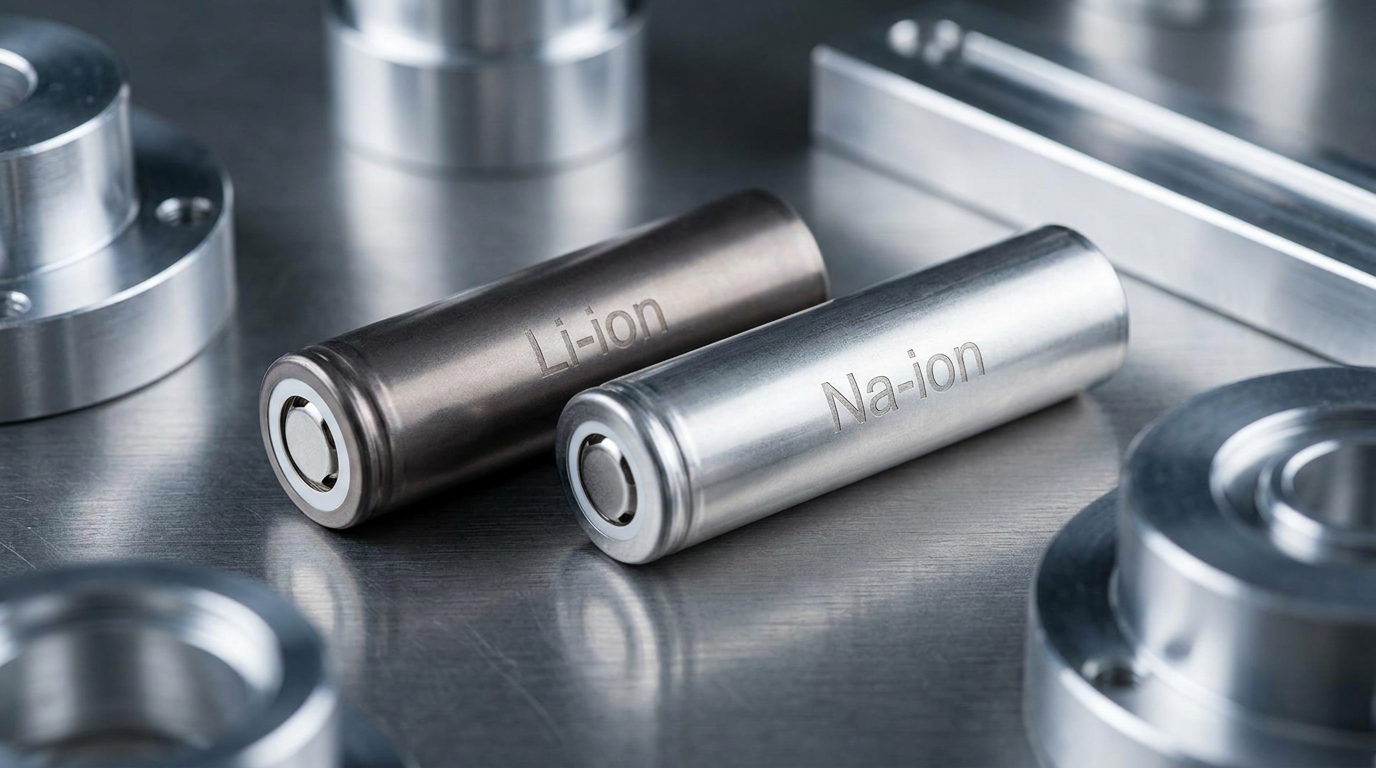
For over three decades, the lithium-ion battery has been the undisputed monarch of portable power, enabling everything from the smartphone revolution to the modern electric vehicle. But in 2026, the energy storage market is undergoing a fundamental bifurcation. Sodium-ion technology, once confined to laboratory experiments and niche applications, has achieved mass commercial scale.[1][3]
This shift marks the end of the one-size-fits-all battery era. Consumers and manufacturers are no longer forced to pay the premium associated with lithium for every single application. Instead, the market has matured into a landscape of specialized chemistries, where the choice between lithium and sodium is dictated by specific use cases, budgets, and operating environments.[2][4]
To navigate this new landscape, buyers must understand the core trade-offs between these two dominant architectures. The decision matrix hinges on three primary pillars: upfront cost, gravimetric energy density (how much power is stored per kilogram), and extreme-weather resilience.[4]
Let us first examine the argument for lithium-ion. The primary case for sticking with lithium is its unmatched energy density. Because lithium is the lightest metal on the periodic table, it can store a massive amount of electrochemical energy in a remarkably small and lightweight package.[4][7]
The evidence for this advantage is clear in the 2026 metrics: premium lithium-ion cells routinely achieve energy densities of 250 to 300 watt-hours per kilogram (Wh/kg). This extreme density is what allows a flagship electric vehicle to travel 400 miles on a single charge without the battery pack becoming prohibitively heavy.[3][7]

However, the argument against lithium-ion centers on supply chain fragility and stubborn cost floors. Lithium extraction is geographically concentrated, resource-intensive, and subject to wild price fluctuations. Furthermore, traditional lithium-ion chemistries often rely on expensive and ethically fraught metals like cobalt and nickel.[2][5]
Conversely, the argument for sodium-ion begins with raw material abundance. Sodium is roughly a thousand times more common than lithium and can be cheaply extracted from seawater or soda ash. This fundamentally alters the economics of battery production, insulating manufacturers from the geopolitical bottlenecks that plague lithium.[1][4]
The evidence for sodium's cost advantage is striking. In 2026, sodium-ion cell costs have dropped to between $40 and $50 per kilowatt-hour at the pack level. This is roughly half the cost of average lithium-ion cells, which continue to hover between $80 and $100 per kilowatt-hour despite manufacturing efficiencies.[1][5]
The argument against sodium-ion, however, is its physical bulk. Sodium ions are larger and heavier than lithium ions. Current commercial sodium-ion cells max out at roughly 160 to 180 Wh/kg. To store the same amount of energy as a lithium battery, a sodium battery must be physically larger and heavier.[4][7]
The argument against sodium-ion, however, is its physical bulk.
Beyond cost and density, the cold-weather performance trade-off is a major differentiator for consumers in northern climates. Lithium-ion batteries are notoriously sluggish in freezing temperatures, suffering from increased internal resistance that severely throttles charging speeds and reduces effective range.[6]
The evidence heavily favors sodium in this arena. Clinical and real-world testing shows that sodium-ion cells retain upwards of 90 percent of their capacity at minus 20 degrees Celsius. For drivers in freezing climates, a sodium-powered EV offers vastly superior winter reliability compared to its lithium counterpart.[3][6]

Safety profiles also diverge significantly. Lithium-ion batteries, particularly those using nickel-manganese-cobalt (NMC) chemistries, carry a known risk of thermal runaway—a cascading fire event that is notoriously difficult to extinguish if the cell is punctured or overheated.[4][6]
Sodium-ion cells are inherently less prone to thermal runaway. Furthermore, they possess a unique logistical advantage: they can be safely discharged to zero volts for transport. Discharging a lithium-ion battery to absolute zero permanently destroys the cell, but sodium batteries can be shipped completely dead and safely revived upon delivery.[2][4]
Synthesizing these trade-offs provides clear guidance on where each technology fits well. Lithium-ion fits perfectly when space and weight are the absolute constraints, and when consumers are willing to pay a premium for maximum performance.[7]
It remains the undisputed choice for flagship electric vehicles requiring ultra-long ranges, premium ultra-thin smartphones, lightweight laptops, and aerial drones. In these applications, the physical bulk of sodium makes it a non-starter.[3][7]
Conversely, lithium-ion does not fit well when upfront cost is the primary barrier to adoption, or in stationary applications where physical footprint and weight are largely irrelevant.[5]
Sodium-ion fits well when budget, safety, and durability outweigh the need for maximum range. It is rapidly becoming the standard chemistry for home solar storage walls, grid-level energy banks, and budget-friendly urban electric vehicles designed for daily commuting rather than cross-country road trips.[1][5]

It also fits exceptionally well for micro-mobility solutions like e-bikes and electric scooters, where the reduced fire risk and lower price point perfectly align with consumer demands.[1][3]
Sodium-ion does not fit well in high-performance sports cars, heavy-duty long-haul electric trucking, or consumer electronics where every millimeter of thickness matters to the end user.[7]
How we got here
1991
Sony commercializes the first lithium-ion battery, revolutionizing portable electronics.
2021
Major battery manufacturer CATL announces its first generation of commercial sodium-ion cells.
2023
The first budget electric vehicles powered by sodium-ion batteries roll off assembly lines in China.
2026
Sodium-ion reaches global mass-market scale, splitting the energy storage industry into distinct premium and budget tiers.
Viewpoints in depth
Automotive Manufacturers
Focused on segmenting their vehicle lineups to maximize profit margins and consumer reach.
For legacy automakers and EV startups alike, the arrival of sodium-ion is a tool for market segmentation. They argue that forcing a $100/kWh lithium battery into a $20,000 urban commuter car destroys profit margins. By adopting sodium for entry-level models, they can finally achieve price parity with internal combustion engines, while reserving their constrained lithium supply for high-margin luxury SUVs and trucks where buyers demand 400-plus miles of range.
Grid Storage Operators
Prioritize absolute cost per kilowatt-hour and safety over physical footprint.
Utility companies and home solar installers view sodium-ion as a holy grail. In a stationary battery park or a garage wall unit, the physical weight and size of the battery are largely irrelevant. Operators argue that sodium's $40-$50/kWh price point fundamentally changes the math of renewable energy storage, making it economically viable to store massive amounts of solar and wind energy without the fire risks associated with massive lithium installations.
Consumer Electronics Brands
Committed to lithium-ion due to the uncompromising space constraints of modern devices.
Designers of smartphones, tablets, and wearables remain firmly tethered to lithium-ion. Their primary argument is spatial economics: consumers demand devices that are millimeters thin but last all day. Because sodium-ion requires significantly more physical volume to hold the same charge, electronics manufacturers argue that adopting sodium would force a regression to the bulky device designs of the early 2010s, a trade-off the premium consumer market will not accept.
What we don't know
- The long-term cycle life degradation of mass-produced sodium-ion cells over a 10-to-15 year lifespan.
- How aggressively lithium prices might drop in response to lost market share, potentially narrowing sodium's cost advantage.
- Whether solid-state lithium advancements will eventually render sodium's safety advantages obsolete.
Key terms
- Gravimetric Energy Density (Wh/kg)
- A measure of how much energy a battery can store relative to its weight; higher numbers mean a lighter battery for the same amount of power.
- Thermal Runaway
- A dangerous chain reaction within a battery cell where rising temperatures cause further heating, potentially leading to a fire that is difficult to extinguish.
- Cell-to-Pack (CTP)
- A manufacturing method that integrates battery cells directly into the final pack without intermediate modules, saving space and weight to help offset sodium's lower density.
Frequently asked
Will a sodium-ion battery make my EV heavier?
Yes. Because sodium-ion has a lower energy density (160-180 Wh/kg) than lithium-ion, a battery pack must be physically larger and heavier to offer the same driving range.
Is sodium-ion safer than lithium-ion?
Generally, yes. Sodium-ion chemistries are less prone to thermal runaway (battery fires) and can be discharged to zero volts for completely safe shipping and handling.
Why are smartphones still using lithium?
Smartphones and laptops have extreme space constraints. The high energy density of lithium-ion is required to keep devices thin while providing all-day battery life.
Do sodium batteries work better in the winter?
Significantly better. Sodium-ion cells can retain up to 90% of their capacity at -20°C, whereas lithium-ion batteries suffer severe range degradation in freezing conditions.
Sources
Source coverage
7 outlets
3 viewpoints surfaced







[1]BloombergCost & Scale Advocates
Sodium-Ion Batteries Reach Commercial Scale in Budget EVs
Read on Bloomberg →[2]ReutersSupply Chain Pragmatists
Automakers Diversify Battery Supply Chains with Sodium Tech
Read on Reuters →[3]ElectrekSupply Chain Pragmatists
The 2026 EV Battery Landscape: Where Sodium Fits In
Read on Electrek →[4]IEEE SpectrumEnergy Density Purists
Comparing the Chemistry: Sodium vs. Lithium at the Cell Level
Read on IEEE Spectrum →[5]CleanTechnicaCost & Scale Advocates
Grid Storage Shifts Toward Sodium-Ion as Costs Plummet
Read on CleanTechnica →[6]Nature EnergySupply Chain Pragmatists
Cold-weather performance and thermal stability of Na-ion architectures
Read on Nature Energy →[7]MIT Technology ReviewEnergy Density Purists
Why Lithium Will Still Dominate Premium Electronics
Read on MIT Technology Review →



Every angle. Every day.
Get shopping stories with full source coverage and perspective breakdowns delivered to your inbox.