
The End of the Supercomputer Bottleneck: How AI is Rewiring Weather Forecasting
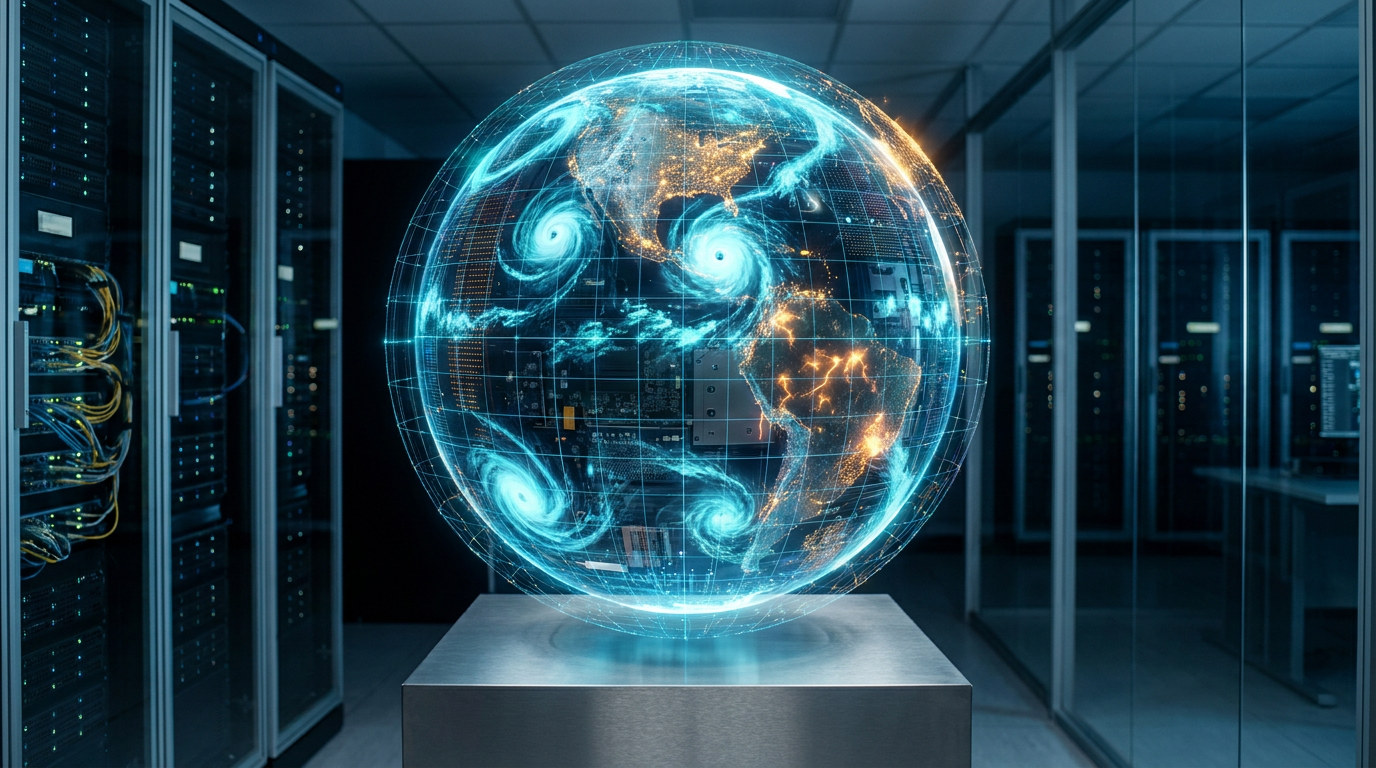
Machine learning models like GenCast and NeuralGCM are now generating 15-day weather forecasts in minutes, outperforming decades of traditional physics-based meteorology.
By Factlen Editorial Team
- Tech Innovators & AI Researchers
- Argue that data-driven machine learning is fundamentally superior to human-coded physics approximations for predicting complex, chaotic systems.
- Operational Meteorologists
- Embrace AI for its speed and accuracy but emphasize that traditional models are still required to gather the initial data that feeds the AI.
- Climate Scientists
- Warn that pure AI models cannot predict unprecedented climate extremes, advocating for hybrid models that retain physical laws.
What's not represented
- · Commercial weather providers
- · Aviation and maritime industries
Why this matters
Accurate weather prediction dictates everything from global supply chains and renewable energy grids to disaster evacuation orders. By reducing the computational cost of forecasting by a factor of 1,000, AI is democratizing access to life-saving meteorological data.
Key points
- Traditional weather forecasting relies on supercomputers solving complex physics equations, a process that takes hours and massive amounts of energy.
- New AI models treat forecasting as a pattern-recognition problem, generating highly accurate 15-day forecasts in minutes.
- Google DeepMind's GenCast uses generative AI to produce 'ensemble' forecasts, outperforming the world's top traditional model on 97.2% of targets.
- Pure AI struggles to predict unprecedented climate extremes because it only learns from historical data.
- Hybrid models like NeuralGCM combine traditional physics with AI to accurately model both daily weather and long-term climate change.
For the past half-century, predicting the weather has been an exercise in brute-force physics. To know if it will rain in London next Tuesday, meteorologists have relied on Numerical Weather Prediction (NWP)—a method that divides the Earth's atmosphere into a three-dimensional grid and uses the world's largest supercomputers to solve wildly complex fluid dynamics equations. It is a marvel of modern science, but it is also slow, incredibly expensive, and highly energy-intensive.[1][7]
That paradigm has officially fractured. Over the last two years, a new generation of artificial intelligence models has proven capable of doing in minutes what takes traditional supercomputers hours. Systems like Google DeepMind's GraphCast, Huawei's Pangu-Weather, and the European Centre for Medium-Range Weather Forecasts' (ECMWF) own Artificial Intelligence Forecasting System (AIFS) are not just matching the accuracy of physics-based models—they are consistently beating them.[1][2][5]
To understand how this revolution works, you have to understand the bottleneck of traditional forecasting. NWP models calculate how air, moisture, and heat move from one grid box to the next. But many crucial weather events—like the formation of a single cloud or a localized thunderstorm—happen at a scale smaller than the grid boxes themselves. To account for this, scientists use "parameterizations," which are essentially educated mathematical guesses about small-scale physics.[3][7]
AI models bypass these equations entirely. Instead of trying to simulate the physics of the atmosphere, they treat weather forecasting as a massive pattern-recognition problem. These machine learning systems are trained on decades of historical weather data—most notably the ECMWF's ERA5 archive, which contains a comprehensive record of global weather spanning more than 40 years. By analyzing billions of past data points, the AI learns exactly how weather systems evolve without ever being taught the laws of thermodynamics.[1][2][7]

The operational advantage is staggering. Once an AI model is trained—a process that does require significant upfront computing power—running a new forecast is computationally trivial. A state-of-the-art AI model can generate a high-resolution 10-day global forecast in less than a minute on a single desktop-sized GPU. Recent estimates suggest that AI forecasting reduces energy use by a factor of 1,000 compared to conventional high-resolution supercomputer runs.[1][7]
But the first wave of AI models had a critical flaw: they were deterministic. They provided a single, "best guess" prediction of the future. In meteorology, a single guess is rarely enough. Because the atmosphere is chaotic—the famous "butterfly effect"—a tiny error in measuring today's temperature can drastically alter next week's forecast. To account for this, operational meteorologists rely on "ensemble forecasting," running a model 50 or more times with slightly tweaked starting conditions to generate a probability spread of possible outcomes.[2][7]
But the first wave of AI models had a critical flaw: they were deterministic.
That hurdle was cleared with the introduction of GenCast, a generative AI model developed by Google DeepMind. GenCast uses diffusion models—the same underlying technology that powers AI image generators—adapted to the spherical geometry of the Earth. Instead of generating a single forecast, GenCast generates an ensemble of 50 or more distinct weather trajectories in just eight minutes on a single TPU chip.[2][7]
The results have forced the meteorological community to rewrite its playbooks. In comprehensive testing, GenCast outperformed the ECMWF's Ensemble Prediction System (ENS)—widely considered the gold standard of global weather forecasting—on 97.2 percent of forecasting targets. For predictions beyond 36 hours, its win rate jumped to 99.8 percent. It proved particularly adept at predicting extreme events like tropical cyclones, heatwaves, and sudden wind shifts, which are notoriously difficult for traditional models to pin down.[2][7]

Despite these triumphs, pure AI models face a looming existential problem: climate change. Because machine learning models are trained exclusively on historical data, they excel at predicting weather patterns that resemble the past. But as global temperatures rise and the atmosphere enters uncharted territory, pure AI models struggle to extrapolate into "unseen" climate regimes. If a model has never seen an ocean this warm, it doesn't intuitively know how that heat will alter a hurricane's intensity.[1][3][7]
This limitation birthed the current frontier of the field: hybrid models. In late 2024, Google Research and the ECMWF published a landmark paper in Nature detailing NeuralGCM (Neural General Circulation Model). NeuralGCM does not discard physics; it merges it with AI. It uses a traditional fluid dynamics solver to handle the large-scale movement of the atmosphere, ensuring the model obeys the fundamental laws of physics even in a warming world.[3][4][6]
Where NeuralGCM deploys AI is in the "parameterizations"—the small-scale phenomena like cloud formation and precipitation that traditional models struggle with. By replacing human-coded approximations with a neural network trained on high-resolution satellite data, NeuralGCM achieves the best of both worlds. It runs at a coarser, faster resolution than traditional models while maintaining high accuracy, allowing for massive computational savings without sacrificing physical reality.[3][6][7]

The hybrid approach has proven wildly successful. NeuralGCM not only matches the accuracy of pure AI models for 1-to-15 day weather forecasts, but it also accurately simulates realistic long-term climate behavior over decades—something pure AI models cannot do. It successfully tracks tropical cyclone patterns and seasonal cycles, proving that machine learning can be used for long-term climate projections, not just next week's rain.[3][4][6]
The integration of these tools into daily life is already underway. The ECMWF now runs its AI forecasting system operationally alongside its traditional physics models, using the two in tandem to cross-check predictions. Meanwhile, AI-driven forecasts are quietly powering consumer applications, improving the accuracy of the weather widgets on smartphones and optimizing the output predictions for commercial wind and solar farms.[1][2][5]
Ultimately, AI is not replacing the meteorologist, nor is it entirely replacing the supercomputer. Traditional physics models remain essential—if only to generate the initial atmospheric data that AI models need to begin their calculations. But the era of relying solely on brute-force physics to predict the sky is over. By teaching algorithms to recognize the atmosphere's patterns, science has unlocked a faster, cheaper, and more accurate way to see the future.[5][7]
How we got here
2021
The ECMWF launches a ten-year roadmap to integrate machine learning into numerical weather prediction.
2023
Models like Google's GraphCast and Huawei's Pangu-Weather demonstrate that AI can outperform traditional models in deterministic forecasting.
Mid-2024
Google Research and ECMWF publish NeuralGCM, proving hybrid models can accurately simulate long-term climate behavior.
Late 2024
Google DeepMind introduces GenCast, successfully applying generative AI to create highly accurate ensemble forecasts.
2025
The ECMWF officially puts its Artificial Intelligence Forecasting System (AIFS) into daily operation alongside its traditional models.
Viewpoints in depth
Tech Innovators & AI Researchers
Argue that data-driven machine learning is fundamentally superior to human-coded physics approximations.
For decades, scientists have tried to perfect the mathematical equations that govern the atmosphere. AI researchers argue this approach has hit a wall of diminishing returns. By feeding decades of high-quality observational data into neural networks, they believe AI can uncover atmospheric patterns and correlations that are too complex for human-written physics equations to capture. In their view, the sheer speed and energy efficiency of AI models make the traditional supercomputer approach obsolete for medium-range forecasting.
Operational Meteorologists
Embrace AI for its speed and accuracy but emphasize that traditional models are still required.
Meteorological agencies like the ECMWF are rapidly adopting AI, but they view it as a powerful new tool rather than a total replacement. They point out a critical dependency: AI models cannot start a forecast from scratch. They require a highly accurate snapshot of the current global weather—known as 'initial conditions'—which is still generated by traditional data assimilation and physics-based models. Furthermore, operational forecasters value the physical transparency of traditional models, whereas AI often operates as a 'black box' where the reasoning behind a specific forecast is obscured.
Climate Scientists
Warn that pure AI models cannot predict unprecedented climate extremes, advocating for hybrid models.
Climate researchers caution against abandoning physics entirely. Because machine learning models are trained exclusively on historical data, they are inherently backward-looking. As greenhouse gas emissions push the Earth's climate into unprecedented states, pure AI models lack the fundamental physical laws required to extrapolate how the atmosphere will behave in conditions it has never seen before. This camp strongly advocates for hybrid approaches, like NeuralGCM, which anchor the AI's pattern recognition within a rigid framework of the laws of thermodynamics and fluid dynamics.
What we don't know
- How pure AI models will perform when faced with unprecedented, climate-driven weather extremes that have no historical precedent in their training data.
- Whether AI can eventually replace the traditional data assimilation process required to generate the initial starting conditions for forecasts.
Key terms
- Numerical Weather Prediction (NWP)
- The traditional method of forecasting that uses supercomputers to solve complex mathematical equations governing fluid dynamics and thermodynamics.
- Parameterization
- In traditional models, the use of simplified mathematical estimates to represent small-scale weather events, like cloud formation, that are too small for the model's grid to simulate directly.
- Ensemble Forecasting
- A forecasting method that generates multiple predictions with slightly different starting conditions to calculate the probability of various weather outcomes.
- Diffusion Model
- A type of generative AI that learns to create data by reversing a process of added noise; used by GenCast to generate multiple realistic weather scenarios.
- ERA5
- A massive dataset produced by the ECMWF containing detailed, hourly global weather data spanning decades, used to train modern AI weather models.
Frequently asked
Does AI replace traditional weather forecasting?
Not entirely. AI models still rely on traditional physics-based systems to provide the 'initial conditions'—the current state of the atmosphere—before they can predict the future.
Why is ensemble forecasting important?
Because the atmosphere is chaotic, a single forecast is often wrong. Ensemble forecasting runs dozens of slightly different scenarios to provide a probability of what will happen, which is crucial for risk management.
Can AI predict climate change?
Pure AI models struggle with long-term climate change because they are trained on past data and cannot easily extrapolate into unprecedented warming. Hybrid models like NeuralGCM are being developed to solve this.
Sources
Source coverage
7 outlets
3 viewpoints surfaced







[1]European Centre for Medium-Range Weather ForecastsOperational Meteorologists
Machine learning in numerical weather prediction
Read on European Centre for Medium-Range Weather Forecasts →[2]Google DeepMindTech Innovators & AI Researchers
GenCast: Predicting weather and extreme risks with generative AI
Read on Google DeepMind →[3]Google ResearchTech Innovators & AI Researchers
Transforming climate modeling with NeuralGCM
Read on Google Research →[4]NatureClimate Scientists
Neural general circulation models for weather and climate
Read on Nature →[5]VOA NewsOperational Meteorologists
AI Tools Aim to Improve Weather Forecasting
Read on VOA News →[6]ESG NewsClimate Scientists
Google Research Team Publishes Groundbreaking Paper in Nature, Neural General Circulation Models
Read on ESG News →[7]Factlen Editorial Team
Synthesis by Factlen editorial team
Read on Factlen Editorial Team →
Every angle. Every day.
Get meta stories with full source coverage and perspective breakdowns delivered to your inbox.