
The Art and Science of the Esports Observer: How In-Game Directors Capture Digital Chaos
Behind every thrilling esports broadcast is a team of "observers"—in-game camera directors who anticipate plays, manage virtual cinematography, and use emerging AI tools to turn digital chaos into a coherent narrative.
By Factlen Editorial Team
- Veteran Observers
- Emphasize the human element of storytelling, arguing that knowing when to look away from the action is just as important as capturing it.
- Broadcast Technologists
- Focus on the integration of AI and automation to reduce the immense cognitive load on production teams and democratize high-quality broadcasting.
- Esports Audiences
- Demand a seamless, narrative-driven viewing experience where the camera never misses the crucial, game-winning moments.
What's not represented
- · Amateur tournament organizers who struggle with the high costs of human broadcast teams.
- · The players themselves, whose in-game strategies are occasionally revealed to opponents by massive arena screens.
Why this matters
As esports viewership rivals traditional sports, understanding how these digital broadcasts are constructed reveals the invisible artistry and emerging AI technology that shape how millions of fans experience competitive gaming.
Key points
- Esports observers act as in-game directors, controlling virtual cameras to capture the most critical moments of a match.
- Top-tier broadcasts rely on coordinated teams of POV, free-cam, and delay observers to ensure no action is missed.
- The role requires anticipating player psychology and prioritizing narrative storytelling over simply showing every elimination.
- Emerging AI tools are beginning to automate baseline camera work, democratizing high-quality broadcasts for smaller tournaments.
- Despite technological advancements, human observers remain essential for capturing the emotional weight and tension of major events.
You are watching the grand finals of a major esports tournament. A player sneaks behind enemy lines, the crowd holds its breath, and the camera cuts to their perspective just a split-second before they secure the game-winning elimination. To the casual viewer, this seamless transition feels like magic, or perhaps an automated feature of the game itself. In reality, it is the meticulous work of an "esports observer"—the invisible director operating inside the game's digital void.[1]
In traditional sports, camera operators stand on the sidelines with physical equipment, tracking a ball they can see with their own eyes. Esports observing is fundamentally different. Observers navigate a three-dimensional virtual environment using a keyboard, mouse, and specialized spectator software. They must master the game's mechanics, anticipate player psychology, and translate a chaotic battlefield into a legible story for millions of viewers.[3]
"If casters are the storytellers, observers are the book," is a common refrain in the broadcast control room. The role requires an intimate understanding of high-level gameplay. An observer isn't just reacting to what happens; they are predicting what is about to happen. They monitor the minimap, track player economies, and recognize tactical setups to ensure the camera is perfectly positioned before the first digital shot is fired.[1][3]
A top-tier esports broadcast rarely relies on a single observer. Instead, it utilizes a highly coordinated team. The primary "Point of View" (POV) observer is responsible for jumping between the perspectives of individual players. This requires a staggering level of situational awareness, as the observer must instantly decide which of the ten players in a standard match is most likely to initiate the action.[1]

Working alongside the POV operator is the "cinematic" or "free-cam" observer. Instead of looking through a player's eyes, this director detaches the camera from the avatars, floating high above the digital arena. They provide the macro view—showing the tactical spacing of a team, the flanking routes, and the overarching geometry of a team fight. This perspective gives the audience crucial context that the players themselves don't even have.[1]
To ensure nothing is missed, major broadcasts also employ "delay observers." Operating on a slight time delay, these specialists scan the game's kill feed and background data to catch crucial moments that the live feed might have missed. If a player secures a massive elimination off-camera, the delay observer flags it, clips it, and feeds it to the replay operators to be shown during the next break in the action.[1]
The philosophy of observing is deeply rooted in narrative restraint. Veteran observer Heather "sapphiRe" Garozzo, who has directed some of the largest broadcasts in the industry, emphasizes that showing everything often means communicating nothing. "You don't need to see every kill on stream, because not every kill matters," Garozzo explains. The goal is to follow the emotional and tactical throughline of a round, even if it means deliberately ignoring a flashy play happening on the other side of the map.[1][3]
The philosophy of observing is deeply rooted in narrative restraint.
The complexity of the job scales dramatically depending on the genre of the game. Tactical shooters like Counter-Strike 2 and Valorant feature incredibly fast "time-to-kill" metrics. An observer must know exactly where a player is aiming and switch perspectives milliseconds before a trigger is pulled. In contrast, Multiplayer Online Battle Arenas (MOBAs) like League of Legends require tracking massive, screen-filling team fights where dozens of spells and abilities are deployed simultaneously.[1][5]
Battle Royale titles present the ultimate observing challenge. Games like PUBG feature 64 or more players scattered across a massive map, with multiple skirmishes breaking out at once. Broadcasting these events requires an in-game director managing a team of six to eight observers, constantly triaging which fight is the most relevant to the tournament standings and calling out camera switches with the rapid-fire cadence of an auctioneer.[5]

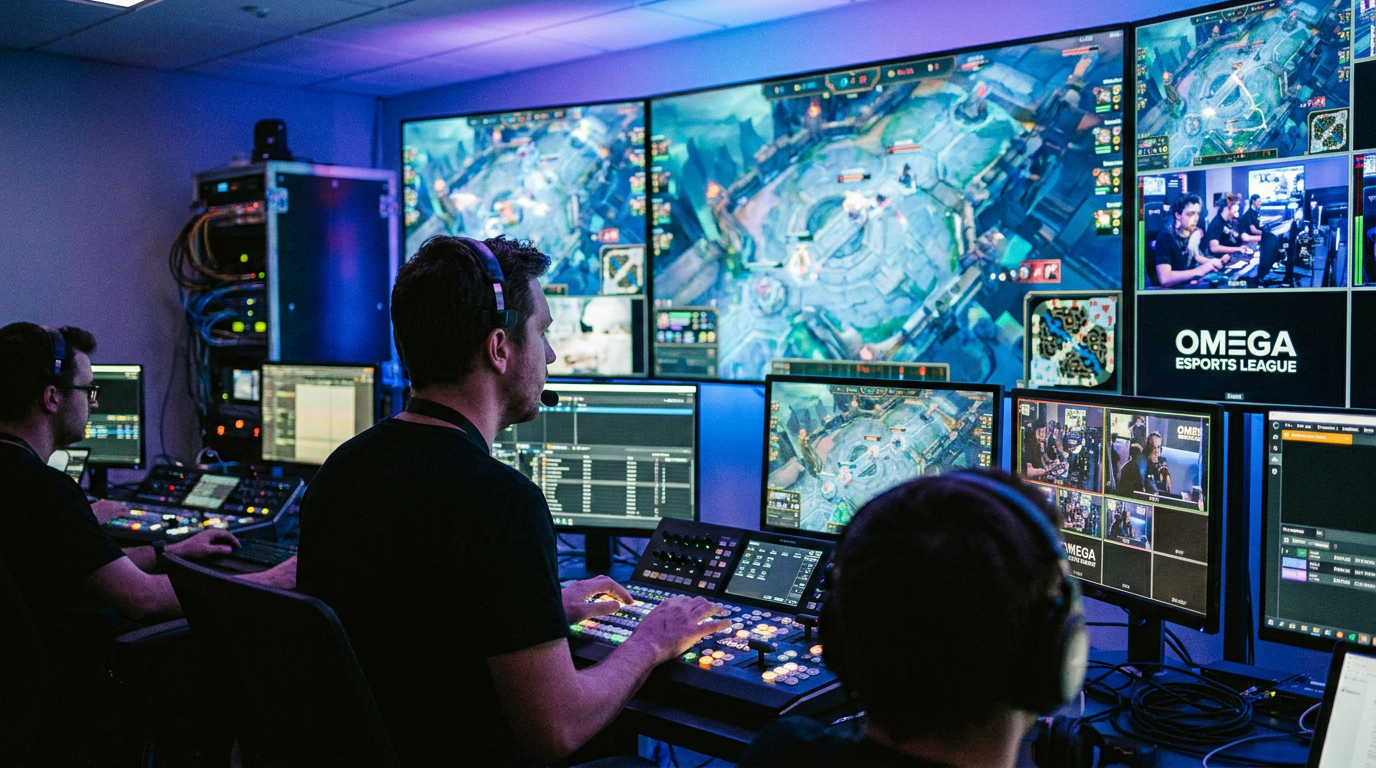
The physical environment of an observer is a high-pressure control room. They sit surrounded by monitors, communicating constantly with the broadcast's technical director and the on-air casters. A symbiotic relationship with the casters is essential; if the commentators are hyping up a specific player's strategy, the observer must instantly provide the visual evidence to back up that narrative, creating a unified experience for the audience.[3][5]
As the esports industry matures, the tools of the trade are evolving. The sheer cognitive load of tracking ten or more players has led to the development of AI-assisted observing software. Tools like Scout AI integrate directly into game engines, tracking real-time events—from economic shifts to positional changes—and automatically switching perspectives to capture the action.[4]
Academic researchers are also pushing the boundaries of automated broadcasting. A team at the Gwangju Institute of Science and Technology (GIST) recently developed an AI framework that uses object detection and human spectating data to identify the "region of common interest" (ROCI). By training neural networks on how human observers watch a game, the AI can predict the most exciting areas of the map and direct the camera accordingly.[2]

These AI tools are not expected to replace human observers at the highest levels of competition. Instead, they act as powerful co-pilots. Automation is particularly valuable for smaller, grassroots tournaments that cannot afford a dedicated production team, or for "B-streams" that run concurrently with main events. By handling the baseline camera work, AI democratizes access to professional-grade broadcasting.[2][4]
For top-tier events, however, the human element remains irreplaceable. AI can detect a high probability of an elimination, but it struggles to understand the emotional weight of a rivalry, the tension of a massive underdog making a desperate play, or the specific narrative a caster is trying to build. The art of observing lies in these intangible, deeply human judgments.[2][5]
Becoming a professional observer requires a unique blend of skills. It demands the mechanical understanding of a high-level player, the visual eye of a cinematographer, and the split-second decision-making of a live television director. Most professionals begin by volunteering for amateur leagues, mastering the spectator clients, and building a portfolio of seamless broadcasts.[3]
Ultimately, the greatest compliment an esports observer can receive is to go entirely unnoticed. When the camera glides perfectly into place, capturing the exact moment a championship is won, the audience simply cheers for the players. They don't see the frantic coordination, the predictive math, or the invisible director who made the moment possible—and for the observer, that means the job was done perfectly.[1][5]
How we got here
Early 2010s
Early esports broadcasts rely on casters manually controlling their own cameras while commentating.
2016–2018
The role of the dedicated 'observer' becomes standardized in major titles like CS:GO and League of Legends.
2019
Battle Royale esports push production limits, requiring massive teams of 6+ observers directed by a single in-game shot-caller.
2022
Researchers at GIST debut an AI framework capable of predicting the most exciting areas of a game map for spectators.
2024–2026
Commercial AI tools like Scout AI integrate into broadcast pipelines, automating baseline camera work for smaller events.
Viewpoints in depth
The Storytellers' View
Veteran observers prioritize narrative and emotional resonance over raw action.
For experienced in-game directors, observing is fundamentally an exercise in cinematic storytelling. They argue that a broadcast shouldn't just be a chaotic highlight reel of eliminations. Instead, it must build tension. By deliberately choosing to focus on a flanking player who hasn't fired a shot yet, an observer creates suspense for the audience. This camp believes that understanding player psychology and the overarching narrative of a tournament is a uniquely human skill that cannot be replicated by algorithms.
The Technologists' View
Engineers and developers see AI as the key to scaling broadcast quality.
Broadcast engineers and AI researchers view the immense cognitive load of observing—especially in 64-player Battle Royale games—as a problem ripe for automation. By training neural networks to identify 'Regions of Common Interest' (ROCI) and automatically switching cameras based on real-time game data, technologists aim to eliminate human error. They argue that AI co-pilots can democratize esports, allowing grassroots tournaments with zero budget to produce broadcasts that rival million-dollar studio productions.
What we don't know
- How fully automated AI observers will handle highly unorthodox or unpredictable player strategies that defy historical data.
- Whether major game developers will eventually build native, AI-driven cinematic director modes directly into their game engines for casual players.
Key terms
- Observer
- The in-game camera operator and director responsible for choosing which perspectives and action the audience sees during an esports broadcast.
- POV Camera
- Point-of-View camera; a spectator mode that shows exactly what a specific player is seeing on their own screen.
- Free-Cam
- A detached, cinematic camera mode that allows the observer to fly freely around the virtual environment to provide a macro view of the battlefield.
- Time-to-Kill (TTK)
- A metric describing how quickly a character can be eliminated in a game, which dictates how fast an observer must react to capture the action.
- Region of Common Interest (ROCI)
- An AI-driven metric that analyzes game state data to predict the most exciting area of the map for spectators to watch.
Frequently asked
What does an esports observer do?
An observer acts as the in-game camera director during an esports broadcast, controlling virtual cameras to capture the most important action and tell the story of the match.
Do observers play the game while broadcasting?
No, observers use specialized spectator software that allows them to fly around the map, view all players' perspectives, and access data the competitors cannot see.
Will AI replace human esports observers?
While AI tools are automating basic camera work for smaller tournaments, human observers remain essential for top-tier events to capture emotional narratives and complex storytelling.
Sources
Source coverage
5 outlets
3 viewpoints surfaced





[1]KotakuVeteran Observers
The Unsung Heroes of Esports Broadcasting
Read on Kotaku →[2]Esports InsiderBroadcast Technologists
South Korean researchers debut model for AI-powered esports observer
Read on Esports Insider →[3]Sports Video GroupVeteran Observers
Heather 'sapphiRe' Garozzo Offers Tips to Aspiring Esports Observers
Read on Sports Video Group →[4]LexogrineBroadcast Technologists
Scout AI: Automating the Observer Role
Read on Lexogrine →[5]Factlen Editorial TeamEsports Audiences
Synthesis by Factlen editorial team
Read on Factlen Editorial Team →
Every angle. Every day.
Get gaming esports stories with full source coverage and perspective breakdowns delivered to your inbox.