
The Rise of the Spatial Workspace: How Immersive Tech and Proximity Audio Are Curing Zoom Fatigue
As remote teams seek to eliminate the friction of traditional video conferencing, spatial computing and proximity audio are transforming the home office into an immersive, context-aware environment.
By Factlen Editorial Team
- Immersive Tech Advocates
- Believe spatial audio and VR restore the spontaneous collaboration and social presence lost in grid-based video calls.
- Async-First Proponents
- Argue that simulating a physical office digitally imports the worst aspects of synchronous work and interrupts deep focus.
- Enterprise IT Leaders
- Focus on the logistical, security, and data privacy challenges of deploying spatial mapping hardware in employees' homes.
- Accessibility Advocates
- Warn that expensive hardware and physiological barriers like eye strain could create a two-tiered remote workforce.
What's not represented
- · Hardware Supply Chain Workers
- · Optometrists and Vision Scientists
Why this matters
As remote work matures, the tools we use are shifting from flat, exhausting video grids to immersive, context-aware environments. Understanding spatial computing and proximity audio is crucial for professionals and managers looking to eliminate 'Zoom fatigue,' restore spontaneous collaboration, and navigate the next major hardware platform in enterprise technology.
Key points
- Spatial workspaces use proximity audio to mimic real-world acoustics, allowing spontaneous conversations without scheduling links.
- Data shows proximity chat can reduce formal meeting times by up to 82 percent by enabling quick, low-friction interactions.
- High-end spatial computing headsets provide an 'infinite canvas' for productivity, replacing physical monitors with massive digital displays.
- Critics warn that virtual offices recreate the interruptions of physical offices, undermining the benefits of asynchronous remote work.
By 2026, the global workforce has largely solved the logistical puzzle of remote work. Cloud infrastructure is robust, asynchronous workflows are documented, and the home office is fully equipped. Yet, one persistent psychological hurdle remains: the "presence" problem. Traditional grid-based video conferencing, while functional, strips away the spatial context and spontaneous micro-interactions that define human collaboration. The result is a highly scheduled, cognitively taxing environment where every conversation requires a calendar invite, a generated link, and the awkward choreography of muting and unmuting.
In response, a new paradigm is rapidly replacing the static video grid: the spatial workspace. Ranging from lightweight, browser-based 2D virtual offices to fully immersive mixed-reality headsets, these platforms are specifically designed to restore the physical dynamics of teamwork to distributed companies. At the core of this technological shift is a fundamental reimagining of how digital audio and visual interfaces operate. Developers are moving away from flat, universal broadcasting toward proximity-based, context-aware environments that respect the natural boundaries of human attention and interaction.
The foundational technology driving this transition is spatial audio, often implemented as "proximity chat." In a traditional video call, all participants share a single audio channel; if two people speak simultaneously, the software aggressively compresses the audio, resulting in a garbled collision. Spatial audio platforms map users onto a virtual floor plan. As a user's digital avatar navigates the space, the platform's audio engine dynamically adjusts the volume and directional panning of other users' voices based on their virtual distance.[2][3][4]
This mechanism mimics real-world acoustics. If you "walk" your avatar past a group of colleagues discussing a project, you hear their conversation faintly in the background. If you step closer, the audio clarifies and centers. This seemingly simple acoustic trick triggers the "cocktail party effect" in the human brain—the psychological ability to focus one's auditory attention on a particular stimulus while filtering out a range of other stimuli. It allows multiple distinct conversations to occur in the same digital room without interference.[4]

The operational impact of proximity audio is profound. By eliminating the friction of scheduling calls, teams can engage in spontaneous, low-stakes interactions. According to data from virtual office platform SoWork, teams utilizing spatial video and audio report an 82 percent improvement in meeting speed and a 41 percent reduction in formally scheduled sessions. The ability to simply "walk up to talk" removes the cognitive load of formalizing a conversation, allowing distributed teams to resolve minor blockers in seconds rather than waiting for a scheduled sync.[2]
While browser-based spatial audio solves the friction of communication, a parallel hardware revolution is solving the limitations of the physical screen. The spatial computing market, projected by Fortune Business Insights to surge from $225 billion in 2026 to over $1 trillion by 2034, is moving immersive headsets out of the gaming niche and into the enterprise workstation. Devices like the Apple Vision Pro and Meta Quest 4 are redefining what a remote desk looks like.[6]

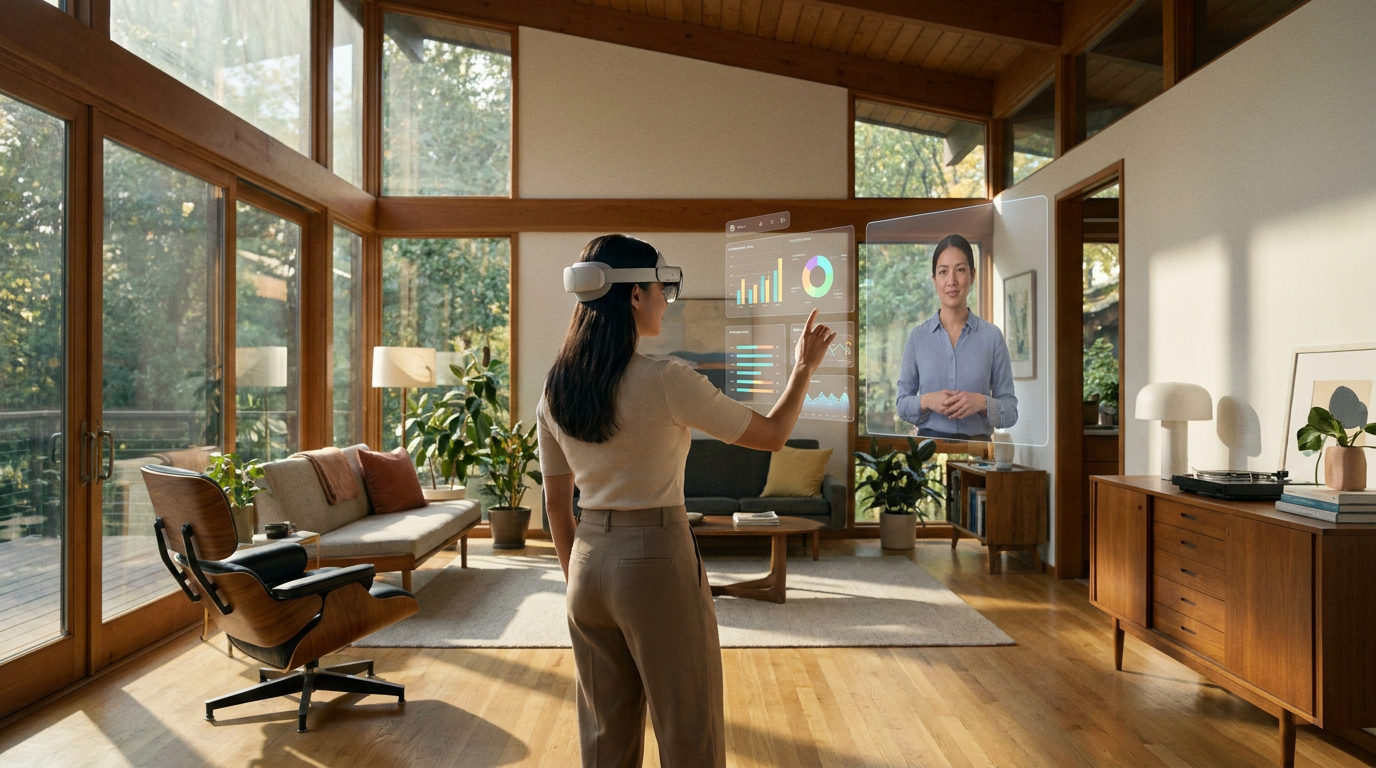
The primary productivity driver of spatial computing is the "infinite canvas." Rather than being constrained by a 14-inch laptop monitor or a dual-screen desk setup, remote workers can project a Mac Virtual Display or Android XR interface into their physical room. High-end micro-OLED displays, pushing over 23 million pixels, render text with the clarity of a printed book. Users can pin a massive architectural diagram to their living room wall, float a Slack channel above their coffee table, and keep a code editor hovering at eye level, drastically reducing the time lost to window-switching.[5][7]
High-end micro-OLED displays, pushing over 23 million pixels, render text with the clarity of a printed book.
Beyond individual productivity, spatial computing is tackling the uncanny valley of remote human connection. Meta's continued development of Codec Avatars utilizes advanced inside-out tracking—relying on sophisticated AI rather than handheld controllers—to predict and render hand movements and facial expressions in real time. These near-photorealistic digital twins allow remote workers to make genuine eye contact and read micro-expressions in virtual meetings, bridging the emotional gap that flat video feeds often create.[7]
The enterprise applications extend far beyond standard knowledge work. In sectors like manufacturing and healthcare, spatial computing is revolutionizing remote onboarding and training. Training Magazine reports that remote hires trained via immersive, hands-on spatial environments demonstrate an 80 percent knowledge retention rate one year post-training, alongside a 76 percent increase in training effectiveness compared to traditional slide-deck methods. A new technician in Ohio can don a headset and be guided through a complex machine repair by a senior engineer teleporting in from Germany, interacting with the same real-time 3D digital twin.[8]
Furthermore, these spatial environments are increasingly populated by non-human participants. Agentic AI bots are being integrated directly into virtual floor plans. In platforms like SoWork, AI assistants "sit" in the virtual office, automatically recording proximity-based meetings, summarizing key decisions, and extracting action items into a searchable library. These digital coworkers act as ambient administrative assistants, ensuring that the spontaneous conversations enabled by spatial audio are still documented for the broader team.[2]
Despite the technological marvels, the spatial workspace movement faces fierce ideological pushback. Proponents of the "async-first" work model argue that recreating the physical office in a digital space is a regressive step. They warn that virtual offices, complete with avatars and proximity chat, simply import the worst aspects of synchronous work—constant interruptions, presenteeism, and the pressure to "look busy"—into the remote environment. For async advocates, the goal of remote work is to decouple productivity from time and presence, not to simulate a 9-to-5 office in the metaverse.[1]
There are also significant physiological hurdles to widespread headset adoption. While hardware has become lighter, wearing a 500-gram computer on your face for an eight-hour workday induces "headset fatigue." The most persistent issue is the Vergence-Accommodation Conflict—a visual phenomenon where the eyes must focus on a screen inches away while converging on digital objects that appear distant. This sensory mismatch can cause severe digital eye strain and nausea, limiting the duration most employees can comfortably work in full spatial computing environments.[7]

Privacy and security present another massive challenge for enterprise IT. A spatial computer requires continuous, real-time mapping of its physical environment to function. It records the layout of an employee's home, the faces of their family members, and any physical documents on their desk. The "Privacy of Space" has emerged as a major legal and compliance battleground in 2026, with privacy advocates demanding hardware-level camera shutters and strict local-only processing to ensure corporate headsets do not become domestic surveillance tools.[7]
Finally, the economics of spatial computing threaten to create a two-tiered remote workforce. While browser-based 2D platforms are highly accessible, high-end mixed-reality headsets still command price tags well over $1,500. There is growing concern among labor advocates that employees without access to these advanced spatial layers—whether due to cost, bandwidth limitations, or physical discomfort—will be at a severe disadvantage in collaboration, visibility, and career advancement compared to their fully immersed peers.[7]
As 2026 progresses, the most successful remote organizations are adopting a hybrid approach to spatial technology. They are deploying accessible, browser-based proximity audio for daily team coordination and spontaneous chatter, while reserving high-end spatial computing headsets for deep, focused workstation tasks and high-stakes collaborative design. By blending the acoustic realism of spatial audio with the visual expansion of mixed reality, companies are finally moving beyond the grid, building remote environments that feel less like software and more like a shared place.[1]
How we got here
2020–2022
The mass adoption of grid-based video conferencing establishes the baseline for global remote work.
2023
Early 2D spatial workspaces gain traction for virtual networking, introducing proximity audio to the browser.
2024
Apple launches the Vision Pro, shifting the industry focus toward high-end spatial computing for enterprise productivity.
2025
AI-powered avatars and real-time meeting summaries are integrated into spatial platforms, automating administrative overhead.
2026
Spatial computing shifts from a novelty to a standard enterprise tool, driven by lighter headsets and advanced acoustic engines.
Viewpoints in depth
Immersive Tech Advocates
Argue that spatial audio and VR restore the spontaneous collaboration lost in grid-based video calls.
This camp, heavily populated by XR developers and virtual office platforms, believes that human collaboration is inherently spatial. They argue that the cognitive load of traditional video conferencing stems from its unnatural, flat acoustic environment. By reintroducing proximity, directional sound, and physical avatars, they claim teams can reclaim the 'watercooler' moments and rapid problem-solving that occur when friction is removed from communication.
Async-First Proponents
Argue that simulating a physical office digitally imports the worst aspects of synchronous work.
Advocates for asynchronous work view spatial virtual offices as a technological regression. They argue that the primary benefit of remote work is the ability to decouple productivity from presence, allowing employees to protect their time for deep, focused work. From this perspective, virtual avatars and proximity chat simply recreate the interruptions, presenteeism, and performative busyness of the physical office, forcing employees to 'look busy' in a digital metaverse rather than judging them purely on their output.
Enterprise IT & Security Leaders
Focus on the data privacy and compliance risks of deploying spatial mapping hardware.
For corporate IT departments, spatial computing introduces unprecedented security vulnerabilities. Because mixed-reality headsets require continuous, real-time mapping of their physical environment to function, they inadvertently record the interiors of employees' homes, family members, and potentially sensitive physical documents. This camp is pushing for strict hardware-level camera shutters, local-only processing, and robust compliance frameworks before allowing spatial computers to connect to enterprise networks.
Accessibility & Labor Advocates
Warn that expensive hardware and physiological barriers could create a two-tiered workforce.
This perspective highlights the physical and economic barriers to immersive tech. High-end headsets costing over $1,500 remain inaccessible to many, and physiological issues like the Vergence-Accommodation Conflict prevent a significant portion of the population from using them comfortably for extended periods. These advocates warn that if companies mandate spatial computing for high-stakes collaboration, it could inadvertently penalize employees who rely on accessible, browser-based tools, creating a divide in visibility and career advancement.
What we don't know
- Whether the cost of high-end mixed-reality headsets will drop fast enough to prevent a two-tiered remote workforce.
- How courts will rule on the 'Privacy of Space' regarding enterprise headsets mapping employees' private homes.
- If the physiological barriers of prolonged headset use, such as digital eye strain, can be fully engineered away.
Key terms
- Spatial Audio
- An audio processing technology that manipulates sound waves to make them appear as though they are coming from specific directions and distances.
- Spatial Computing
- The digitization of activities involving machines, people, and environments, often utilizing AR/VR headsets to blend digital content with the physical world.
- Vergence-Accommodation Conflict
- A visual phenomenon in VR headsets where the eyes must focus on a screen inches away while converging on digital objects that appear far away, leading to eye strain.
- Codec Avatars
- Highly realistic, AI-driven digital representations of users that capture and translate real-time facial expressions into a virtual environment.
- Proximity Chat
- A communication feature where a user's audio volume increases as their digital avatar moves closer to another user's avatar, and fades as they move away.
Frequently asked
Do I need a VR headset to use spatial audio workspaces?
No. Many spatial workspaces operate entirely within a standard web browser, using 2D maps and your computer's headphones to simulate proximity audio without requiring immersive hardware.
How does spatial computing improve productivity compared to a laptop?
High-end headsets provide an "infinite canvas," allowing users to arrange multiple massive virtual displays around them, which drastically reduces the time lost to constantly switching tabs and windows.
Is it safe for companies to use spatial computers at home?
It introduces new privacy challenges. Because spatial computers constantly map their physical surroundings to function, enterprise IT departments must implement strict data-handling policies to ensure home environments aren't improperly recorded.
Sources
Source coverage
8 outlets
4 viewpoints surfaced








[1]Factlen Editorial TeamAsync-First Proponents
Synthesis by Factlen editorial team
Read on Factlen Editorial Team →[2]SoWorkImmersive Tech Advocates
Spatial Collaboration and Virtual Office Design
Read on SoWork →[3]SpatialChatAccessibility Advocates
Immersive Virtual Environments and Natural Networking
Read on SpatialChat →[4]RemoAccessibility Advocates
How Spatial Audio Works in Virtual Offices
Read on Remo →[5]KinemericImmersive Tech Advocates
Spatial Computing in 2026: From 'Wow' to 'Work'
Read on Kinemeric →[6]Fortune Business InsightsEnterprise IT Leaders
Global Spatial Computing Market Size and Forecast 2026
Read on Fortune Business Insights →[7]TechVeritasImmersive Tech Advocates
Spatial Computing 2026: The Precision Revolution
Read on TechVeritas →[8]Training MagazineImmersive Tech Advocates
Enhancing Remote Hires Through Spatial Computing
Read on Training Magazine →
Every angle. Every day.
Get careers work stories with full source coverage and perspective breakdowns delivered to your inbox.