
Evidence Pack: Does Ranked-Choice Voting Actually Reduce Political Polarization?
As ranked-choice voting spreads across the U.S., researchers are analyzing decades of election data to determine if the system truly reduces polarization, boosts turnout, and improves representation.
By Factlen Editorial Team
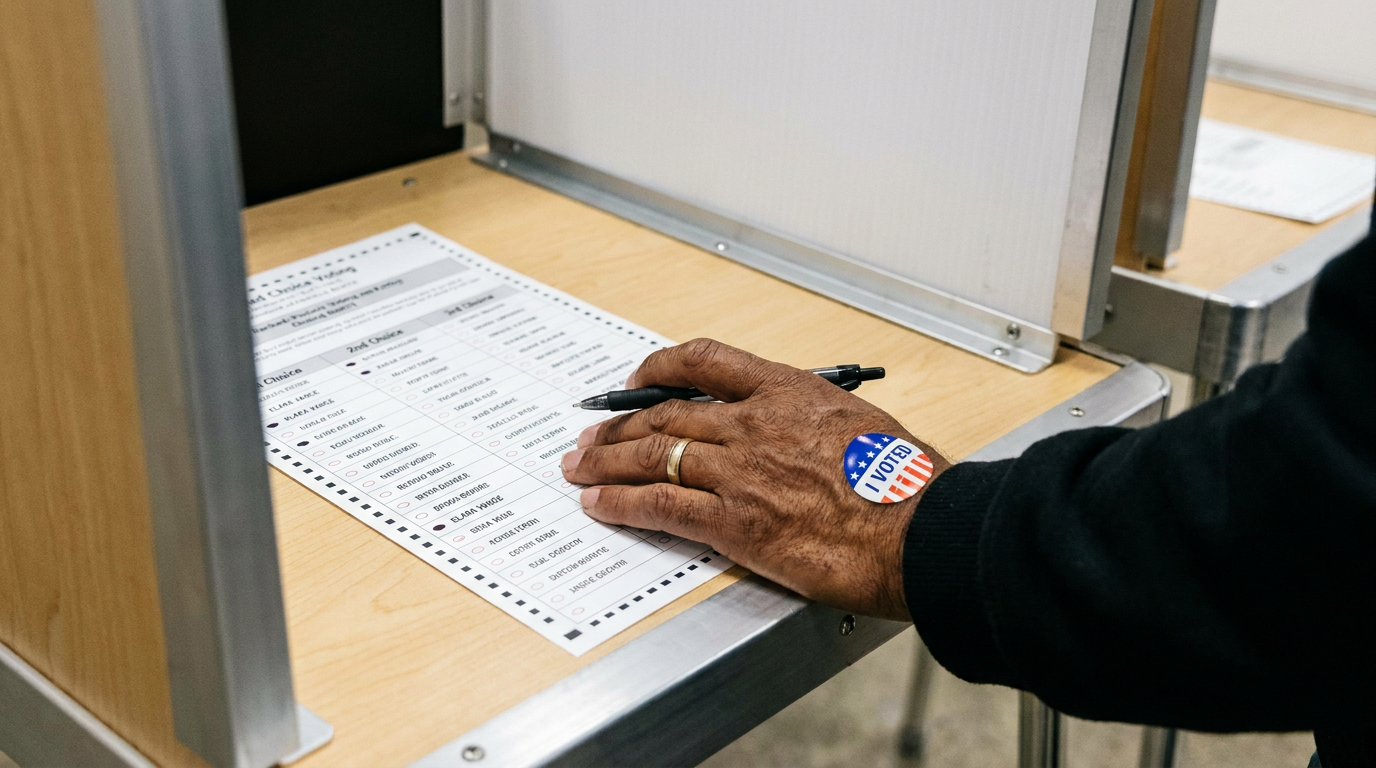
- Electoral Reform Advocates
- Argue that RCV eliminates the spoiler effect, boosts campaign civility, and ensures winners have majority support.
- System Skeptics
- Argue that RCV is overly complex, leads to discarded ballots, and fails to deliver on promises of reduced polarization.
- Academic Researchers
- Emphasize that while RCV improves representation, its effects on broad polarization are marginal and highly context-dependent.
What's not represented
- · Local Election Administrators
- · Third-Party Candidates
Why this matters
As dissatisfaction with the two-party system grows, ranked-choice voting is being pitched as the ultimate fix for American democracy. Understanding whether the data actually supports these claims is crucial for voters who are increasingly being asked to approve or ban the system at the ballot box.
Key points
- Ranked-choice voting requires a candidate to secure 50 percent of the vote through an instant-runoff process.
- Proponents argue the system reduces negative campaigning, though evidence suggests this effect is minimal in highly polarized areas.
- Studies show RCV increases youth voter turnout by roughly nine percentage points due to increased campaign outreach.
- Critics warn of 'ballot exhaustion,' where voters who fail to rank multiple candidates have their votes discarded in later rounds.
- Data consistently shows the system improves the electoral success of women and candidates of color.
- Despite its mechanical neutrality, RCV has become a highly partisan issue, with 17 states enacting legislative bans.
The American electoral system is undergoing its most significant mechanical shift in a century. Ranked-choice voting, a system that allows citizens to list candidates in order of preference rather than choosing just one, has expanded from a niche municipal experiment to a statewide reality in places like Alaska and Maine. For decades, the traditional plurality system—where the candidate with the most votes wins, regardless of whether they secure a majority—has been the unquestioned standard. But as political polarization deepens and dissatisfaction with the two-party system grows, reformers have pushed ranked-choice voting as a structural antidote to electoral dysfunction.[3][7]
Yet the reform is facing fierce political headwinds across the country. By 2026, seventeen states have enacted legislative bans against the use of ranked-choice voting, and voters in several states recently rejected ballot measures to adopt it. The debate over the system is often clouded by intense partisan rhetoric, with proponents hailing it as a necessary cure for political toxicity and critics dismissing it as a confusing, disenfranchising gimmick that complicates the simple act of casting a ballot. This backlash has forced election administrators and civic organizations to defend the mechanics of the system in increasingly hostile political environments.[2]
To separate hope from hype, political scientists, legal researchers, and election watchdogs have begun compiling hard data on how ranked-choice voting actually performs in the wild. Instead of relying on theoretical models, these researchers are analyzing decades of municipal election data and recent statewide contests to measure the true impact of the system. This evidence pack examines the academic consensus on three core claims surrounding the reform: its impact on political polarization, its effect on overall voter turnout, and its ability to improve diverse representation in government.[7]
Before evaluating the academic claims, it is essential to understand the underlying mechanics of the system. Under ranked-choice voting, citizens receive a ballot that allows them to rank candidates as their first, second, third, and sometimes fourth choices, rather than being forced to select a single name. When the polls close, election officials tally all the first-choice votes. If a single candidate secures more than 50 percent of those first-choice votes, the election is immediately over, and that candidate is declared the outright winner, just as they would be in a traditional election.[7]
However, if no candidate crosses the 50 percent threshold in that initial tally, the system triggers an automatic instant runoff. The candidate who received the fewest first-choice votes is eliminated from the race entirely. Crucially, the ballots of the voters who chose that eliminated candidate as their top pick are not discarded; instead, those specific votes are transferred to the candidates those voters marked as their second choices. This ensures that a voter's voice still matters even if their favorite candidate fails to gain traction.[7]
This process of elimination and redistribution repeats round by round until one candidate finally secures a majority of the active votes. The mechanical goal of this instant runoff is to ensure that the ultimate winner possesses broad, if not always enthusiastic, support from the electorate. Theoretically, this eliminates the frustrating scenario where a deeply unpopular candidate wins a crowded, multi-candidate field with a mere 35 percent plurality simply because the majority opposition was split among several similar alternatives.[7]
The first major claim made by proponents is that ranked-choice voting reduces negative campaigning and cools the temperature of political polarization. The theory suggests that because candidates need to secure second-choice votes from their opponents' supporters to survive the later rounds of counting, they are heavily disincentivized from launching scorched-earth, negative attacks. If a candidate alienates a rival's base through toxic rhetoric, they risk being left off those voters' ballots entirely, effectively dooming their chances in a tight instant runoff scenario.[4]

The evidence supporting this claim is mixed but leans positive in specific contexts. A 2025 report by the American Bar Association found that the system encourages greater consensus-building and more civil political campaigns, particularly in local municipal elections where candidates often cross-endorse each other to build winning coalitions. Furthermore, the Lugar Center for Bipartisanship recently ranked the congressional delegations from Alaska and Maine—the two states using the system for federal elections—as the most bipartisan in the nation, suggesting the electoral mechanics reward cooperation.[1][4]
The evidence supporting this claim is mixed but leans positive in specific contexts.
However, other researchers caution against viewing the system as a panacea for polarization. A 2024 review noted that in locales that are already deeply polarized along partisan lines, the impact on campaign civility was minimal. A study by the Humphrey School of Public Affairs also concluded that ranked-choice voting fails to significantly reduce the broader, entrenched polarization of the major political parties, suggesting that mechanical tweaks to a ballot cannot easily override deep cultural divides or the influence of nationalized political media.[3][6]
The second major claim is that ranked-choice voting increases overall voter turnout. Proponents argue that by eliminating the "spoiler effect"—the fear that voting for a third-party candidate will inadvertently help a voter's least favorite candidate win—the system empowers citizens to vote their conscience. By removing the strategic anxiety of wasting a vote, advocates believe the system draws more disillusioned and independent voters to the polls who might otherwise stay home during a traditional plurality election. This theoretical boost is a major selling point for civic organizations.[4]
Research from the University of Iowa supports this dynamic, finding significant and substantially higher probabilities of turnout in places that use the ranked system. The study attributes this increase not just to voter enthusiasm, but to heightened direct voter contact. Because campaigns are forced to reach out to a wider swath of the electorate to secure crucial down-ballot rankings, they end up mobilizing voters who are typically ignored by traditional get-out-the-vote operations that focus solely on a narrow partisan base.[5]
Youth turnout appears to see a particularly notable bump under the new system. Multiple studies indicate that younger voters are roughly nine percentage points more likely to cast a ballot in cities utilizing ranked-choice voting compared to traditional plurality cities. Researchers attribute this surge to the increased viability of alternative and independent candidates, which resonates strongly with younger demographics who are increasingly dissatisfied with the binary choices offered by the two major political parties. This demographic shift could have long-term implications for local policy.[1][5]
The counter-argument regarding turnout centers on the phenomenon of "ballot exhaustion" and voter error. Researchers at the University of Pennsylvania found that voters make significantly more mistakes on ranked ballots, increasing the risk of invalidation. If a voter only ranks one candidate who is subsequently eliminated early in the tally, their ballot is "exhausted" and does not factor into the final, decisive round. Critics argue this dynamic can artificially depress the effective turnout of the election, particularly among lower-information voters who may find the ranking process overly complex.[3][6]
The third major claim—that ranked-choice voting increases diverse representation—is where the academic evidence is most robust. Traditional plurality voting often penalizes candidates of color or women who run against each other by splitting a shared demographic base. This vote-splitting frequently allows a less representative, establishment candidate to win with a narrow plurality simply because the opposition was divided among multiple diverse challengers. Ranked-choice voting was designed specifically to mitigate this exact structural disadvantage. By allowing voters to rank multiple diverse candidates, the system consolidates minority support.[1][4]

Data compiled by electoral researchers demonstrates that candidates of color consistently gain more votes in the round-by-round counting process. Because voters can rank multiple candidates from similar backgrounds, these candidates pay no penalty when competing against others of the same racial or ethnic group. This consensus-building mechanism has led to demonstrably more diverse city councils and mayoral offices in jurisdictions that have adopted the reform, providing a clear, measurable victory for advocates of proportional representation. This effect is particularly pronounced in crowded primary elections.[4]
Despite its intended neutrality, the implementation of ranked-choice voting has become highly polarized in its own right. A 2025 study from the University of Illinois revealed a near-linear correlation between Republican vote share and opposition to ballot measures proposing the system. As the reform gained traction, conservative lawmakers framed it as a confusing scheme designed to undermine traditional election integrity, leading to the wave of preemptive legislative bans across red states. This partisan sorting has complicated efforts to expand the system nationally.[2]
Yet, the reform also faces skepticism from the left; the same University of Illinois study noted that ranked-choice voting consistently underperformed expectations even in heavily Democratic-leaning areas. This suggests a broader, bipartisan voter hesitance toward overhauling the fundamental mechanics of how Americans cast their ballots. Voters across the political spectrum often express a preference for the simplicity of the traditional system, even if they acknowledge its structural flaws and tendency to produce unrepresentative outcomes. Change is inherently difficult to sell at the ballot box.[2]
Ultimately, the aggregated data suggests that ranked-choice voting is a powerful mechanical tweak rather than a democratic magic wand. It demonstrably improves diverse representation and alters local campaign incentives, but it requires massive voter education to prevent ballot exhaustion and cannot single-handedly erase decades of entrenched political polarization. As more jurisdictions experiment with the system, the debate will increasingly rely on this emerging empirical record rather than the theoretical promises and partisan fears that have defined the conversation thus far.[7]

How we got here
2004
San Francisco implements RCV for municipal elections, sparking modern adoption.
2016
Maine becomes the first state to adopt RCV for statewide and federal elections.
2020
Alaska voters approve a top-four primary system combined with an RCV general election.
2024-2026
A partisan backlash results in 17 states passing legislative bans on the use of RCV.
Viewpoints in depth
Electoral Reform Advocates
Advocates see RCV as a necessary structural fix to a broken plurality system.
Proponents argue that the traditional 'first-past-the-post' system forces voters to choose between the lesser of two evils, stifling competition and empowering extremes. By allowing voters to rank their preferences, advocates contend that RCV eliminates the 'spoiler effect' of third-party candidates. Furthermore, they point to data showing that candidates of color and women perform better under RCV, as they no longer split the vote of a shared demographic base.
System Skeptics
Critics argue the system is a confusing gimmick that disenfranchises voters.
Skeptics point to the phenomenon of 'ballot exhaustion,' where voters who do not rank every candidate risk having their ballots discarded in later rounds. They argue this disproportionately affects low-information voters and can artificially depress effective turnout. Furthermore, critics highlight that despite promises of increased civility, RCV has not demonstrably cooled the partisan temperature in deeply divided electorates, viewing it as a mechanical distraction from deeper cultural divides.
Academic Researchers
Researchers view RCV as a mechanical tweak with nuanced, context-dependent outcomes.
Political scientists emphasize that RCV is not a magic wand. While data confirms it alters campaign incentives—encouraging candidates to seek second-choice votes—its impact on systemic polarization is marginal. Researchers note that the success of RCV heavily depends on robust voter education campaigns. Without them, the complexity of the ballot can lead to higher error rates, offsetting the theoretical benefits of broader representation.
What we don't know
- Whether the bipartisan behavior seen in Alaska and Maine's congressional delegations is a direct result of RCV or unique state cultures.
- How RCV would perform in a highly polarized, high-turnout national presidential election.
- Whether the high rate of ballot exhaustion among low-information voters decreases over time as the electorate becomes more familiar with the system.
Key terms
- Ranked-Choice Voting (RCV)
- An electoral system where voters rank candidates by preference rather than selecting just one.
- Ballot Exhaustion
- When a ballot does not count in the final tally because all the candidates ranked by the voter have been eliminated.
- Spoiler Effect
- When a third-party candidate draws votes away from a major candidate with similar views, unintentionally helping their mutual opponent win.
- Plurality Voting
- The traditional system where the candidate with the most votes wins, even if they do not secure a majority.
- Instant Runoff
- The process in RCV where the lowest-performing candidate is eliminated and their votes are redistributed until someone reaches 50 percent.
Frequently asked
What happens if I only rank one candidate?
Your vote will count for that candidate in the first round. If they are eliminated, your ballot becomes 'exhausted' and will not transfer to anyone else in subsequent rounds.
Does ranked-choice voting favor one political party?
Academic studies show RCV does not inherently favor Democrats or Republicans. However, it has recently become a polarized issue, with Republican-led states banning the practice.
Has ranked-choice voting ever been repealed?
Yes. While many cities have adopted it, some jurisdictions, including several states in 2024, have voted to repeal or ban the system after initial implementation.
Sources
Source coverage
7 outlets
3 viewpoints surfaced







[1]American Bar AssociationElectoral Reform Advocates
Can Ranked Choice Voting Enhance American Democracy?
Read on American Bar Association →[2]University of IllinoisAcademic Researchers
Ranked-Choice Voting: What is It and Who Likes It?
Read on University of Illinois →[3]The Washington PostSystem Skeptics
Why not give ranked-choice voting a try?
Read on The Washington Post →[4]FairVoteElectoral Reform Advocates
Data on Ranked Choice Voting
Read on FairVote →[5]University of IowaAcademic Researchers
Does ranked choice Voting Increase voter turnout and mobilization?
Read on University of Iowa →[6]Freedom Foundation of MinnesotaSystem Skeptics
Fact Check: Ranked Choice Voting 'Fails' to Live up to Hype
Read on Freedom Foundation of Minnesota →[7]Factlen Editorial TeamAcademic Researchers
Synthesis by Factlen editorial team
Read on Factlen Editorial Team →
More in news politics
See all 7 stories →Election Integrity
Evidence Pack: The Real Impact of AI Deepfakes on Recent Global Elections
6 sources

Second Amendment
Supreme Court Narrows Federal Law Banning Drug Users From Owning Guns
8 sources
Second Amendment
Supreme Court Unanimously Narrows Federal Gun Ban for Drug Users
8 sources
US-Iran Pact
US and Iran Sign 14-Point Memorandum to End 110-Day War and Reopen Strait of Hormuz
8 sources
Every angle. Every day.
Get news politics stories with full source coverage and perspective breakdowns delivered to your inbox.