
Best Fitness Trackers of 2026: Apple Watch vs. Garmin vs. Oura Ring
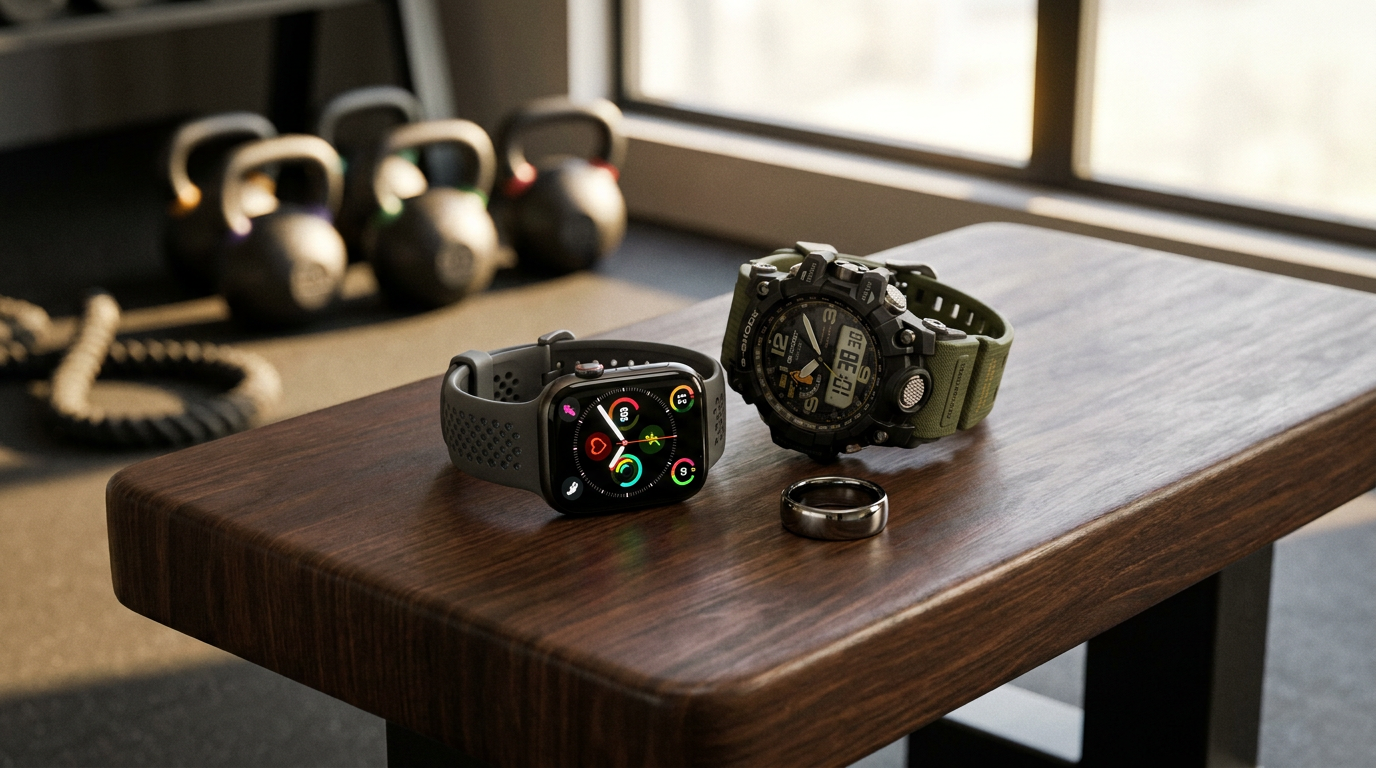
The 2026 fitness wearable market has fractured into three distinct paradigms: the all-in-one smartwatch, the dedicated performance tracker, and the screenless recovery ring. We compare the Apple Watch Series 11, Garmin Venu 4, and Oura Ring 4 to determine which device fits your specific training needs.
By Factlen Editorial Team
- Smartwatch Generalists
- Prioritize seamless smartphone integration, third-party apps, and real-time connectivity over multi-day battery life.
- Performance Athletes
- Value deep training metrics, physical durability, and long battery life without recurring subscription fees.
- Recovery Optimizers
- Prefer unobtrusive, screenless designs that focus on sleep tracking, stress management, and 24/7 wearability.
What's not represented
- · Budget-conscious consumers seeking sub-$50 trackers
- · Users with visual impairments navigating screen-heavy interfaces
Why this matters
Choosing the right fitness tracker dictates whether you actually wear it consistently enough to improve your health. Understanding the trade-offs between battery life, subscription costs, and form factor prevents expensive buyer's remorse.
Key points
- The Apple Watch Series 11 offers the most accurate heart rate tracking but requires daily charging.
- The Garmin Venu 4 provides up to 14 days of battery life and deep performance metrics without a subscription.
- The Oura Ring 4 excels in unobtrusive sleep tracking but requires a monthly fee for full data access.
- Choosing a tracker depends entirely on whether a user prioritizes smart features, battery life, or screenless comfort.
The fitness tracker market in 2026 has evolved far beyond simple step-counters and basic calorie estimators. Today's wearables are sophisticated health computers capable of detecting atrial fibrillation, measuring blood oxygen saturation, and using artificial intelligence to prescribe daily workout loads based on overnight recovery. However, as the underlying technology has matured, the market has fractured into three distinct paradigms. Consumers are no longer choosing between slightly different rubber bands; they are choosing between entirely different philosophies of health tracking and digital engagement.
These three philosophies are best represented by the market's current leaders, each dominating a specific niche. The Apple Watch Series 11 champions the all-in-one smartwatch approach, integrating fitness seamlessly into a broader digital life. The Garmin Venu 4 represents the dedicated performance tracker, prioritizing deep athletic metrics, physical durability, and battery longevity. Finally, the Oura Ring 4 leads the screenless recovery movement, appealing to users who want 24/7 physiological data without the distraction of another glowing display. Understanding the specific trade-offs of each paradigm is essential for finding a device that will actually be worn consistently.
When evaluating the Apple Watch Series 11, the primary argument for its adoption is its unparalleled integration into the iOS ecosystem and its sheer sensor accuracy. For iPhone users, it functions as a frictionless extension of their digital lives, handling phone calls, text messages, mobile payments, and third-party applications with ease. Furthermore, its optical heart rate sensor array remains the industry gold standard for wrist-based wearables, providing medical-grade insights that rival dedicated chest straps during steady-state cardiovascular exercise. The device actively rewards users for closing their daily activity rings, gamifying movement in a way that has proven highly effective for general population fitness.[1]
The argument against the Apple Watch Series 11 centers entirely on its battery life and its potential for digital distraction. Because it powers a bright, high-refresh-rate AMOLED display and maintains constant communication with a smartphone, it remains tethered to a daily charging cycle. For users trying to disconnect during their workouts, the constant influx of emails, calendar alerts, and text notifications can also detract from the mental benefits of exercise. The watch demands attention, which runs counter to the needs of athletes who prefer to focus solely on their physical exertion.

Evidence from recent testing quantifies this specific trade-off. During rigorous laboratory evaluations conducted by CNET, the Apple Watch Series 11 demonstrated the lowest average heart rate error of just 0.98 percent when compared to a clinical-grade chest strap. However, its battery life still hovers between 18 and 36 hours depending on GPS usage. This limitation makes continuous sleep tracking cumbersome, as users must intentionally find time to charge the device during the day—often while showering or working at a desk—to ensure it survives the night without dying.[1]
Ultimately, the Apple Watch Series 11 fits well when a user wants a full-fledged smartwatch, already owns an iPhone, and values medical-grade heart rate accuracy above all else. It serves as the ultimate generalist device for those who view fitness as one component of a highly connected lifestyle. However, it does not fit when a user requires multi-day battery life for wilderness excursions, uses an Android smartphone, or actively wishes to reduce their daily screen time and digital interruptions.
For the Garmin Venu 4, the primary argument for its selection is its robust battery life and its deep, subscription-free athletic metrics. Garmin has built its reputation on serving serious athletes, and the Venu 4 brings high-end features like multi-band GPS and a proprietary Training Readiness score into a sleek, stainless-steel chassis. It provides a wealth of actionable recovery data, including detailed sleep architecture and heart rate variability trends, without hiding any of these crucial insights behind a monthly paywall.[2]
For the Garmin Venu 4, the primary argument for its selection is its robust battery life and its deep, subscription-free athletic metrics.
The argument against the Garmin Venu 4 focuses on its smartwatch limitations and its interface complexity. While it handles basic smartphone notifications and offline music playback, it lacks the deep third-party app ecosystem and seamless voice assistant integration found in Apple or Google devices. Additionally, the sheer volume of data presented in the Garmin Connect application can be overwhelming for casual users who simply want to know if they moved enough that day, rather than analyzing their precise aerobic load and VO2 max trends.
Evidence from Forbes Vetted testing highlights the Garmin Venu 4's strengths as a dedicated fitness tool. Reviewers praised its ability to last up to 14 days on a single charge in smartwatch mode, a massive advantage over daily-charge competitors. Furthermore, its advanced metrics, such as body battery and workout recovery times, were found to be highly accurate for runners and triathletes who need to carefully manage their training volume to prevent overtraining and injury. The inclusion of a triathlon mode further cements its status as a serious athletic companion rather than a casual lifestyle accessory.[2]

The Garmin Venu 4 fits well when a user is a dedicated runner, cyclist, or triathlete who needs reliable GPS tracking, long battery life, and deep performance data without recurring fees. It is the ideal choice for those who view their wearable primarily as a sports instrument designed to optimize physical output. Conversely, it does not fit when a user prioritizes smart features like on-wrist texting, seamless smart home control, or a minimalist aesthetic that blends perfectly with formal attire. It remains, at its core, a piece of athletic equipment.
Turning to the Oura Ring 4, the primary argument for its adoption is its unobtrusive, screenless design and its supremacy in sleep tracking. By moving the optical sensors from the wrist to the finger, Oura captures highly accurate pulse and temperature data while remaining comfortable enough to wear 24 hours a day. It is designed to fade entirely into the background, collecting physiological data silently and presenting it only when the user actively chooses to open the companion smartphone application.[3][5]
The argument against the Oura Ring 4 is twofold: its reliance on a mandatory subscription model and its lack of real-time workout feedback. Users must pay a monthly fee to access their detailed health insights, which significantly increases the long-term cost of ownership over several years. Furthermore, because it lacks a screen or haptic pacing alerts, users cannot check their heart rate, distance, or pace mid-run, making it fundamentally less useful for active interval training or live performance monitoring.

Evidence from NBC News and Garage Gym Reviews confirms the Oura Ring 4's specialized role in the wearable ecosystem. Testers noted that its battery lasts up to eight days, and its updated software features automatic heart rate monitoring for over 40 different activities. However, reviewers consistently highlighted that while it excels at measuring sleep stages, blood oxygen, and daytime stress, it requires users to pull out their phones to view any actionable data during a workout, which breaks the flow of exercise.[3][4][5]
The Oura Ring 4 fits well when a user prioritizes sleep and recovery tracking, prefers wearing traditional mechanical watches on their wrist, and wants comprehensive health data without the distraction of a glowing screen. It is the ultimate passive monitoring tool. It does not fit when a user needs real-time pacing data during runs, heavily engages in barbell strength training where a metal ring might be uncomfortable or prone to scratching, or strongly opposes paying ongoing subscription fees for their own health data.
Choosing the best fitness tracker in 2026 is no longer about finding the single most advanced piece of hardware; it is about matching the device's philosophy to your daily habits. Whether you need the connected convenience of the Apple Watch, the relentless endurance of the Garmin Venu 4, or the silent observation of the Oura Ring 4, the ideal choice is the one that seamlessly integrates into your specific lifestyle. By honestly assessing your tolerance for daily charging, subscription fees, and screen time, you can select a wearable that actively enhances your health journey rather than becoming another discarded gadget.[6]
How we got here
2015
The original Apple Watch launches, shifting the market from simple step-counters to full smartwatches.
2021
Subscription models become mainstream in fitness wearables, led by Whoop and Oura.
2024
Smart rings gain mass adoption as consumers seek screenless alternatives for sleep tracking.
2026
AI-driven coaching and automatic activity detection become standard features across premium devices.
Viewpoints in depth
Smartwatch Generalists
Users who view fitness tracking as one feature within a broader digital ecosystem.
This camp argues that the best fitness tracker is the one you already wear for other reasons. By integrating health sensors into a device that also handles mobile payments, text messages, and smart home controls, companies like Apple ensure the device is never left on the nightstand. They accept the trade-off of daily charging because the utility of the device extends far beyond the gym.
Performance Athletes
Users who prioritize deep athletic metrics and battery longevity over smart features.
For serious runners, cyclists, and triathletes, a fitness tracker is a dedicated tool, not a smartphone extension. This camp values physical buttons that work with sweaty hands, multi-band GPS that doesn't drop in dense forests, and battery life that can survive a 100-mile ultramarathon. They often view smartwatch features as unnecessary distractions that drain battery life and detract from the focus required for high-level training.
Recovery Optimizers
Users who focus on sleep, stress, and 24/7 wearability without screen fatigue.
This growing segment believes that recovery is just as important as the workout itself. They advocate for screenless devices like smart rings or minimalist bands that track heart rate variability and sleep stages without bombarding the user with notifications. Their primary goal is to gather continuous, high-quality health data while maintaining the aesthetic freedom to wear traditional mechanical watches or no wristwear at all.
What we don't know
- Whether upcoming software updates will successfully bridge the gap between dedicated performance trackers and general smartwatches.
- How the long-term battery degradation of smart rings compares to traditional wrist-based trackers over a multi-year lifespan.
Key terms
- HRV (Heart Rate Variability)
- The variation in time between consecutive heartbeats, used as a primary metric to measure physical recovery and stress.
- AMOLED Display
- A type of screen technology that offers deep blacks and vibrant colors, commonly used in premium smartwatches.
- Training Readiness Score
- An aggregate metric that combines sleep, recovery, and recent activity data to advise how hard you should exercise on a given day.
Frequently asked
Do I need a subscription to use these fitness trackers?
The Apple Watch and Garmin Venu 4 do not require ongoing subscriptions for their core features. The Oura Ring 4 requires a monthly membership to access detailed health insights.
Which tracker is the most accurate for heart rate?
In clinical-style testing, the Apple Watch Series 11 demonstrated the lowest error rate compared to a chest strap, though Garmin and Oura are highly accurate for steady-state cardio.
Can I wear the Oura Ring while lifting weights?
While the Oura Ring is durable, many users find it uncomfortable or prone to scratching when gripping heavy metal barbells, making wrist-based trackers preferable for heavy strength training.
Sources
Source coverage
6 outlets
3 viewpoints surfaced






[1]CNETSmartwatch Generalists
The Best Fitness Trackers of 2026 for Every Type of Workout
Read on CNET →[2]Forbes VettedPerformance Athletes
Best Fitness Trackers 2026 | Trainer Tested
Read on Forbes Vetted →[3]NBC NewsSmartwatch Generalists
The 7 Best Fitness Trackers of 2026, Tested and Reviewed
Read on NBC News →[4]Garage Gym ReviewsRecovery Optimizers
The 13 Best Fitness Trackers, Tested by Trainers (2026)
Read on Garage Gym Reviews →[5]Men's HealthRecovery Optimizers
The 9 Best Fitness Trackers, Tested By Our Fitness and Tech Experts
Read on Men's Health →[6]TechRadarPerformance Athletes
Best fitness trackers 2026: Apple Watch, Fitbit, Samsung and more
Read on TechRadar →


Every angle. Every day.
Get guides stories with full source coverage and perspective breakdowns delivered to your inbox.