
2026 Rivian R2 vs. Tesla Model Y: The Ultimate Mid-Size EV Comparison
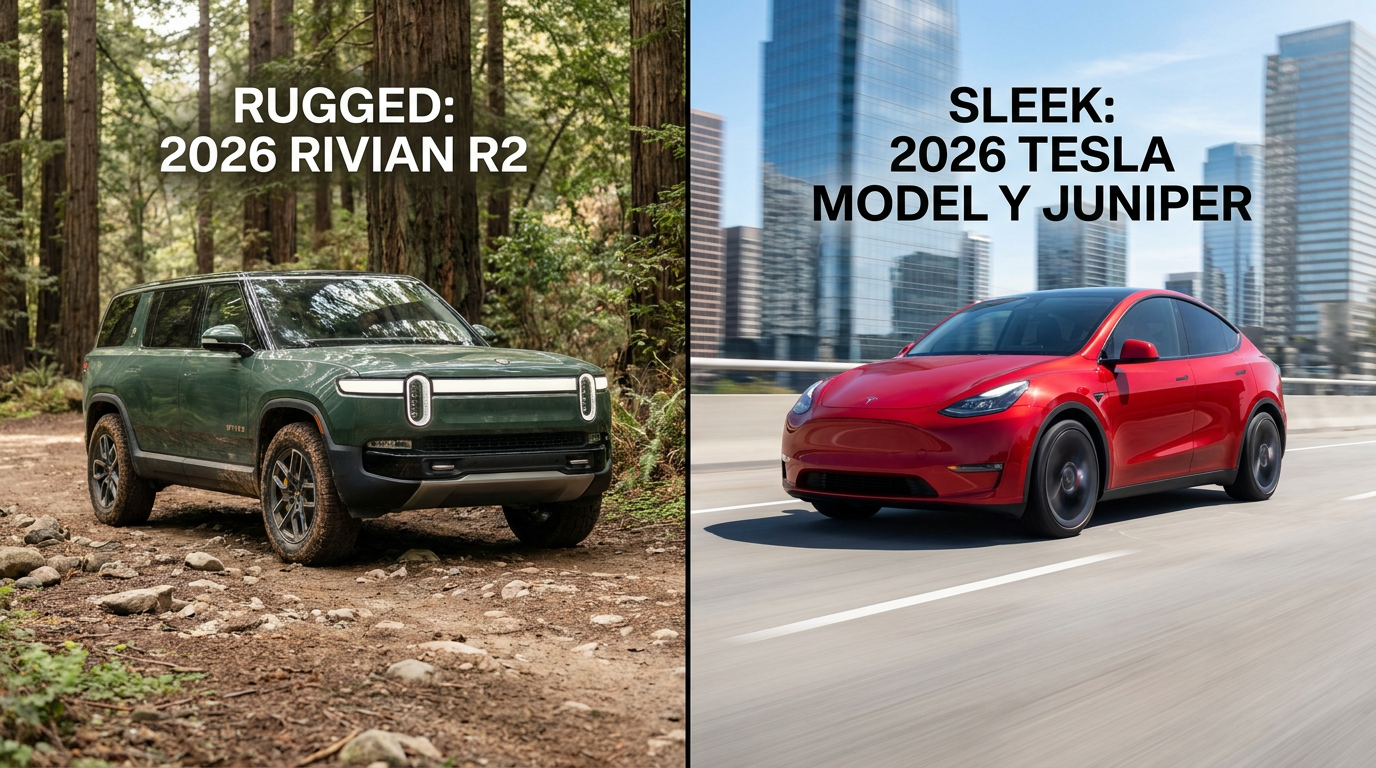
The all-new Rivian R2 and the refreshed Tesla Model Y 'Juniper' face off in a battle of rugged utility versus aerodynamic efficiency.
By Factlen Editorial Team
- Adventure & Utility Focus
- Prioritizes off-road capability, cargo volume, and rugged design.
- Efficiency & Tech Focus
- Values maximum driving range, aerodynamic design, and software features.
- Value & Commuter Focus
- Focuses on the lowest cost of entry and daily driving comfort.
What's not represented
- · Traditional legacy automakers currently losing market share to these two EV startups.
- · Buyers requiring three rows of seating, as the R2 is strictly a five-seater.
Why this matters
The mid-size electric SUV segment is the most popular vehicle category in the world. For the first time, buyers have a genuine choice between the reigning aerodynamic champion and a rugged, adventure-ready alternative at the exact same price point.
Key points
- The 2026 Tesla Model Y 'Juniper' update brings a refined suspension, ventilated seats, and up to 357 miles of range.
- The all-new Rivian R2 offers a rugged, boxy alternative with 90.1 cubic feet of cargo space and fold-flat seating.
- Both vehicles feature native NACS ports, granting them equal access to the Tesla Supercharger network.
- The Model Y starts slightly lower at $41,630, while the R2 begins at $46,485.
- Performance variants of both SUVs deliver staggering acceleration, hitting 60 mph in under 3.7 seconds.
The 2026 electric vehicle market has officially delivered the ultimate mid-size SUV showdown: the all-new Rivian R2 versus the heavily updated Tesla Model Y, widely known by its 'Juniper' refresh codename. For years, the Model Y has dominated global sales charts virtually unchallenged, offering a compelling blend of range, technology, and charging convenience. Now, Rivian has entered the fray with a vehicle designed to target the exact same demographic, but with a radically different approach. Both vehicles start in the highly competitive mid-$40,000 range and offer over 300 miles of driving range, but they represent entirely different philosophies of what a modern electric crossover should be. Buyers are no longer forced to compromise; they can choose between the reigning aerodynamic champion and a rugged, adventure-ready alternative.[1][2]
**The Case For the Tesla Model Y:** The primary argument for the Model Y centers on aerodynamic efficiency and proven on-road dynamics. **Evidence:** The Juniper update retains the sleek, teardrop shape that allows the vehicle to slip effortlessly through the air, minimizing drag at highway speeds. This aerodynamic advantage helps the Premium Rear-Wheel Drive trim achieve an impressive 357 miles of range on a single charge, making it one of the most efficient vehicles in its class. For commuters who rack up significant highway miles, this efficiency translates directly into fewer charging stops and lower electricity costs over the lifetime of the vehicle.[2][3]
**Against the Model Y:** The primary drawback of the Tesla is its street-bound design and limited overall utility. The sloping, coupe-like roofline that gives the vehicle its aerodynamic edge severely restricts the loading of taller items in the trunk, capping total cargo capacity at 75.5 cubic feet. Furthermore, its lower ground clearance and street-oriented suspension make it unsuitable for serious off-road trails or deep snow. The egg-like styling has also become incredibly common on public roads, meaning buyers looking for a vehicle that stands out from the crowd may find the Model Y's ubiquitous design somewhat uninspired.[1][6]

**The Case For the Rivian R2:** The argument for the R2 is built entirely around unmatched adventure utility and boxy practicality. **Evidence:** Rivian utilized a squared-off, traditional SUV silhouette that yields a class-leading 90.1 cubic feet of total storage space. This includes a massive 5.2-cubic-foot front trunk that easily swallows muddy gear or groceries. Inside, both the first and second rows of seats fold completely flat, transforming the cabin into a cavernous cargo hold or a perfectly level makeshift tent for car camping. For outdoor enthusiasts, this level of purpose-built utility is a game-changer that the Tesla simply cannot replicate.[1][4]
**Against the Rivian R2:** The main compromise of the R2 lies in the aerodynamic penalty of its rugged profile. Pushing a boxy, upright shape through the air requires significantly more energy, especially at highway speeds. This physical limitation caps the R2's maximum estimated range at 330 miles, despite the vehicle utilizing a large 87.9-kWh battery pack. Buyers who prioritize maximum range for long-distance road trips will find themselves stopping slightly more often than they would in the sleeker Model Y, highlighting the inherent trade-off between interior volume and aerodynamic efficiency.[4][5]
When evaluating straight-line performance, the trade-offs shift from utility to pure acceleration and ride comfort. The Model Y Performance utilizes a highly refined 460-horsepower dual-motor setup to sprint from zero to 60 mph in a blistering 3.3 seconds. Beyond just straight-line speed, the Juniper update introduces a retuned, more absorbent suspension system that directly addresses and fixes the notoriously harsh ride of previous generations. The result is a vehicle that handles corners with sports-car precision while remaining comfortable over broken city pavement.[2][3]
When evaluating straight-line performance, the trade-offs shift from utility to pure acceleration and ride comfort.
Rivian counters Tesla's on-road precision with sheer brute force and off-road capability. The R2 Performance Launch Edition is equipped with a staggering 656 horsepower and 609 pound-feet of torque. While it hits 60 mph in a slightly slower 3.6 seconds due to its heavier, less aerodynamic frame, it dominates when the pavement ends. The R2 boasts 9.6 inches of ground clearance, superior approach and departure angles, and available all-terrain tires, making it vastly more capable on dirt trails, rocky paths, and deep snow than its Tesla counterpart.[5][6]

Inside the cabin, the user experience and design language diverge sharply. The Model Y Juniper update addresses past criticisms by significantly upgrading material quality and adding highly requested features like ventilated front seats. The cabin now features wrap-around ambient lighting and an eight-inch rear touchscreen for passengers to control climate and entertainment, cementing its status as a tech-forward, minimalist lounge. The entire vehicle is controlled through the central 15.4-inch display, maintaining Tesla's signature button-less aesthetic. This streamlined approach appeals to buyers who want their car to feel like a rolling smartphone, though it does require a learning curve for those accustomed to traditional physical controls.[2][3]
Rivian’s interior leans heavily into a 'nature-inspired minimalism' that retains clever physical features and tactile controls. The R2 includes dual gloveboxes for extra storage, pop-out rear quarter windows for increased airflow, and a signature party trick: a rear window that drops fully into the tailgate. This allows owners to easily accommodate oversized gear like surfboards or lumber without leaving the liftgate open. The Rivian also features a dedicated digital instrument cluster behind the steering wheel, providing crucial driving information directly in the driver's line of sight without requiring them to glance at the center screen.[4][5]
The charging infrastructure battle, once a decisive and exclusive victory for Tesla, has officially ended in a tie for the 2026 model year. The Rivian R2 features a native North American Charging Standard (NACS) port built directly into the vehicle. This grants Rivian owners seamless, adapter-free access to the exact same Supercharger network that Model Y owners enjoy. With both vehicles capable of charging from 10 to 80 percent in roughly 30 minutes at a Supercharger station, road-trip anxiety is effectively eliminated regardless of which SUV a buyer chooses.[4][5]

Pricing remains fiercely competitive in this segment, though Tesla maintains a slight edge for budget-conscious buyers looking for the lowest possible monthly payment. The base Model Y Standard starts at an incredibly attractive $41,630, offering exceptional value for a vehicle with over 300 miles of range. In contrast, the entry-level Rivian R2 Standard commands a slightly higher $46,485 starting price. While the Rivian justifies this premium with its larger cargo capacity and rugged hardware, the $5,000 price gap could be the deciding factor for families strictly adhering to a budget.[3][4]
**Fits well when:** The Tesla Model Y is the ideal choice when buyers prioritize maximum driving range, razor-sharp on-road handling, and the absolute lowest cost of entry. It is the perfect daily commuter for those who want a tech-forward, highly efficient crossover that excels on the highway and offers a quiet, refined cabin. **Does not fit well when:** Owners need to haul oversized gear, regularly venture off paved roads, or desire a standout, rugged aesthetic that breaks away from the ubiquitous teardrop shape seen in every suburban driveway.[3][6]
**Fits well when:** The Rivian R2 is the perfect match when drivers want a versatile, adventure-ready vehicle that can swallow camping gear, handle rough trails, and offer a commanding, truck-like driving position. Its fold-flat seats and massive cargo volume make it the ultimate tool for weekend warriors and outdoor enthusiasts. **Does not fit well when:** Maximizing highway efficiency, achieving the absolute lowest purchase price, or securing the fastest possible 0-60 mph acceleration on paved roads are the primary goals of the buyer.[1][6]
How we got here
March 2024
Rivian officially unveils the R2 mid-size SUV to the public.
Late 2025
Tesla introduces the highly anticipated 'Juniper' refresh for the Model Y.
Mid 2026
The first Rivian R2 Performance Launch Edition models begin customer deliveries.
Viewpoints in depth
Outdoor Enthusiasts
Prioritizing ground clearance, cargo volume, and off-road capability.
For buyers who regularly camp, hike, or haul oversized gear, the Rivian R2 is the undisputed champion. Its 9.6 inches of ground clearance, all-terrain tire options, and completely flat-folding seats make it a functional tool for the outdoors. The drop-down rear window and massive 90.1 cubic feet of cargo space cater directly to this demographic, offering utility that the sloping roofline of the Model Y simply cannot match.
Efficiency & Tech Maximizers
Focusing on aerodynamic range, software integration, and on-road dynamics.
Commuters and tech-focused buyers lean heavily toward the Tesla Model Y. The Juniper update refines an already winning formula, offering up to 357 miles of range thanks to its teardrop aerodynamics. The addition of ventilated seats, a rear entertainment screen, and a retuned suspension make it a superior daily driver on paved roads, while its lower starting price presents an unbeatable value proposition for those who never plan to leave the asphalt.
What we don't know
- Real-world long-term reliability of the all-new Rivian R2 platform remains untested compared to the mature Model Y.
- Exact delivery timelines for the base $46,485 Rivian R2 Standard trim, which follows the initial Launch Edition.
Key terms
- NACS
- North American Charging Standard, the charging plug design pioneered by Tesla and now adopted by Rivian and other automakers.
- Frunk
- A front trunk, utilizing the space where a traditional gas engine would sit to provide additional enclosed cargo storage.
- Juniper
- The internal codename for Tesla's comprehensive 2026 design and engineering refresh of the Model Y.
Frequently asked
Which vehicle has more cargo space?
The Rivian R2 offers significantly more cargo space, with 90.1 cubic feet total compared to the Tesla Model Y's 75.5 cubic feet.
Can the Rivian R2 use Tesla Superchargers?
Yes, the 2026 Rivian R2 comes equipped with a native NACS port, allowing it to plug directly into Tesla Superchargers without an adapter.
Which EV is faster?
The Tesla Model Y Performance is slightly faster, reaching 60 mph in 3.3 seconds, compared to the Rivian R2 Performance's 3.6 seconds.
Sources
Source coverage
6 outlets
3 viewpoints surfaced






[1]CarBuzzAdventure & Utility Focus
Rivian R2 vs Tesla Model Y comparison 2026
Read on CarBuzz →[2]AutoblogEfficiency & Tech Focus
2026 Tesla Model Y Review: The Juniper Update
Read on Autoblog →[3]Car and DriverEfficiency & Tech Focus
2026 Tesla Model Y Pricing and Specs
Read on Car and Driver →[4]EdmundsAdventure & Utility Focus
2026 Rivian R2 Preview and First Impressions
Read on Edmunds →[5]Kelley Blue BookAdventure & Utility Focus
2026 Rivian R2 Pricing, Range, and Specs
Read on Kelley Blue Book →[6]CarConfectionsValue & Commuter Focus
2027 Rivian R2 vs. 2026 Tesla Model Y Comparison
Read on CarConfections →

Every angle. Every day.
Get automotive stories with full source coverage and perspective breakdowns delivered to your inbox.