
Wired for Beauty: How Neuroscience is Rewiring Interior Design
The emerging science of neuroaesthetics is transforming interior design from an intuitive art into a biological intervention, using brain data to create spaces that measurably lower stress and improve cognitive function.
By Factlen Editorial Team
- Cognitive Neuroscientists
- Researchers focused on mapping the brain's empirical responses to spatial stimuli using fMRI and biometric data.
- Commercial Designers
- Architects and workplace strategists utilizing neuroaesthetics to boost employee productivity and reduce fatigue.
- Residential Wellness Advocates
- Designers and real estate experts prioritizing the 'home biome' and longevity through soothing, personalized domestic spaces.
What's not represented
- · Low-income housing developers
- · Traditional decorators relying solely on intuition
Why this matters
With humans spending over 90 percent of their lives indoors, the built environment acts as a constant, silent regulator of our nervous systems. Applying neuroaesthetic principles allows us to engineer homes and workplaces that actively reduce cortisol, boost productivity, and serve as a passive form of preventive mental healthcare.
Key points
- Neuroaesthetics uses neuroscience to measure how interior design impacts the brain and nervous system.
- Thoughtfully designed spaces can act as preventive mental healthcare, lowering stress hormones by up to 20%.
- The brain prefers coherence, fascination, and hominess when processing architectural environments.
- Biophilic design—incorporating natural patterns and textures—measurably boosts productivity and reduces fatigue.
- Curvilinear shapes and dynamic circadian lighting activate emotion-processing centers and regulate biological clocks.
Walking into a room and feeling an immediate sense of calm—or an inexplicable spike of anxiety—is a universal human experience. For decades, interior designers relied on intuition, aesthetic training, and trial-and-error to craft spaces that simply felt right to the occupants. The mechanisms behind those feelings remained largely mysterious, chalked up to personal taste or elusive design magic.[9]
But in 2026, the design industry is undergoing a profound paradigm shift. The subjective art of decorating is being rapidly overtaken by a hard science known as neuroaesthetics. This emerging discipline sits at the intersection of cognitive neuroscience and environmental design, utilizing advanced medical technology to measure exactly how the human brain and nervous system respond to the built environment.[4][9]
The implications of this research are transforming how architects approach their blueprints. As Kay Sargent, director of thought leadership for interiors at the global design firm HOK, explains, design is no longer just an aesthetic choice; it is a biological intervention. Spaces are not passive backdrops. They are active agents that continuously shape human health, emotion, and behavior before conscious thought even registers.[3]
The stakes for optimizing these environments are remarkably high. People in developed nations spend upwards of 90 percent of their lives indoors. If those indoor environments are poorly optimized—featuring harsh lighting, sharp angles, or chaotic acoustics—they can trigger low-grade, chronic stress responses. Conversely, spaces designed with neuroaesthetic principles can act as a seamless form of preventive mental healthcare.[1][9]

To understand how this works, researchers have mapped the brain's real-time reactions to spatial stimuli using functional magnetic resonance imaging (fMRI) and biometric sensors. A landmark study published in the journal Cognitive Processing by researchers from the University of Pennsylvania identified three core psychological dimensions that dictate our response to architectural interiors: coherence, fascination, and hominess.[1]
Coherence refers to the brain's ability to easily organize and comprehend a scene. When a room lacks coherence—perhaps due to visual clutter or conflicting geometric patterns—the brain expends excess cognitive energy trying to process it, leading to fatigue. Fascination involves informational richness that generates interest without overwhelming the senses, while hominess dictates a feeling of personal ease and safety.[1]
When these dimensions are balanced, the biological effects are highly measurable. Data aggregated by the Science in Design institute demonstrates that thoughtfully designed spaces can yield a 15 to 20 percent reduction in stress hormones like cortisol. In these optimized environments, heart rates slow, blood pressure drops, and the brain releases serotonin and dopamine, the neurotransmitters associated with pleasure and contentment.[4]
When these dimensions are balanced, the biological effects are highly measurable.
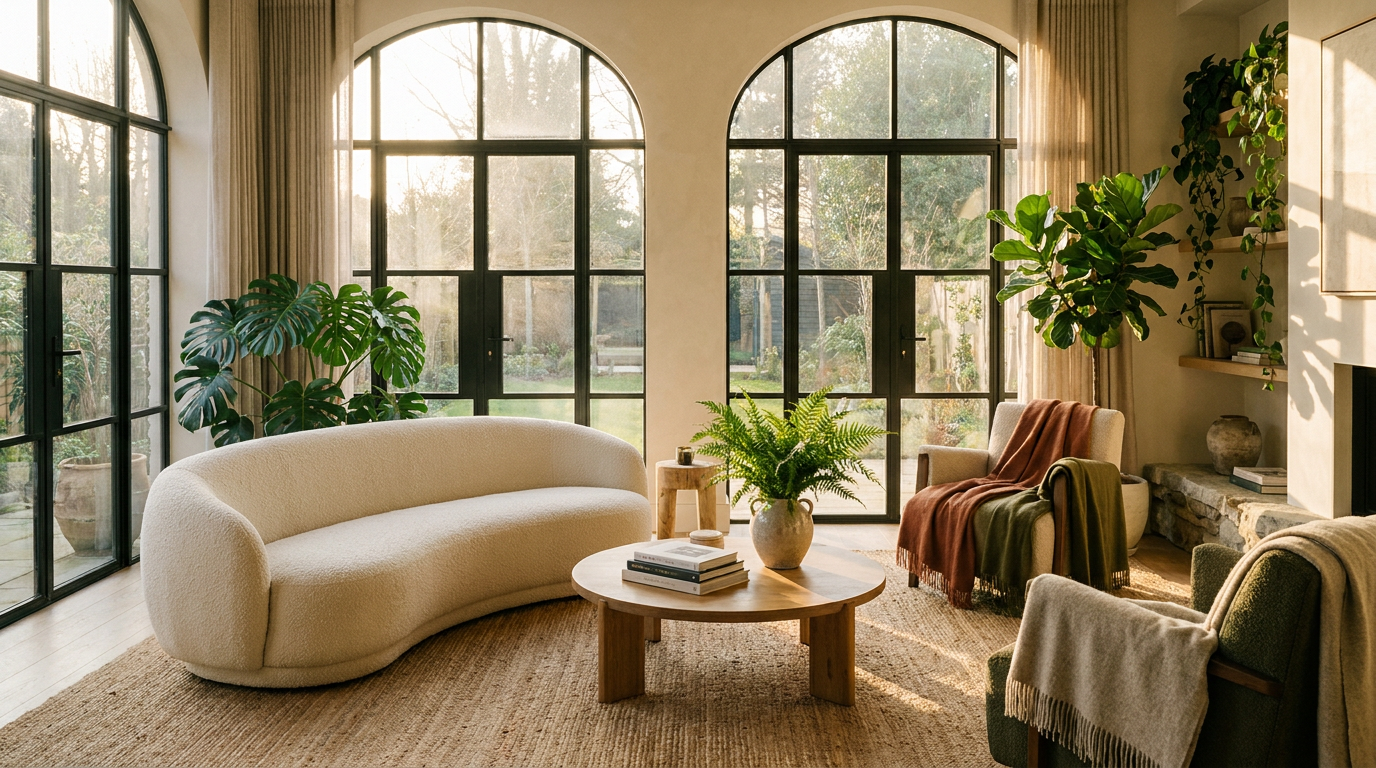
A central pillar of neuroaesthetic design is biophilia—the innate human drive to connect with nature. However, neuroaesthetics proves that biophilic design is much more than simply placing a potted plant in a corner. It involves integrating the underlying fractal patterns, textures, and rhythms found in the natural world directly into the architecture and furnishings.[7][8]

The brain does not necessarily require these inputs to be living nature; it responds powerfully to the mere representation of it. Wood grains, woven fibers, stone finishes, and biomorphic shapes all trigger neural pathways associated with safety and relaxation. In commercial settings, research shows that employees working in biophilic offices report 15 percent higher productivity and significantly lower fatigue compared to those in sterile environments.[8]
Evolutionary biology also plays a crucial role in how we perceive space, specifically through the concept of prospect and refuge. Humans are evolutionarily wired to seek environments that offer clear sightlines of our surroundings (prospect) while providing a sense of protected enclosure (refuge). Rooms that offer expansive window views but feature cozy, sheltered seating areas naturally lower cognitive uncertainty and anxiety.[3][9]
Lighting is another critical lever in the neuroaesthetic toolkit. The human circadian rhythm is deeply tethered to the shifting color temperature of the sun. Static, artificial lighting disrupts this biological clock, leading to poor sleep and mood dysregulation. Neuroaesthetic design employs dynamic lighting systems that mimic the progression of daylight—cool and blue-toned in the morning to stimulate alertness, transitioning to warm, amber hues in the evening to promote melatonin production.[8]

Beyond the visual, neuroaesthetics emphasizes multisensory layering. The brain processes an environment holistically, combining sight, sound, and touch. Unpredictable acoustic noise elevates cortisol and maintains a heightened stress state. Designers are increasingly utilizing sound-absorbing materials, soft furnishings, and intentional spatial layouts to create acoustic harmony, which is vital for both workplace concentration and domestic tranquility.[4][7]
The physical shape of the space itself also dictates neural activity. Brain imaging studies have shown that viewing curvilinear rooms—spaces with rounded edges and arched doorways—activates the anterior cingulate cortex, a brain region heavily involved in processing emotion. Participants consistently rate curvilinear spaces as more beautiful and relaxing than rectilinear rooms dominated by sharp, 90-degree angles.[1][9]
Similarly, ceiling height dramatically alters cognitive function. High ceilings activate neural structures involved in visuospatial attention and exploration, fostering feelings of freedom and abstract thinking. Lower ceilings, while sometimes necessary for creating intimacy, can trigger feelings of confinement if not carefully balanced with light and proportion.[1][9]

The commercial real estate and hospitality sectors have been quick to adopt these principles at scale. At the 2026 Global Wellness Institute symposium, industry leaders noted a distinct pivot away from superficial luxury amenities toward longevity residences. The focus has shifted entirely to how the home biome and the built environment can support healthier, longer lives in measurable ways.[2]
This shift is also redefining residential interior design trends. The movement toward color drenching—enveloping a room in a single, saturated hue like deep blue or muted green—is rooted in the desire to create an immersive, atmospheric environment that soothes the nervous system. Authentic, tactile materials are favored over mass-produced, glossy finishes because they offer the sensory richness the brain craves.[6]
Ultimately, the rise of neuroaesthetics represents a maturation of the design industry. It bridges the gap between art and biology, proving that beauty is not merely a subjective luxury, but a fundamental human need. By designing spaces that align with our neurological wiring, we can transform the buildings we inhabit into active allies in our pursuit of health, focus, and emotional resilience.[5][9]
How we got here
1999
The term 'neuroaesthetics' is first coined by neurobiologist Semir Zeki.
2018
Google's installation at Milan Design Week brings mainstream attention to how different room designs alter physiological states.
2021
A landmark University of Pennsylvania study maps the 'Neuro-Architecture Triad' of coherence, fascination, and hominess.
2026
Neuroaesthetics becomes a dominant framework in commercial real estate and wellness-focused residential design.
Viewpoints in depth
The Neuroscientist's View
Focuses on the empirical, biological mechanisms triggered by the built environment.
For cognitive neuroscientists, a room is not a collection of furniture, but a complex matrix of sensory inputs that the brain must constantly process. Using fMRI scanners and biometric tracking, researchers have proven that elements like sharp angles, poor acoustics, and harsh lighting require excess cognitive load, triggering the amygdala and elevating cortisol. Conversely, spaces that mimic natural fractal patterns and offer spatial coherence activate the brain's reward pathways, releasing dopamine and actively downregulating the nervous system.
The Commercial Strategist's View
Views neuroaesthetics as a measurable tool for improving workplace performance and employee retention.
In the commercial sector, neuroaesthetics is rapidly replacing the trend of superficial office perks. Workplace designers argue that ping-pong tables and open-plan layouts often increase sensory noise and distraction. Instead, they advocate for 'neuro-inclusive' design: utilizing circadian lighting, acoustic dampening, and biophilic elements to create environments that sustain focus and reduce mid-afternoon fatigue. For these strategists, the return on investment is clear: optimized spaces directly correlate with lower absenteeism and higher cognitive output.
The Residential Designer's View
Prioritizes the 'home biome' as a sanctuary for longevity and emotional recovery.
Residential architects and interior decorators are shifting away from trend-chasing toward designing for emotional resonance. This camp emphasizes the concept of the 'home biome'—the idea that a house should function as a restorative ecosystem. By employing techniques like 'color drenching' with soothing hues, incorporating tactile organic materials, and designing clear zones of 'prospect and refuge,' they aim to create domestic spaces that act as a daily antidote to the overstimulation of the modern world.
What we don't know
- How individual neurodivergence (such as ADHD or autism) alters the baseline response to specific neuroaesthetic stimuli.
- The long-term, multi-decade health impacts of living exclusively in neuro-optimized environments.
- How to perfectly standardize neuroaesthetic metrics across vastly different cultural interpretations of beauty and comfort.
Key terms
- Neuroaesthetics
- The scientific study of the neural bases for the contemplation and creation of a work of art or architectural space.
- Biophilia
- The innate human instinct to connect with nature and other living systems.
- The Neuro-Architecture Triad
- A framework identifying three psychological dimensions—coherence, fascination, and hominess—that dictate human responses to interior spaces.
- Prospect and Refuge
- A design theory based on evolutionary biology that balances the need for expansive views with the need for a sheltered, safe enclosure.
- Circadian Lighting
- Artificial lighting systems designed to mimic the natural progression of sunlight throughout the day to support the body's internal clock.
Frequently asked
What is neuroaesthetics?
Neuroaesthetics is an emerging scientific field that studies how the human brain and nervous system respond to beauty, art, and architectural design.
How does biophilic design affect the brain?
Biophilic design incorporates natural elements, fractal patterns, and organic textures into spaces. This triggers neural pathways associated with safety, lowering cortisol levels and reducing stress.
What is the 'prospect and refuge' theory?
It is an evolutionary concept suggesting humans feel most comfortable in environments where they have a clear view of their surroundings (prospect) while feeling safely enclosed or protected (refuge).
Can neuroaesthetic principles be applied on a budget?
Yes. Simple interventions like maximizing natural light, reducing visual clutter to improve coherence, and incorporating affordable natural textures can significantly improve a space's impact on the brain.
Sources
Source coverage
9 outlets
3 viewpoints surfaced









[1]Cognitive ProcessingCognitive Neuroscientists
The neuroaesthetics of architectural spaces
Read on Cognitive Processing →[2]BeautyMatterResidential Wellness Advocates
From the Festivalization of Wellness to Longevity Residences: Top 2026 Wellness Trends
Read on BeautyMatter →[3]HOKCommercial Designers
HOK Forward 2026: Wired for Beauty
Read on HOK →[4]Science in DesignCognitive Neuroscientists
What is Neuroaesthetics?
Read on Science in Design →[5]Business of HomeResidential Wellness Advocates
What is neuroaesthetics, and why should designers care?
Read on Business of Home →[6]House BeautifulResidential Wellness Advocates
Interior design trends that will carry effortlessly into 2026
Read on House Beautiful →[7]ModulyssCommercial Designers
Elevating Experiences Through Neuroaesthetic Design
Read on Modulyss →[8]Pearl AcademyCommercial Designers
Neuroaesthetics in Interior Spaces: Designing for Mental Well-Being and Productivity
Read on Pearl Academy →[9]Factlen Editorial TeamResidential Wellness Advocates
Synthesis by Factlen editorial team
Read on Factlen Editorial Team →
Every angle. Every day.
Get home stories with full source coverage and perspective breakdowns delivered to your inbox.