
Ultra-High Energy Cosmic Rays Identified as Heavy Atomic Nuclei, Not Protons, Rewriting Their Origin Story
Astrophysicists have determined that the universe's most energetic particles are ultra-heavy atomic nuclei rather than solitary protons, solving a decades-old paradox about how they travel across intergalactic space.
By Factlen Editorial Team
- High-Energy Astrophysicists
- Focus on how heavy nuclei bypass the GZK limit and retain kinetic energy across vast intergalactic distances.
- Observational Astronomers
- Emphasize the empirical air-shower data from ground arrays that proves the transition to heavy elements at extreme energies.
- Multimessenger Astronomers
- Argue that because heavy nuclei are deflected by magnetic fields, their sources can only be confirmed by correlating them with neutrinos and gravitational waves.
What's not represented
- · Particle physicists studying hadronic interactions beyond the limits of human-made colliders.
Why this matters
Identifying ultra-high-energy cosmic rays as heavy nuclei solves a decades-old paradox about how these particles travel across the universe, fundamentally shifting where astronomers look for the most violent cosmic engines in existence.
Key points
- Ultra-high-energy cosmic rays were long assumed to be solitary protons.
- Protons cannot travel further than 160 million light-years without losing energy to the cosmic microwave background.
- New models and observatory data prove these extreme particles are actually ultra-heavy atomic nuclei.
- Heavy nuclei retain their energy better, allowing them to travel from much further away in the universe.
- The particles are likely accelerated by collapsars or binary neutron-star mergers.
- Because heavy nuclei are deflected by magnetic fields, they do not point directly back to their sources.
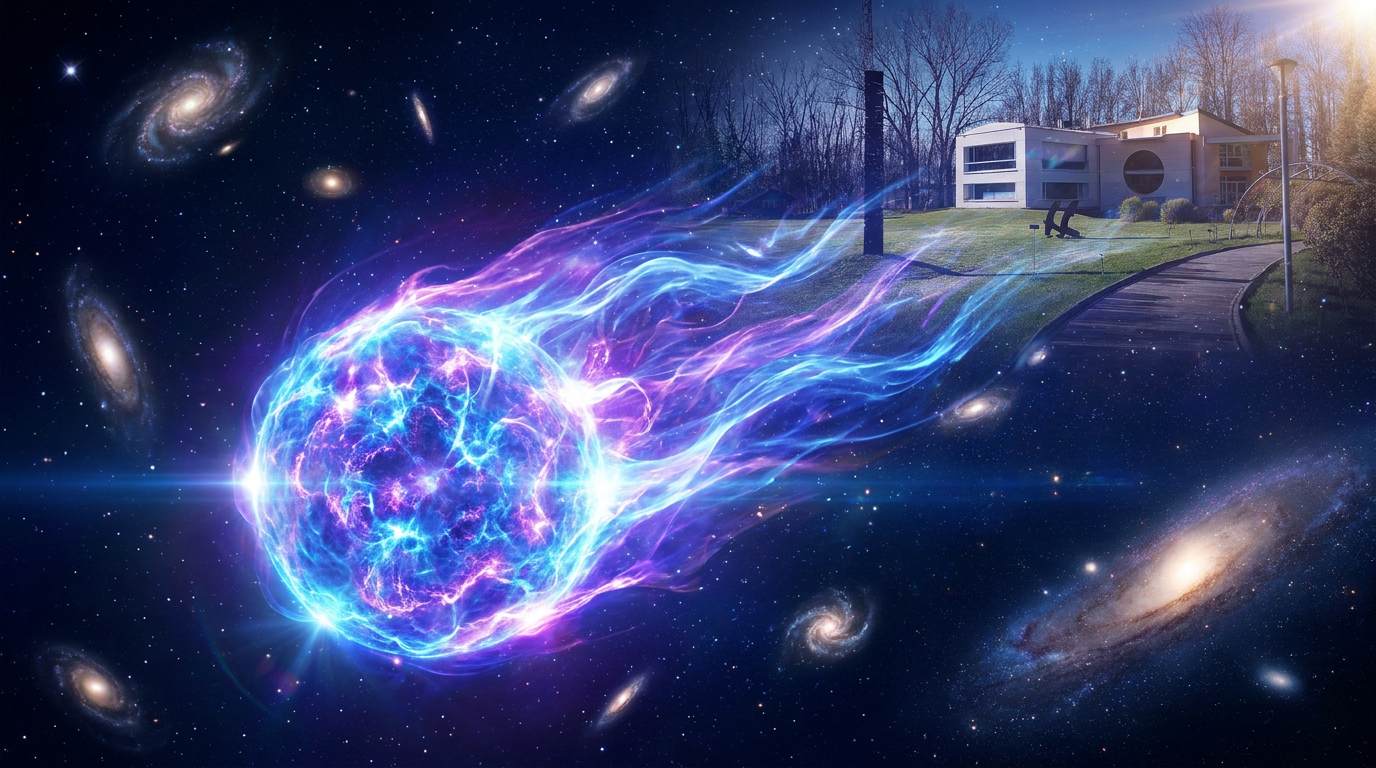
Earth is constantly bombarded by subatomic particles from deep space, but a rare few arrive with kinetic energies that defy comprehension. These ultra-high-energy cosmic rays (UHECRs) carry tens of millions of times more energy than the particles accelerated in the Large Hadron Collider, packing the kinetic punch of a fast-moving baseball into a single subatomic point.[1][2]
For over a century, the origin of these extreme particles has remained one of the most stubborn mysteries in astrophysics. When the so-called "Amaterasu particle" was detected recently, it struck the atmosphere with an energy of 244 exa-electron volts, reigniting the debate over what kind of cosmic engine could possibly launch a particle with such devastating force.[5]
Until now, conventional astrophysical models operated on a standard assumption: these high-energy travelers were solitary protons. Protons are the most abundant nuclei in the universe, making them the most logical candidates to be scooped up and accelerated to near-light speeds by violent cosmic events.[2][6]
However, the proton theory created a massive paradox for physicists due to a physical barrier known as the Greisen-Zatsepin-Kuzmin (GZK) limit. Space is not entirely empty; it is filled with relic photons from the cosmic microwave background, the faint, pervasive afterglow of the Big Bang.[1][2]
When a fast-moving proton travels across intergalactic space, it inevitably collides with these microwave photons. These collisions cause the proton to bleed energy, effectively capping its maximum travel distance at roughly 160 million light-years before it drops below ultra-high-energy thresholds.[2][5]

This spatial constraint meant that if UHECRs were protons, their sources had to be located within our local cosmic neighborhood. Yet, when astronomers looked in the directions these particles came from, they found empty voids, lacking the massive black holes or exploding stars necessary to accelerate them.[5][6]
A new wave of research, culminating in a June 2026 study published in Physical Review Letters by researchers at Penn State University, has fundamentally rewritten this narrative. Through advanced computational modeling, the team demonstrated that the highest-energy cosmic rays are not protons at all, but rather ultra-heavy atomic nuclei with masses exceeding that of iron.[2][6]
This structural difference completely alters the physics of their journey through deep space. The simulations revealed that at extreme energy thresholds, ultra-heavy nuclei retain their structural integrity and kinetic energy far better than lighter elements or isolated protons.[2]
This structural difference completely alters the physics of their journey through deep space.
By losing velocity at a much slower rate during their interactions with the cosmic microwave background, these heavier elements can travel across vast intergalactic distances without dipping below detectable energy thresholds. They act like a heavy bowling ball rolling through a headwind, whereas a proton acts like a golf ball.[1][6]
This survival rate effectively bypasses the spatial constraints imposed by the GZK limit. If a UHECR is an ultra-heavy nucleus, its origin point does not need to sit within the local 160-million-light-year stretch; it could easily have originated billions of light-years away in the deeper universe.[2][5]
The theoretical models are now being backed up by observational data from the world's largest cosmic ray detectors: the Pierre Auger Observatory in Argentina and the Telescope Array in Utah. These massive installations cover thousands of square kilometers of terrain to catch the rare impacts.[3][4]

These observatories do not catch the cosmic rays directly. Instead, they observe the "air showers" of secondary particles created when a UHECR smashes into Earth's upper atmosphere. By measuring the fluorescent light emitted by these showers, scientists can determine a metric called Xmax—the depth in the atmosphere where the shower reaches its maximum particle count.[3]
Heavy nuclei interact much earlier and higher in the atmosphere compared to lighter protons, which penetrate deeper before detonating into a shower. The latest Xmax data from both observatories shows a clear transition: as energy levels rise to the extreme, the composition shifts definitively toward heavy nuclei.[3][4]

Identifying these particles as heavy nuclei narrows down the list of cosmic engines capable of creating them. Accelerating an iron-like nucleus to near-light speeds requires environments of immense gravitational and magnetic intensity, far beyond standard supernovae.[5][6]
Astrophysicists are now pointing to two primary candidates. The first involves collapsars—the explosive collapse of massive, rapidly rotating stars into black holes or highly magnetized neutron stars known as magnetars, which can act as cosmic particle accelerators.[2][5]
The second mechanism involves binary neutron-star mergers. These cataclysmic collisions are already known to be the universe's primary forges for heavy elements like gold and platinum, and they generate the exact magnetic conditions needed to launch these newly forged nuclei across the cosmos.[2][6]

While the heavy-nucleus discovery solves the GZK distance paradox, it introduces a new challenge for astronomers trying to pinpoint exact sources. Because heavy nuclei carry a larger electric charge than protons, their paths are bent much more severely by intergalactic magnetic fields.[1][4]
This magnetic deflection explains why the arrival directions of UHECRs do not point straight back to obvious sources. Moving forward, solving the final pieces of the cosmic ray puzzle will require multimessenger astronomy—correlating these heavy nuclei detections with the straight-line paths of neutrinos and gravitational waves emitted by the same violent cosmic engines.[1][4][5]
How we got here
1966
Physicists propose the GZK limit, predicting that high-energy protons cannot travel further than 160 million light-years.
1991
The 'Oh-My-God' particle is detected, shocking astrophysicists with its impossible energy level.
2021
The Telescope Array detects the Amaterasu particle, one of the highest-energy cosmic rays ever recorded.
June 2026
Researchers publish models proving that ultra-high-energy cosmic rays are heavy nuclei, resolving the GZK distance paradox.
Viewpoints in depth
High-Energy Astrophysicists
Focus on how heavy nuclei bypass the GZK limit.
For theorists, the identification of UHECRs as heavy nuclei is a massive relief. The GZK limit was a mathematically sound barrier that protons simply could not cross without bleeding energy into the cosmic microwave background. By shifting the model to ultra-heavy nuclei, astrophysicists no longer have to invent exotic new physics to explain how these particles reach Earth from beyond our local cosmic neighborhood. The heavier mass acts as a kinetic battery, allowing the particle to punch through the microwave background with minimal energy loss.
Observational Astronomers
Emphasize the empirical air-shower data from ground arrays.
Researchers operating massive ground arrays like the Pierre Auger Observatory rely on the physical mechanics of atmospheric entry. Because heavy nuclei have a larger cross-section, they interact with Earth's atmosphere much higher up than protons do. The resulting 'Xmax' data—the altitude where the particle shower peaks—provides an undeniable empirical signature. For these astronomers, the debate is settled not by theoretical modeling, but by the consistent, repeatable measurements of these high-altitude showers.
Multimessenger Astronomers
Argue that magnetic deflection requires new tracking methods.
While the heavy-nucleus discovery solves the distance problem, it complicates the search for the particles' origins. Heavy nuclei have a higher electric charge, meaning they are easily deflected by the universe's magnetic fields. Multimessenger astronomers argue that we can no longer rely on tracing a cosmic ray's path backward in a straight line. Instead, the field must pivot to correlating these cosmic ray strikes with unbendable signals—like gravitational waves and neutrinos—emitted by the same violent events.
What we don't know
- The exact cosmic engines responsible for accelerating these specific heavy nuclei.
- The precise strength and structure of the intergalactic magnetic fields that deflect their paths.
- Whether the composition shifts entirely to iron-like elements at the absolute highest energies, or if even heavier elements are present.
Key terms
- Ultra-High-Energy Cosmic Ray (UHECR)
- An extremely energetic subatomic particle from deep space, possessing kinetic energy exceeding 10^18 electron volts.
- GZK Limit
- A theoretical upper limit on the energy of cosmic ray protons traveling through space, caused by energy-draining collisions with the cosmic microwave background.
- Xmax
- The depth in Earth's atmosphere where a cosmic ray-induced air shower reaches its maximum number of particles, used to determine the mass of the original cosmic ray.
- Collapsar
- A massive, rapidly rotating star that collapses under its own gravity to form a black hole, often generating intense magnetic fields and gamma-ray bursts.
Frequently asked
What is an ultra-high-energy cosmic ray?
It is a subatomic particle traveling through space at near the speed of light, carrying kinetic energy tens of millions of times greater than what human-made particle accelerators can produce.
Why do heavy nuclei survive longer in space than protons?
Heavy nuclei have more mass and structural integrity, allowing them to push through the cosmic microwave background without losing as much velocity or energy as a lighter proton would.
How do observatories detect these particles?
They don't catch the particles directly. Instead, they use massive ground arrays to detect the 'air shower' of secondary particles created when a cosmic ray smashes into Earth's upper atmosphere.
Sources
Source coverage
6 outlets
3 viewpoints surfaced






[1]Factlen Editorial TeamMultimessenger Astronomers
Synthesis by Factlen editorial team
Read on Factlen Editorial Team →[2]Physical Review LettersHigh-Energy Astrophysicists
Ultraheavy Nuclei as the Origin of Ultra-High-Energy Cosmic Rays
Read on Physical Review Letters →[3]Pierre Auger ObservatoryObservational Astronomers
Energy evolution of the mass composition of cosmic rays
Read on Pierre Auger Observatory →[4]Telescope ArrayObservational Astronomers
Mass composition and anisotropy of UHECRs
Read on Telescope Array →[5]arXivMultimessenger Astronomers
The astrophysical puzzle of the Amaterasu particle and UHECR composition
Read on arXiv →[6]Penn State UniversityHigh-Energy Astrophysicists
Computational models reveal heavy nuclei composition of extreme cosmic rays
Read on Penn State University →

Every angle. Every day.
Get science stories with full source coverage and perspective breakdowns delivered to your inbox.