
The 2024 IBC Mandate: Why Carbon Monoxide Detectors Are Now Required in Every Building with a Gas Appliance
The 2024 International Building Code has expanded carbon monoxide detection requirements beyond homes and schools, mandating life-safety sensors in all commercial and industrial buildings with fuel-burning appliances.
By Factlen Editorial Team
- Code Officials & Safety Advocates
- Argue that closing the commercial loophole is a long-overdue necessity to prevent workplace and public poisoning tragedies.
- Fire Protection Engineers
- Focus on the technical benefits of merging NFPA 720 into NFPA 72, which streamlines the design and integration of life-safety systems.
- Commercial Building Owners
- Acknowledge the safety benefits but highlight the significant financial and logistical burdens of retrofitting older buildings to meet the new code.
What's not represented
- · Small business tenants leasing older commercial spaces
- · Manufacturers of legacy metal-oxide sensors
Why this matters
Carbon monoxide poisoning is a leading cause of accidental poisoning deaths, yet commercial spaces have historically lacked detection mandates. This code change forces thousands of property owners to retrofit life-safety systems, fundamentally upgrading how non-residential buildings protect occupants from invisible HVAC failures.
Key points
- The 2024 IBC requires carbon monoxide detectors in all commercial and industrial buildings with gas appliances.
- The mandate closes a historical loophole that previously only required detectors in residential and educational spaces.
- Carbon monoxide binds to hemoglobin 200 times stronger than oxygen, causing severe cellular hypoxia.
- Modern detectors use electrochemical sensors that generate an electrical current when exposed to the gas.
- Commercial spaces must use system-type detectors hardwired into the central fire alarm panel.
- Retroactive requirements mean existing buildings will also need to be upgraded as states adopt the code.
For decades, building codes treated carbon monoxide as a strictly residential problem. If you slept in a building or attended school in it, the law required a carbon monoxide detector. But if you worked in a factory, shopped in a retail mall, or dined in a commercial restaurant, you were largely unprotected from the invisible gas. That historical blind spot has officially closed.[4][5]
That era ended with the publication of the 2024 International Building Code (IBC). In a sweeping update to Section 915, the International Code Council mandated that carbon monoxide detection must now be installed in all occupancies—including commercial, industrial, mercantile, and assembly spaces—where a carbon monoxide-producing device is present.[1]
The trigger for this requirement is simple but ubiquitous: the presence of any fuel-burning appliance. This includes gas-fired furnaces, boilers, water heaters, and commercial kitchen equipment. The mandate also applies to any building with an attached enclosed parking garage, recognizing that vehicle exhaust can easily infiltrate adjacent occupied spaces and poison entire structures.[1][5]
To understand why the code council made this universal shift, one must look at the biology of carbon monoxide poisoning. Carbon monoxide is a colorless, odorless, and tasteless gas generated by the incomplete combustion of fossil fuels. Because it cannot be detected by human senses, individuals are often severely symptomatic or unconscious before they realize they are breathing toxic air.[3]
At the molecular level, carbon monoxide is an aggressive hijacker. When inhaled, it diffuses rapidly across the pulmonary capillary membrane and binds to the iron in hemoglobin, the protein responsible for carrying oxygen in red blood cells.[3]
The bond carbon monoxide forms with hemoglobin—creating a compound called carboxyhemoglobin—is roughly 200 to 250 times stronger than the bond formed by oxygen. By aggressively occupying these binding sites, the gas effectively starves the body's tissues of oxygen, inducing severe cellular hypoxia.[3]

But the biological damage extends beyond simple oxygen displacement. The presence of carboxyhemoglobin alters the shape of the hemoglobin molecule, causing a "leftward shift" in the oxyhemoglobin dissociation curve. This means that whatever oxygen is still bound to the hemoglobin is held much tighter, preventing it from being released into the tissues that desperately need it.[3]
Furthermore, carbon monoxide acts as a direct cellular toxin. It binds to cytochrome c oxidase, a crucial enzyme in the mitochondrial electron transport chain. By inhibiting this enzyme, the gas shuts down aerobic metabolism and halts the production of ATP, the cell's primary energy currency, leading to catastrophic damage in the heart and central nervous system.[3]
Furthermore, carbon monoxide acts as a direct cellular toxin.
Because humans cannot detect this chemical cascade, life safety relies entirely on technological intervention. The vast majority of modern carbon monoxide detectors utilize electrochemical sensors, which essentially function as highly specialized, miniature fuel cells.[6]
Inside an electrochemical sensor, a gas-permeable membrane allows ambient air to diffuse into a chamber containing an electrolyte solution—often sulfuric acid—and three electrodes. The primary component is the working electrode, which is typically coated with a platinum catalyst.[6]
When carbon monoxide reaches this working electrode, a reduction-oxidation reaction occurs. The gas is oxidized into carbon dioxide, a process that releases electrons and generates a small electrical current. The strength of this current is directly proportional to the concentration of carbon monoxide in the air, measured in parts per million.[6]

If the sensor detects a sustained current indicating dangerous levels—such as 70 parts per million for an extended period, or 400 parts per million for just a few minutes—the device's microprocessor triggers the alarm. This electrochemical method is highly accurate, draws very little power, and is vastly less prone to false alarms than older biomimetic or metal-oxide technologies.[6]
The 2024 IBC mandate does not just require these sensors; it dictates exactly how they must be integrated into a building's infrastructure. This brings into play a major regulatory consolidation: the retirement of the standalone carbon monoxide standard, NFPA 720.[2][4]
For years, the National Fire Protection Association maintained NFPA 720 as a separate rulebook. However, having divergent standards for fire alarms and carbon monoxide alarms proved inefficient for code officials and engineers. Consequently, NFPA 720 was withdrawn, and its requirements were fully integrated into Chapter 17 of NFPA 72, the National Fire Alarm and Signaling Code.[2][4]
Under the unified NFPA 72 and the new IBC, commercial buildings face much stricter requirements than residential homes. While a battery-operated, standalone alarm might suffice in a single-family dwelling, commercial occupancies generally require a "system-type" carbon monoxide detector.[4][5]
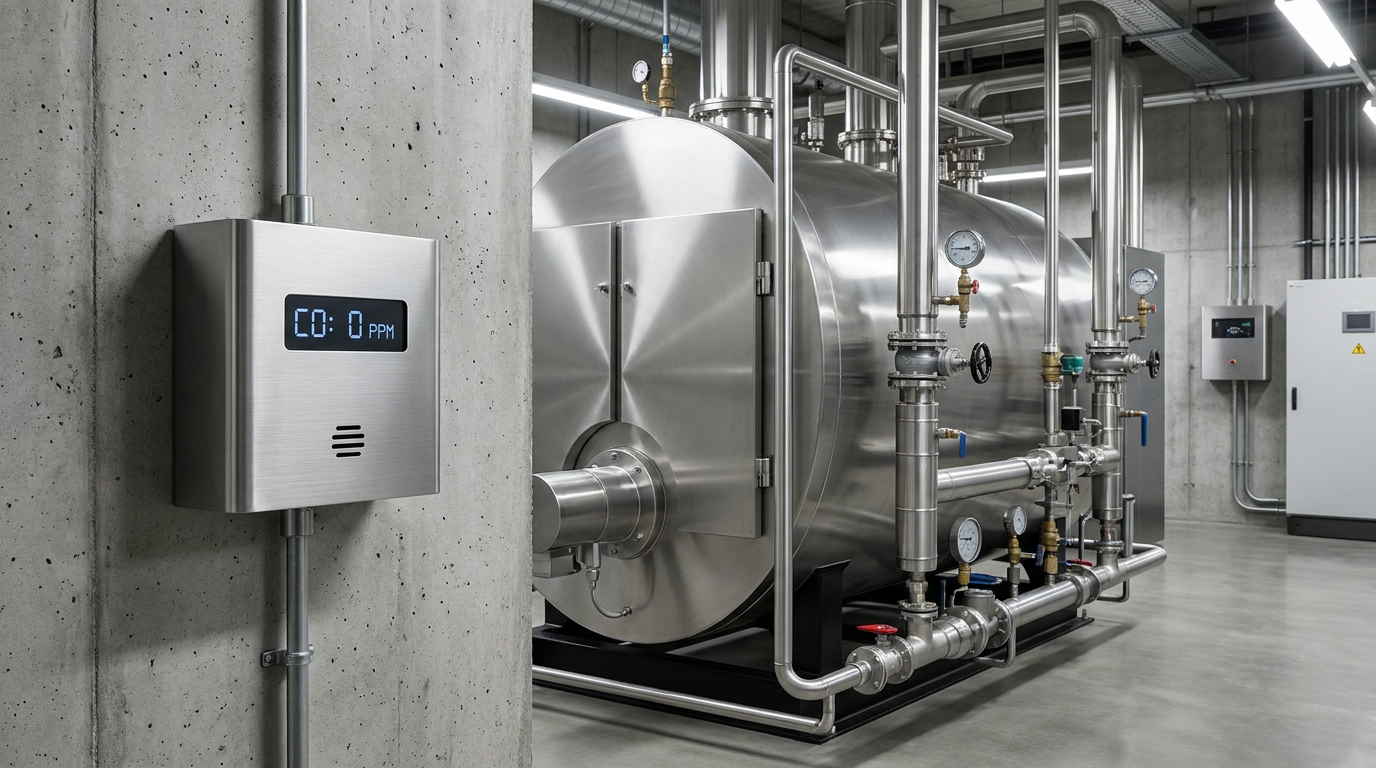
A system-type detector does not merely sound a local horn; it is hardwired into the building's central fire alarm control panel. If carbon monoxide is detected in a commercial boiler room, the system can automatically shut down the malfunctioning equipment, trigger exhaust ventilation, and alert a 24/7 monitoring station to dispatch emergency responders.[5]
The financial and logistical implications of this mandate are substantial. While new construction will simply incorporate these systems into initial architectural designs, existing buildings are not exempt. The 2024 International Fire Code includes retroactive requirements, meaning property owners will have to retrofit detection systems into older commercial spaces.[1]

The rollout of these requirements will be staggered. Because building codes are adopted at the state and municipal levels, the 2024 IBC will become law in waves over the next three to five years. Jurisdictions like New Jersey and Washington are already moving to adopt the 2024 standards, while others will follow their own legislative timelines.[1][6]
Ultimately, the 2024 IBC mandate represents a paradigm shift in commercial building safety. By recognizing that carbon monoxide poses an equal threat in a factory, a retail store, or a living room, the code closes a decades-old loophole, ensuring that the invisible killer is monitored wherever fossil fuels are burned.[1][6]
How we got here
Pre-2015
Building codes primarily require carbon monoxide detection only in residential dwellings and schools.
2018
The NFPA announces the withdrawal of NFPA 720, beginning the process of merging CO standards into the main fire alarm code.
2019
NFPA 72 is updated to fully incorporate carbon monoxide detection requirements, unifying life-safety systems.
2023
The International Code Council finalizes the 2024 IBC, expanding Section 915 to cover all occupancies.
2024–2028
State and municipal governments begin the staggered adoption and enforcement of the 2024 IBC standards.
Viewpoints in depth
Code Officials & Safety Advocates
Argue that closing the commercial loophole is a long-overdue necessity to prevent workplace poisoning tragedies.
For safety advocates and code officials, the 2024 IBC update corrects a glaring historical oversight. They point out that carbon monoxide does not discriminate by zoning classification; a malfunctioning boiler in a retail store is just as lethal as one in a basement. By mandating detection across all occupancies, advocates argue the code finally aligns with the biological reality of the hazard, ensuring that employees and patrons are afforded the same baseline life-safety protections as homeowners.
Fire Protection Engineers
Focus on the technical benefits of merging NFPA 720 into NFPA 72, which streamlines the design of life-safety systems.
Engineers and system designers view the mandate through the lens of integration. Previously, managing separate standards for fire alarms (NFPA 72) and carbon monoxide alarms (NFPA 720) created redundant paperwork and conflicting design parameters. By rolling CO detection into the central fire alarm code, engineers can design unified, hardwired systems that handle both smoke and gas threats simultaneously. This allows for smarter automated responses, such as programming the central panel to shut down specific HVAC zones the moment an electrochemical sensor detects a leak.
Commercial Building Owners
Acknowledge the safety benefits but highlight the significant financial and logistical burdens of retrofitting older buildings.
While few property owners argue against the life-saving intent of the mandate, many are bracing for the financial impact of the retroactive requirements. Upgrading an existing commercial space is not as simple as plugging a detector into a wall. It requires hiring licensed electricians to run new conduit, integrating system-type detectors into legacy fire alarm panels, and potentially upgrading the panels entirely if they lack the capacity for new zones. For owners of large, older industrial facilities, compliance will represent a major capital expenditure over the next few years.
What we don't know
- Exactly how strictly local municipalities will enforce the retroactive retrofit requirements for older commercial buildings.
- Whether the increased demand for system-type electrochemical sensors will cause supply chain bottlenecks as states adopt the 2024 code.
Key terms
- Carboxyhemoglobin (COHb)
- A compound formed in the blood when carbon monoxide binds to hemoglobin, preventing the transport of oxygen to tissues.
- Electrochemical Sensor
- A detection device that uses a chemical reaction between a target gas and an electrode to generate a measurable electrical current.
- NFPA 72
- The National Fire Alarm and Signaling Code, which now governs the installation and maintenance of both fire and carbon monoxide detection systems.
- Cytochrome c Oxidase
- A critical enzyme in cellular respiration that is inhibited by carbon monoxide, shutting down a cell's ability to produce energy.
- Oxyhemoglobin Dissociation Curve
- A graphical representation of how easily hemoglobin releases oxygen into tissues; carbon monoxide shifts this curve, trapping oxygen in the blood.
Frequently asked
Does the 2024 IBC mandate apply to existing buildings?
Yes. The International Fire Code (IFC) Chapter 11 includes retroactive requirements, meaning older commercial buildings must be retrofitted with carbon monoxide detection if they have gas appliances.
What is the difference between a CO alarm and a CO detector?
A CO alarm is a standalone device that sounds a local horn, typically used in homes. A system-type CO detector is hardwired into a building's central fire alarm panel, used in commercial spaces to trigger automated safety responses.
How long do electrochemical CO sensors last?
Most electrochemical sensors have a lifespan of 5 to 10 years, after which the internal electrolyte depletes or the catalyst degrades, requiring the entire device to be replaced.
Sources
Source coverage
6 outlets
3 viewpoints surfaced






[1]International Code CouncilCode Officials & Safety Advocates
2024 International Building Code (IBC) Significant Changes
Read on International Code Council →[2]National Fire Protection AssociationCode Officials & Safety Advocates
NFPA 72: National Fire Alarm and Signaling Code
Read on National Fire Protection Association →[3]National Institutes of Health
Carbon Monoxide Toxicity: Pathophysiology and Mechanism
Read on National Institutes of Health →[4]Electrical Contractor MagazineFire Protection Engineers
Carbon Monoxide Detectors in Codes and Standards
Read on Electrical Contractor Magazine →[5]Quick Response Fire SupplyFire Protection Engineers
Commercial Carbon Monoxide Detection Rules in the International Building Code
Read on Quick Response Fire Supply →[6]Factlen Editorial TeamCommercial Building Owners
Synthesis by Factlen editorial team
Read on Factlen Editorial Team →
Every angle. Every day.
Get home stories with full source coverage and perspective breakdowns delivered to your inbox.