
The Science of Biometric Access: How Facial and Palm Recognition Smart Locks are Rewriting Residential Security
Advanced 3D facial mapping and near-infrared palm vein scanners are replacing traditional keys and fingerprint pads on residential front doors. By processing biometric data locally, these new smart locks offer frictionless entry without compromising digital privacy.
By Factlen Editorial Team
- Smart Home Adopters
- Values frictionless entry, hands-free convenience, and seamless ecosystem connectivity.
- Privacy Advocates
- Focuses on the risks of digitizing physical access and the necessity of local data storage.
- Security Professionals
- Prioritizes anti-spoofing measures, physical durability, and mechanical fail-safes.
What's not represented
- · Traditional lock manufacturers facing market disruption
- · Renters unable to modify their exterior doors
Why this matters
As contactless biometrics replace physical keys and PIN codes, homeowners must understand how palm vein and 3D facial recognition work—and how to ensure their physical access data remains stored locally rather than in vulnerable cloud databases.
Key points
- Palm vein scanners use near-infrared light to read internal vascular patterns, bypassing the surface-level issues of fingerprint locks.
- 3D facial recognition uses structured light to map facial depth, preventing spoofing via photographs or masks.
- Dual-biometric locks combine both technologies for multi-factor contactless entry.
- Active approach sensing uses radar to wake the lock up before the user reaches the door.
- Premium smart locks store biometric templates locally on encrypted chips, avoiding vulnerable cloud databases.
For centuries, residential security relied on a simple piece of jagged metal. The physical key was a reliable, if rudimentary, tool that eventually gave way to the first wave of digital access: PIN pads and early Bluetooth proximity sensors. By the early 2020s, fingerprint scanners had become the premium standard, promising a future where homeowners could leave their keys behind entirely. But in 2026, the front door is undergoing a truly frictionless revolution. The latest generation of smart locks has abandoned physical touch altogether, utilizing advanced 3D facial recognition and near-infrared palm vein scanning to grant access. The door no longer requires you to prove you have a key; it simply looks at you and knows who you are.
This shift toward contactless biometrics is driven by a desire to eliminate the friction of everyday entry. Homeowners carrying groceries, wrangling children, or returning from a run are increasingly unwilling to fumble for keys or tap out a code on a touchscreen. The new standard demands that a door unlock the moment an authorized resident steps onto the welcome mat. To achieve this, manufacturers have had to miniaturize and weatherize biometric sensors that were previously reserved for high-security corporate facilities or advanced smartphones, bringing enterprise-grade identity verification to the residential threshold.
To understand the rapid adoption of contactless systems, one must first look at the limitations of the previous standard. While fingerprint smart locks successfully brought biometric entry to the mainstream market, they suffer from inherent environmental vulnerabilities. Traditional capacitive and optical fingerprint sensors rely on reading the microscopic ridges on the surface of the skin. When those ridges are perfectly clean and dry, the systems work flawlessly. But the reality of residential life is rarely so pristine, leading to a frustrating user experience right when quick access is most desired.[5]
As security professionals and locksmiths frequently note, fingerprint sensors struggle significantly when hands are wet from rain, dirty from yard work, or worn down from manual labor. A homeowner returning from the gym with sweaty hands, or carrying wet bags from a rainstorm, will often face repeated false rejections. These environmental factors can push the false rejection rate of a standard fingerprint lock to between one and three percent. While that number sounds low, in practice, it means standing on a dark porch repeatedly wiping a thumb on a shirt to get the door to open—a failure of the convenience the lock was supposed to provide.[5]

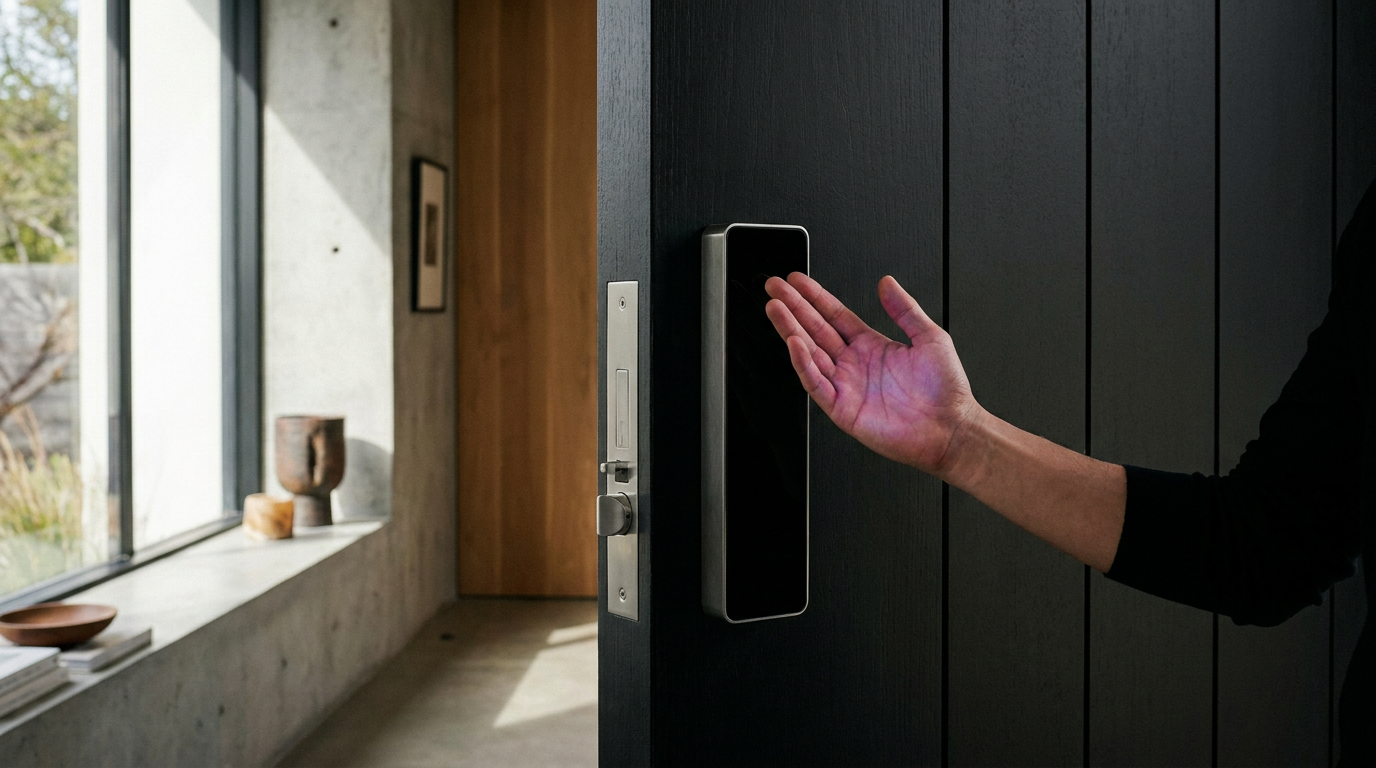
Palm vein recognition has emerged as the definitive solution to the surface-level vulnerabilities of the fingerprint. Rather than looking at the outside of the hand, palm vein technology looks beneath the skin. When a user holds their hand a few inches from the lock, the device emits a flash of near-infrared light. The deoxygenated blood flowing through the veins in the palm absorbs this infrared light, creating a distinct, high-contrast pattern that the lock's camera captures and analyzes.[4][5]
Because this vascular pattern is entirely internal, it offers massive security and reliability advantages. It cannot be copied from a smudged glass or replicated with a silicone mold, making it virtually impossible to spoof. Furthermore, because the sensor is reading beneath the epidermis, it works flawlessly regardless of whether the skin on the surface is wet, calloused, dirty, or covered in minor cuts. The vein pattern of every individual is entirely unique—even identical twins have different internal vascular structures—resulting in a false acceptance rate of just 0.002 percent.[5]
The residential application of this technology was pioneered by major brands like Philips, which introduced its 5000 Series Palm Recognition Lock to widespread acclaim, bringing contactless palm scanning to consumer front doors. By 2026, the technology has rapidly proliferated across the market. Brands such as Lockin, Tapo, and DESLOC now offer advanced palm-scanning deadbolts that can authenticate a user and retract the locking mechanism in under 0.17 seconds. Users simply hover their hand in front of the device, and the door opens instantly, completely bypassing the need for physical contact.[1][2][3][4]
By 2026, the technology has rapidly proliferated across the market.
Running parallel to the rise of palm scanners is the maturation of 3D facial recognition for residential locks. Early attempts at facial recognition in smart home devices often relied on basic 2D cameras, which raised significant security concerns because they could theoretically be fooled by a high-resolution photograph or a video displayed on a tablet. To solve this, the industry adopted the same sophisticated depth-mapping technology used in flagship smartphones, ensuring that the lock requires a live, three-dimensional human face to grant access.[5]

Modern facial recognition locks utilize structured light and time-of-flight sensors to achieve this. These sensors project thousands of invisible infrared dots onto the user's face, creating a precise, three-dimensional topographical map that measures the exact depth of the jawline, the distance between the eyes, and the contours of the cheekbones. Devices like the Lockly Visage and the SwitchBot Lock Vision Pro use this depth data to perform rigorous liveness detection, making them virtually immune to photo, video, or even 3D-printed mask spoofing.[3][5][6]
The cutting edge of the 2026 market is now combining both of these technologies into single, ultra-secure devices. At recent industry showcases, manufacturers unveiled dual-biometric locks, such as the ULTRALOQ Bolt Sense, which incorporate both 3D facial mapping and palm vein scanning. This allows homeowners to set multi-factor authentication for high-security scenarios—requiring both a recognized face and a verified palm to unlock the door—or simply offers the flexibility of using whichever method is most convenient in the moment.[7]
To make these biometric interactions truly frictionless, manufacturers have integrated active approach sensing. Using low-power radar or infrared proximity sensors, the lock detects when a person is walking up to the door. This allows the device to wake up from its battery-saving sleep mode, activate its biometric scanners, and begin the authentication process before the user even reaches the doorstep. By the time the homeowner raises a hand or looks at the camera, the system is already primed, resulting in a zero-wait entry experience.[7]
However, as front doors begin actively scanning faces and internal vein structures, privacy concerns have naturally escalated among consumers. The digitization of physical access means that highly sensitive biometric data is being captured daily. The primary debate in the smart lock industry now centers on data sovereignty: specifically, where this biometric information is stored, how it is processed, and who ultimately has access to it.[4]

Security experts and privacy advocates draw a hard line between cloud-based and local storage. The industry standard for premium biometric locks has firmly shifted toward strict local storage. In these systems, the mathematical templates of a user's face or palm are encrypted and housed on a secure, tamper-proof microchip located on the interior half of the lock itself. This data never touches a Wi-Fi network, is never transmitted to a companion app, and is never uploaded to a manufacturer's external server.[4][6]
This local-only approach is critical for maintaining residential security. If a smart lock company's cloud infrastructure were to be compromised by hackers, the users' biometric identities would remain entirely safe, because the data simply does not exist off-device. Privacy advocates stress that buyers should explicitly avoid cheaper, entry-level biometric locks that rely on cloud processing, warning that centralized databases of residential facial scans represent a massive and unnecessary security vulnerability.[4]

Beyond security, the appeal of these advanced locks lies in their ability to serve as the trigger for broader home automation. As the Matter protocol standardizes smart home communication, biometric locks are seamlessly integrating with entire residential ecosystems. A recognized face or palm doesn't just retract a deadbolt anymore; it can simultaneously disarm the security system, adjust the thermostat to a preferred temperature, and turn on the entryway lights, creating a highly personalized welcome.[3][7]
Ultimately, the rise of biometric smart locks represents the final step in the evolution of residential access. By moving beyond physical tokens that can be lost, and PIN codes that can be forgotten or shared, the industry has tied home security directly to the unalterable physical identity of the resident. As palm vein and 3D facial recognition technologies become the new standard, the era of fumbling for keys in the dark is officially ending, replaced by a front door that simply knows who belongs.
How we got here
2010s
Fingerprint smart locks enter the residential market, offering early keyless entry but struggling with wet or dirty hands.
Jan 2024
Philips unveils the 5000 Series Palm Recognition Lock at CES, bringing contactless palm scanning to consumer front doors.
Mid 2025
3D facial recognition locks gain traction, replacing easily spoofed 2D cameras with advanced depth-mapping sensors.
Jan 2026
Dual-biometric locks, such as the ULTRALOQ Bolt Sense, debut at CES, combining face and palm scanning for multi-factor contactless security.
Viewpoints in depth
Privacy & Data Sovereignty Advocates
Focuses on the risks of digitizing physical access and the necessity of local data storage.
This camp argues that the convenience of biometric entry must not come at the cost of personal privacy. They warn against smart locks that upload facial or palm templates to cloud servers, noting that centralized biometric databases are prime targets for hackers. For these advocates, the only acceptable biometric locks are those that utilize strict, on-device encryption, ensuring that a user's physical identity data never leaves the front door.
Security Professionals & Locksmiths
Prioritizes anti-spoofing measures, physical durability, and fail-safes.
Locksmiths and physical security experts evaluate smart locks based on their resistance to both digital spoofing and physical tampering. They champion 3D structured light and palm vein technologies because they effectively eliminate the false-acceptance vulnerabilities of older 2D cameras and basic fingerprint scanners. However, this camp also insists that every biometric lock must retain a high-security mechanical key override, warning that purely electronic systems can fail during extreme weather or catastrophic battery depletion.
Smart Home Integrators
Values frictionless entry and seamless ecosystem connectivity.
For early adopters and home automation enthusiasts, the front door is the trigger for the rest of the house. This perspective values locks that use active approach sensing to unlock instantly without physical contact. They prioritize devices that integrate with the Matter protocol, allowing a recognized face or palm to not only unlock the door, but simultaneously disarm the security system, adjust the thermostat, and turn on the entryway lights.
What we don't know
- How long the internal batteries of dual-biometric locks will last in extreme winter climates.
- Whether insurance companies will eventually offer premium discounts for homes secured by advanced biometric deadbolts.
Key terms
- Palm Vein Recognition
- A biometric authentication method that uses near-infrared light to map the unique, internal blood vessel patterns inside a person's hand.
- Structured Light 3D Scanner
- A technology that projects a pattern of invisible infrared dots onto an object (like a face) to measure its three-dimensional shape and depth.
- False Acceptance Rate (FAR)
- The probability that a biometric security system will incorrectly identify an unauthorized person as an authorized user.
- False Rejection Rate (FRR)
- The probability that a biometric system will fail to recognize a legitimate, enrolled user.
- Local Storage
- The practice of saving sensitive data (like biometric templates) directly on the device's internal hardware rather than transmitting it to remote cloud servers.
Frequently asked
Does palm vein recognition work if my hands are dirty or wet?
Yes. Because the sensor uses near-infrared light to read the vein patterns beneath your skin, surface dirt, water, or calluses do not affect its accuracy.
Can a photograph fool a facial recognition smart lock?
Modern 3D facial recognition locks use structured light and depth sensors to map the contours of a face, making them virtually immune to 2D photo or video spoofing.
What happens if the lock's battery dies?
Most biometric locks feature emergency backup power ports (like USB-C) on the exterior to jump-start the device, and they always include a hidden mechanical key override.
Is my biometric data uploaded to the cloud?
Premium biometric locks process and store your facial or palm data locally on an encrypted chip inside the device, ensuring it never touches the internet.
Sources
Source coverage
7 outlets
3 viewpoints surfaced







[1]CNETSmart Home Adopters
Philips' New Smart Lock Reads Your Palm to Open the Door
Read on CNET →[2]TechHiveSmart Home Adopters
Philips' new smart lock reads your palm to unlock your door
Read on TechHive →[3]GearBrainSmart Home Adopters
Best Smart Locks of 2026: Facial Recognition and Palm Vein Tech
Read on GearBrain →[4]LockinPrivacy Advocates
Veno Plus Palm Vein Recognition Video Smart Lock: Privacy and Security
Read on Lockin →[5]Alarm Experts NZSecurity Professionals
Smart Locks Biometric 2026: Choosing the Right Keyless Entry
Read on Alarm Experts NZ →[6]BioEnableTechPrivacy Advocates
Lockly Visage: Setting a New Standard with Facial Recognition
Read on BioEnableTech →[7]Silver Eagle LocksmithSecurity Professionals
ULTRALOQ Bolt Sense at CES 2026 – The Most Advanced Biometric Smart Lock Yet?
Read on Silver Eagle Locksmith →

Every angle. Every day.
Get home stories with full source coverage and perspective breakdowns delivered to your inbox.