
Millions of Gamers Are Solving Real-World Scientific Data Through Blockbuster 'Citizen Science' Integrations
Major video game publishers have partnered with global research institutions to embed real scientific data sorting into popular games, resulting in millions of players accelerating medical and astronomical research while they play.
By Factlen Editorial Team
- Scientific Researchers
- Focus on the massive data-processing potential of crowdsourced human intuition.
- Game Developers
- Focus on seamless integration, ensuring the science enhances rather than disrupts the entertainment value.
- Citizen Scientists & Gamers
- Motivated by the intersection of play, community collaboration, and real-world impact.
What's not represented
- · Medical Ethics Boards
- · Traditional AI Developers
Why this matters
By integrating crowdsourced scientific micro-tasks into the entertainment people already consume, researchers are bypassing the traditional bottleneck of data analysis. This turns billions of hours of leisure time into a massive, decentralized supercomputer capable of accelerating cures for diseases and mapping the universe.
Key points
- Major video game studios are embedding real scientific data sorting into blockbuster titles.
- Millions of gamers are unknowingly mapping the human microbiome and discovering exoplanets while they play.
- Human spatial reasoning continues to outperform automated AI in specific biological alignment tasks.
- The data generated by players is being used to train the next generation of machine learning models.
- Developers ensure participation by tying scientific tasks to in-game rewards and loot.
The modern video game industry commands the attention of over three billion people worldwide, representing an unprecedented reservoir of human cognitive power. For decades, this massive engagement was viewed purely through the lens of entertainment and leisure. However, a quiet revolution has transformed the landscape of both gaming and scientific research. Millions of players logging into blockbuster titles are now unknowingly acting as the world's largest decentralized supercomputer, solving complex biological and astronomical problems simply by playing.[7]
By 2026, the integration of "citizen science" into major AAA video games has crossed a critical threshold, moving from experimental novelties to standard features in major releases. Researchers have realized that instead of asking the public to download dry, academic software, they can bring the science directly to where the people already are. By partnering with major studios, scientific institutions are embedding real-world data sorting into the core gameplay loops of the world's most popular digital worlds.[3][7]
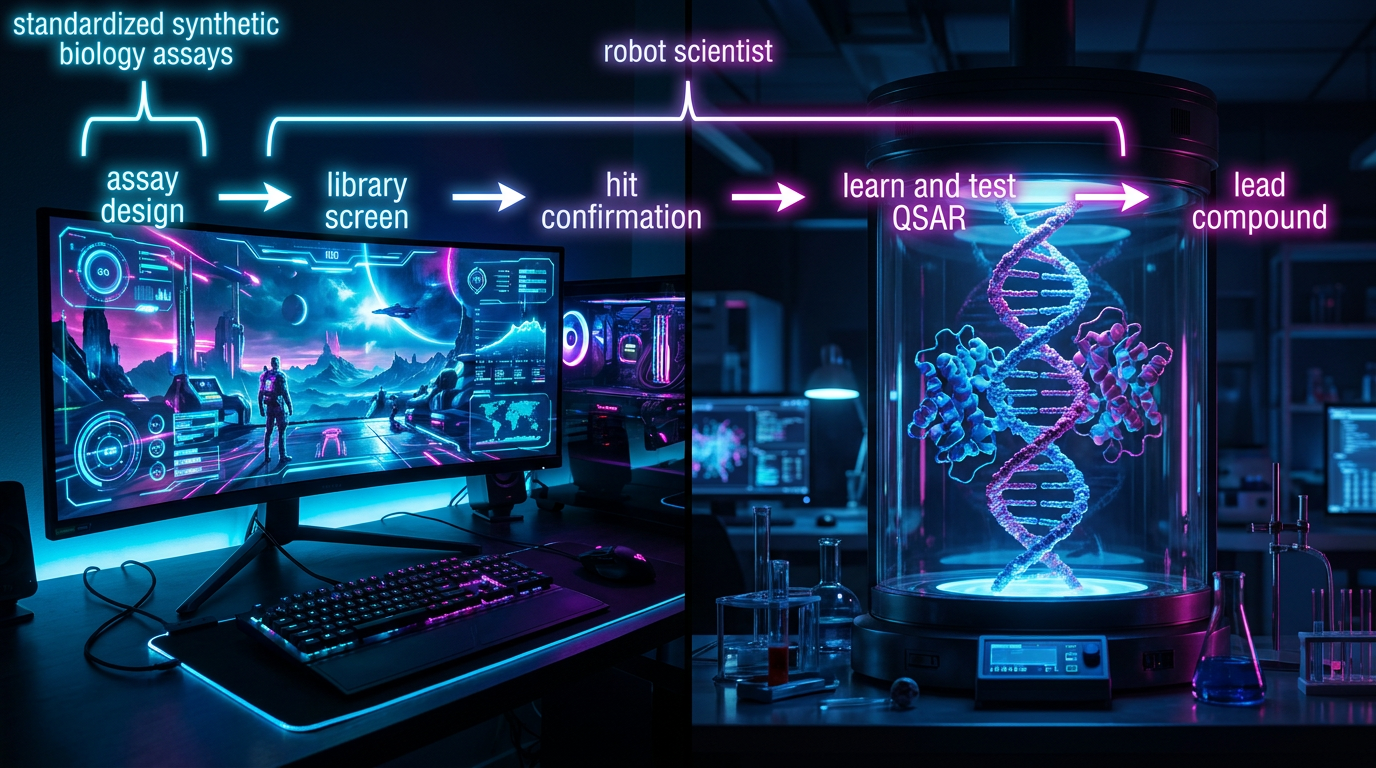
The mechanism behind this collaboration is elegantly simple. Complex scientific challenges—such as mapping the evolutionary history of bacteria or identifying the structure of proteins—are stripped of their academic jargon and translated into intuitive visual puzzles. Players are presented with tasks that look and feel like traditional mini-games, such as aligning colored blocks or tracing patterns, completely unaware that they are manipulating actual DNA sequences or astronomical imagery.[6]
One of the most successful implementations of this concept is "Borderlands Science," a mini-game embedded within the critically acclaimed looter-shooter Borderlands 3. Created through a partnership between Gearbox Entertainment, McGill University, and the Swiss IT company Massively Multiplayer Online Science (MMOS), the initiative invites players to interact with an arcade cabinet inside the game's virtual world.[2][3]

When players engage with the arcade cabinet, they are presented with a Tetris-like puzzle where they must align rows of colored tiles. In reality, these tiles represent the genetic building blocks of different microbes sourced from the American Gut Project. Every time a player successfully aligns a sequence to maximize their high score, they are helping researchers trace the evolutionary relationships of the human microbiome, a critical step in understanding diseases and human health.[1][2]
The sheer scale of the data generated by this gamified approach is staggering. Within its first few months, the Borderlands initiative attracted over 4.5 million participants who collectively generated 50 million puzzle solutions. This volume of work oscillated between 10,000 and 15,000 hours of labor per day, saving medical researchers hundreds of thousands of hours they would have otherwise spent training computers to perform the same tasks.[1][2]
The reliance on human players raises a common question: why can't artificial intelligence and machine learning algorithms handle this data? While AI is exceptionally powerful, human spatial reasoning, intuition, and pattern recognition remain superior for certain complex, ambiguous biological tasks. Humans possess an innate ability to spot visual anomalies and adapt strategies on the fly—skills that algorithms still struggle to replicate when dealing with noisy or imperfect data.[5]
The reliance on human players raises a common question: why can't artificial intelligence and machine learning algorithms handle this data?
This phenomenon was first dramatically proven by "Foldit," an experimental puzzle game developed by the University of Washington. Tasked with predicting the three-dimensional structure of protein molecules, Foldit players were challenged to solve the configuration of a protein-cutting enzyme from an AIDS-like virus. The problem had stumped automated methods and top scientists for 15 years; the gamers, utilizing their collective spatial intuition, produced an accurate model in just three weeks.[4][5]
The success of Foldit paved the way for deeper integrations in massive multiplayer environments. In the sprawling sci-fi universe of EVE Online, developers introduced "Project Discovery," a feature that allowed players to analyze real-world data between space battles. EVE players have successfully analyzed millions of images of cells to map protein structures and have sifted through luminosity data from distant stars to help astronomers locate exoplanets.[6]

For the scientific community, these integrations solve a critical bottleneck. Modern research technologies generate petabytes of data—far more information than the world's limited number of professional scientists can possibly analyze in a lifetime. By crowdsourcing this labor to the gaming community, researchers can process massive datasets at unprecedented speeds, accelerating the pace of discovery across multiple disciplines.[3][7]
Crucially, the data generated by citizen scientists does not just solve immediate problems; it creates a vital feedback loop for the future of artificial intelligence. The millions of puzzle solutions provided by gamers serve as high-quality, human-annotated training data. This data is systematically fed back into machine learning models, fine-tuning algorithms and teaching AI how to better navigate complex biological sequence alignments.[1]
However, the success of these initiatives hinges entirely on game design. If a citizen science mini-game feels like a chore, an educational lecture, or a disruption to the core experience, players will simply ignore it. Developers must ensure that the scientific tasks are genuinely fun and seamlessly integrated into the game's existing reward systems, offering players exclusive loot, character skins, or in-game currency for their contributions.[2][6]
The response from the gaming community has consistently exceeded expectations. Rather than rejecting the inclusion of real-world work in their escapist entertainment, players have embraced the opportunity to contribute to global causes. Dedicated guilds and online communities frequently form around these mini-games, with players sharing strategies and collaborating to optimize their scientific output and climb global leaderboards.[4][7]

As the industry moves deeper into 2026, the perception of video games is fundamentally shifting. Once heavily criticized as isolating or unproductive, the medium is increasingly recognized as a powerful tool for collective action. Major studios are no longer viewing citizen science as a niche public relations stunt, but as a legitimate avenue to leverage their massive cultural footprint for tangible global good.[3][7]
The boundary between digital entertainment and real-world scientific discovery has permanently blurred. By transforming the leisure time of millions into a decentralized engine for research, the gaming industry has proven that the collective power of human play can be harnessed to map the universe, cure diseases, and push the boundaries of human knowledge.[7]
How we got here
2008
The University of Washington releases 'Foldit', an experimental puzzle game focused on protein folding.
2011
Foldit players solve the structure of an AIDS-like retrovirus enzyme in three weeks, a problem that had stumped scientists for 15 years.
2016
EVE Online launches 'Project Discovery', integrating real astronomical and biological data analysis into the massive multiplayer game.
2020
'Borderlands Science' launches within Borderlands 3, quickly becoming one of the most active citizen science initiatives in history.
2026
Citizen science integrations become a recognized industry standard, with millions of players routinely training AI and advancing medical research through AAA titles.
Viewpoints in depth
Scientific Researchers
Scientists view gamers as an untapped, massive resource for data processing.
For the scientific community, the primary bottleneck in modern research is no longer data collection, but data analysis. Projects like the American Gut Project generate petabytes of genetic information that require complex spatial alignment. Researchers argue that human intuition and pattern recognition still outperform automated AI in these specific tasks. By gamifying the process, they can crowdsource hundreds of thousands of hours of labor that would otherwise be impossible to fund or staff.
Game Developers
Studios see citizen science as a way to enrich gameplay and build community.
For AAA game developers, integrating citizen science is a delicate balancing act. The primary goal of a blockbuster game is entertainment; if a mini-game feels like a chore or an educational lecture, player engagement drops. Developers focus on seamlessly weaving these tasks into the game's existing reward loops—offering exclusive loot, character skins, or in-game currency. When done correctly, they argue, it elevates the medium, allowing studios to offer players a sense of real-world purpose alongside digital escapism.
The Gaming Community
Players are highly motivated by the opportunity to contribute to real-world causes.
The response from the gaming community has been overwhelmingly positive, often exceeding the expectations of both scientists and developers. Gamers have formed dedicated guilds and online forums specifically to optimize their scientific output. Many players express that the knowledge of their time directly contributing to cancer research, microbiome mapping, or exoplanet discovery adds a profound layer of satisfaction to their hobby, pushing back against the stereotype of gaming as an isolating or unproductive activity.
What we don't know
- Whether the gamification model can be successfully applied to scientific fields outside of spatial alignment and pattern recognition.
- How long human intuition will continue to outperform AI before machine learning models fully close the gap.
Key terms
- Citizen Science
- Scientific research conducted, in whole or in part, by amateur or nonprofessional scientists, often through crowdsourcing.
- Microbiome
- The combined genetic material of the microorganisms in a particular environment, such as the human gut.
- Protein Folding
- The physical process by which a protein chain acquires its native three-dimensional structure, which dictates its function.
- Sequence Alignment
- A way of arranging the sequences of DNA, RNA, or protein to identify regions of similarity that may indicate functional or evolutionary relationships.
Frequently asked
Do I need to know anything about science to participate?
No. The games are designed to translate complex scientific data into simple visual puzzles, like matching colors or aligning shapes. The game handles the science; you just solve the puzzle.
What kind of research are gamers actually doing?
Players are helping map the human microbiome, folding proteins to understand diseases like HIV and Alzheimer's, and analyzing astronomical data to find exoplanets.
Why can't artificial intelligence just do this?
While AI is powerful, human spatial reasoning and pattern recognition are still superior for certain complex, ambiguous biological tasks. Furthermore, the data generated by human players is actually being used to train the next generation of AI models.
Sources
Source coverage
7 outlets
3 viewpoints surfaced







[1]Nature BiotechnologyScientific Researchers
Largest global citizen science project accelerates knowledge of human microbiome
Read on Nature Biotechnology →[2]McGill UniversityScientific Researchers
Borderlands Science: Mobilizing millions of players for science
Read on McGill University →[3]The ScientistCitizen Scientists & Gamers
Researchers explore how video games can improve scientific understanding
Read on The Scientist →[4]The GuardianCitizen Scientists & Gamers
How gamers are helping science's biggest problems
Read on The Guardian →[5]University of WashingtonScientific Researchers
Gamers solve a decade-old viral protein structure in weeks
Read on University of Washington →[6]Massively Multiplayer Online ScienceGame Developers
Breaking the wall between science and video games
Read on Massively Multiplayer Online Science →[7]Factlen Editorial Team
Synthesis by Factlen editorial team
Read on Factlen Editorial Team →

Every angle. Every day.
Get entertainment stories with full source coverage and perspective breakdowns delivered to your inbox.