
The Box in Plymouth Wins World's Largest Museum Prize for Pioneering Civic Impact
Plymouth's flagship cultural hub, The Box, has been named the Art Fund Museum of the Year 2026, securing a £120,000 prize for its transformative community outreach and £244 million economic impact.
By Factlen Editorial Team
- Civic Cultural Advocates
- Argue that museums must function as active community hubs and drivers of public health.
- Economic Planners
- Focus on the tangible financial returns and regeneration driven by cultural capital investments.
- Progressive Curators
- Value the active reinterpretation of historical archives by contemporary voices and marginalized communities.
What's not represented
- · Traditionalist Historians
- · Local Taxpayers
Why this matters
The Box's victory proves that regional museums can rival capital-city heavyweights by functioning as active community hubs, providing a blueprint for how cultural investments can drive local economies and improve public health.
Key points
- The Box in Plymouth has won the Art Fund Museum of the Year 2026, securing a £120,000 prize.
- The institution beat out major London and Cambridge museums by demonstrating profound civic and community impact.
- Since opening in 2020, The Box has generated a £244 million boost to the local economy and £100 million in health benefits.
- The museum actively engages 89% of Plymouth's schools and partners with marginalized groups to reinterpret its archives.
In a landmark moment for regional cultural institutions, The Box in Plymouth has been crowned the winner of the Art Fund Museum of the Year 2026, securing the world's most lucrative museum prize. The £120,000 award was presented to the institution's chief executive, Victoria Pomery, during a ceremony aboard the Cutty Sark in Greenwich. The Box triumphed over a formidable shortlist of British cultural heavyweights, including London's National Gallery, the V&A East Storehouse, and Cambridge's Fitzwilliam Museum. Broadcaster and judging panel member June Sarpong praised the venue as a revelation that "genuinely belongs to the people it serves," highlighting its ambitious and welcoming approach to curation. The victory signals a broader shift in the UK's cultural landscape, proving that world-class innovation is no longer the exclusive domain of the capital.[1][2][3][5][6]
The Box is not a traditional museum, but rather a hybrid civic space that merges a gallery, a natural history collection, and a city archive under a single roof. Opened in September 2020 following a £48 million capital investment, the institution was built with a clear mandate from Plymouth City Council: to be "nationally known and locally loved." It houses more than two million artworks, historical objects, biological specimens, and archival materials that collectively narrate the complex history of the South West. However, the judges did not award the prize merely for the size or quality of the collection. Instead, the accolade recognizes the underlying mechanism of how The Box operates—transforming static archives into an active engine for community engagement and social cohesion.[1][2][3][4][5]
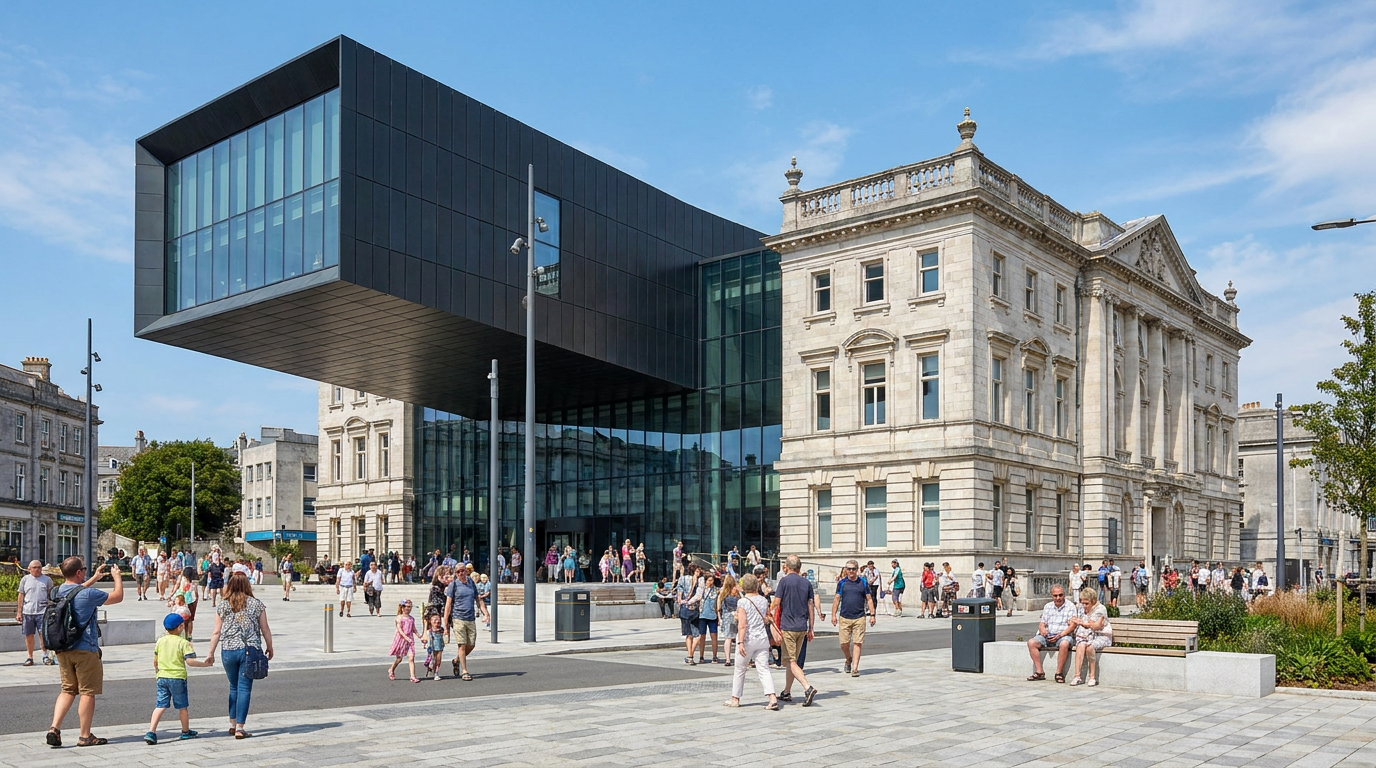
The physical design of The Box serves as a metaphor for its philosophy of transparency and accessibility. Architects transformed the city's former Edwardian museum and library buildings, seamlessly fusing them with a striking contemporary extension characterized by a dramatic cantilevered "box" that seemingly floats above the public plaza. This architectural intervention was not merely aesthetic; it was designed to physically open the institution to the street, removing the intimidating, temple-like facades that often deter marginalized communities from entering traditional museums. The resulting public square has become a natural gathering point in Plymouth, blurring the boundary between the city's daily life and its cultural heritage.[4]
To understand why The Box won, one must look at the empirical evidence of its civic impact, which fundamentally redefines the return on investment for cultural funding. According to a comprehensive social and economic impact report published for its fifth anniversary, the museum has welcomed more than 1.3 million visitors since its doors opened. This footfall has translated into a staggering £244 million boost to Plymouth's local economy, driven by cultural tourism, job creation, and increased spending in surrounding local businesses. For economic planners and local governments, this data provides a compelling proof-of-concept that upfront capital investment in regional arts infrastructure can yield massive, compounding financial returns for a city.[1][2][4][5][6]

Beyond the direct financial metrics, The Box has pioneered a model of cultural health intervention, generating an estimated £100 million in health and wellbeing benefits for the local population. This mechanism operates through targeted community programs, social prescribing initiatives, and the provision of safe, welcoming public spaces that actively combat urban isolation. By partnering with local health authorities and community groups—such as Plymouth's Windrush generation—the museum functions as a piece of social infrastructure rather than just a repository for artifacts. Jenny Waldman, director of the Art Fund and chair of the judges, specifically highlighted this dual social and economic impact as a demonstration of what long-term, sustained investment in culture can achieve.[1][2][3][4][5]
The institution's educational outreach further illustrates its integrated civic model. Rather than relying on the traditional, passive model of occasional school field trips, The Box has embedded itself directly into the region's educational ecosystem. The museum's programming currently reaches 89 percent of all schools in Plymouth, engaging approximately 10,000 children every year. Educators utilize the museum's vast archives to teach everything from local maritime history to complex global trade networks, turning the galleries into an extension of the classroom. This deep, systemic integration ensures that the museum is a daily resource for the next generation, fulfilling its mandate to be a living, breathing part of the city's fabric.[1][2][5][6]
The institution's educational outreach further illustrates its integrated civic model.
Curatorially, The Box has distinguished itself by inviting contemporary artists to interrogate and reframe its historical collections, actively challenging traditional museum narratives. A prime example of this strategy was the 2024–2025 exhibition "When Will We Be Good Enough?" by artist Osman Yousefzada. Yousefzada utilized the museum's artifacts to address and unpack colonial histories, forcing audiences to confront the uncomfortable realities of Britain's imperial past through a localized lens. By handing over curatorial power to external, diverse voices, the museum avoids the trap of institutional neutrality, instead fostering a dynamic and sometimes challenging dialogue with its own archives.[1][2][3][4][5]

This strategy of artistic intervention extended throughout 2025 with highly acclaimed projects that brought the archives directly into the public realm. Artist Jyll Bradley's "Running and Returning" explored innovative ways to make historical records physically and emotionally accessible to modern audiences. Similarly, Jeremy Deller's "Hello Sailor!"—developed in partnership with The Box as part of the National Gallery's bicentenary celebrations—spilled out of the museum's walls to engage the broader public with spectacular joy. These artist-led projects demonstrate a crucial mechanism of modern curatorial practice: historical objects only retain their power when they are actively used, questioned, and recontextualized by the communities that inherit them.[1][2][3][4][5]
The contrast between The Box and its fellow nominees underscores a shifting paradigm in what the Art Fund values. The shortlist included the Fitzwilliam Museum in Cambridge and the National Gallery in London—institutions with globally unparalleled collections of fine art. Yet, the judging panel, led by Jenny Waldman, signaled that the sheer accumulation of masterpieces is no longer sufficient to claim the title of Museum of the Year. By elevating The Box, the Art Fund has explicitly prioritized civic utility, social impact, and audience diversification over traditional metrics of prestige and exclusivity, sending a clear directive to the entire heritage sector.[1][3][5][6]

A critical component of this civic utility is the museum's dedication to representing the full spectrum of Plymouth's demographic makeup. June Sarpong specifically commended The Box's deep partnerships with local grassroots organizations, noting its extensive work with the city's Windrush community. By co-curating oral histories, personal artifacts, and photographic archives with the descendants of Caribbean migrants, the museum ensures that these previously marginalized narratives are permanently inscribed into the official civic record. This participatory approach to archiving shifts the power dynamic, transforming community members from passive subjects of study into active authors of their own history.[1][4]
The integration of the city's archives into the museum space is another radical departure from standard practice. Typically, municipal archives are relegated to dusty, off-site facilities accessed only by academic researchers and genealogists. The Box, however, placed the archive at the physical and conceptual center of the visitor experience. Visitors can seamlessly transition from viewing a contemporary art installation to examining 16th-century maritime logs or mid-century urban planning documents. This cross-pollination encourages everyday citizens to engage with primary source materials, demystifying the historical process and fostering a deeper, more critical understanding of how Plymouth was built and governed over the centuries.[2][4]

The national policy implications of The Box's victory are significant, particularly as the UK government evaluates how to distribute cultural funding outside of London. Museums Minister Baroness Twycross, who recently visited the Plymouth site, called the award a "truly deserved recognition" and praised the institution as a central pillar of the city's cultural life. The success of The Box provides a blueprint for the government's "levelling up" agenda, proving that when regional cities are trusted with major capital investments, they can build institutions that rival, and even surpass, the legacy museums of the capital in terms of innovation and civic utility.[3][4][5][6]
However, the triumph of The Box also highlights a profound uncertainty facing the broader UK cultural sector: the crisis in local government funding. While Plymouth City Council has championed and sustained The Box, many other regional councils are currently facing severe budget deficits, forcing them to slash discretionary spending on arts and heritage. The £48 million initial investment required to launch The Box is a sum that few local authorities could easily muster in the current economic climate. Consequently, while The Box proves that the civic museum model works brilliantly, it remains unclear how easily this success can be replicated in other underfunded municipalities without major central government intervention.[2][4][5][6]
As The Box enters its next chapter, the £120,000 prize money will be deployed to further expand the museum's accessibility initiatives and community outreach programs, ensuring that even more marginalized groups can benefit from its resources. This summer, the venue is set to host a major exhibition dedicated to Gillian Ayres, one of Britain's most influential abstract painters, alongside "Echoes of Us," a showcase featuring works by Barbara Hepworth and Chris Ofili drawn from the Government Art Collection. Ultimately, The Box stands not just as the museum of the year, but as the definitive template for what a 21st-century cultural institution must be: fearless in its curation, deeply embedded in its community, and unapologetically civic.[1][3][4][5]
How we got here
September 2020
The Box opens to the public following a £48 million capital investment and redevelopment.
November 2024
Artist Osman Yousefzada opens an exhibition utilizing the museum's collections to address colonial histories.
September 2025
The Box publishes its five-year impact report, revealing a £244 million boost to the local economy.
June 25, 2026
The Box is crowned Art Fund Museum of the Year, winning the £120,000 prize at a ceremony in Greenwich.
Viewpoints in depth
Civic Cultural Advocates
Argue that museums must function as active community hubs and drivers of public health.
This perspective, championed by organizations like the Art Fund, views the traditional 'treasure house' model of museums as outdated. Advocates argue that cultural institutions must justify their public funding by delivering measurable social interventions, such as combating urban isolation and supporting mental health through social prescribing. They point to The Box's £100 million in wellbeing benefits as proof that museums are essential social infrastructure, not just tourist attractions.
Economic Planners
Focus on the tangible financial returns and regeneration driven by cultural capital investments.
For local governments and urban developers, cultural institutions are evaluated as economic engines. This camp highlights The Box's £244 million contribution to Plymouth's economy as a textbook example of successful regeneration. They argue that upfront capital investments in the arts—like the £48 million spent to build The Box—pay for themselves by driving footfall, creating local jobs, and stimulating secondary spending in the surrounding hospitality and retail sectors.
Progressive Curators
Value the active reinterpretation of historical archives by contemporary voices and marginalized communities.
This viewpoint emphasizes the intellectual and curatorial risks taken by institutions. Progressive curators argue that holding two million artifacts is meaningless unless those objects are actively used to challenge dominant historical narratives. They celebrate The Box for handing curatorial power to contemporary artists and grassroots groups—such as the Windrush community—allowing them to reframe colonial histories and democratize the city's archives.
What we don't know
- Whether the £48 million capital investment model used to build The Box can be replicated by other UK councils currently facing severe budget deficits.
- How the new government will adjust national cultural funding policies to better support regional institutions outside of London.
Key terms
- Civic Museum
- A museum model that prioritizes active community engagement, social welfare, and local economic impact over the passive storage of historical artifacts.
- Art Fund Museum of the Year
- The world's largest and most prestigious museum prize, awarding £120,000 annually to a UK institution demonstrating exceptional innovation and impact.
- Social Prescribing
- A healthcare practice where medical professionals refer patients to local, non-clinical services—such as museum programs or community groups—to improve mental health and wellbeing.
- Capital Investment
- Large-scale, upfront funding used to build or significantly upgrade physical infrastructure, such as the £48 million used to create The Box.
Frequently asked
What is The Box in Plymouth?
The Box is a major cultural institution that combines a museum, gallery, and city archive. It opened in 2020 following a £48 million redevelopment.
Why did The Box win Museum of the Year?
Judges praised its ambitious community outreach, its £244 million boost to the local economy, and its innovative exhibitions that reframe traditional historical narratives.
How much is the Art Fund Museum of the Year prize?
The winning institution receives £120,000, making it the largest museum prize in the world.
Who were the other finalists for the 2026 award?
The shortlist included the National Gallery, the V&A East Storehouse, the Fitzwilliam Museum, and Norwich Castle Museum & Art Gallery.
Sources
Source coverage
6 outlets
3 viewpoints surfaced





[1]The GuardianCivic Cultural Advocates
Plymouth's the Box wins 2026 Art Fund museum of the year award
Read on The Guardian →[2]The Art NewspaperProgressive Curators
The Box in Plymouth, 'a welcoming space' which 'reaches beyond its walls', wins UK Art Fund's Museum of the Year prize
Read on The Art Newspaper →[3]Art FundCivic Cultural Advocates
The Box in Plymouth announced as Art Fund Museum of the Year 2026
Read on Art Fund →[4]Plymouth City CouncilEconomic Planners
The Box Plymouth wins Art Fund Museum of the Year 2026
Read on Plymouth City Council →[5]FAD MagazineProgressive Curators
The Box Plymouth Wins Art Fund Museum of the Year 2026
Read on FAD Magazine →[6]Arts ProfessionalCivic Cultural Advocates
Plymouth's The Box named Art Fund Museum of the Year
Read on Arts Professional →

Every angle. Every day.
Get culture stories with full source coverage and perspective breakdowns delivered to your inbox.