
Vice President Vance Dismisses Watergate Scandal, Claims 'Deep State' Targeted Nixon
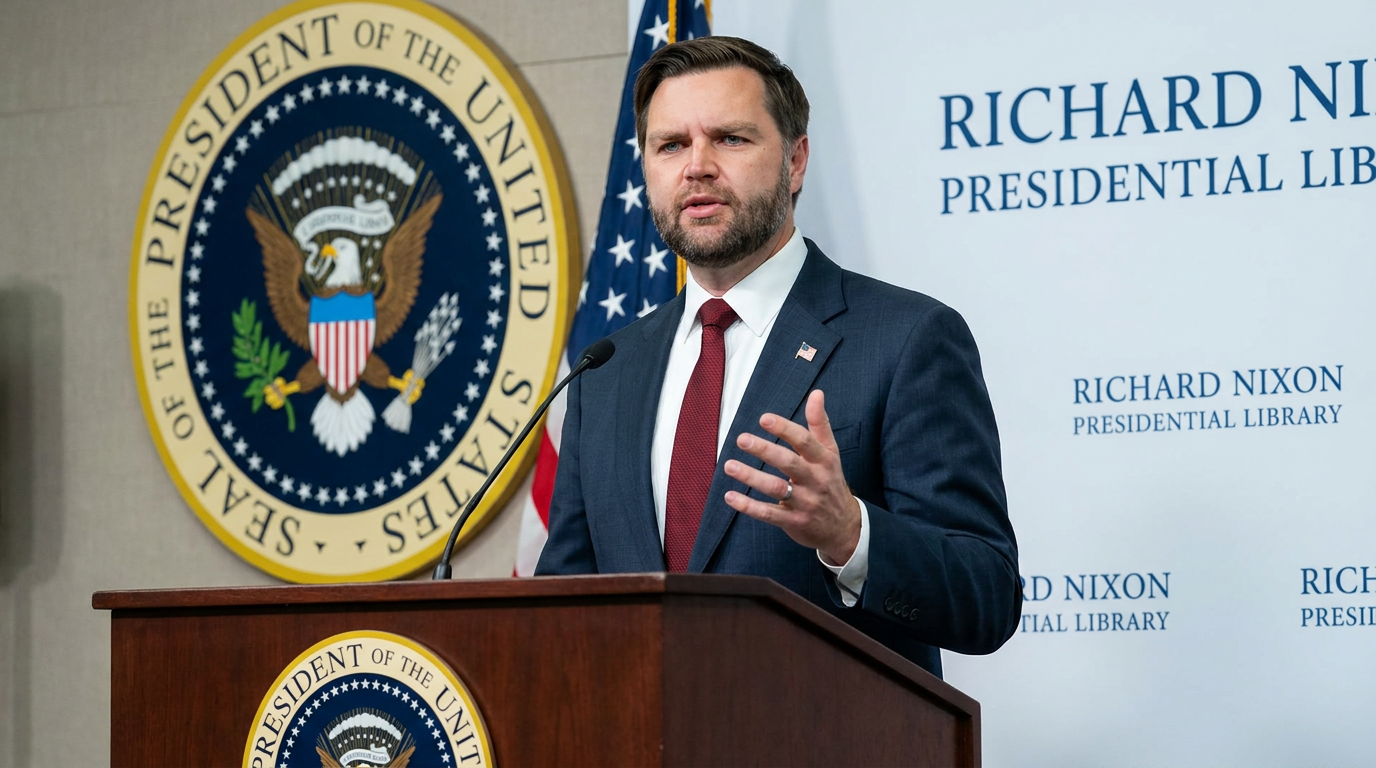
Speaking at the Richard Nixon Presidential Library, Vice President JD Vance argued that the Watergate scandal would only be a '12-hour news story' today and claimed both Nixon and Donald Trump were victims of a 'deep state' apparatus.
By Factlen Editorial Team
- Institutionalist Watchdogs
- Emphasize the historical gravity of Watergate and the danger of eroding presidential accountability.
- Populist Conservatives
- Argue that the federal bureaucracy and media unfairly target conservative presidents like Nixon and Trump.
- Neutral Observers
- Focus on the political strategy behind Vance's remarks and the factual details of the event.
What's not represented
- · Former Nixon Administration Officials
- · Good Government Advocates
Why this matters
The Vice President's remarks represent a significant effort by the current administration to rewrite the historical consensus on presidential accountability. By framing the most consequential political scandal of the 20th century as institutional overreach, the administration is laying rhetorical groundwork to delegitimize ongoing and future investigations into executive power.
Key points
- Vice President JD Vance claimed the Watergate scandal would only be a '12-hour news story' in today's media environment.
- Speaking at the Nixon Presidential Library, Vance argued that both Richard Nixon and Donald Trump were targeted by a hostile 'deep state.'
- Vance drew personal parallels between himself and Nixon, noting they both served as young senators from California and vice presidents.
- He praised Nixon's handling of the Vietnam War, comparing it favorably to the current administration's military objectives in Iran.
- Historians warn that reframing Watergate undermines the post-1974 consensus on presidential accountability and institutional independence.
Vice President JD Vance has ignited a fierce historical and political debate by asserting that the Watergate scandal—widely considered the defining American political crisis of the 20th century—would barely register in today's hyper-partisan media environment. Speaking to an audience at the Richard Nixon Presidential Library and Museum in Yorba Linda, California, Vance argued that the infamous break-in and subsequent cover-up would amount to little more than a "12-hour news story" if it occurred today. Dismissing the severity of the constitutional crisis that gripped the nation in the 1970s, the Vice President called the idea that such an event forced a presidential resignation "crazy." His remarks represent a stark departure from the traditional bipartisan consensus that views Watergate as a necessary and triumphant exercise of the American system of checks and balances.[1][2][3]
The Vice President's provocative historical assessment came during a promotional event for his new book, Communion, where he initially discussed his personal spiritual journey from atheism to Catholicism before pivoting to a sympathetic defense of the 37th president. Vance suggested to the gathered crowd that Nixon's legacy is currently enjoying a rightful "renaissance," arguing that modern political lenses offer a more forgiving view of his tenure. Rather than focusing on the criminal obstruction of justice that defined Nixon's downfall, Vance explicitly framed the former president's political demise as the result of an institutional coup orchestrated by unelected bureaucrats and a hostile press corps.[2][3][4]
Drawing a direct line between the political battles of the 1970s and the modern era, Vance argued that the forces that ousted Nixon are the exact same entities that opposed Donald Trump. "If you look at the story of how the 'deep state' took down Richard Nixon, it's not all that different from what the same groups of people, the same institutions tried to do to Donald Trump in the first Trump administration," Vance told the applauding audience. "There is a parallel." By linking the two presidents, Vance effectively cast both men as victims of a sprawling, unaccountable federal apparatus rather than leaders held accountable for their own executive overreach.[1][4][5]

Beyond defending Nixon's embattled record, Vance drew striking personal comparisons between himself and the disgraced former president. Noting that Nixon also served as a young, polarizing Republican senator from California before ascending to the vice presidency at the age of 40, Vance highlighted their shared political trajectories and mutual disdain for the mainstream press. "Young senator, vice president, writes some bestselling books, is hated by the media," Vance mused from the podium. "It kind of sounds like JD Vance. I've always liked Richard Nixon." The comparison notably omitted the role Nixon is most famous for—the presidency itself—while cementing Vance's alignment with Nixon's combative political style.[1][2][3]
Beyond defending Nixon's embattled record, Vance drew striking personal comparisons between himself and the disgraced former president.
Vance also used the Yorba Linda address to connect Nixon's foreign policy achievements to the current administration's ongoing military engagements overseas. He specifically praised Nixon for extracting the United States from the quagmire of the Vietnam War from a "position of strength," drawing a deliberate parallel to President Trump's current military campaign against Iran. Vance argued that true leadership involves defining a clear, uncompromising objective, accomplishing that specific goal, and preventing the kind of "mission creep" that transforms a hard-won victory into a protracted defeat. This framing attempts to elevate Nixon's diplomatic and military record above the domestic scandals that ultimately defined his administration.[1][3]
The Vice President's comments strike at the heart of the post-Watergate consensus, which has long held that the scandal was a vital stress test of American democracy. The crisis, which began with a botched 1972 burglary at the Democratic National Committee headquarters by operatives tied to Nixon's reelection campaign, culminated in August 1974 when Nixon resigned to avoid certain impeachment. The fallout from the scandal prompted a generation of sweeping reforms intended to rein in presidential authority, including the establishment of greater independence for government watchdogs, inspectors general, and the Department of Justice.[3][4][6]

Historians and political analysts view Vance's remarks not as an offhand historical observation, but as part of a broader, calculated effort by the Trump administration and its allies to rewrite the public understanding of executive accountability. By reframing Watergate as a cautionary tale of institutional overreach and "deep state" sabotage rather than a catastrophic failure of presidential integrity, the administration is actively challenging the legitimacy of the very mechanisms designed to police the Oval Office. This rhetorical groundwork serves to insulate the current executive branch from ongoing and future investigations by casting all institutional scrutiny as inherently partisan.[1][5][6]
President Trump himself has previously expressed sympathy for Nixon's plight, suggesting in past statements that the 37th president "may" have been innocent of the charges that drove him from office. This shared rhetorical alignment with Nixon bolsters the administration's overarching narrative that established government institutions are fundamentally hostile to conservative leaders and must be systematically dismantled or brought to heel. By normalizing the idea that Nixon was wronged, Vance and Trump are attempting to shift the Overton window regarding what constitutes acceptable presidential conduct and what qualifies as an illegitimate investigation.[3][5]
Following the event, the Vice President's office did not immediately respond to requests for clarification regarding whether Vance was speaking facetiously about the 12-hour lifespan of a modern Watergate, nor did they provide his specific definition of the scandal's scope. However, his unprompted, full-throated defense of Richard Nixon underscores a growing and powerful sentiment among modern populist figures: that the traditional boundaries of presidential authority, and the unelected institutions designed to enforce them, are fundamentally illegitimate and ripe for dismantling.[1][5]
How we got here
June 1972
Five men are arrested for breaking into the Democratic National Committee headquarters at the Watergate complex.
August 1974
Facing certain impeachment for his role in the cover-up, President Richard Nixon resigns from office.
December 2019
Donald Trump is impeached for the first time, an event his allies frequently compare to the investigations of Nixon.
June 2026
Vice President JD Vance delivers a speech at the Nixon Library, claiming the 'deep state' took down Nixon and defending his legacy.
Viewpoints in depth
Trump Administration Allies
Argue that entrenched government institutions unfairly target conservative leaders.
This camp views the federal bureaucracy, intelligence agencies, and the mainstream media as a hostile 'deep state' that actively works to undermine populist or conservative presidents. By rehabilitating Richard Nixon's image, they aim to demonstrate that the tactics used against Donald Trump—such as impeachment proceedings and special counsel investigations—are part of a long-standing historical pattern of institutional overreach rather than legitimate mechanisms of accountability.
Historical and Legal Consensus
Maintain that Watergate was a necessary and justified check on presidential abuse of power.
Mainstream historians, legal scholars, and institutionalists view Watergate as the ultimate proof that the American system of checks and balances works. They argue that Nixon's orchestration of a criminal cover-up and his attempts to weaponize federal agencies against political opponents were severe constitutional violations. From this perspective, dismissing the scandal as a mere media phenomenon dangerously undermines the legal precedents and watchdog reforms established in its wake.
What we don't know
- It remains unclear if Vance's remarks signal a formal administration push to dismantle post-Watergate institutional reforms, such as the independence of inspectors general.
- The Vice President's office has not clarified whether Vance was speaking hyperbolically or offering a literal assessment of the Watergate break-in and cover-up.
Key terms
- Watergate
- A major political scandal in the 1970s involving a break-in at the Democratic National Committee headquarters and the subsequent cover-up by the Nixon administration.
- Deep State
- A political conspiracy theory alleging that a clandestine network of entrenched federal employees and intelligence officials operates independently of elected leadership to influence state policy.
- Mission Creep
- The gradual broadening of a military or political campaign's original objectives, often leading to long-term entanglements.
- Inspector General
- An independent official within a government agency responsible for auditing operations to prevent and detect fraud, waste, and abuse.
Frequently asked
What exactly did JD Vance say about Watergate?
Vance stated that if the Watergate scandal happened today, it would be a '12-hour news story,' and called the idea that it took down a presidency 'crazy.'
Why did Vance compare Nixon to Trump?
Vance argued that both presidents were victims of a 'deep state' apparatus—a coalition of hostile government institutions and media organizations that sought to undermine their administrations.
What were the actual consequences of the Watergate scandal?
The scandal led to the resignation of President Richard Nixon in 1974 and prompted sweeping reforms designed to limit presidential power and increase government transparency.
Sources
Source coverage
6 outlets
3 viewpoints surfaced






[1]The Washington PostInstitutionalist Watchdogs
Vance dismisses Watergate scandal, says 'deep state' went after Nixon
Read on The Washington Post →[2]Associated PressNeutral Observers
Vance, an admirer of Richard Nixon, says Watergate would be 'a 12-hour news story' today
Read on Associated Press →[3]The GuardianInstitutionalist Watchdogs
JD Vance claims Watergate would be '12-hour news story' today
Read on The Guardian →[4]National PostNeutral Observers
JD Vance calls it 'crazy' that Watergate toppled Nixon, blames 'deep state'
Read on National Post →[5]Sunday Guardian LiveNeutral Observers
US Vice President JD Vance sparks debate by claiming Watergate would be a '12-hour news story'
Read on Sunday Guardian Live →[6]CityNewsNeutral Observers
Vance, an admirer of Richard Nixon, says Watergate would be 'a 12-hour news story' today
Read on CityNews →

More in news politics
See all 6 stories →Defense Tech
SpaceX Clashes With Pentagon Over Starlink Use in Military Drone Strikes
7 sources

Taiwan Strait
Taiwan Simulates Countering Chinese Maritime Blockade in Major Defense Exercise
8 sources

NATO Security
Poland Warns Russia May Stage 'False Flag' Operation to Justify Attack on NATO Territory — As US Troops Rotate In
7 sources

Military Health
Pentagon Restores Mandatory Flu Shots for Recruits Following Deadly Base Outbreak
6 sources

Every angle. Every day.
Get news politics stories with full source coverage and perspective breakdowns delivered to your inbox.