
100-Fold Lifetime Boost Turns Magnons Into Durable Quantum Information Carriers
Physicists have extended the lifespan of magnons to 18 microseconds, a nearly 100-fold increase that transforms the fleeting magnetic waves into robust carriers of quantum information. The breakthrough overcomes a major hurdle in quantum computing, paving the way for highly compact, chip-based quantum processors.
By Factlen Editorial Team
- Solid-State Physicists
- Argue that magnons are the most promising quasiparticle for quantum interconnects due to their wave-like behavior and nanometer scalability.
- Materials Engineers
- View the breakthrough as a mandate to refine synthesis techniques, focusing on eliminating trace contaminants in ferromagnetic crystals to push lifetimes even higher.
- Quantum Network Architects
- Value magnons primarily for their ability to act as universal translators, bridging the gap between microwave qubits and optical photons in hybrid systems.
What's not represented
- · Commercial quantum computing manufacturers
- · Cryogenics engineers
Why this matters
Current quantum computers require massive, complex cooling systems and struggle with wiring bottlenecks as they scale. By proving that magnons can reliably store and transmit quantum data, this discovery opens the door to building powerful quantum processors that fit on a chip no larger than a one-cent coin.
Key points
- Physicists have extended the lifetime of magnons to 18 microseconds, a nearly 100-fold increase over previous records.
- Magnons are quasiparticles representing magnetic waves, highly sought after for their ability to transmit quantum data on a microscopic scale.
- The breakthrough was achieved by cooling ultra-pure yttrium iron garnet spheres to 30 millikelvin and exciting short-wavelength magnons.
- The research proves that magnon lifespan is limited by material purity rather than fundamental physics, opening the door to further improvements.
- Durable magnons could serve as a 'quantum bus,' connecting hundreds of qubits and enabling quantum computers the size of a coin.
The physical reality of today's quantum computers is a far cry from the sleek silicon chips that power modern smartphones. Leading quantum processors are massive, chandelier-like structures suspended in cryogenic vats, plagued by a "wiring bottleneck" where each delicate qubit requires its own dedicated control line.[4]
To build a quantum computer that can scale to millions of qubits, engineers need a "quantum bus"—a reliable, microscopic highway capable of shuttling quantum information across a chip without losing its fragile state. For decades, physicists have theorized that tiny magnetic waves called magnons could serve this exact purpose.[2]
But there was a fatal flaw in the magnon blueprint: they vanished almost as soon as they were created. Until now, the lifespan of a magnon was limited to a few hundred nanoseconds, rendering them far too ephemeral to perform complex quantum operations or transmit data over meaningful distances.[1]
That fundamental barrier has just been shattered. In a landmark study published in Science Advances, an international team of physicists led by the University of Vienna has successfully extended the lifetime of magnons to 18 microseconds.[1][2]

This nearly 100-fold increase transforms magnons from fleeting, lossy signals into highly durable carriers of quantum information. At 18 microseconds, magnon coherence is now on par with the superconducting qubits used in the world's most advanced quantum processors.[3]
"In this state, magnons are no longer fleeting signals, but become long-lived, reliable carriers of quantum information," the University of Vienna research team noted, suggesting the breakthrough could eventually enable quantum computers the size of a one-cent coin.[2]
To understand the magnitude of this leap, it helps to understand what a magnon actually is. Unlike an electron or a photon, a magnon is a "quasiparticle." It is a collective excitation—a wave of magnetization that ripples through the spin lattice of a solid magnetic material, much like a wave spreading across the surface of a pond after a stone is dropped.[4][6]
To understand the magnitude of this leap, it helps to understand what a magnon actually is.
Because magnons travel exclusively within solid materials, their wavelengths can be compressed down to the nanometer scale. This makes them incredibly attractive for chip-based quantum circuits, as they do not require the bulky vacuum spaces or optical fibers needed to transmit photons.[2]
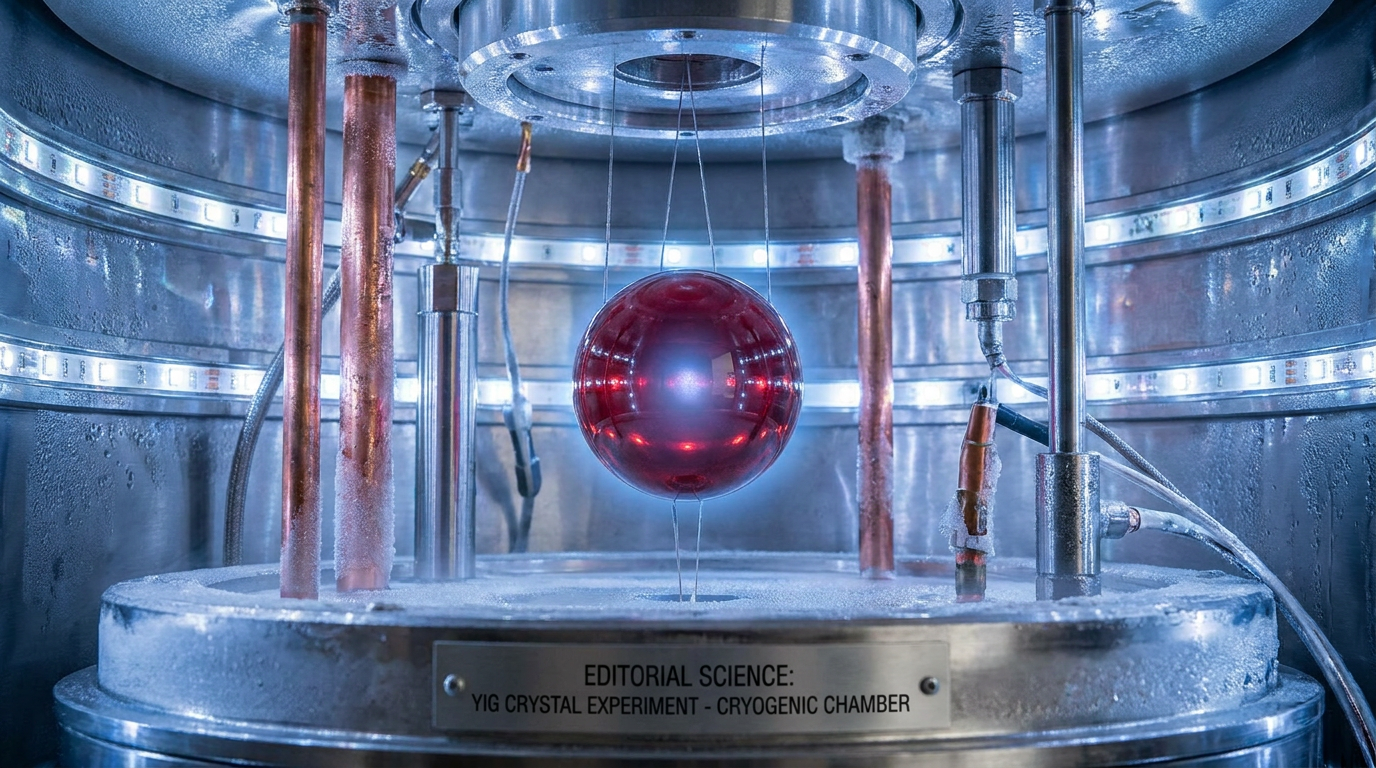
To achieve the unprecedented 18-microsecond lifespan, the research team turned to yttrium iron garnet (YIG), a synthetic ferromagnetic material prized for its exceptionally low energy dissipation. They fabricated ultra-pure, millimeter-sized spheres of YIG and placed them inside a mixed-phase cryostat.[1][5]

The environment was cooled to an astonishing 30 millikelvin—a fraction of a degree above absolute zero. At these ultra-cold temperatures, the thermal "noise" that normally disrupts quantum states is almost entirely suppressed, allowing the researchers to isolate and measure individual magnon excitations.[3]
The crucial innovation, however, lay in how the magnons were generated. Previous experiments typically relied on uniform, long-wavelength magnons, which are highly susceptible to microscopic defects on the surface of the YIG crystal. When these waves hit a surface imperfection, they scatter and die.[1]
The Vienna team bypassed this issue by intentionally exciting short-wavelength magnons. Because these tighter waves propagate deeper within the bulk of the crystal, they naturally avoid the treacherous surface defects that had doomed previous experiments to the nanosecond regime.[1][3]

The results revealed a profound shift in how physicists view magnon decay. The researchers discovered that below 100 millikelvin, the magnon lifetime plateaued. The decay was no longer dictated by immutable laws of quantum mechanics or thermodynamics, but entirely by the microscopic purity of the YIG crystal itself.[2]
This discovery effectively downgrades a fundamental physics roadblock into a materials engineering challenge. "Even the least pure sample surpassed all previous records," the researchers observed, proving that as materials science yields even purer synthetic garnets, magnon lifetimes will only continue to climb.[1][5]
Beyond serving as a quantum bus, durable magnons offer a secondary superpower: they are universal translators. Because they exist as physical vibrations within a solid, magnons naturally couple to a wide variety of other quantum systems, including microwave photons, acoustic phonons, and electron spins.[3][6]

In a hybrid quantum architecture, a magnon could receive a signal from a superconducting qubit, translate it into an optical photon, and send it across a fiber-optic network. By bridging the gap between incompatible technologies, magnons could become the connective tissue of the future quantum internet.[4][6]
How we got here
2013–2020
Early experiments demonstrate the generation of single magnons, but lifetimes remain trapped in the nanosecond range.
2021–2024
Theoretical models propose that short-wavelength magnons could avoid surface defects, but experimental verification at quantum limits remains elusive.
May 2026
University of Vienna physicists successfully measure 18-microsecond magnon lifetimes in ultra-pure YIG spheres at 30 millikelvin.
Viewpoints in depth
Quantum Hardware Engineers
Focus on the 'quantum bus' and solving the wiring bottleneck.
For engineers tasked with scaling quantum computers from hundreds of qubits to millions, the primary adversary is the wiring bottleneck. Current superconducting architectures require dedicated control lines for nearly every qubit, leading to massive thermal loads and physical crowding. This camp views the 18-microsecond magnon as the ultimate solution: a microscopic, on-chip 'quantum bus' that can route information between distant qubits without requiring bulky external wiring. If magnons can reliably hold state for 18 microseconds, they provide ample time to execute complex logic gates across a shared network.
Materials Scientists
Focus on the shift from fundamental physics limitations to a purity and engineering challenge.
To materials scientists, the most significant revelation of the Vienna study is that magnon decay at millikelvin temperatures is not governed by an inescapable law of quantum mechanics, but by crystal impurities. By proving that even the least pure samples of yttrium iron garnet outlasted previous records when short-wavelength magnons were used, the research shifts the burden of progress onto materials engineering. This camp is now focused on refining synthesis techniques to eliminate trace contaminants, theorizing that perfectly pure ferromagnetic crystals could push magnon lifetimes into the millisecond regime.
Hybrid Architecture Theorists
Focus on magnons as universal translators between disparate quantum systems.
Theorists designing the future 'quantum internet' face a translation problem: the superconducting qubits that excel at processing information operate at microwave frequencies, while the photons needed to transmit that information long distances operate at optical frequencies. This camp values magnons for their unique ability to couple to both. Because a magnon is a physical vibration within a solid lattice, it can interact with microwave photons, acoustic phonons, and electron spins alike. Theorists argue that durable magnons will serve as the essential 'universal translators' in hybrid systems, seamlessly converting data between processing nodes and transmission networks.
What we don't know
- Whether the 18-microsecond lifetime can be maintained when the YIG crystal is integrated into a complex, multi-component quantum circuit.
- How quickly materials scientists can develop even purer ferromagnetic crystals to push magnon lifetimes into the millisecond range.
- Whether magnons can be effectively controlled and routed at scale without introducing new sources of thermal noise.
Key terms
- Magnon
- A quasiparticle representing a collective wave of magnetization rippling through the spin lattice of a solid material.
- Quasiparticle
- A disturbance or excitation in a medium that behaves like a distinct particle, used to simplify complex quantum interactions.
- Yttrium Iron Garnet (YIG)
- A synthetic ferromagnetic crystal prized in quantum physics for its exceptionally low energy dissipation and magnetic properties.
- Superconducting Qubit
- The fundamental unit of quantum information used in most of today's leading quantum computers, relying on zero electrical resistance.
- Millikelvin
- A unit of temperature equal to one-thousandth of a degree above absolute zero, required to suppress thermal noise in quantum experiments.
- Quantum Bus
- A proposed communication channel capable of shuttling quantum information between multiple qubits without destroying their fragile states.
Frequently asked
Why are magnons better than photons for quantum computing?
While photons are excellent for long-distance communication, they require bulky optical fibers or empty space. Magnons travel exclusively within solid materials, allowing their circuits to be scaled down to the nanometer level.
What was causing magnons to die so quickly before?
Previous experiments relied on long-wavelength magnons, which frequently collided with microscopic defects on the surface of the crystal, causing them to scatter and lose their quantum state.
Does this mean we will have coin-sized quantum computers soon?
Not immediately. While this breakthrough proves the fundamental viability of a chip-scale 'quantum bus,' engineers still need to integrate these magnon pathways with actual qubits and control systems.
Sources
Source coverage
6 outlets
3 viewpoints surfaced






[1]Science AdvancesSolid-State Physicists
Ultralong-living magnons in the quantum limit
Read on Science Advances →[2]University of ViennaQuantum Network Architects
Magnons: A hundredfold longer lifetime paves the way for a quantum computer on a chip
Read on University of Vienna →[3]arXivSolid-State Physicists
Ultralong-living magnons in the quantum limit
Read on arXiv →[4]Applied Physics LettersMaterials Engineers
Yttrium iron garnet films for quantum magnonics
Read on Applied Physics Letters →[5]NatureQuantum Network Architects
Quantum magnonics: The quantum states of magnons and their hybridization
Read on Nature →[6]Factlen Editorial TeamQuantum Network Architects
Synthesis by Factlen editorial team
Read on Factlen Editorial Team →
Every angle. Every day.
Get science stories with full source coverage and perspective breakdowns delivered to your inbox.