
Turnkey vs. Fixer-Upper: Weighing the True Costs of Homeownership in 2026
As housing inventory remains tight, buyers face a critical choice between paying a premium for move-in ready homes or taking on the unpredictable costs of a renovation project.
By Factlen Editorial Team
- Turnkey Advocates
- Value immediate comfort, predictable costs, and minimal stress over maximum financial leverage.
- Sweat-Equity Investors
- Value lower purchase prices, deep customization, and building wealth through forced appreciation.
- Real Estate Analysts
- Focus on market dynamics, financing hurdles, and the mathematical realities of resale value.
What's not represented
- · General Contractors
- · Local Zoning Boards
Why this matters
Choosing the right property type dictates not just your initial mortgage, but your weekend free time, your emergency fund requirements, and your long-term equity growth.
Key points
- Turnkey homes offer immediate comfort and predictable costs but carry a 10% to 20% price premium.
- Fixer-uppers provide a lower entry price and the opportunity to build forced appreciation through strategic renovations.
- Renovation projects frequently encounter unexpected expenses, requiring a minimum 20% cash contingency fund.
- Financing options differ significantly, with turnkey properties easily qualifying for standard mortgages while fixer-uppers often require specialized loans.
The 2026 real estate market presents a classic dilemma for prospective homeowners and investors alike: pay a premium for a pristine, move-in ready property, or hunt for a discount on a home that requires significant work. With housing inventory still tight in many desirable neighborhoods, buyers are forced to weigh their budget constraints against their tolerance for stress and construction delays.[8]
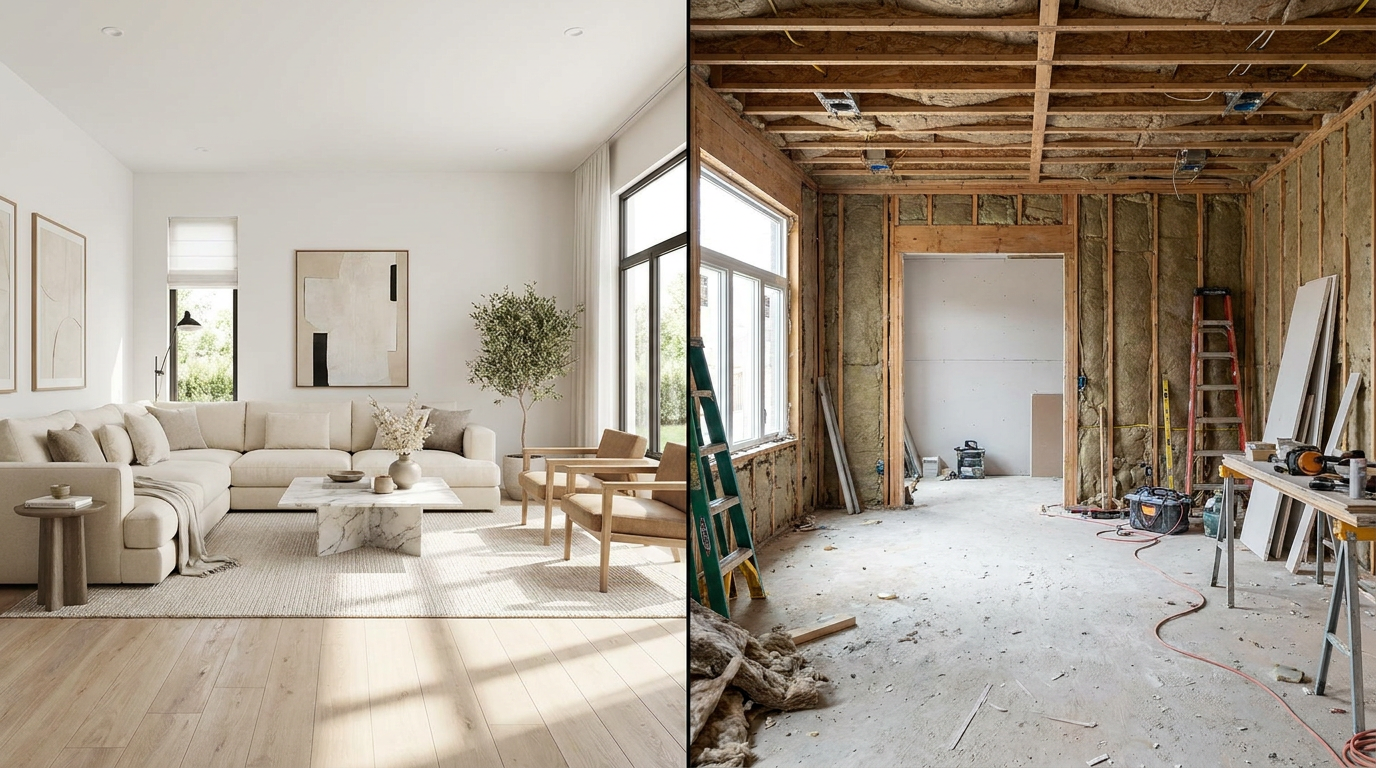
At one end of the spectrum is the turnkey home. By definition, a turnkey property is in excellent condition, requiring no immediate repairs, renovations, or updates before move-in. The roof is sound, the HVAC system is modern, and the cosmetic finishes align with current design trends. Buyers literally just need to turn the key in the front door and begin living.[1]
At the opposite end is the fixer-upper. These properties range from homes needing minor cosmetic updates—like fresh paint and new flooring—to total gut rehabilitations requiring structural, electrical, and plumbing overhauls. They are often described as diamonds in the rough, offering a blank canvas for buyers willing to put in the sweat equity to realize a property's full potential.[3][5]
The primary argument for the turnkey approach centers on immediate comfort and predictable costs. Buyers avoid the stress of managing contractors, securing permits, and living in a dusty construction zone. For real estate investors, turnkey properties offer the distinct advantage of immediate cash flow, as the home can be rented out to tenants on day one without waiting for rehabilitation work to conclude.[1][6]
Conversely, the most significant drawback to buying turnkey is the financial premium. Sellers and developers price these homes to recoup their renovation costs plus a healthy profit margin. Buyers typically pay a 10% to 20% premium for this convenience compared to unrenovated homes in the same area. Furthermore, buyers inherit someone else's design choices, which may result in a generic aesthetic that lacks personal character.[1][2]

Market evidence supporting the turnkey premium is clear in competitive regions. Move-in ready homes attract the largest pool of potential buyers, frequently resulting in multiple-offer scenarios that drive the final sale price even higher. Buyers are essentially paying a disruption tax to skip the headaches of renovation, trading potential upside for absolute predictability.[5][6]
On the other side of the debate, the core argument for a fixer-upper is financial leverage and customization. Fixer-uppers generally list for 10% to 20% below market value, and in some cases, an equivalent non-distressed fixer-upper can offer a 25% to 50% discount over a fully ready turnkey property. This lower entry point allows buyers to access desirable neighborhoods that might otherwise be entirely out of their budget.[2][6]
On the other side of the debate, the core argument for a fixer-upper is financial leverage and customization.
The primary arguments against the fixer-upper approach highlight budget overruns and timeline delays. Once walls are opened, contractors frequently discover hidden issues like outdated wiring, plumbing leaks, or structural rot. Industry experts recommend maintaining a minimum 20% cash cushion specifically for these unintended expenses. Additionally, supply chain bottlenecks and labor shortages can stretch a three-month project into a year-long ordeal.[3][4]
The evidence for fixer-uppers highlights the power of forced appreciation. According to recent remodeling impact data, homeowners who complete strategic renovations recover an average of 60% to 75% of their project costs at resale. If the purchase price plus renovation costs and a contingency fund is at least 10% to 15% less than a comparable turnkey home, the fixer-upper is mathematically a sound investment.[2]

Financing these two paths also presents a stark contrast. Turnkey homes easily qualify for standard conventional or FHA mortgages, and investors can often secure Debt Service Coverage Ratio (DSCR) loans based on the property's immediate rental potential. The lending process is straightforward because the asset is already in prime condition and poses minimal risk to the bank.[7]
Conversely, financing a fixer-upper can be complex. Traditional lenders may balk at properties with safety issues or missing infrastructure. Buyers often must rely on specialized renovation loans—like the FHA 203(k)—or short-term hard money loans, which carry significantly higher interest rates and require strict project oversight to ensure the renovations are completed to code.[4][7]
The decision ultimately hinges on a buyer's lifestyle bandwidth. Taking on a renovation means dedicating evenings and weekends to selecting materials, answering contractor questions, and managing the inevitable decision fatigue. For families, living through a major renovation can be highly disruptive, sometimes necessitating the cost of a short-term rental elsewhere while the heavy construction takes place.[4]

When evaluating which path fits best, a turnkey property is the ideal choice when you have limited time, lack renovation experience, or need to move in immediately. It is also highly recommended for out-of-state buyers or passive investors who want to hand the keys directly to a property management company without overseeing a complex rehabilitation project from afar.[1][6]
However, the turnkey route does not fit well if you are on a tight budget and trying to maximize your purchasing power. It also frustrates buyers who have a highly specific design vision, as tearing out brand-new, builder-grade finishes to install custom materials makes little financial sense and destroys the premium you just paid for.[1][2]
A renovation project fits perfectly when you are buying in a highly desirable neighborhood where move-in ready homes are financially out of reach. It works best for buyers who have substantial cash reserves for surprises, possess a clear vision for the space, and plan to stay in the home for at least five to seven years to ride out market fluctuations and recoup their investment.[2][3]

Conversely, you should walk away from a fixer-upper if the home has severe foundational, environmental, or structural issues that will consume your budget without adding visible value. It is also the wrong choice if you are stretching your budget just to make the down payment, leaving no safety net for the inevitable unexpected repair costs that come with older homes.[2][3]
Viewpoints in depth
Turnkey Advocates
Argue that time is money and the disruption tax is worth paying.
This camp emphasizes that the true cost of a fixer-upper is rarely captured in the initial budget. By factoring in the value of personal time, the stress of managing contractors, and the potential for costly delays, turnkey advocates argue that paying a 10% to 20% premium upfront is actually a bargain. For investors, the ability to place a tenant immediately and start generating cash flow often outweighs the potential equity gained from a lengthy rehab project.
Sweat-Equity Investors
Believe that buying unrenovated property is the most reliable path to building wealth.
Sweat-equity investors argue that buying a turnkey home means paying retail price for someone else's labor. By purchasing a fixer-upper at a discount, buyers can force appreciation—increasing the home's value by more than the cost of the renovations. This camp views the disruption of construction not as a tax, but as an active investment of time that yields a highly customized living space and a stronger financial position at resale.
Real Estate Analysts
Focus on how local market conditions and financing rates dictate which strategy wins.
Analysts point out that the turnkey vs. fixer-upper debate cannot be settled without looking at macroeconomic factors. In a high-interest-rate environment, the carrying costs of a delayed renovation project can quickly erase any potential profit. Conversely, in highly competitive markets with low inventory, a fixer-upper might be the only mathematical way for a first-time buyer to enter a desirable neighborhood. They stress that the decision must be driven by strict budget equations rather than emotional attachment.
What we don't know
- How local labor shortages will impact renovation timelines in specific regional markets.
- Whether future material costs will stabilize or continue to fluctuate, affecting renovation budgets.
- The exact hidden issues behind the walls of a fixer-upper until demolition begins.
Key terms
- Turnkey Property
- A home that is fully renovated, updated, and ready for immediate occupancy or rental without any additional work.
- Fixer-Upper
- A real estate property that requires significant maintenance, repair, or cosmetic updates to reach its full market potential.
- Forced Appreciation
- The process of actively increasing a property's value through renovations, additions, or operational improvements.
- Contingency Fund
- A reserve of cash—typically 10% to 20% of the total budget—set aside to cover unexpected expenses discovered during a renovation.
- DSCR Loan
- Debt Service Coverage Ratio loan, a type of financing for real estate investors based on the property's cash flow potential rather than the borrower's personal income.
Frequently asked
What exactly is a turnkey home?
A turnkey home is a property that is completely move-in ready and requires no immediate repairs, renovations, or updates. The major systems are functional, and the cosmetic finishes are modern.
How much cheaper is a fixer-upper?
Fixer-uppers typically list for 10% to 20% below the market value of comparable updated homes. In cases of severe distress, they can be discounted up to 50%, though these require massive capital to rehabilitate.
Can I get a regular mortgage for a fixer-upper?
If the home is habitable and safe, standard mortgages often apply. However, if it lacks basic safety features or working systems, you will likely need a specialized renovation loan like an FHA 203(k) or a hard money loan.
What is forced appreciation?
Forced appreciation is the process of actively increasing a property's value through strategic renovations and improvements, rather than simply waiting for the overall real estate market to rise over time.
Sources
Source coverage
8 outlets
3 viewpoints surfaced








[1]Rocket MortgageTurnkey Advocates
What Is A Turnkey Home?
Read on Rocket Mortgage →[2]OpendoorSweat-Equity Investors
Buying a Fixer-Upper: Complete Guide for 2026
Read on Opendoor →[3]State FarmSweat-Equity Investors
Pros and cons of buying a fixer-upper home
Read on State Farm →[4]TravelersReal Estate Analysts
Pros and Cons of Buying a Fixer-Upper House
Read on Travelers →[5]Windermere Real EstateReal Estate Analysts
Turnkey vs. Fixer-Upper: Pros and Cons
Read on Windermere Real Estate →[6]List With CleverTurnkey Advocates
Pros and cons of buying a turnkey home
Read on List With Clever →[7]InvstgReal Estate Analysts
Comparing Costs: Turnkey vs. Fixer-Upper Investments
Read on Invstg →[8]Factlen Editorial TeamReal Estate Analysts
Synthesis by Factlen editorial team
Read on Factlen Editorial Team →
Every angle. Every day.
Get real estate stories with full source coverage and perspective breakdowns delivered to your inbox.