
The Science of Umami: How to Engineer Deep Savory Flavor in Plant-Based Cooking
Understanding the molecular synergy between glutamates and ribonucleotides allows home cooks to build complex, meat-like savoriness entirely from plant sources.
By Factlen Editorial Team

- Culinary Science
- Focuses on the molecular interactions, receptor biology, and specific cooking techniques required to maximize flavor.
- Nutritional Science
- Views umami primarily as a dietary tool to increase the palatability of healthy foods and reduce global sodium intake.
- Traditional Gastronomy
- Emphasizes the historical discovery of umami and its foundational role in traditional Asian fermentation and broth-making.
What's not represented
- · Commercial food manufacturers who utilize synthetic umami enhancers
- · Individuals with specific sensitivities to free glutamates
Why this matters
As more people adopt plant-forward diets for health and environmental reasons, mastering the science of flavor ensures these meals are deeply satisfying rather than feeling like a culinary compromise. Understanding umami also provides a powerful tool for reducing sodium intake without sacrificing taste.
Key points
- Umami is the fifth basic taste, triggered by the amino acid glutamate.
- Plant-based cooking often lacks the natural umami found in meat and dairy.
- Tomatoes, fermented soy, and nutritional yeast are excellent sources of plant-based glutamate.
- Combining glutamates with guanylates (found in dried mushrooms) multiplies savory flavor by up to eight times.
- Maximizing umami allows cooks to reduce sodium by up to 40% without sacrificing taste.
The transition to plant-based eating often comes with a common culinary hurdle: the absence of the deep, lingering savoriness traditionally provided by meat, dairy, and animal fats. Home cooks frequently find their vegetable-centric dishes tasting "bright" or "fresh," but lacking a certain foundational gravity that makes a meal feel complete.[2][4]
This missing dimension is umami, the fifth basic taste alongside sweet, sour, salty, and bitter. First identified in 1908 by Japanese chemist Kikunae Ikeda, umami translates roughly from Japanese to "pleasant savory taste" or "deliciousness."[3]
Ikeda made his breakthrough discovery while investigating the profound, mouth-filling flavor of dashi, a traditional Japanese broth made from kombu (kelp). Through rigorous chemical analysis, he isolated the source of the flavor: glutamate, a naturally occurring amino acid.[3][6]
For decades, Western culinary science treated umami with skepticism, often dismissing it as merely a flavor enhancer rather than a distinct, standalone taste. It wasn't until the early 2000s that biologists identified specific taste receptors on the human tongue—known as the T1R1 and T1R3 receptor complex—that are explicitly tuned to detect glutamates.[1][4]
Understanding how to trigger these specific biological receptors is the key to unlocking profound flavor in plant-based cooking. Glutamate is abundant in the plant kingdom, but it often requires specific preparation methods to become "free" glutamate, which is the unbound state that our taste buds actually perceive.[2][6]
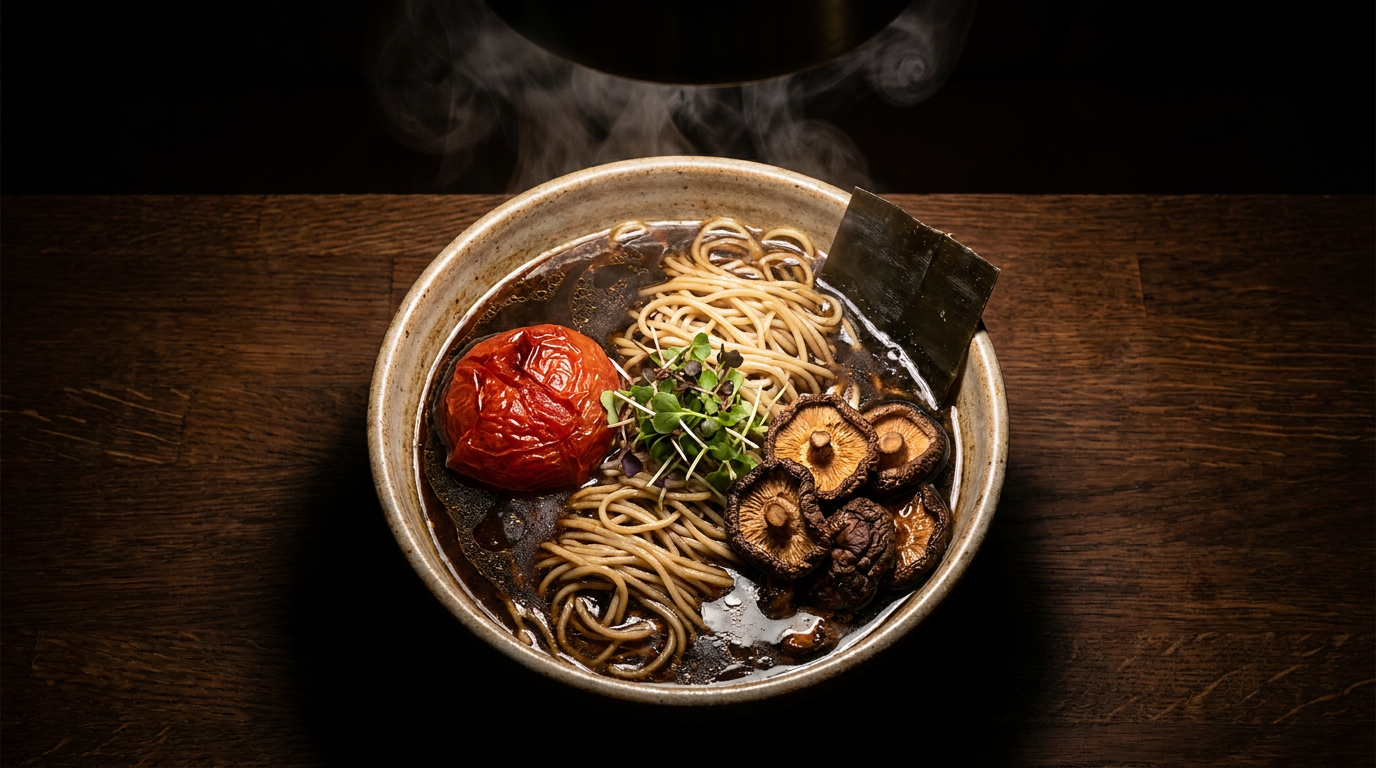
Tomatoes are one of the most accessible and potent sources of free glutamate in the Western pantry. As a tomato ripens, its glutamate levels surge naturally. When tomatoes are cooked down into a concentrated paste or roasted slowly in the oven, the water evaporates, concentrating these amino acids into a dense flavor bomb.[2][4]
Fermentation is another crucial mechanism for generating umami. During the fermentation process, microorganisms break down complex proteins into their constituent amino acids, releasing massive amounts of free glutamate. This biological breakdown is why fermented soy products like soy sauce, miso paste, and tempeh are indispensable tools in the vegan kitchen.[4][6]
Nutritional yeast, a deactivated strain of Saccharomyces cerevisiae often utilized by vegan chefs, is similarly packed with free glutamates. Its cheesy, nutty flavor profile makes it a powerful ingredient for adding savory depth to sauces, pestos, and dressings without relying on aged dairy cheeses like Parmesan, which are traditional umami heavyweights.[2]
Nutritional yeast, a deactivated strain of Saccharomyces cerevisiae often utilized by vegan chefs, is similarly packed with free glutamates.
But the true secret to maximizing savory depth lies in a biological phenomenon known as "umami synergy." Glutamates are powerful on their own, but when combined with certain ribonucleotides—specifically inosinates and guanylates—the savory impact is magnified exponentially on the palate.[1][3]

In animal-based cooking, this synergy happens naturally and effortlessly when meat (which is rich in inosinates) is cooked alongside vegetables (which are rich in glutamates), such as in a classic beef stew. In plant-based cooking, inosinates are virtually absent, meaning cooks must rely entirely on guanylates to achieve this multiplier effect.[3][4]
The premier plant-based source of guanylate is the dried shiitake mushroom. The physical drying process breaks down the mushroom's cellular structure, enzymatically converting its nucleic acids into potent guanylates. Fresh mushrooms, while flavorful, do not possess this specific chemical advantage.[2][3]

When a cook combines a glutamate-rich ingredient (like miso paste or tomato) with a guanylate-rich ingredient (like dried shiitake mushroom broth), the T1R1 and T1R3 receptors on the tongue actually change shape, remaining open and firing signals to the brain for a longer duration. Culinary scientists estimate this synergistic pairing can amplify the perception of savoriness by up to eight times compared to using either ingredient in isolation.[1][4]
This chemical synergy explains why a vegan ragu made with both concentrated tomato paste and dried mushroom soaking liquid tastes exponentially richer, darker, and more "meaty" than a sauce made with just one or the other. It is quite literally a mathematical equation for flavor.[2][6]
Beyond pure culinary enjoyment, mastering umami has significant public health implications. Because umami enhances the overall palatability, perceived saltiness, and perceived "thickness" of a dish, it allows cooks to drastically reduce the amount of added sodium without the food tasting bland or watered down.[5]

Clinical dietary studies indicate that optimizing umami compounds can allow for a 30% to 40% reduction in salt content in certain recipes while maintaining the same level of diner satisfaction. For individuals adopting plant-forward diets specifically for cardiovascular health or blood pressure management, this makes umami an essential dietary tool.[5][6]
The Maillard reaction—the chemical browning of amino acids and reducing sugars under high heat—also plays a vital supporting role. Roasting vegetables like onions, carrots, and garlic until they are deeply caramelized creates hundreds of new, complex flavor compounds that complement and enhance the inherent umami of the dish.[4]
While pure monosodium glutamate (MSG) powder is a highly effective, safe, and direct way to add umami to any dish, many home cooks prefer the challenge and complexity of building it through whole foods and traditional culinary techniques. Biologically, both approaches are chemically identical in how the glutamate molecule interacts with the tongue's receptors.[1][5]
Ultimately, understanding the science of umami transforms plant-based cooking from a restrictive exercise in substitution into a creative canvas for deep, complex flavor architecture. By mastering the molecular interactions of glutamates and guanylates, any home cook can engineer dishes that are profoundly and universally satisfying.[2][6]
How we got here
1908
Japanese chemist Kikunae Ikeda isolates glutamate from kombu broth and coins the term 'umami'.
1909
The first commercial production of monosodium glutamate (MSG) begins in Japan.
2000
Researchers at the University of Miami discover the specific taste receptors on the tongue dedicated to detecting umami.
2002
The T1R1/T1R3 receptor complex is definitively identified as the mammalian umami sensor, cementing umami as a fundamental biological taste.
Viewpoints in depth
Culinary Science
Focuses on the molecular mechanics of flavor building in the kitchen.
For culinary scientists and test kitchen developers, umami is treated as a structural component of a recipe rather than just a seasoning. They focus heavily on the 'umami synergy' equation, actively engineering recipes to ensure both glutamates (from tomatoes, soy, or yeast) and ribonucleotides (from dried mushrooms) are present. This perspective emphasizes technique—such as reducing liquids to concentrate amino acids and utilizing the Maillard reaction—to build a robust flavor architecture that can stand independently of animal fats.
Nutritional Science
Views umami as a critical tool for public health and dietary adherence.
Public health dietitians and nutritional researchers view umami through the lens of harm reduction and diet sustainability. Because the number one reason people abandon plant-based or heart-healthy diets is a perceived lack of flavor, umami is seen as the solution to dietary adherence. Furthermore, because umami compounds trick the brain into perceiving a dish as saltier and richer than it actually is, dietitians actively promote umami-rich ingredients as a primary strategy for lowering global sodium intake without triggering consumer backlash.
Traditional Gastronomy
Emphasizes the historical and cultural roots of umami-rich foods.
From the perspective of traditional food historians and Asian gastronomy experts, the 'discovery' of umami in 1908 was merely the scientific validation of culinary practices that had existed for millennia. This viewpoint highlights how ancient preservation techniques—specifically the fermentation of soybeans into soy sauce and miso, and the curing of kelp into kombu—were intuitively designed to maximize free glutamates long before the chemistry was understood. They advocate for traditional, slow-fermentation methods over modern, synthesized flavor enhancers.
What we don't know
- Whether individual genetic variations in the T1R1/T1R3 receptors cause some people to experience umami synergy more intensely than others.
- The exact evolutionary reason why human taste buds developed such a highly specific, synergistic reward mechanism for cooked and fermented foods.
Key terms
- Glutamate
- An amino acid found abundantly in plant and animal proteins that is the primary trigger for the umami taste receptors on the human tongue.
- Guanylate
- A ribonucleotide found in high concentrations in dried mushrooms that synergizes with glutamate to massively amplify savory flavor.
- Umami Synergy
- The biological phenomenon where combining glutamates with specific ribonucleotides (like guanylates) multiplies the intensity of the savory taste by up to eight times.
- Maillard Reaction
- A chemical reaction between amino acids and reducing sugars that gives browned food its distinctive flavor, commonly achieved through roasting or searing.
- T1R1 and T1R3
- The specific protein receptors on the human taste bud that bind to glutamates and signal the perception of umami to the brain.
Frequently asked
What exactly is umami?
Umami is the fifth basic taste, alongside sweet, sour, salty, and bitter. It is a deep, savory, mouth-filling flavor primarily triggered by the amino acid glutamate.
Why do dried mushrooms have more umami than fresh?
The drying process breaks down the mushroom's cellular structure, enzymatically converting its nucleic acids into guanylates, which are powerful umami compounds.
Can umami help reduce salt intake?
Yes. Because umami enhances the overall palatability and perceived saltiness of a dish, cooks can reduce added sodium by 30% to 40% without the food tasting bland.
Is MSG safe to use in home cooking?
Yes. Extensive scientific consensus and public health organizations have affirmed that MSG is safe. It is simply the sodium salt of the naturally occurring amino acid glutamate.
Sources
Source coverage
6 outlets
3 viewpoints surfaced






[1]National Center for Biotechnology InformationNutritional Science
Umami taste receptor T1R1/T1R3 and its role in savory perception
Read on National Center for Biotechnology Information →[2]Serious EatsCulinary Science
The Food Lab: How to Add Umami to Vegan and Vegetarian Meals
Read on Serious Eats →[3]Umami Information CenterTraditional Gastronomy
What is Umami? The Discovery and Science of the Fifth Taste
Read on Umami Information Center →[4]America's Test KitchenCulinary Science
The Science of Savory: Maximizing Umami in the Home Kitchen
Read on America's Test Kitchen →[5]Harvard T.H. Chan School of Public HealthNutritional Science
The Nutrition Source: Using Umami to Reduce Dietary Sodium
Read on Harvard T.H. Chan School of Public Health →[6]Factlen Editorial TeamCulinary Science
Synthesis by Factlen editorial team
Read on Factlen Editorial Team →
More in food drink
See all 37 stories →Sustainable Viticulture
The Rise of PIWI Grapes: How Fungus-Resistant Vines Are Reshaping Sustainable Wine
6 sources

Cocktail Science
The Science of Clarified Milk Punch: How Curdled Milk Makes Crystal-Clear Cocktails
6 sources

Tea Chemistry
The Chemistry of Tea: How Processing and L-Theanine Alter the Health and Cognitive Effects of Camellia Sinensis
7 sources
Restaurant Tech
The 60-Second Drive-Thru: How AI and Automation Are Rewiring Fast Food
6 sources

Every angle. Every day.
Get food drink stories with full source coverage and perspective breakdowns delivered to your inbox.