
The Science of the Clean and Jerk: How Olympic Weightlifting Builds Maximum Human Power
Olympic weightlifting is the ultimate test of explosive strength. Biomechanical research reveals how the clean and jerk generates unparalleled power output, offering surprising benefits for bone density and healthy aging.
By Factlen Editorial Team
- Sports Biomechanists
- Focus on the physics of the lift, emphasizing the massive wattage and rate of force development required to accelerate the barbell.
- Athletic Performance Coaches
- Value the clean and jerk for its transferability to field sports, using the triple extension to improve athletes' sprinting and jumping ability.
- Longevity Researchers
- Highlight the health benefits of explosive lifting for the general population, particularly its ability to increase bone density and prevent age-related muscle loss.
What's not represented
- · Recreational gym-goers who may find the technical barrier to entry for Olympic lifting intimidating.
Why this matters
Understanding the biomechanics of explosive lifting isn't just for elite athletes. The same principles that allow an Olympian to hoist 500 pounds overhead are now being used to help older adults preserve fast-twitch muscle fibers, improve balance, and dramatically increase bone density.
Key points
- The clean and jerk generates higher power output (wattage) than almost any other athletic movement.
- The 'triple extension' of the hips, knees, and ankles transfers directly to sprinting and jumping performance.
- Olympic weightlifting creates significantly higher bone mineral density than traditional slow-tempo powerlifting.
- Explosive lifting helps older adults preserve fast-twitch muscle fibers, which are crucial for fall prevention.
- Variations of the lifts can be scaled for beginners to safely acquire the neurological and physiological benefits.
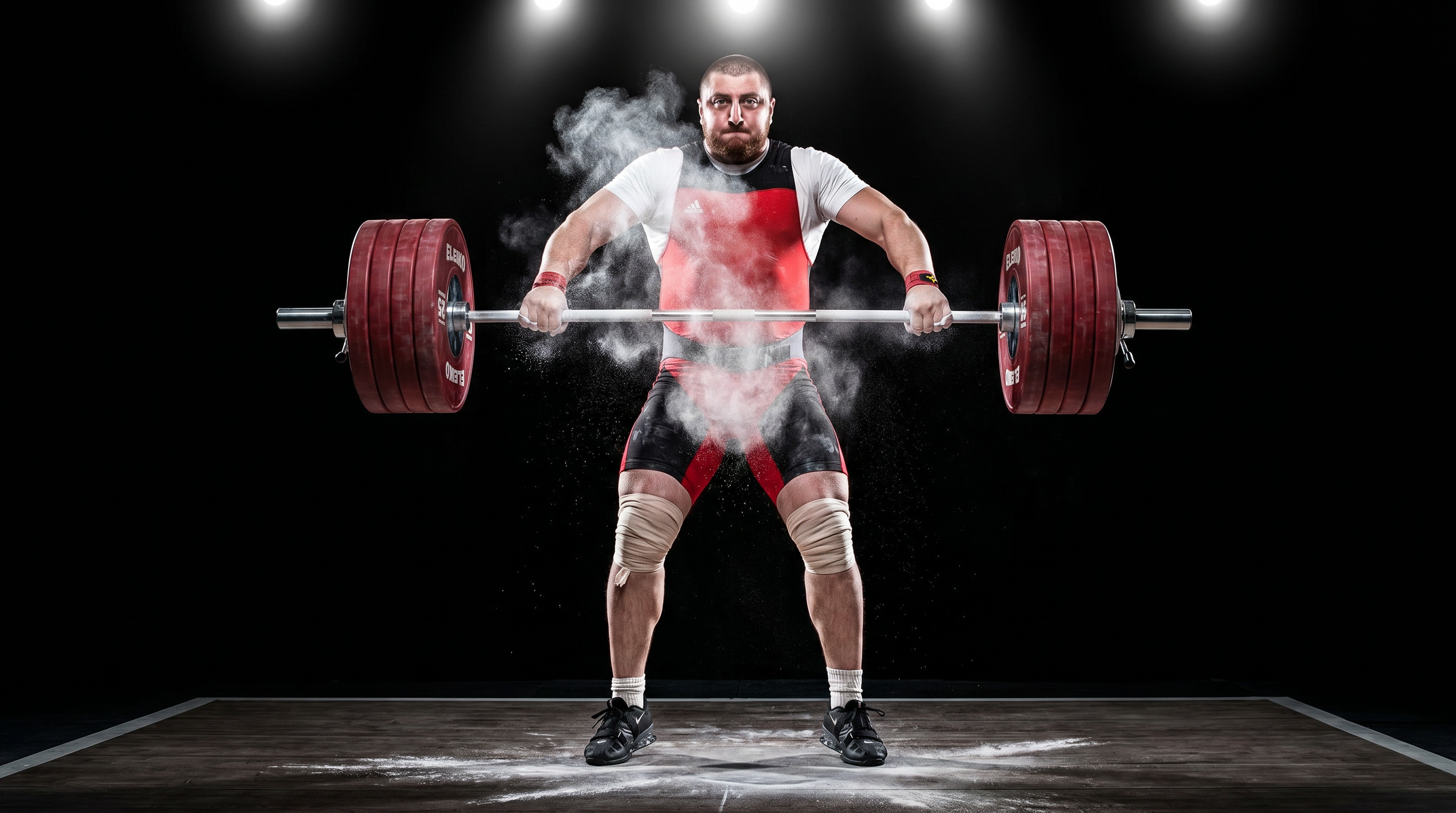
To the untrained eye, the clean and jerk looks like a feat of brute, unadulterated strength. A heavily loaded barbell rests on the floor; seconds later, it is locked out overhead, held steady by an athlete trembling under the immense strain. But in the realm of sports science, the clean and jerk is understood not merely as a test of strength, but as a masterclass in physics, biomechanics, and the absolute limits of human power output.[6]
There is a fundamental difference between absolute strength and explosive power. Powerlifters—who compete in the squat, bench press, and deadlift—demonstrate absolute strength by moving massive loads, often slowly. Olympic weightlifters, however, must move heavy loads incredibly fast. Power is mathematically defined as force multiplied by velocity. Because the clean and jerk requires accelerating a barbell from the floor to the shoulders, and then driving it overhead in a fraction of a second, it generates wattage that dwarfs almost any other athletic movement.[3][6]
The lift is divided into distinct biomechanical phases. It begins with the "first pull," where the lifter breaks the barbell's inertia off the floor. The goal here is not maximum speed, but optimal positioning. The lifter maintains a constant back angle, using the quadriceps and glutes to smoothly elevate the bar to just above the knees. This phase sets the stage for the explosive violence that follows.[4][6]
As the bar passes the knees, the lifter initiates the "second pull." This is the most critical fraction of a second in weightlifting. The athlete violently extends their hips, knees, and ankles simultaneously—a biomechanical phenomenon known as "triple extension." This explosive uncoiling transfers massive kinetic energy into the barbell, accelerating it upward and creating a brief moment of weightlessness.[4]

During this weightless window, the lifter must rapidly pull their own body underneath the bar, catching it across the front of the shoulders in a deep squat. This transition requires extraordinary mobility in the ankles, hips, and wrists, alongside the neurological precision to switch from pulling upward to pushing downward in the blink of an eye. Standing up from this front squat completes the "clean" portion of the lift.[3]
The final phase is the "jerk." The lifter dips their knees slightly and explosively drives the bar upward off the shoulders. Instead of pressing the weight with their arms—which would be impossible with maximal loads—the lifter uses the upward momentum to drop their body underneath the bar again, catching it with locked elbows before standing tall to complete the lift.[3][4]
The sheer wattage generated during these movements is staggering. Classic biomechanical research conducted by Dr. John Garhammer analyzed the power output of elite weightlifters. Garhammer found that during the second pull of the clean, heavy lifters routinely exceeded 4,000 watts of power output. For context, a professional cyclist sprinting at maximum effort might sustain 1,500 watts for a few seconds. The clean and jerk demands a neurological firing rate that pushes the human nervous system to its absolute peak.[1]
The sheer wattage generated during these movements is staggering.
This incredible "Rate of Force Development" (RFD)—the speed at which the muscular system can recruit motor units to generate force—is why Olympic weightlifting is a staple in the strength and conditioning programs of almost every professional sport. An isometric mid-thigh pull, which mimics the second pull of a clean, can generate an RFD of up to 22,000 Newtons per second. By comparison, a heavy deadlift generates roughly 6,400 Newtons per second.[4][6]

Because the triple extension of the hips, knees, and ankles perfectly mimics the biomechanics of jumping and sprinting, athletes from NFL linebackers to Olympic sprinters use variations of the clean and jerk to improve their vertical leap and acceleration on the field. The ability to apply massive force into the ground in a fraction of a second is the universal currency of athletic performance.[3][4]
However, the benefits of the clean and jerk extend far beyond elite sports. In recent years, sports scientists and longevity researchers have discovered that the unique physiological demands of Olympic weightlifting offer profound health benefits for the general public, particularly as they age.[5][6]
One of the most significant benefits is the impact on bone mineral density (BMD). Bones respond to mechanical stress by remodeling and becoming denser—a concept known as Wolff's Law. Research has shown that bones respond more favorably to the high rate of strain produced by explosive movements than to the slow, heavy strain of traditional powerlifting.[2][5]
Studies comparing the bone density of elite Olympic weightlifters, powerlifters, and soccer players have consistently found that Olympic lifters possess significantly denser bones, particularly in the lumbar spine and the femoral neck (the top of the thigh bone). These are the exact areas most vulnerable to osteoporotic fractures in older adults. The explosive loading and catching phases of the clean and jerk force the skeletal system to fortify itself against high-velocity impacts.[2]

Furthermore, Olympic weightlifting is uniquely suited to combat sarcopenia, the age-related loss of muscle mass and function. As humans age, they preferentially lose Type II (fast-twitch) muscle fibers, which are responsible for explosive power and quick reactions. Traditional, slow-tempo resistance training primarily targets Type I (slow-twitch) fibers. The ballistic nature of the clean and jerk forces the nervous system to recruit and preserve those crucial fast-twitch fibers.[5]
This preservation of fast-twitch muscle has a direct impact on fall prevention. When an older adult trips, the ability to rapidly step forward and catch their balance requires explosive power and rapid motor unit recruitment. Researchers have found that older adults who engage in Olympic-style lifting demonstrate superior balance and proprioception compared to their non-training peers, as the lifts demand intense core stabilization and postural control.[5]
The rise of functional fitness programs like CrossFit has democratized these movements, introducing the clean and jerk to millions of recreational athletes. While the full squat clean and split jerk require immense technical proficiency, the benefits can be scaled. Beginners and older adults often perform variations like the "power clean" (catching the bar without a full squat) or the "hang clean" (starting with the bar at the knees) using lighter weights or even PVC pipes to groove the neurological patterns.[3][6]

Ultimately, the clean and jerk is a beautiful paradox. It is a movement of extreme violence executed with balletic precision. Whether it is being used by a super-heavyweight Olympian to break a world record, a sprinter to shave hundredths of a second off their start, or an older adult to build fracture-resistant bones, the science remains the same. It is the ultimate expression of human kinetic potential.[4][5][6]
Viewpoints in depth
Sports Biomechanists
Focuses on the physics and sheer wattage generated during the lift.
For sports scientists, the clean and jerk is a fascinating study in human kinetic potential. Researchers focus on the 'Rate of Force Development' (RFD)—how quickly the nervous system can recruit motor units to move a resting object. Because power is a product of force and velocity, the necessity of moving massive weights at high speeds results in power outputs that exceed 4,000 watts. Biomechanists study the precise angles of the 'triple extension' to understand how humans can maximize leverage to overcome gravity.
Athletic Performance Coaches
Values the lifts as a training tool to build explosive power for field and track athletes.
Strength and conditioning coaches rarely care about how much weight an athlete can clean and jerk for the sake of the sport itself; they care about how that movement transfers to the field. The biomechanics of the second pull perfectly mirror the mechanics of a vertical jump or the first three steps of a 40-yard dash. By training the nervous system to fire rapidly under a heavy load, coaches use Olympic lifts to build athletes who can accelerate faster and hit harder than those who only train slow, absolute strength.
Longevity Researchers
Highlights the protective health benefits of high-velocity loading for aging populations.
Medical professionals and longevity experts view Olympic weightlifting through the lens of disease prevention. As the body ages, it naturally sheds fast-twitch muscle fibers and loses bone mineral density, leading to frailty and osteoporosis. Researchers have found that the high-velocity mechanical stress of the clean and jerk forces the body to adapt by building denser bones—particularly in the vulnerable lumbar spine and hips—and preserving the fast-twitch fibers necessary for balance and fall prevention. This has led to a growing movement of incorporating scaled Olympic lifts into geriatric fitness programs.
What we don't know
- The exact threshold of load and velocity required to trigger optimal bone mineral density adaptations in older adults.
- How long-term participation in scaled Olympic weightlifting compares to traditional resistance training for lifespan extension in non-athletes.
Key terms
- Triple Extension
- The simultaneous and explosive straightening of the hip, knee, and ankle joints, which generates maximum upward power.
- Rate of Force Development (RFD)
- A measure of how quickly an athlete can recruit muscle fibers to generate maximum force; crucial for explosive athletic movements.
- Bone Mineral Density (BMD)
- A measurement of the amount of minerals (mostly calcium and phosphorous) contained in a certain volume of bone, used as an indicator of bone strength.
- Fast-Twitch Muscle Fibers
- Muscle fibers (Type II) that generate short, explosive bursts of power but fatigue quickly; these are the first to atrophy as humans age.
- Sarcopenia
- The natural, age-related loss of skeletal muscle mass, strength, and function.
Frequently asked
What is the difference between a clean and a jerk?
The clean is the first part of the movement, where the lifter pulls the barbell from the floor and catches it on their shoulders. The jerk is the second part, where the lifter explosively drives the barbell from their shoulders to a locked-out position overhead.
Why do football players and sprinters do Olympic lifts?
The 'triple extension' of the hips, knees, and ankles used in the clean and jerk perfectly mimics the biomechanics of jumping and sprinting, helping athletes develop explosive power and acceleration.
Is Olympic weightlifting safe for older adults?
Yes, when properly coached and scaled. Older adults often use lighter weights and modified variations (like the power clean) to safely improve balance, preserve fast-twitch muscle fibers, and increase bone density.
Does weightlifting build more bone density than running?
Yes. Research shows that bones respond most favorably to high-velocity, high-load mechanical stress. Olympic weightlifters possess some of the highest bone mineral densities recorded in athletes.
Sources
Source coverage
6 outlets
3 viewpoints surfaced






[1]Medicine and Science in Sports and ExerciseSports Biomechanists
Power production by Olympic weightlifters
Read on Medicine and Science in Sports and Exercise →[2]Journal of Strength and Conditioning ResearchLongevity Researchers
Bone Mineral Density in Elite Junior Olympic Weightlifters
Read on Journal of Strength and Conditioning Research →[3]Mass General BrighamAthletic Performance Coaches
Understanding Olympic Weightlifting and Its Fitness Benefits
Read on Mass General Brigham →[4]Science for SportAthletic Performance Coaches
Olympic Weightlifting for Athletic Performance
Read on Science for Sport →[5]IDEA Health & Fitness AssociationLongevity Researchers
The Benefits of Olympic Weightlifting in Older Populations
Read on IDEA Health & Fitness Association →[6]Factlen Editorial TeamSports Biomechanists
Synthesis by Factlen editorial team
Read on Factlen Editorial Team →

More in sports
See all 390 stories →Pro Volleyball Boom
How Women's Professional Volleyball Finally Broke Through in America
6 sources
Women's Sports
How Women's Wrestling Became the Fastest-Growing Collegiate Sport in America
8 sources
Engine Regulations
The 2026 Formula 1 Engine Revolution: How Sustainable Fuel and a 50/50 Hybrid Split Are Changing the Sport
8 sources

MLB Milestones
Brewers' Jacob Misiorowski Throws Historic 15-Strikeout, One-Hit Shutout
7 sources
Every angle. Every day.
Get sports stories with full source coverage and perspective breakdowns delivered to your inbox.