
The Science of Soft Bread: How Tangzhong and Yudane Transform Baking
By pre-cooking a small portion of flour, the Tangzhong and Yudane methods manipulate starch gelatinization to create incredibly soft, long-lasting bread. These Asian baking techniques allow dough to hold massive amounts of water, revolutionizing both commercial and home baking.
By Factlen Editorial Team
- Home Bakers & Enthusiasts
- Values the accessibility and convenience of achieving bakery-tier softness at home.
- Culinary Scientists & Professionals
- Focuses on the precise manipulation of starch gelatinization to optimize hydration and shelf life.
- Vegan & Plant-Based Bakers
- Values the techniques for providing rich, brioche-like tenderness without dairy or eggs.
What's not represented
- · Industrial Dough Conditioner Manufacturers
- · Traditional European Artisan Bakers
Why this matters
Understanding these techniques empowers home bakers to achieve bakery-tier softness and extend the shelf life of their bread by days without using artificial preservatives. It also offers a scientific pathway to reduce expensive fats like butter and create high-quality vegan pastries.
Key points
- Tangzhong and Yudane are Asian baking techniques that pre-cook a portion of flour to create exceptionally soft, fluffy bread.
- The methods rely on starch gelatinization, which allows the flour to absorb and trap up to twice as much liquid as raw flour.
- Tangzhong uses a 1:5 ratio of flour to liquid cooked on a stovetop, yielding a delicate, feathery crumb.
- Yudane uses a 1:1 ratio of flour to boiling water, creating a resilient, mochi-like chew and a stronger dough structure.
- Both techniques drastically extend the shelf life of bread by delaying the starch recrystallization process that causes staling.
For centuries, the pinnacle of European baking has been defined by a hard, crackling crust giving way to a chewy, open crumb. But across the globe, a completely different bread philosophy has quietly perfected the art of the soft loaf. In Asian bakeries, the ideal bread is practically cloud-like—subtly sweet, impossibly tender, and capable of melting in the mouth. Achieving this feathery texture, famously showcased in Japanese milk bread or Shokupan, relies on a fundamental manipulation of baking chemistry rather than simply dumping more butter or sugar into the mixing bowl. The secret lies in two distinct but related techniques that have revolutionized both commercial and home baking: Tangzhong and Yudane. By pre-cooking a small portion of the recipe's flour, bakers can fundamentally alter how the dough behaves, unlocking levels of moisture and softness that traditional Western methods simply cannot match.[1][2]
At the heart of both the Tangzhong and Yudane methods is a solution to the baker's eternal dilemma: hydration. Water is the key to soft bread, as it creates steam during the bake that lifts the dough and yields a tender crumb. However, there is a strict limit to how much liquid raw flour can absorb before the dough turns into a sticky, unworkable soup. Standard bread recipes typically hover around 60 percent hydration. If a baker tries to push that to 75 or 80 percent using traditional mixing methods, the dough loses its structural integrity, collapsing into a puddle rather than holding a shape. Asian baking techniques bypass this limitation entirely by changing the physical properties of the flour before the main mixing process even begins, allowing the dough to hold massive amounts of water while remaining smooth, cohesive, and easy to knead.[3]
The scientific engine driving this transformation is known as starch gelatinization. Flour is packed with microscopic starch granules, which in their raw state are hard and crystalline. When these raw granules are mixed with cold or room-temperature water, they absorb very little liquid. But when heat is introduced to the equation, the intermolecular bonds within the starch molecules begin to break down. As the temperature climbs above 65 degrees Celsius, or roughly 150 degrees Fahrenheit, the granules swell rapidly like tiny sponges. This process allows the hydrogen bonding sites within the starch to engage with significantly more water, irreversibly transforming the mixture from a loose liquid into a viscous, sticky paste. It is the exact same chemical reaction that gives the boiled exterior of a bagel its signature chewiness, but here it is harnessed to trap moisture deep within the crumb of a loaf.[3][4]
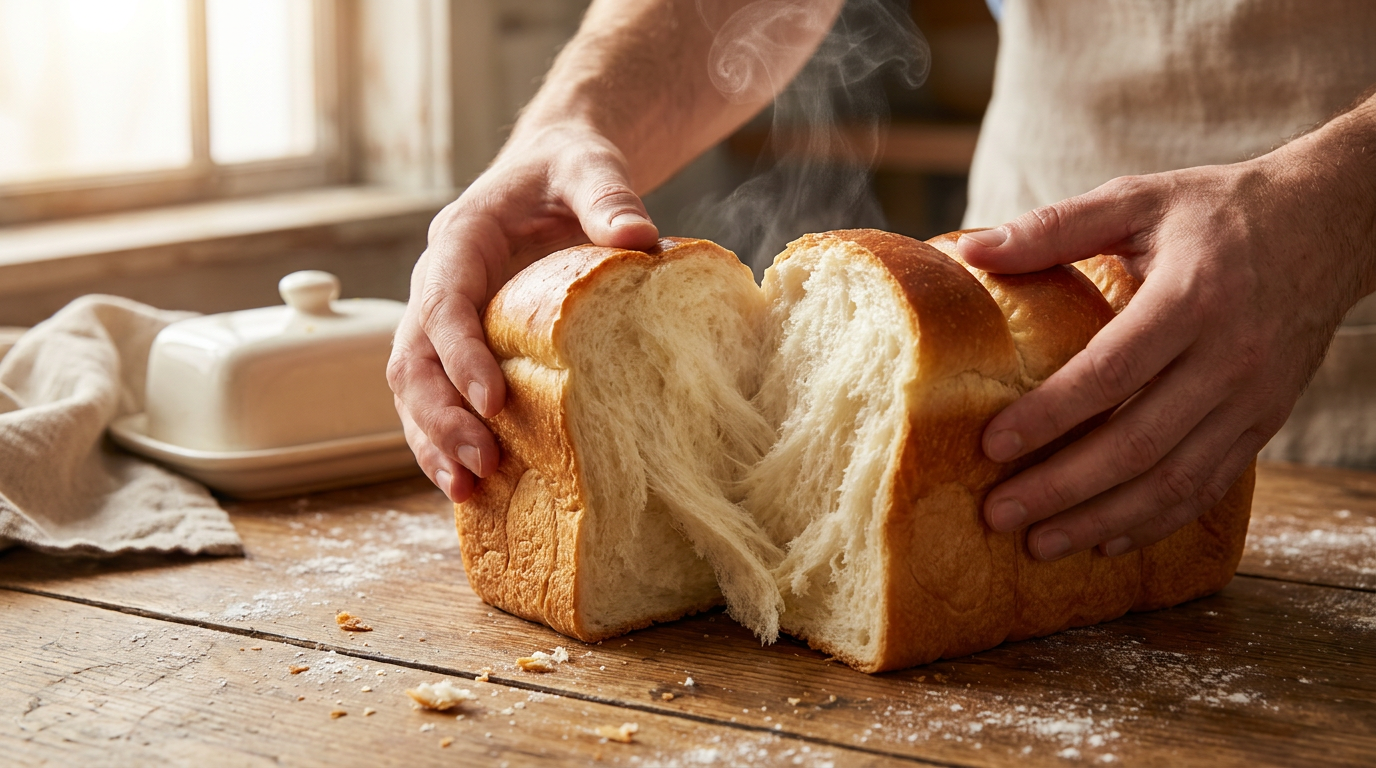
Because gelatinized starch can absorb up to twice as much liquid as raw flour, pre-cooking just a small fraction of the recipe's total flour yields outsized results. The water trapped within this heated paste is locked in place; it will not bleed out and turn the rest of the dough into a sticky mess during kneading. Instead, it rides along safely within the dough matrix, keeping the overall structure strong and pliable. When the bread finally hits the hot oven, all that trapped moisture turns into steam, pushing the dough upward to create an incredibly tall, airy rise. The resulting loaf boasts a hydration level that would normally be impossible to handle, yet it emerges from the oven with a perfectly domed top and a crumb that pulls apart in delicate, cotton-like shreds.[1][4]

The most widely known application of this science is the Tangzhong method, which traces its modern popularity to Chinese and Taiwanese baking traditions. To create a Tangzhong, a baker takes a small portion of the recipe's total flour—usually around five to ten percent—and whisks it together with liquid, typically water or milk, at a ratio of one part flour to five parts liquid by weight. This slurry is then cooked gently on a stovetop over medium heat. The baker must stir continuously as the temperature rises, watching carefully for the moment the liquid suddenly thickens into a glossy, pudding-like roux. Once the whisk leaves distinct trails in the bottom of the pan, the Tangzhong is removed from the heat, cooled to room temperature, and then seamlessly incorporated into the main dough alongside the rest of the ingredients.[1][3]
Bread baked using the Tangzhong method is characterized by its delicate, feathery fluffiness. Because the roux is cooked into a smooth, homogenous paste, it blends effortlessly into enriched doughs, creating a remarkably uniform and tender crumb. The high liquid content of the 1:5 ratio ensures that the final loaf feels incredibly light on the palate, almost dissolving as it is eaten. Culinary scientists note that Tangzhong doughs often start out feeling a bit softer and stickier during the initial mixing phase, but they quickly develop into a strong, elastic mass as the gluten network forms during kneading. This makes the technique particularly well-suited for intricate shaped breads, such as braided brioches, cinnamon rolls, or the pull-apart milk bread rolls that have become a viral staple of modern bakery display cases and social media feeds.[1][2]
While Tangzhong relies on a stovetop slurry, the Japanese Yudane method achieves starch gelatinization through a distinctly different, and arguably simpler, scalding process. Instead of cooking the flour and liquid together over sustained heat, the Yudane technique calls for pouring boiling water directly over raw flour at a strict one-to-one ratio by weight. The baker simply stirs the boiling water into the flour until it forms a thick, shaggy, and somewhat gritty paste. Because the water is at a rolling boil—100 degrees Celsius—it instantly gelatinizes the starch on contact, requiring no additional time on the stove. This scalding method uses a much larger percentage of the recipe's total flour, often between 15 and 20 percent, fundamentally altering the structural backbone of the resulting dough.[1][5]

The baker simply stirs the boiling water into the flour until it forms a thick, shaggy, and somewhat gritty paste.
The preparation of Yudane requires a bit more patience than Tangzhong, as the scalded dough must be tightly wrapped and left to rest, typically in the refrigerator for four to eight hours, or ideally overnight. This resting period allows the starches to fully hydrate and the mixture to relax into a pliable, dough-like block. When it is time to bake, the chilled Yudane is torn into smaller chunks and mixed into the main dough. Because the Yudane paste is much stiffer and contains less water than a Tangzhong roux, the resulting bread dough often feels smoother, stronger, and easier to handle right out of the mixing bowl. The yeast also responds well to this method, as the pre-gelatinized starches provide readily available sugars for fermentation, aiding in a robust and steady rise.[3][5]
The textural results of the Yudane method are distinct from its stovetop cousin. While Tangzhong produces a loaf that is airy and delicate, Yudane yields a bread that is incredibly moist but possesses a satisfying, springy chew. Professional bakers often compare the texture of Yudane bread to mochi, noting its remarkable elasticity and resilience. When pressed down, a slice of Yudane bread will spring right back to its original shape like a sponge. This tighter, more cohesive crumb structure makes it the preferred method for commercial sandwich loaves, as the bread holds up beautifully to slicing, toasting, and heavy fillings without falling apart or turning soggy. The higher percentage of pre-gelatinized flour also contributes to a slightly taller rise in the baking tin.[2][4]
Beyond the immediate textural upgrades, both of these Asian water-roux methods offer a massive commercial and practical advantage: they drastically extend the shelf life of the bread. Staling is not simply a matter of bread drying out; it is a complex chemical process called starch retrogradation, where the starch molecules slowly recrystallize and push water out of the bread's structure. Because the starches in Tangzhong and Yudane have been pre-gelatinized and their structures fundamentally altered, this recrystallization process is severely delayed. While a standard homemade loaf might turn hard and crumbly within two days, breads made with these techniques remain soft, pliable, and fresh-tasting for up to a week on the kitchen counter, significantly reducing food waste.[1][3]

This exceptional moisture retention has also caught the attention of health-conscious bakers and commercial manufacturers looking to optimize their ingredient lists. In traditional European baking, long-lasting softness is usually achieved by heavily enriching the dough with expensive fats like butter, oil, and egg yolks, which coat the flour proteins and inhibit staling. However, because Tangzhong and Yudane rely on trapped water rather than fat to maintain their tender crumb, bakers can drastically reduce the amount of butter and oil in their recipes without sacrificing quality. The Institute of Culinary Education conducted experiments comparing these methods to standard loaves, concluding that the water-roux techniques allowed for significant fat reduction while actually improving the bread's shelf stability and mouthfeel.[2][3]
For the growing community of vegan and plant-based bakers, the science of starch gelatinization is nothing short of a game-changer. Replicating the rich, pillowy texture of a classic brioche or milk bread without dairy or eggs has historically been a massive challenge, as plant-based butter substitutes often behave differently under high heat. By utilizing a water-based Tangzhong or Yudane, vegan bakers can achieve that coveted open interior and shreddable softness using only flour, water, yeast, and salt. Furthermore, the techniques are highly adaptable; bakers have successfully created Tangzhong slurries using alternative liquids like unsweetened almond milk, oat milk, or soy milk, proving that the underlying chemistry works flawlessly regardless of the specific liquid used.[1][3]
When deciding which method to employ, home bakers must weigh their desired outcome against their schedule. Tangzhong is the ultimate tool for spontaneous baking. Because the stovetop roux cools down in just a few minutes, it can be whipped up and added to a dough on the very same day, making it ideal for weekend cinnamon rolls or a quick batch of dinner rolls. It requires a bit of active whisking at the stove and careful attention to evaporation rates, but the reward is a reliably fluffy, cloud-like pastry that pulls apart in satisfying, wispy layers. For bakers seeking maximum tenderness with minimal forethought, the Chinese roux method remains the undisputed champion.[1][4]

Conversely, Yudane is the method of choice for bakers who prefer to plan ahead and value hands-off convenience. Boiling water in a kettle and pouring it over flour takes mere seconds, completely eliminating the need to stand over a hot stove or wash a sticky saucepan. While the mandatory overnight resting period requires a bit of foresight, it breaks the bread-making process into highly manageable, bite-sized steps. For those chasing the ultimate structural integrity for daily sandwich bread, or for those who crave that signature Japanese mochi-like chew, the Yudane scald is well worth the wait. It provides a robust, easy-to-handle dough that forgives minor mixing errors and bakes up into a towering, resilient loaf.[4][5]
Ultimately, the rise of Tangzhong and Yudane in Western kitchens represents a beautiful democratization of bakery science. For decades, achieving a loaf that stayed soft for days seemed to require industrial dough conditioners, artificial preservatives, or commercial-grade steam ovens. Now, armed with nothing more than a kitchen scale, a saucepan, and a basic understanding of how starch reacts to heat, any home baker can manipulate the molecular structure of their flour. These techniques strip away the intimidation factor of high-hydration doughs, replacing sticky, frustrating messes with smooth, supple doughs that are a joy to knead and shape.[1][3]
Whether opting for the feathery lightness of Tangzhong or the satisfying, springy chew of Yudane, bakers are discovering that the secret to extraordinary bread doesn't lie in expensive ingredients, but in technique. By simply rethinking how and when water is introduced to flour, the boundaries of what can be achieved in a home oven have been permanently expanded. The result is a global baking culture that is increasingly trading hard, crusty loaves for the comforting, pillowy embrace of Asian milk bread—one perfectly gelatinized batch of dough at a time.[1][2]
How we got here
1860s
British baker Robert Clarke opens Yokohama Bakery in Japan, introducing Western-style bread that would eventually evolve into Japanese milk bread.
20th Century
Asian bakers develop the Yudane and Tangzhong methods to adapt bread to local palates, prioritizing extreme softness and longer shelf life.
2000s
The Tangzhong method gains massive popularity across Asia and online baking communities following the publication of Taiwanese cookbooks detailing the technique.
2020s
Both Tangzhong and Yudane become mainstream techniques in Western home baking, popularized by food blogs and pandemic-era sourdough enthusiasts seeking softer crumb structures.
Viewpoints in depth
Home Bakers & Enthusiasts
Focuses on the accessibility and convenience of achieving bakery-tier softness without industrial equipment.
For home bakers, the appeal of Tangzhong and Yudane lies in their sheer accessibility. Historically, achieving a loaf that stayed soft for days required chemical dough conditioners or commercial steam-injection ovens. These water-roux methods democratize that process, requiring only a saucepan or a kettle of boiling water. Enthusiasts frequently debate the convenience factor online, with many favoring Yudane for its hands-off preparation, while others swear by Tangzhong for spontaneous, same-day baking projects like weekend cinnamon rolls.
Culinary Scientists & Professionals
Focuses on the precise manipulation of starch gelatinization to optimize hydration, shelf life, and ingredient costs.
From a commercial and scientific perspective, these techniques are viewed as masterful manipulations of flour chemistry. Culinary professionals value how pre-gelatinized starches trap water, allowing doughs to reach 80 percent hydration without losing structural integrity. Beyond texture, the commercial appeal is heavily tied to economics: because the trapped moisture naturally extends shelf life and provides a tender mouthfeel, bakeries can significantly reduce their reliance on expensive enriching fats like butter and oil, lowering production costs while actually improving the final product.
Vegan & Plant-Based Bakers
Values the techniques for providing rich, brioche-like tenderness without the need for dairy or eggs.
In the plant-based baking community, Tangzhong and Yudane are celebrated as essential tools for replacing animal products. Traditional soft breads rely heavily on the fats and proteins in butter, milk, and egg yolks to coat flour strands and inhibit staling. By shifting the mechanism of tenderness from fat to trapped water, vegan bakers can produce incredibly soft, shreddable breads using only flour, water, and yeast. The adaptability of the roux to alternative milks like oat or soy further cements its status as a staple in modern vegan pastry.
What we don't know
- While Tangzhong is widely associated with Chinese and Taiwanese baking, culinary historians still debate the exact timeline of whether it evolved directly from the Japanese Yudane method or developed independently.
- The exact mathematical formula for converting any standard European bread recipe into a water-roux recipe varies, as different flour brands and protein contents absorb the gelatinized moisture differently.
Key terms
- Starch Gelatinization
- The process where starch granules swell and absorb liquid when heated, breaking down their intermolecular bonds and trapping moisture.
- Hydration
- The ratio of liquid to flour in a bread recipe, expressed as a percentage. Higher hydration generally leads to softer, more open bread.
- Roux
- A cooked mixture of flour and liquid (usually fat, but water/milk in Asian baking) used as a thickening agent or dough improver.
- Shokupan
- A traditional Japanese milk bread known for its square shape, subtly sweet flavor, and incredibly soft, feathery texture.
- Starch Retrogradation
- The chemical process where gelatinized starches slowly recrystallize over time, pushing water out and causing bread to go stale.
Frequently asked
Can I use Tangzhong or Yudane in any bread recipe?
Yes, but you must adjust the recipe's overall liquid content. You cannot simply add the roux on top of an existing recipe; the flour and liquid used in the paste must be subtracted from the recipe's total ingredient weights.
Which method makes the bread last longer?
Both methods significantly extend shelf life compared to standard baking by trapping moisture and delaying starch retrogradation. However, Yudane's higher percentage of pre-gelatinized flour often gives it a slight edge in keeping bread fresh for up to a week.
Do I have to use milk for Tangzhong?
No. While milk adds richness and flavor, Tangzhong works perfectly with plain water or plant-based alternatives like oat and almond milk, as the core science relies on hydrating the starch, not the dairy.
Sources
Source coverage
6 outlets
3 viewpoints surfaced






[1]King Arthur BakingHome Bakers & Enthusiasts
Tangzhong vs. yudane: Which is better for soft bread?
Read on King Arthur Baking →[2]Institute of Culinary EducationCulinary Scientists & Professionals
The Science of Soft Bread: Tangzhong and Yudane
Read on Institute of Culinary Education →[3]The Perfect LoafVegan & Plant-Based Bakers
How to Make Tangzhong (and Yudane) for Softer Bread
Read on The Perfect Loaf →[4]ChainBakerHome Bakers & Enthusiasts
Tangzhong vs Yudane, What is the Difference?
Read on ChainBaker →[5]Ricardo CuisineCulinary Scientists & Professionals
What is the Yudane Bread-Making Method?
Read on Ricardo Cuisine →[6]Factlen Editorial TeamVegan & Plant-Based Bakers
Synthesis by Factlen editorial team
Read on Factlen Editorial Team →
Every angle. Every day.
Get food drink stories with full source coverage and perspective breakdowns delivered to your inbox.