
The Rise of On-Device AI: How Small Language Models Are Putting Chatbots in Your Pocket
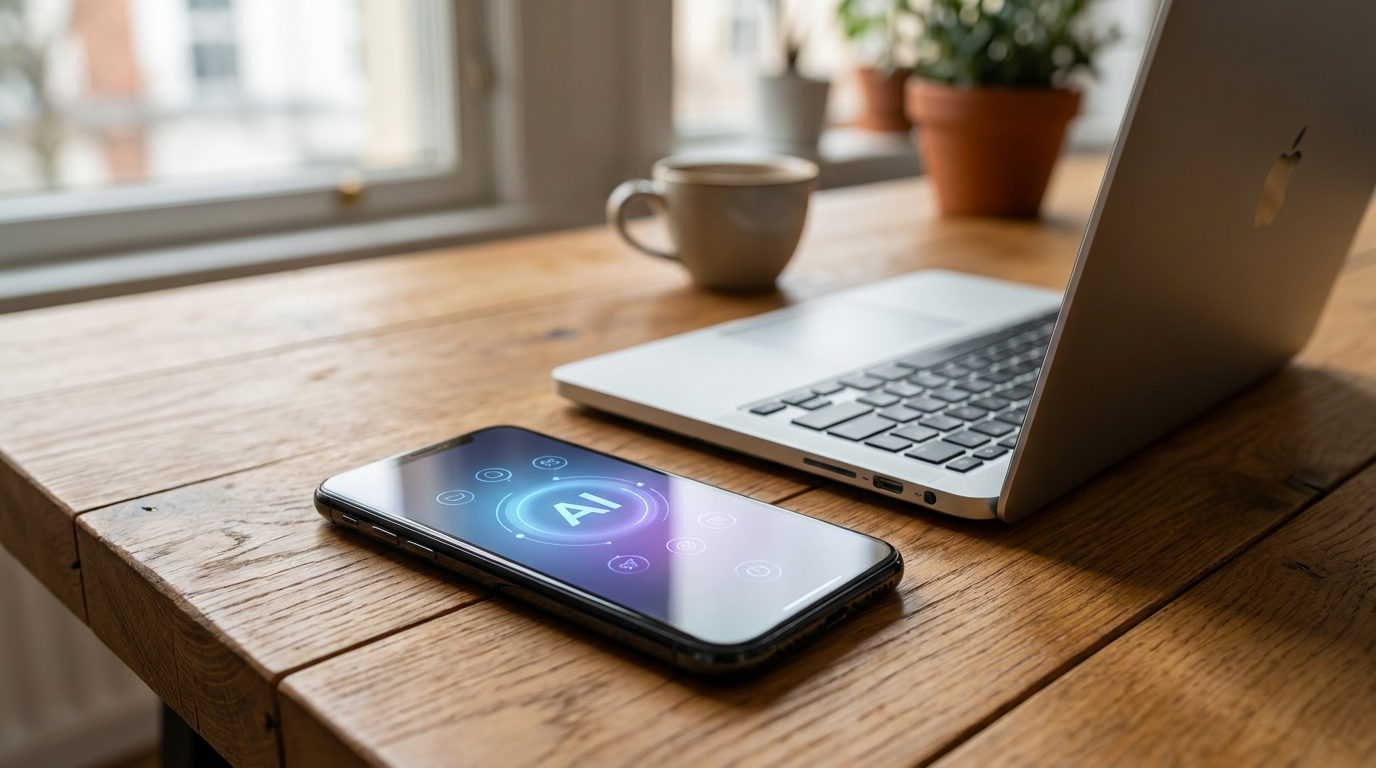
Tech giants are shifting from massive cloud-based AI to "Small Language Models" (SLMs) that run directly on your phone or laptop. This on-device approach promises better privacy, zero subscription fees, and offline functionality without sacrificing core capabilities.
By Factlen Editorial Team
- On-Device Privacy Advocates
- Argue that local processing is essential for protecting user data from corporate surveillance and data breaches.
- Enterprise & Edge Providers
- Focus on the economic and performance benefits of running AI without cloud dependency.
- Open-Source AI Community
- Champion SLMs as a way to democratize artificial intelligence and break Big Tech's monopoly.
What's not represented
- · Cloud Infrastructure Providers
- · Regulatory Agencies
Why this matters
By shifting AI processing from the cloud to your personal device, tech companies are eliminating subscription fees, enabling offline use, and ensuring your most sensitive data never leaves your phone.
Key points
- Small Language Models (SLMs) run directly on phones and laptops, eliminating the need for cloud servers.
- On-device processing ensures sensitive personal data never leaves the user's hardware.
- Running AI locally removes API fees and subscription costs for basic tasks.
- Techniques like knowledge distillation and quantization allow massive AI capabilities to fit into small file sizes.
- While highly efficient, SLMs still struggle with the broad, complex reasoning of massive cloud models.
The AI boom of the early 2020s was defined by massive data centers, thousands of GPUs, and trillion-parameter models. But by 2026, the most significant shift in artificial intelligence is happening locally. Tech giants and open-source communities are pivoting toward "Small Language Models" (SLMs)—compact, highly efficient AI systems designed to run directly on your smartphone, tablet, or laptop.[7]
Unlike their massive counterparts, which require constant internet connectivity and vast computational resources, SLMs typically range from 1 million to 10 billion parameters. They are built for specialized tasks and fast inference, proving that when it comes to everyday utility, smaller often means smarter.[4][5]
The push for on-device AI is driven by three major factors: privacy, cost, and latency. Sending personal messages, financial data, or health queries to a cloud server inherently carries privacy risks. By processing prompts directly on the device, SLMs ensure that sensitive information never traverses the internet.[4][6]

This local approach also eliminates the recurring costs associated with cloud computing. For power users and developers, running AI locally means avoiding steep API fees and monthly subscription charges. Furthermore, because the processing happens on local silicon, the AI can respond almost instantly without waiting for network transmission.[1][5][6]
But how do developers fit the intelligence of a massive data center into a device that fits in your pocket? The secret lies in optimization techniques like knowledge distillation, pruning, and quantization. Knowledge distillation involves training a smaller "student" model to mimic the outputs of a massive "teacher" model, capturing its core capabilities without the bloat.[5]
Pruning further slims the model by stripping away redundant neural pathways, while quantization reduces the mathematical precision of the model's parameters, drastically shrinking its file size and memory footprint. These techniques allow a model that once required a server farm to run efficiently on a consumer-grade Neural Processing Unit (NPU).[5][7]

These techniques allow a model that once required a server farm to run efficiently on a consumer-grade Neural Processing Unit (NPU).
Apple has made on-device processing the cornerstone of its Apple Intelligence suite. The system is designed to be aware of a user's personal context—reading emails, messages, and calendar events—without ever collecting or storing that data externally.[3]
When an Apple device encounters a request too complex for its local SLM, it utilizes "Private Cloud Compute." This hybrid approach routes the specific task to secure, Apple-silicon servers that process the data statelessly; the information is used solely to fulfill the request and is immediately deleted, a promise verifiable by independent security researchers.[3]
Google has taken a similar architectural approach with Android, embedding its Gemini Nano model directly into the operating system. Managed by a system service called AICore, Gemini Nano operates under strict data isolation rules, ensuring that one app cannot access the AI data of another.[2]

This allows Android developers to build features like smart replies, text summarization, and offline translation without routing user keystrokes through external servers. Because AICore cannot directly access the internet, the system provides a secure sandbox for processing sensitive user inputs.[2]
The shift to local AI extends beyond smartphones. At recent industry events, companies like Nvidia have showcased SLMs running on desktop PCs, powering AI assistants that can adjust complex computer settings or act as real-time advisors in strategy games. These PC-based models operate entirely offline, preserving privacy while saving users from costly cloud subscriptions.[1]

Despite their advantages, SLMs are not a complete replacement for massive cloud models. Because they are trained on smaller, more targeted datasets, they lack the broad, encyclopedic knowledge of a GPT-4. An SLM optimized for summarizing emails might struggle with complex coding tasks or deep logical reasoning.[4][5]
They are also more prone to errors when faced with highly ambiguous scenarios outside their specific training domain. For tasks requiring deep contextual understanding or creative writing across multiple disciplines, large language models remain the superior tool.[4][5]
However, for the vast majority of daily digital interactions—drafting messages, organizing notifications, and retrieving local files—SLMs offer a frictionless, secure solution. As hardware continues to evolve, the distinction between cloud and edge computing will blur, making on-device AI the default standard for consumer technology.[6][7]
How we got here
2023
Massive, cloud-based Large Language Models (LLMs) dominate the tech landscape, requiring constant internet access.
Mid-2024
Google introduces Gemini Nano, bringing foundational on-device AI capabilities to Android smartphones.
Late-2024
Apple announces Apple Intelligence, making on-device processing and Private Cloud Compute the core of its privacy strategy.
2025-2026
Highly capable open-source SLMs become widely available, allowing developers to run powerful AI locally on standard laptops.
Viewpoints in depth
On-Device Privacy Advocates
Argue that local processing is essential for protecting user data from corporate surveillance and data breaches.
For privacy advocates, the shift to Small Language Models is a necessary corrective to the data-hungry practices of the early AI boom. By ensuring that sensitive inputs—like health queries, financial documents, and personal messages—never leave the device, SLMs eliminate the risk of interception or unauthorized cloud storage. This camp argues that true AI utility cannot come at the expense of user privacy, making local processing the only ethical path forward for consumer tech.
Enterprise & Edge Providers
Focus on the economic and performance benefits of running AI without cloud dependency.
From a business and hardware perspective, relying entirely on cloud-based LLMs is an expensive and fragile architecture. Enterprise providers highlight that SLMs drastically reduce server costs, eliminate API subscription fees, and provide zero-latency responses. Furthermore, because these models work offline, they are critical for edge computing environments—like hospitals, remote industrial sites, or secure corporate networks—where constant internet connectivity is either impossible or a security liability.
Open-Source AI Community
Champion SLMs as a way to democratize artificial intelligence and break Big Tech's monopoly.
Open-source developers view the rise of SLMs as a democratization of power. When AI requires a billion-dollar data center to run, only a few massive corporations can control it. Small Language Models, however, can be downloaded, fine-tuned, and run on consumer-grade laptops. This community argues that SLMs empower independent developers and researchers to build custom, specialized AI tools without being beholden to the pricing models or content restrictions of centralized cloud providers.
What we don't know
- How quickly hardware advancements will allow SLMs to match the complex reasoning capabilities of today's largest cloud models.
- Whether the widespread adoption of on-device AI will lead to significantly shorter lifespans for older smartphones lacking dedicated NPUs.
- How tech companies will monetize AI features if users shift entirely to free, offline, on-device processing.
Key terms
- Small Language Model (SLM)
- A compact AI model designed to run efficiently on consumer devices like phones and laptops, rather than on massive cloud servers.
- Knowledge Distillation
- A training technique where a smaller AI model learns to mimic the behavior and outputs of a larger, more complex model.
- Quantization
- A method of shrinking an AI model's file size and memory usage by reducing the mathematical precision of its underlying data.
- Neural Processing Unit (NPU)
- A specialized hardware chip designed specifically to accelerate artificial intelligence and machine learning tasks on a device.
- Inference
- The process of an AI model analyzing a prompt and generating a response or prediction.
Frequently asked
Do I need an internet connection to use an SLM?
No. Because the model is downloaded and stored directly on your device's hardware, it can process prompts and generate text entirely offline.
Will running AI locally drain my phone's battery?
While AI processing is resource-intensive, modern smartphones use specialized Neural Processing Units (NPUs) designed to run these models efficiently without severely impacting battery life.
Can a Small Language Model write code or essays like ChatGPT?
Yes, but with limitations. SLMs are excellent at specific, focused tasks like summarizing text or drafting emails, but they lack the broad, encyclopedic knowledge of massive cloud models.
Is my data safe when using on-device AI?
Yes. Because the data never leaves your device and is not sent to a cloud server, on-device AI is inherently more private and secure than cloud-based alternatives.
Sources
Source coverage
7 outlets
3 viewpoints surfaced







[1]CNETEnterprise & Edge Providers
I Saw On-Device AI in Action. It's Changing How We Interact With Computers
Read on CNET →[2]Google Developer BlogOn-Device Privacy Advocates
How Gemini Nano and AICore protect user privacy
Read on Google Developer Blog →[3]AppleOn-Device Privacy Advocates
Apple Intelligence and privacy on iPhone
Read on Apple →[4]Red HatOpen-Source AI Community
SLMs vs LLMs: What are small language models?
Read on Red Hat →[5]Hugging FaceOpen-Source AI Community
Small Language Models Explained
Read on Hugging Face →[6]OracleEnterprise & Edge Providers
What Are Small Language Models (SLMs)?
Read on Oracle →[7]Factlen Editorial TeamOn-Device Privacy Advocates
Synthesis by Factlen editorial team
Read on Factlen Editorial Team →

More in ai
See all 7 stories →Weather Prediction
AI Weather Models Officially Surpass Traditional Physics-Based Forecasting in Speed and Accuracy
6 sources

Edge AI
How Small Language Models Are Moving AI From the Cloud to Your Pocket
6 sources
Content Provenance
How Content Provenance and AI Watermarking Are Actually Working in 2026
8 sources

Local AI
How Local AI Became Mainstream: Running LLMs on Your Own Hardware in 2026
8 sources
Every angle. Every day.
Get ai stories with full source coverage and perspective breakdowns delivered to your inbox.