
Meta Quest 3 vs. Apple Vision Pro: The 2026 Spatial Computing Trade-Offs
A comprehensive breakdown of the $3,000 price gap between the market's leading headsets, weighing Apple's premium productivity ecosystem against Meta's dominant gaming value.
By Factlen Editorial Team
- VR Gaming Enthusiasts
- Prioritizes interactive software libraries, precise controller tracking, and untethered freedom.
- Spatial Computing Professionals
- Focuses on display fidelity, ecosystem integration, and replacing physical monitors.
- Market Pragmatists
- Evaluates the hardware based on price-to-value ratio and mass-market viability.
What's not represented
- · Enterprise IT deployment managers
- · Educators using VR in classrooms
Why this matters
Choosing the wrong headset in 2026 means either overspending by thousands for features you won't use, or missing out on the display fidelity required for actual professional work. Understanding these specific hardware trade-offs ensures buyers match the right tool to their daily workflow.
Key points
- The Meta Quest 3 costs $499 and dominates in standalone VR gaming, physical controllers, and mass-market value.
- The Apple Vision Pro starts at $3,499 and leads in display fidelity, ecosystem integration, and spatial productivity.
- Apple's micro-OLED displays deliver 34 pixels per degree, making it viable for reading text and replacing physical monitors.
- Meta's headset is lighter and fully wireless, but its LCD lenses and lower-resolution passthrough limit professional use cases.
- Buyers should choose based on their primary workflow: interactive entertainment versus premium spatial computing.
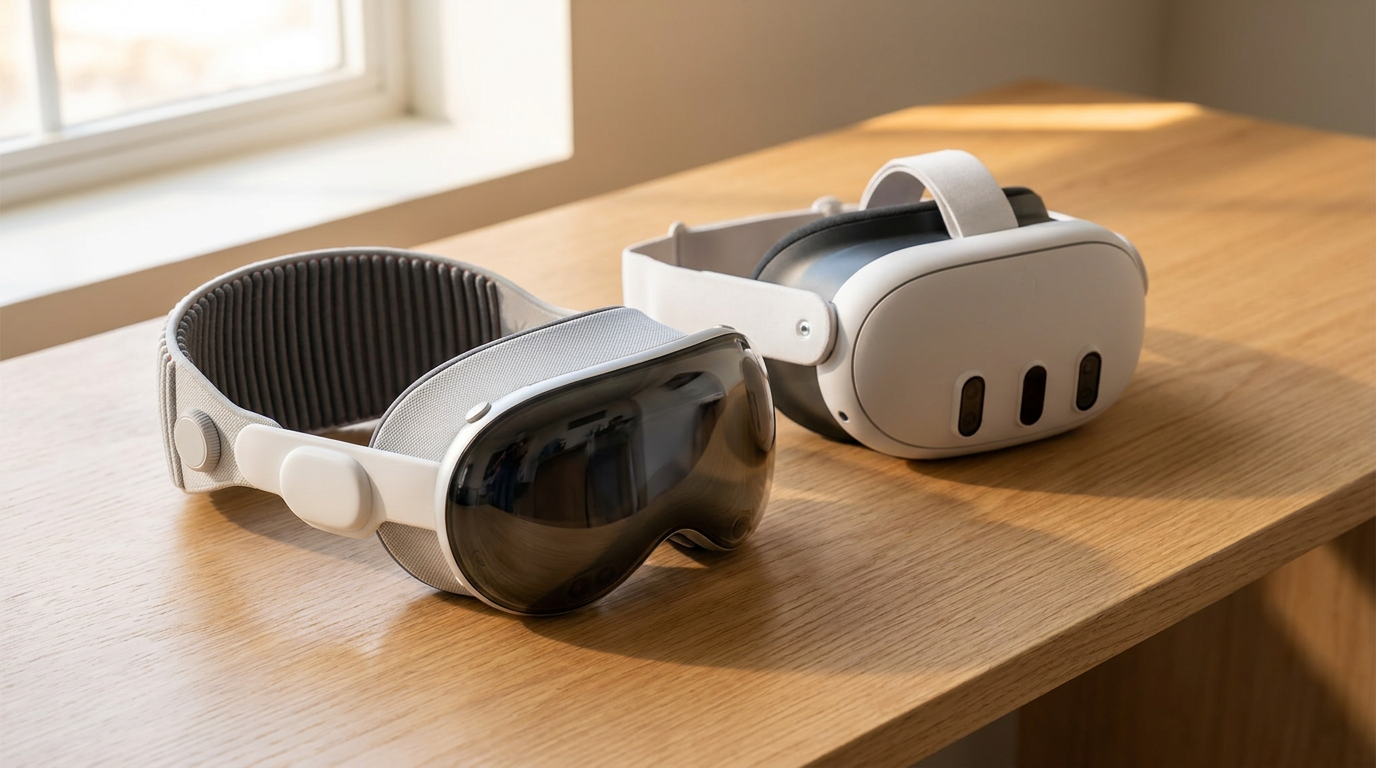
The spatial computing landscape in 2026 is defined by a massive divergence in philosophy and price. On one side sits the Meta Quest 3, a $499 device built primarily for standalone virtual reality gaming and accessible mixed reality. On the other side is the Apple Vision Pro, starting at $3,499, engineered as a premium spatial computer designed to integrate seamlessly into professional Apple workflows. Buyers are no longer just choosing a headset; they are choosing between two entirely different computing paradigms. The seven-fold price difference forces a rigorous evaluation of what each platform actually delivers in daily practice.[4][7]
For the Apple Vision Pro, the core argument for adoption centers on unmatched display fidelity and seamless ecosystem integration. The evidence is quantifiable: its dual micro-OLED panels push 23 million pixels, achieving roughly 34 pixels per degree. This density renders text, architectural models, and spatial media with near-photographic clarity, making it a genuine replacement for physical monitors. Against adoption, the primary friction points are weight, cost, and input limitations. At 600 to 650 grams on the face, plus a tethered 353-gram battery pack, sustained comfort becomes a limiting factor for sessions exceeding two hours, and the lack of physical controllers restricts its utility for fast-paced interactive software.[3][4][5]
For the Meta Quest 3, the argument for adoption is rooted in unmatched value, ergonomic freedom, and a massive interactive software library. The evidence lies in its lightweight 515-gram all-in-one design, the inclusion of precision Touch Plus controllers, and a $499 entry price that democratizes mixed reality. Against adoption, the trade-offs are entirely visual and ecosystem-based. Its LCD pancake lenses deliver roughly 18 pixels per degree, which is excellent for gaming but introduces visible pixelation when reading small text or working in virtual desktop environments for extended periods. Furthermore, its color passthrough exhibits higher latency and distortion at depth compared to Apple's implementation.[2][4][5]

The technical gap matters most where it is immediately visible: passthrough quality and display sharpness. Apple Vision Pro renders the physical world through its cameras at roughly 6.5 milliseconds of latency, creating a mixed reality experience that feels like looking through tinted glass. This makes it ideal for high-end enterprise use cases, such as real estate developers showing multi-million dollar pre-construction apartments where material finishes must look flawless. The Quest 3, while offering full-color passthrough that is a massive leap over its predecessor, still reads as a rendered video feed with noticeable noise in low light, making it less suitable for pixel-perfect professional demonstrations.[1][5]
Input methodology represents another fundamental divergence between the two platforms. Apple has bet entirely on eye tracking and hand gestures, utilizing the R1 chip to process sensor data instantly. Users simply look at an interface element and pinch their fingers to select it—a system that feels magical for browsing, media consumption, and spatial productivity. However, this controller-free approach falls short in scenarios requiring tactile feedback or rapid, out-of-sight hand movements. The Meta Quest 3 relies on its tracked controllers for precise aiming and physical movement, which remains the gold standard for virtual reality gaming, though its optical hand tracking has improved significantly through software updates.[2][6]
Input methodology represents another fundamental divergence between the two platforms.
Processing architecture dictates what these devices can actually run natively. The Vision Pro is powered by the Apple M2 chip, delivering laptop-class performance that allows users to open multiple floating 4K screens, run native visionOS applications, and wirelessly mirror a Mac display with near-zero latency. This makes it a legitimate productivity workstation. The Quest 3 utilizes the Snapdragon XR2 Gen 2 chipset, which provides excellent mobile graphics for standalone games but cannot match the multitasking overhead required for heavy computing workflows. While the Quest 3 can connect to a PC for high-end VR, its standalone productivity features feel secondary to its entertainment focus.[4][7]

Comfort and ergonomics present a complex trade-off for both devices. Apple's decision to use premium materials like aluminum and glass results in a heavier headset. To mitigate this, the battery was moved to an external aluminum puck that sits in the user's pocket, pulling weight off the temples but introducing a tether that can snag on armrests. Meta opted for a plastic chassis with a built-in battery, keeping the device entirely wireless. While the Quest 3 is lighter overall, the front-heavy design can cause facial fatigue, leading many users to invest in third-party rigid head straps to improve weight distribution for longer sessions. Both devices effectively cap out at around two to two-and-a-half hours of battery life.[1][2][5]
The software ecosystems reflect the hardware priorities. Meta has spent years cultivating partnerships with game studios, resulting in the deepest dedicated VR game catalog available, alongside robust fitness applications and social platforms. Apple, conversely, launched with a focus on spatial video, premium media partnerships, and compatibility with over a million existing iPad apps. While the Vision Pro's native app library is growing, it remains heavily skewed toward productivity, design, and passive entertainment rather than immersive, room-scale gaming.[1][6]
When evaluating these platforms, the Meta Quest 3 fits well when the primary use cases are gaming, virtual fitness, social VR, or exploring mixed reality on a budget. It is the definitive choice for users who want a wireless, highly capable entertainment device that does not require a broader ecosystem commitment. It does not fit well when the user intends to replace their physical monitors for eight-hour workdays, requires pixel-perfect text rendering for coding, or needs to present high-fidelity 3D models to premium enterprise clients.[4][6]

Conversely, the Apple Vision Pro fits well when the user is deeply entrenched in the Apple ecosystem, requires a portable spatial workstation with massive virtual displays, or demands the absolute highest visual fidelity for media consumption and design review. It is a tool for early adopters and professionals who view the $3,499 price tag as an investment in a new computing paradigm. It does not fit well when the user wants to play fast-paced VR games, desires a lightweight untethered experience for active movement, or is highly sensitive to the ergonomic strain of wearing a 600-gram aluminum device on their face.[4][7]
The brand signal also plays a subtle but real role in enterprise and professional adoption. In client-facing scenarios, the Vision Pro carries a premium aesthetic that aligns with high-end services, whereas the Quest 3 is widely recognized as a consumer gaming device. This distinction matters in architecture, luxury retail, and executive presentations, where the hardware itself communicates a level of investment and sophistication. However, for internal training, education, and scaled deployments, the Quest 3's cost-efficiency makes it the only viable option for outfitting an entire team.[5][7]

Ultimately, framing this as a direct competition misses the reality of the 2026 spatial computing market. The Quest 3 and Vision Pro are not rivals fighting for the exact same customer; they are the best-in-class representatives of two different product categories. Meta has perfected the accessible, interactive virtual reality console, while Apple has established the baseline for premium spatial computing. Buyers who honestly assess their daily workflows—prioritizing either interactive entertainment or high-fidelity productivity—will find that the hardware trade-offs make the correct choice abundantly clear.[6][8]
How we got here
June 2023
Apple officially announces the Vision Pro at WWDC, signaling its entry into spatial computing.
October 2023
Meta releases the Quest 3, introducing full-color mixed reality to the mass market.
February 2024
Apple Vision Pro launches in the US, establishing the premium benchmark for micro-OLED displays.
Mid-2026
Both platforms see mature software ecosystems, clarifying the divide between productivity and gaming.
Viewpoints in depth
Spatial Computing Professionals
Focuses on display fidelity, ecosystem integration, and replacing physical monitors.
For this camp, the headset is an investment in a new computing paradigm. They prioritize the 34 PPD micro-OLED displays and seamless Mac mirroring over gaming capabilities. To them, the $3,499 price tag is justified if it successfully replaces a multi-monitor workstation and enables high-fidelity spatial design workflows.
VR Gaming Enthusiasts
Prioritizes interactive software libraries, precise controller tracking, and untethered freedom.
This perspective views headsets primarily as interactive entertainment consoles. They argue that without dedicated physical controllers and a massive library of native VR games, a headset lacks core utility. From this viewpoint, the Quest 3 is the undisputed winner because it delivers a superior gaming experience at a fraction of the cost, without the ergonomic burden of an external battery pack.
Market Pragmatists
Evaluates the hardware based on price-to-value ratio and mass-market viability.
Pragmatists look at the 7x price difference and conclude that the Quest 3 is the only logical choice for 95% of consumers. While they acknowledge Apple's technological superiority in passthrough and display resolution, they argue that those premium features do not yet justify the massive cost premium for everyday users. They view the Vision Pro as an impressive developer kit for the future, while the Quest 3 is the definitive product for the present.
What we don't know
- How quickly Apple can incentivize developers to build native, highly interactive spatial applications beyond floating iPad windows.
- Whether Meta's future software updates can bridge the productivity gap without requiring new hardware.
- How the secondary market will value first-generation premium spatial computers as newer, lighter models are inevitably announced.
Key terms
- Spatial Computing
- A paradigm where digital content blends seamlessly with the physical world, allowing users to interact with virtual interfaces in 3D space.
- Passthrough
- The technology that uses external cameras on a headset to display the real world inside the screens.
- Micro-OLED
- A premium display technology that packs millions of pixels into a tiny physical area, resulting in ultra-sharp text and images.
- Pancake Lenses
- A folded optical design that allows VR headsets to be significantly thinner and lighter than older models.
- Pixels Per Degree (PPD)
- A measurement of display sharpness in VR; higher numbers mean less visible pixelation and clearer text.
Frequently asked
Can the Meta Quest 3 be used for work and productivity?
Yes, it supports virtual desktop applications, but its lower display resolution makes reading small text for long periods less comfortable than on the Vision Pro.
Does the Apple Vision Pro have VR games?
While it supports some spatial games and Apple Arcade titles, it lacks the dedicated controllers and massive VR library found on the Quest 3.
Do I need a Mac to use the Apple Vision Pro?
No, it functions as a standalone computer, but its ability to wirelessly mirror a Mac display is one of its strongest productivity features.
Which headset is better for watching movies?
The Apple Vision Pro offers a vastly superior cinematic experience due to its high-resolution micro-OLED displays and advanced spatial audio.
Sources
Source coverage
8 outlets
3 viewpoints surfaced







[1]FluidVR Gaming Enthusiasts
Meta Quest 3 vs Apple Vision Pro trade-offs
Read on Fluid →[2]MashableVR Gaming Enthusiasts
Apple Vision Pro vs. Meta Quest 3: How much does $3,500 really get you?
Read on Mashable →[3]VR EddieVR Gaming Enthusiasts
Side-by-side specification comparison for Apple Vision Pro and Meta Quest 3
Read on VR Eddie →[4]Reality AtlasSpatial Computing Professionals
Meta Quest 3 and Apple Vision Pro compared — gaming vs spatial computing
Read on Reality Atlas →[5]R2USpatial Computing Professionals
Hardware comparison: what matters for a sales gallery
Read on R2U →[6]VR.orgVR Gaming Enthusiasts
Meta Quest 3 vs Apple Vision Pro compared
Read on VR.org →[7]Smart Glass LogicSpatial Computing Professionals
Meta Quest 3 vs Apple Vision Pro — Which Is Worth It?
Read on Smart Glass Logic →[8]Factlen Editorial TeamMarket Pragmatists
Synthesis by Factlen editorial team
Read on Factlen Editorial Team →
Every angle. Every day.
Get meta stories with full source coverage and perspective breakdowns delivered to your inbox.