
Solid-State Batteries: How the 'Holy Grail' of EV Tech Works
After decades of lab research, solid-state batteries are entering pilot production in 2026, promising to double EV range and eliminate fire risks. Here is how the technology works, why it took so long, and when it will actually reach your driveway.
By Factlen Editorial Team
- Aggressive Commercializers
- Automakers and startups pushing to integrate solid-state batteries into production vehicles by 2026 or 2027 to gain a first-mover advantage.
- Cautious Incumbents
- Established battery giants who argue that while pilot lines are active, true mass-market adoption won't happen until 2030 due to cost and manufacturing hurdles.
- Battery Physicists
- Researchers focused on the mechanical challenges of solid-state technology, emphasizing that replacing liquid with solid introduces complex contact and expansion issues.
What's not represented
- · Lithium Mining Communities
- · Independent Auto Repair Shops
Why this matters
If successful at scale, solid-state batteries will make electric vehicles lighter, safer, and capable of charging as fast as filling a gas tank—effectively ending range anxiety and reshaping the global auto industry.
Key points
- Solid-state batteries replace flammable liquid electrolytes with solid ceramic or sulfide materials.
- The technology enables the use of a pure lithium-metal anode, dramatically increasing energy density.
- First-generation cells project up to 745 miles of range and 10-to-15-minute charging times.
- Honda, QuantumScape, and Toyota are pushing pilot production lines live in 2026.
- High manufacturing costs mean mass-market adoption is unlikely before 2030.
For nearly thirty years, lithium-ion batteries have powered the digital revolution through slow, incremental upgrades. But in 2026, the electric vehicle industry is aggressively pivoting toward a fundamental rewrite of battery architecture: the solid-state battery. Long described as the "holy grail" of energy storage, the technology is finally moving from laboratory benches to pilot production lines.
The shift accelerated in June 2026, when Honda announced a major joint research agreement with California-based QuantumScape to commercialize solid-state cells, following a similar move by Volkswagen. Meanwhile, Chinese automakers like Dongfeng and GAC-backed Greater Bay Technology are preparing to put solid-state batteries into low-volume production vehicles by the end of the year.[1][2][3][6]
To understand why automakers are investing billions into this transition, one must look inside the cells that power today's EVs. In a conventional lithium-ion battery, energy is stored and released as lithium ions shuttle back and forth between two electrodes—the cathode and the anode.
These ions travel through a liquid organic solvent, which acts as the electrolyte. While effective, this liquid electrolyte is inherently flammable. If a conventional battery is pierced, short-circuited, or overheated, the liquid can ignite, leading to the notoriously difficult-to-extinguish fires that have occasionally plagued modern EVs.[4]

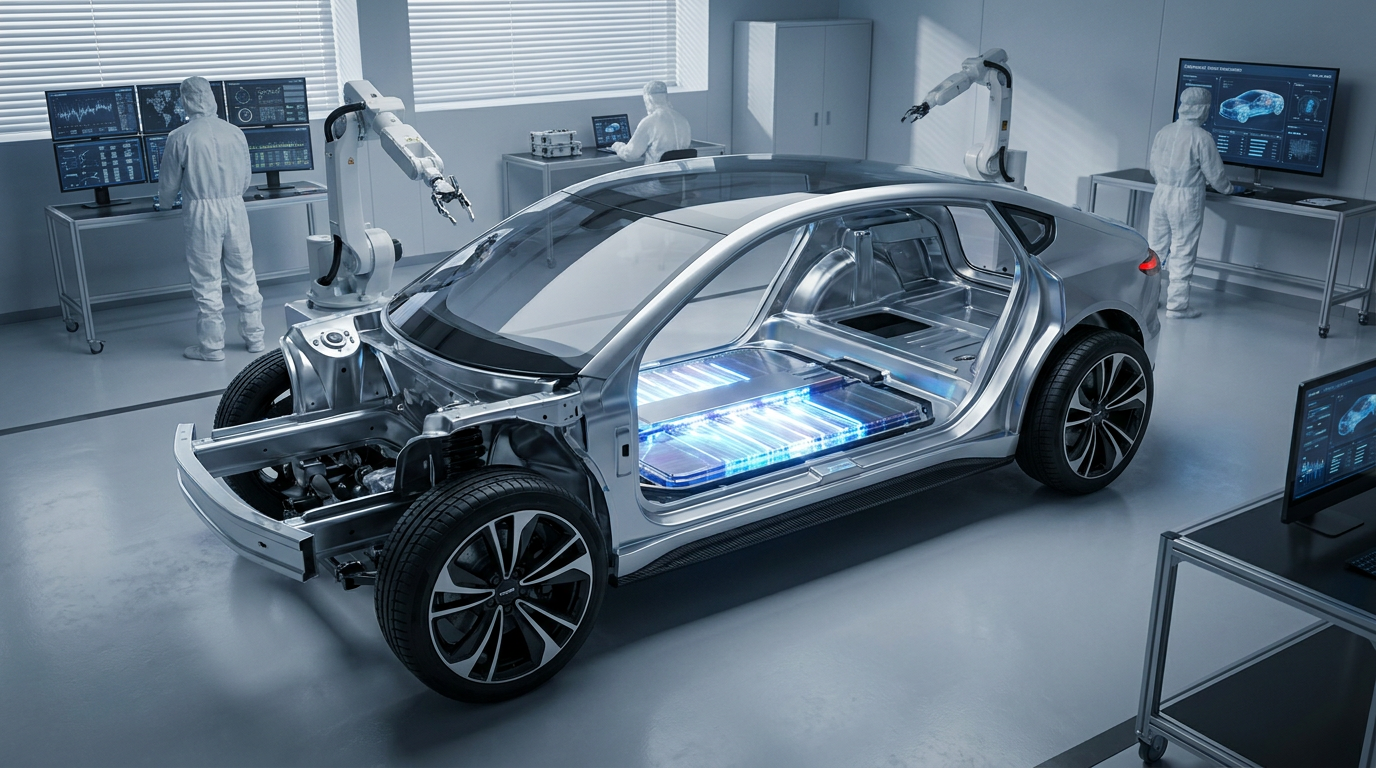
A solid-state battery, as the name implies, replaces this liquid solvent with a solid material—typically a specialized ceramic, glass, or sulfide compound. This solid electrolyte still allows lithium ions to pass through, but it fundamentally alters the physics and safety profile of the cell.
The most immediate benefit is safety. By eliminating the flammable liquid, solid-state batteries are virtually fireproof. They can safely operate at internal temperatures up to 80 degrees Celsius (176 degrees Fahrenheit), whereas conventional lithium-ion cells begin to degrade and risk thermal runaway once they cross 50 degrees Celsius.[4]
Because they are so thermally stable, solid-state batteries require significantly less heavy, bulky protective casing and cooling infrastructure. This allows automakers to pack more active energy-storing material into the same physical footprint, instantly improving the vehicle's overall efficiency.
But the solid electrolyte unlocks an even bigger prize: the lithium-metal anode. In today's batteries, the anode is typically made of graphite, a bulky material whose only job is to house the lithium ions. The solid ceramic separator in a next-generation battery is strong enough to allow engineers to remove the graphite entirely.
But the solid electrolyte unlocks an even bigger prize: the lithium-metal anode.
Instead, the battery uses a pure lithium-metal anode. Because lithium metal stores far more energy by weight and volume than graphite, this single substitution dramatically increases the battery's energy density. QuantumScape's latest QSE-5 cells, for example, boast an energy density of 844 watt-hours per liter, far exceeding conventional limits.[1]
For the consumer, this translates directly to range and convenience. Toyota, which has secured Japanese government approval to begin pilot production, projects that its first-generation solid-state batteries will deliver up to 745 miles (1,200 kilometers) of range on a single charge.[8]

Charging speeds also see a massive leap. Because the solid electrolyte can handle immense electrical currents without overheating, these batteries can safely absorb power at unprecedented rates. Honda and QuantumScape's prototypes have demonstrated the ability to charge from 10 percent to 80 percent in just 12.2 minutes—approaching the time it takes to fill a traditional gas tank.[1][8]
If the benefits are so transformative, why has it taken decades to bring them to market? The answer lies in the brutal realities of mechanical physics. When you replace a liquid with a solid, you trade chemical instability for mechanical complexity.
During charging and discharging, the lithium-metal anode expands and contracts—a process battery engineers refer to as 'breathing.' In a liquid battery, the fluid simply flows around the expanding materials. In a solid-state battery, two rigid solid materials must remain in intimate, microscopic contact while expanding and contracting thousands of times.[5]
If the solid electrolyte and the anode lose contact even slightly, electrical resistance spikes, performance plummets, and the battery dies prematurely. Solving this contact-mechanics problem has required immense engineering feats, including applying precise mechanical pressure to the cells and developing flexible sulfide-based solid electrolytes.
Cost remains the final, towering hurdle. According to industry analysts, sulfide-based solid-state cells are currently three to five times more expensive to manufacture than conventional lithium-ion batteries. The manufacturing processes require entirely new factory equipment, ultra-dry clean rooms, and novel supply chains.[7]
This economic reality is driving a wedge between the marketing timelines and the engineering timelines. While companies like Greater Bay Technology and Dongfeng are pushing for low-volume vehicle integration in late 2026, the world's largest battery manufacturer is urging caution.

CATL, the Chinese battery behemoth, recently noted that while it is targeting small-batch production by 2027, the technology remains at a relatively early readiness level for true mass manufacturing. CATL's leadership has bluntly stated that the chances of seeing solid-state batteries in millions of vehicles before 2030 are very small.[7]
Consequently, the rollout will be staggered. The first solid-state batteries will appear in premium, high-margin vehicles—such as luxury sedans and high-performance sports cars—where buyers can absorb the initial cost premium.
As manufacturing yields improve and economies of scale take hold, the technology will gradually trickle down to mass-market vehicles in the early 2030s. Until then, solid-state batteries stand as the most consequential engineering race of the decade—one that will ultimately dictate the winners and losers of the electric era.
How we got here
Late 20th Century
Solid electrolytes are discovered, but early versions suffer from poor conductivity at room temperature.
2023
Toyota announces a major breakthrough in solid-state durability, targeting commercialization by 2027.
Jan 2025
Honda begins pilot production of solid-state batteries at its Sakura plant in Japan.
June 2026
QuantumScape and Honda sign a major joint research agreement to commercialize solid-state cells.
Late 2026
Chinese automakers like Dongfeng plan to integrate the first solid-state batteries into low-volume production vehicles.
Viewpoints in depth
Aggressive Commercializers
Automakers and startups pushing to integrate solid-state batteries into production vehicles by 2026 or 2027.
Companies like QuantumScape, Greater Bay Technology, and Toyota are aggressively pushing the timeline forward. They argue that the core chemical challenges have been solved and that pilot production lines are already yielding automotive-grade cells. For these players, getting solid-state batteries into premium, low-volume vehicles by 2026 or 2027 is crucial for establishing market dominance and proving the technology's real-world viability to investors.
Cautious Incumbents
Established battery giants who argue that true mass-market adoption won't happen until 2030.
Market leaders like CATL view the aggressive 2026 timelines as overly optimistic for mass production. They point out that while producing a few thousand cells in a lab or pilot plant is feasible, scaling to millions of vehicles requires entirely new supply chains and manufacturing equipment. With solid-state cells currently costing three to five times more than conventional lithium-ion batteries, these incumbents believe the technology won't reach true mass-market parity until the early 2030s.
Battery Physicists
Researchers focused on the mechanical challenges of solid-state technology.
For materials scientists and battery physicists, the conversation is less about timelines and more about mechanical durability. They emphasize the 'breathing' problem: because the lithium-metal anode expands and contracts during charging, maintaining microscopic contact with a rigid solid electrolyte is incredibly difficult. If contact degrades, the battery fails. These experts warn that while energy density is high, proving that these cells can survive thousands of charge cycles in harsh, real-world automotive conditions remains the ultimate test.
What we don't know
- Whether automakers can successfully scale the highly sensitive clean-room manufacturing processes required for solid-state cells.
- How quickly the 3-5x cost premium will fall to achieve price parity with traditional lithium-ion batteries.
- How the solid-state cells will perform after a decade of real-world temperature fluctuations and road vibrations.
Key terms
- Electrolyte
- The medium inside a battery that allows ions to travel between the cathode and anode during charging and discharging.
- Anode
- The negative electrode of a battery; in solid-state batteries, this is often made of pure lithium metal rather than bulky graphite.
- Energy Density
- The amount of energy a battery can store relative to its physical size or weight.
- Thermal Runaway
- A dangerous chain reaction where a battery overheats uncontrollably, often leading to fires in conventional liquid-electrolyte cells.
- Dendrites
- Microscopic, needle-like structures that can grow inside a battery and cause short circuits, which solid electrolytes help prevent.
Frequently asked
What makes a solid-state battery different?
It replaces the flammable liquid electrolyte found in conventional lithium-ion batteries with a solid material, like ceramic or glass, allowing for a more energy-dense lithium-metal anode.
Will solid-state batteries catch fire?
They are virtually fireproof. Because they lack flammable liquid solvents, they can operate safely at much higher temperatures without the risk of thermal runaway.
When can I buy a car with a solid-state battery?
While some automakers plan to introduce them in low-volume premium vehicles between 2026 and 2028, mass-market availability is not expected until 2030 or later.
Sources
Source coverage
8 outlets
3 viewpoints surfaced







[1]ElectrekAggressive Commercializers
Honda, QuantumScape enter solid-state battery tie-up
Read on Electrek →China ramps up solid-state EV battery production
Read on Electrek →[3]CarsGuideAggressive Commercializers
Timeline for solid-state batteries pushed back as brands plot 2027 launches
Read on CarsGuide →[4]EV Infrastructure NewsBattery Physicists
Technology fundamentals explained: Solid-state batteries
Read on EV Infrastructure News →[5]MediumBattery Physicists
The hard part of solid-state batteries isn't just chemistry — it's physics
Read on Medium →[6]QuantumScapeAggressive Commercializers
QuantumScape Announces Agreement with Honda on Solid-State Battery Technology
Read on QuantumScape →[7]GasgooCautious Incumbents
'Mass Production' Declarations vs. Reality for Solid-State Batteries
Read on Gasgoo →[8]Green Car ReportsCautious Incumbents
Toyota provides more detailed roadmap for solid-state batteries
Read on Green Car Reports →
Every angle. Every day.
Get transportation stories with full source coverage and perspective breakdowns delivered to your inbox.