
How Clean Energy Apprenticeships Are Reshaping Vocational Education
Driven by federal incentives and a massive skills shortage, the renewable energy sector is fueling a resurgence in 'earn while you learn' apprenticeships. These green-collar vocational programs are offering workers high starting salaries and zero student debt, challenging the traditional four-year college pathway.
By Factlen Editorial Team
- Workforce Development Agencies
- Focuses on the macroeconomic data, job growth projections, and the structural need for skilled labor.
- Clean Energy Industry & Advocates
- Emphasizes the urgent need to fill the skills gap to meet project deadlines and the benefits of the apprenticeship model.
- State Policy & Equity Planners
- Prioritizes using the green transition to provide equitable economic opportunities for disadvantaged communities.
Why this matters
The surge in green-collar apprenticeships offers a lucrative, debt-free alternative to traditional four-year college degrees. For readers navigating career choices or advising young adults, understanding these pathways is critical to accessing some of the fastest-growing and highest-paying entry-level jobs in the modern economy.
For decades, the conventional blueprint for economic mobility in the United States relied heavily on the four-year university degree. However, a structural shift in the global energy economy is rapidly rewriting that script, elevating vocational training and the skilled trades to the forefront of workforce development. The catalyst is the clean energy transition, which has birthed a surging demand for "green collar" workers—individuals whose daily labor directly contributes to reducing environmental harm or building renewable infrastructure. As billions of dollars in public and private capital flow into decarbonization efforts, the bottleneck has shifted from funding to human capital. There are simply not enough trained hands to build, wire, and maintain the infrastructure required for a low-carbon future, prompting a massive resurgence in apprenticeship models that bypass the traditional college route entirely.[7][8]
The most striking evidence of this shift comes directly from federal labor data. According to the latest projections from the U.S. Bureau of Labor Statistics for the 2024–2034 decade, the two fastest-growing occupations in the entire American economy are in the renewable energy sector. Demand for wind turbine service technicians is projected to grow by a staggering 50 percent, while the need for solar photovoltaic installers is expected to increase by 42 percent. While these percentages represent rapid growth in relatively specialized fields, they signal a broader industrial pivot. These roles require rigorous technical training and physical stamina, but they do not require a bachelor's degree, making them highly accessible entry points into a booming sector.[1]

This domestic boom mirrors a massive global realignment in industrial labor. As of the latest assessments, the global renewable energy sector employs roughly 16.6 million people, with solar photovoltaics acting as the single largest employer worldwide. International labor experts project that under pathways aligned with global climate targets, the renewable energy sector could support upwards of 43 million jobs by 2050. This staggering scale of job creation is forcing governments and educational institutions to rethink how they prepare the next generation of workers, moving away from purely academic tracks toward applied, hands-on technical education that can rapidly deploy skilled personnel into the field.[3]
The primary mechanism driving this workforce expansion is the Registered Apprenticeship Program (RAP). Unlike traditional vocational schooling where students pay tuition and hope for a job upon graduation, RAPs operate on an "earn while you learn" model. Apprentices are hired as full-time employees from day one, receiving a guaranteed wage that progressively increases as their skill levels advance. This on-the-job training is paired with supplemental classroom instruction, culminating in a nationally recognized credential. For workers, this model entirely eliminates the burden of student debt while providing immediate economic stability, fundamentally altering the risk-reward calculus of post-secondary education.[2][6]
The financial mathematics of the apprenticeship model present a compelling alternative to the traditional university track. Data from the Department of Energy indicates that workers who complete a Registered Apprenticeship Program in the energy sector earn an average of $77,000 in their first year on the job. By comparison, the average salary for a worker in their twenties holding a college degree is approximately $52,000, while those in the same age bracket without a degree or specialized training average just $30,000. This immediate earning premium is reshaping how young adults, particularly Generation Z, view their career options, driving a surge of interest in the skilled trades.[2][7]

The economic advantages of the green collar apprenticeship extend far beyond the initial starting salary. Over the course of a career, an individual who completes a Registered Apprenticeship is projected to earn approximately $300,000 more in wages and benefits compared to peers who lack such structured training. For employers, the return on investment is equally tangible; industry metrics suggest that companies gain an average of $1.47 for every dollar invested in their apprenticeship programs through increased productivity, improved safety records, and significantly lower employee turnover. This mutual financial benefit is the engine making the apprenticeship model sustainable at scale.[2][6]
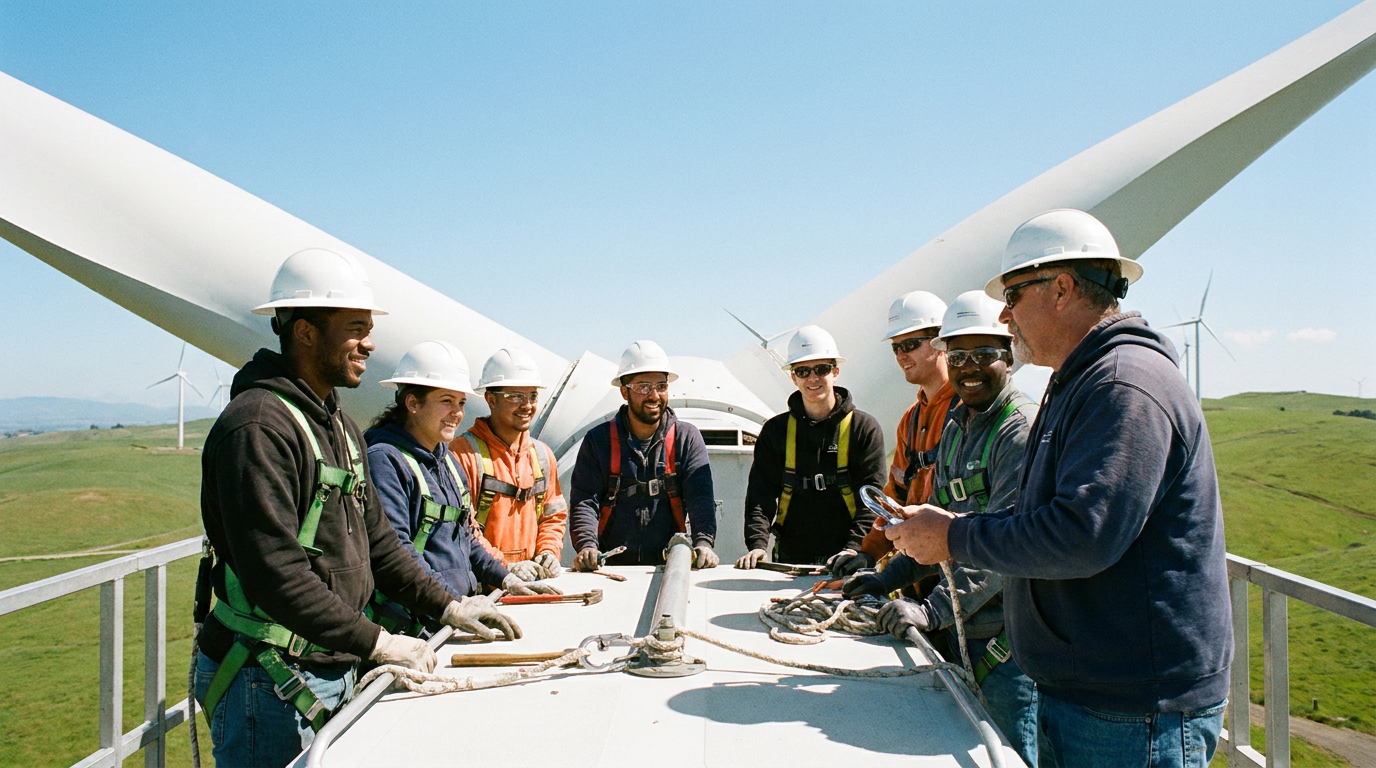
To understand the full scope of the green collar economy, labor economists divide these roles into three distinct tiers, starting with "direct jobs." These are the highly visible positions that exist specifically because of renewable energy projects. The wind turbine technician suspended hundreds of feet in the air off the coast, the electrician wiring a commercial solar array, and the geothermal drilling specialist all fall into this category. Direct jobs are the primary focus of most vocational training programs because they require highly specific, non-transferable certifications and safety protocols that must be taught through rigorous, hands-on instruction.[5]
The second tier consists of "indirect jobs," which form the massive industrial supply chain supporting the clean energy transition. These roles include the factory workers manufacturing solar modules, the logistics coordinators managing the transport of massive wind turbine blades, and the steelworkers forging the specialized towers required for offshore wind farms. While these workers might not be climbing turbines or wiring panels, their trades are inextricably linked to the green economy. Vocational training for these roles often overlaps with traditional advanced manufacturing and logistics, requiring skills in robotics, precision machining, and supply chain management.[5]
The second tier consists of "indirect jobs," which form the massive industrial supply chain supporting the clean energy transition.
The final tier encompasses "induced jobs," which are generated by the economic ripple effects of the green collar workforce. When a newly minted solar technician earning $77,000 a year spends their wages in their local community—buying groceries, eating at restaurants, or purchasing a home—they sustain a broader local economy. In rural areas where massive wind and solar installations are frequently located, this influx of high-paying, stable employment can revitalize communities that have suffered from decades of industrial decline or agricultural consolidation, making green vocational training a potent tool for regional economic development.[5]

Federal policy has acted as a massive accelerant for this vocational renaissance, most notably through the requirements embedded in the Inflation Reduction Act. To qualify for the maximum tax incentives available for large-scale renewable energy projects, developers are now legally required to ensure that at least 15 percent of all labor hours are completed by workers enrolled in Registered Apprenticeship Programs. This regulatory lever has transformed apprenticeships from a "nice-to-have" workforce development initiative into a strict financial necessity for energy companies, triggering a frantic rush to establish and scale training pipelines across the industry.[6]
State governments are aggressively compounding this federal push with localized funding and infrastructure. In April 2026, the New York State Energy Research and Development Authority (NYSERDA) launched new competitive solicitations for Clean Energy Career Pathways Training. These state-level initiatives are designed to counteract recent federal policy fluctuations and ensure a steady, in-state pipeline of skilled talent. By funding curriculum development, training equipment, and technical instruction in areas like building electrification and smart grid infrastructure, states are actively building the institutional capacity required to train thousands of new workers annually.[4]
A critical component of these modern vocational initiatives is a deliberate focus on equity and access. Historically, the skilled trades have struggled with diversity, but new green collar programs are explicitly designed to change that demographic makeup. For example, NYSERDA's training programs require that a minimum of 50 percent of participants come from disadvantaged communities or priority populations. By pairing technical training with wraparound support services—such as childcare, transportation assistance, and mentoring—these programs aim to remove the systemic barriers that have traditionally prevented underrepresented groups from accessing high-paying industrial careers.[2][4]
The transition to a green economy is also facilitating a massive lateral movement of skilled labor from traditional fossil fuel sectors. The oil and gas industry, for instance, is a profound reservoir of talent for the clean energy sector. The technical expertise required to manage a complex offshore oil rig translates remarkably well to the deployment of offshore wind farms. With targeted upskilling and specific safety certifications, workers from carbon-intensive industries are finding lucrative second acts in the green economy, ensuring that the energy transition does not leave the existing industrial workforce behind.[7]
Despite the clear financial incentives and policy support, scaling these vocational programs is not without significant friction. The primary bottleneck is the heavy administrative burden placed on employers attempting to launch Registered Apprenticeship Programs. Navigating the bureaucratic requirements of the Department of Labor, developing standardized curricula, and ensuring rigorous compliance tracking can overwhelm small and medium-sized clean energy contractors. Many companies simply lack the human resources bandwidth to manage the paperwork and reporting required to maintain a federally recognized apprenticeship program.[6][8]

To alleviate this administrative gridlock, industry intermediaries and national coalitions have emerged as vital connective tissue. Organizations like the Apprenticeships in Clean Energy (ACE) Network provide free technical assistance to employers, helping them design programs, register with the government, and pool resources. By sharing apprenticeship structures across multiple employers, these intermediaries drastically reduce the barrier to entry, allowing a contractor to go from having zero apprentices to managing a robust, compliant training pipeline in a matter of months.[6]
The final, and perhaps most difficult, hurdle is the acute shortage of qualified instructors. To train a new generation of green collar workers, the industry needs thousands of experienced journey-workers willing to step off the tools and into the classroom or mentorship roles. However, because demand for their skills is so high in the field, experienced technicians can often earn significantly more working on projects than they can teaching. Solving this instructional deficit—through higher compensation for trainers or hybrid teaching models—remains the most pressing challenge for the vocational education sector as it attempts to build the workforce of the future.[3][8]
Viewpoints in depth
Workforce Development Agencies
Federal and international labor organizations tracking the macroeconomic shift toward green trades.
Labor economists and federal agencies view the green collar boom as a necessary structural correction to decades of over-indexing on four-year degrees. By tracking the massive projected growth in roles like wind turbine technicians (50%) and solar installers (42%), these agencies argue that the future of middle-class economic stability lies in technical, hands-on skills. Their primary concern is ensuring that training infrastructure can scale rapidly enough to meet the 43 million global renewable energy jobs projected by 2050, preventing a labor bottleneck that could stall global climate targets.
Clean Energy Employers
Contractors and energy developers focused on filling immediate skills gaps to complete projects.
For the companies actually building the clean energy grid, the apprenticeship boom is a matter of immediate operational survival. Driven by strict federal compliance requirements—such as the Inflation Reduction Act's mandate that 15% of labor hours be completed by apprentices—employers are desperate for structured training pipelines. Industry advocates emphasize that the 'earn while you learn' model is the only viable way to recruit talent fast enough, though they frequently cite the heavy administrative burden of registering and maintaining these federal programs as a major hurdle.
State Policy & Equity Planners
State-level authorities using the energy transition to drive equitable economic development.
State energy authorities view the vocational boom not just as a climate necessity, but as a generational opportunity to correct historical economic inequities. Agencies like NYSERDA are aggressively funding training programs with strict mandates that a significant portion of participants come from disadvantaged communities. From this perspective, the green collar transition must include wraparound services like childcare and transportation assistance, ensuring that the high starting salaries of the clean energy sector are accessible to populations that have traditionally been excluded from lucrative industrial trades.
What we don't know
- Whether the supply of experienced journey-workers willing to become instructors can scale fast enough to train the incoming wave of apprentices.
- How long-term changes in federal tax incentives might alter the financial viability of employer-sponsored training programs.
- The exact rate at which workers from traditional fossil fuel sectors will successfully transition into the clean energy workforce.
Sources
Source coverage
8 outlets
3 viewpoints surfaced








[1]Bureau of Labor StatisticsWorkforce Development Agencies
Fastest Growing Occupations: 2024-2034
Read on Bureau of Labor Statistics →[2]Department of EnergyWorkforce Development Agencies
Why DOE is Focused on Registered Apprenticeships
Read on Department of Energy →[3]International Labour OrganizationWorkforce Development Agencies
Renewable energy jobs reach 16.6 million globally
Read on International Labour Organization →[4]NYSERDAState Policy & Equity Planners
NYSERDA Announces Funding for Clean Energy Career Pathways
Read on NYSERDA →[5]Green Fuel JournalClean Energy Industry & Advocates
What Are Renewable Energy Jobs? The Rise of the Green-Collar Worker
Read on Green Fuel Journal →[6]Interstate Renewable Energy CouncilClean Energy Industry & Advocates
Apprenticeships in Clean Energy (ACE) Network
Read on Interstate Renewable Energy Council →[7]MultiplierClean Energy Industry & Advocates
The Rise of Green Jobs and Green Skills
Read on Multiplier →[8]Factlen Editorial TeamState Policy & Equity Planners
Synthesis by Factlen editorial team
Read on Factlen Editorial Team →
Every angle. Every day.
Get education stories with full source coverage and perspective breakdowns delivered to your inbox.