
Buying New Construction vs. Existing Homes: The 2026 Trade-Off Guide
A rare market anomaly in 2026 has pushed the median price of existing homes above that of new construction, flipping traditional real estate logic. This guide breaks down the financial, timeline, and lifestyle trade-offs between building new and buying resale to help buyers navigate the current landscape.
By Factlen Editorial Team
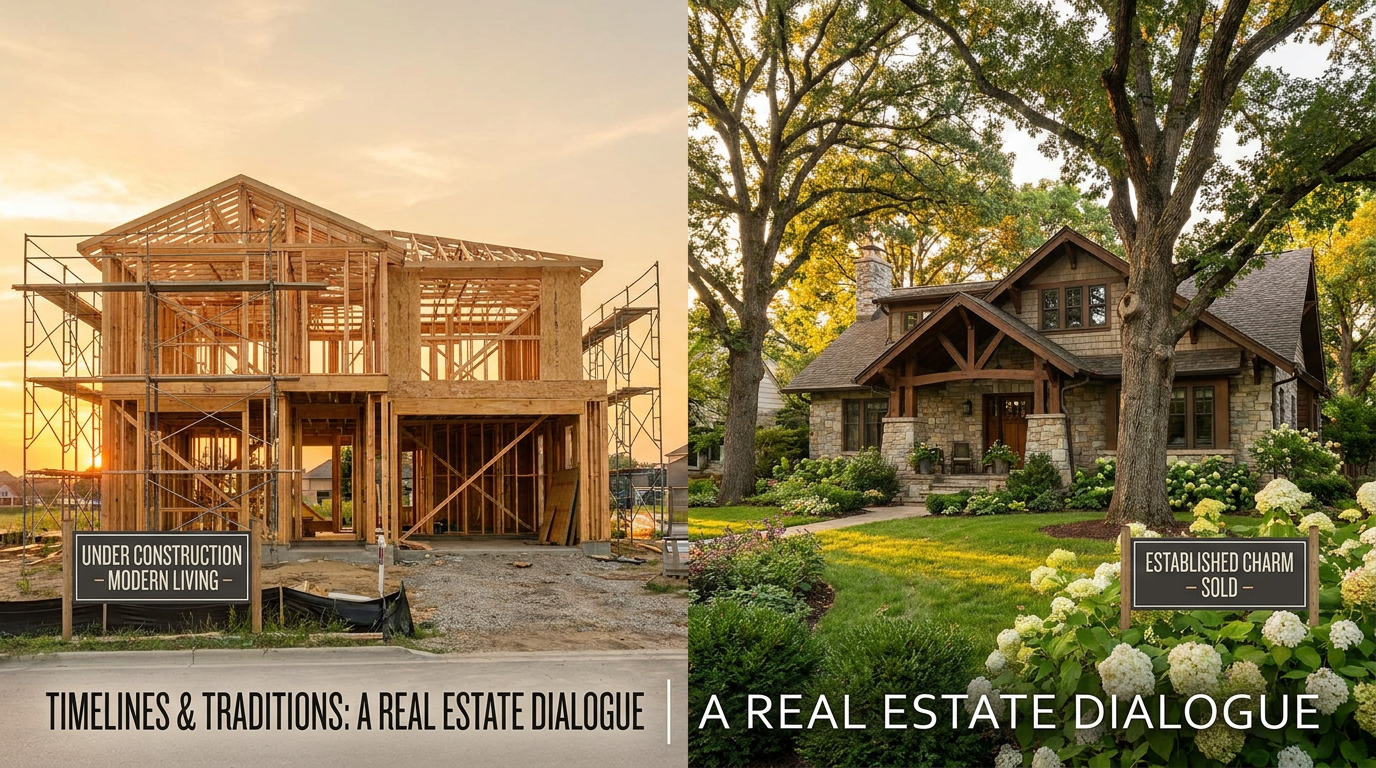
- New Construction Advocates
- Focuses on the financial leverage of builder incentives and the long-term savings of energy efficiency.
- Resale Market Proponents
- Prioritizes location, neighborhood maturity, and the speed of transaction.
- Financial Analysts
- Evaluates the trade-offs through the lens of total cost of ownership and market dynamics.
What's not represented
- · Renters priced out of both markets
- · Local municipal planners managing exurban sprawl
Why this matters
For the first time in modern history, buying a brand-new home is often cheaper upfront than purchasing an older one. Understanding the hidden costs, financing incentives, and timeline trade-offs of this market inversion is essential for anyone looking to maximize their purchasing power in 2026.
Key points
- The median price of existing homes ($429,400) has surpassed new construction ($410,800) in a rare historical market inversion.
- Builders are offering aggressive incentives, including mortgage rate buydowns that can secure rates under 5%.
- New construction offers significant energy savings and warranty protection, but requires a 7-to-12-month building timeline.
- Existing homes provide immediate move-in readiness and mature neighborhoods, but carry risks of deferred maintenance.
- Buyers must calculate the total cost of ownership over a five-to-seven-year horizon, factoring in utilities, insurance, and repairs.
The 2026 real estate market has delivered a historical anomaly that is fundamentally reshaping how buyers approach homeownership. For decades, purchasing a brand-new home carried a steep premium, often pricing first-time and middle-market buyers out of the new construction sector entirely. Today, that dynamic has completely inverted. Driven by a massive lock-in effect where current homeowners refuse to abandon their sub-four-percent mortgages, the supply of existing homes remains constrained, driving up their prices. Meanwhile, builders have adapted by constructing slightly smaller footprints and leveraging their capital to move inventory. The result is a rare window where buyers are finding that a never-lived-in home can actually cost less upfront than a decades-old property down the street.[4][5]
The raw numbers illustrate the depth of this market shift. According to recent data from the U.S. Census Bureau and the National Association of Realtors, the median price for a newly constructed single-family home has settled around $410,800. In contrast, the median price for an existing resale home has climbed to $429,400. This $18,600 gap marks the largest historical margin where used homes cost more than new ones. While regional variations exist—the Northeast still sees a massive premium for new builds due to land scarcity—the national trend is clear. Buyers are essentially being asked to pay a premium for someone else's lived-in space, while builders are offering brand-new inventory for less money.[2][4]

In evaluating new construction, the primary argument for this path centers on financing leverage and long-term cost predictability. The evidence lies in the aggressive concessions builders are currently offering to move their inventory. With standard 30-year fixed mortgage rates hovering around 6.3 percent in 2026, many national and regional builders are using their own profits to fund permanent or temporary mortgage rate buydowns. It is increasingly common for buyers to secure rates under 5 percent, or even in the high 4 percent range, simply by choosing a new build and using the builder's preferred lender. This financing advantage can save a buyer hundreds of dollars on their monthly payment, completely altering their purchasing power.[4][5]

Furthermore, the argument for new construction is bolstered by energy efficiency and reduced immediate maintenance. The evidence shows that modern insulation standards, high-efficiency HVAC systems, tight building envelopes, and smart thermostats can reduce monthly utility bills by 30 to 50 percent compared to a home built in the 1990s. Additionally, new homes come with comprehensive builder warranties covering the roof, foundation, and major mechanical systems for years. This allows buyers to accurately predict their monthly homeownership costs without the looming anxiety of a sudden $15,000 roof replacement or a failing air conditioning unit during their first year of occupancy.[1][2]
Conversely, the argument against new construction focuses heavily on timeline uncertainty and geographic limitations. The evidence shows that building a home from dirt to completion typically takes seven to twelve months, a timeline that is highly susceptible to weather delays, permitting backlogs, and supply chain hiccups. For buyers who need to relocate for a job or align their move with a school calendar, this uncertainty is often a dealbreaker. Furthermore, because large tracts of developable land are scarce in urban cores, new construction communities are almost exclusively located in suburban or exurban areas. Buyers opting for new builds frequently face longer commutes and must wait years for the surrounding commercial infrastructure—like grocery stores, restaurants, and community centers—to fully develop.[2][3]

Conversely, the argument against new construction focuses heavily on timeline uncertainty and geographic limitations.
Shifting to the resale market, the argument for buying an existing home is anchored in immediate availability, location, and neighborhood maturity. The evidence is clear in the transaction speed: a preapproved buyer can typically close on an existing home and receive the keys in 30 to 45 days. There is no guesswork regarding what the finished product will look like, how the natural light hits the living room, or whether the lot grading will cause drainage issues. Existing homes are also more likely to be situated in established neighborhoods with mature tree canopies, proven school districts, and immediate proximity to urban amenities. For buyers who prioritize a five-minute commute or a highly walkable neighborhood, the resale market is often the only viable option.[1][2]
Another critical distinction lies in the negotiation process. The argument for existing homes includes the flexibility of dealing with an individual seller. The evidence shows that in a balanced or buyer-leaning market, individuals are often willing to negotiate on the final purchase price, leave behind appliances or furniture, or accommodate highly specific closing timelines to facilitate the deal. In contrast, corporate builders rarely negotiate on the base price of the home, as doing so would negatively impact the comparable sales data for the rest of the neighborhood. Instead, builders prefer to negotiate through design center credits or closing cost assistance, which protects their neighborhood valuations but offers less flexibility on the actual sticker price.[1][6]
Additionally, the argument for existing homes highlights architectural character and lot size. The evidence points to the fact that homes built decades ago often feature larger property footprints, greater distance between neighbors, and unique craftsmanship—such as original hardwood floors, plaster walls, or custom millwork—that is prohibitively expensive to replicate in modern tract housing. Furthermore, existing homes do not typically come with the sudden property tax shock that new construction buyers face in their second year, when the local municipality reassesses the previously vacant land to include the value of the completed structure.[1][6]

However, the argument against existing homes revolves around hidden capital expenditures, energy inefficiency, and rising insurance costs. The evidence points to the aging infrastructure of the U.S. housing stock. A buyer purchasing a 30-year-old home must budget for deferred maintenance, as systems like plumbing, electrical panels, and water heaters approach the end of their functional lifespans. In states prone to extreme weather, such as Florida or California, older homes that do not meet current building codes are facing skyrocketing homeowners insurance premiums, if they can secure coverage at all. The gap between what an older home looks like today and what a buyer wants it to look like often requires tens of thousands of dollars in renovation costs, which must typically be paid in cash rather than rolled into the mortgage.[1][6]
When comparing the two paths, buyers must look beyond the initial listing price and calculate the total cost of ownership over a five-to-seven-year horizon. A lower-priced resale home may look better on a preliminary spreadsheet, but if it requires new windows, upgraded insulation, and immediate cosmetic updates, the actual capital required to make it comfortable can quickly surpass the cost of a turnkey new build. Conversely, a new construction home might offer a lower monthly payment thanks to a builder rate buydown, but if the buyer is forced to purchase a car and commute an extra hour each day, the hidden lifestyle and transportation costs may negate the financial savings.[6]

Ultimately, the new construction path fits well when a buyer has a flexible moving timeline, prioritizes energy efficiency, wants to minimize weekend maintenance projects, and needs the financial leverage of a builder-subsidized mortgage rate. It is the optimal choice for those who value modern, open floor plans and the peace of mind that comes with comprehensive warranties. However, new construction does not fit well when a buyer is on a strict relocation deadline, demands a highly walkable urban location, or desires a home with historical architectural character and a large, heavily wooded lot.[6]
On the other hand, the existing home path fits well when a buyer needs to secure housing and move in within 45 days, places a premium on established community infrastructure, and prefers a shorter commute to major employment centers. It is ideal for buyers who have the cash reserves to handle unexpected repairs and enjoy the process of renovating and adding personal character to a property over time. Existing homes do not fit well when a buyer's budget is stretched to the absolute limit by the down payment, leaving no safety net for the inevitable system failures and maintenance demands that accompany older properties.[6]
How we got here
2020–2021
Mortgage rates hit historic lows, allowing millions of homeowners to lock in rates under 4 percent.
2022–2023
Interest rates spike rapidly, creating a 'lock-in effect' that severely constrains the supply of existing homes on the market.
2024
Home builders pivot their strategies, constructing homes with smaller footprints to maintain affordability amid rising costs.
2025
In a rare historical flip, the median price of an existing home officially surpasses the median price of a new construction home.
2026
Builders aggressively deploy mortgage rate buydowns and concessions, creating a unique buying window for new construction.
Viewpoints in depth
New Construction Advocates
Focuses on the financial leverage of builder incentives and the long-term savings of energy efficiency.
This camp argues that the traditional real estate math is outdated. By factoring in builder-subsidized mortgage rate buydowns, the monthly carrying cost of a new home is often significantly lower than an existing home, even if the sticker prices are similar. Furthermore, they emphasize that modern building codes and high-efficiency systems virtually eliminate the risk of catastrophic maintenance bills in the first decade of ownership, making new builds the safer financial bet for first-time buyers.
Resale Market Proponents
Prioritizes location, neighborhood maturity, and the speed of transaction.
Advocates for the existing home market argue that real estate's golden rule—location, location, location—still reigns supreme. They point out that new construction is increasingly pushed to the exurbs, forcing buyers into longer commutes and car-dependent lifestyles that erode any savings on the purchase price. Additionally, this camp highlights that older homes often feature larger lots and superior architectural character, and that the ability to close in 30 days provides essential certainty for families needing to relocate quickly.
Financial Analysts
Evaluates the trade-offs through the lens of total cost of ownership and market dynamics.
Financial analysts view the current market as a unique arbitrage opportunity created by the lock-in effect of sub-four-percent mortgages. They advise buyers to look past the initial purchase price and calculate the total cost of ownership over a five-to-seven-year horizon. This includes modeling the impact of property tax reassessments on new builds against the deferred maintenance and rising insurance premiums associated with aging properties. Their consensus is that buyers must weigh the immediate cash flow benefits of a rate buydown against the long-term appreciation potential of a prime location.
What we don't know
- Whether the price inversion between new and existing homes will persist if mortgage rates drop significantly.
- How long builders can sustain aggressive rate buydowns before impacting their profit margins.
- The long-term durability of materials used in 2026 rapid-build construction compared to mid-century homes.
Key terms
- Lock-in Effect
- A market dynamic where current homeowners refuse to sell their properties because doing so would mean giving up a historically low mortgage rate for a much higher current rate.
- Rate Buydown
- A financing tool where a seller or builder pays an upfront fee to the lender to reduce the buyer's mortgage interest rate, either temporarily or permanently.
- Deferred Maintenance
- The practice of postponing necessary home repairs or system replacements, which often becomes a hidden cost for the next buyer of an existing home.
- Exurbs
- Prosperous residential areas situated beyond the traditional suburbs of a city, where much of today's new home construction is taking place due to land availability.
- Concessions
- Financial incentives offered by a seller or builder to sweeten a real estate deal, such as covering closing costs or paying for upgrades.
Frequently asked
Why are existing homes currently more expensive than new builds?
A massive 'lock-in effect' has kept current homeowners from selling, as they refuse to give up their low mortgage rates from previous years. This constrained supply has driven up the price of existing homes, while builders have adapted by building smaller homes and offering price cuts to move inventory.
What is a mortgage rate buydown?
A rate buydown is a financing incentive where a home builder pays a lump sum to the lender at closing to lower the buyer's interest rate. This can be temporary (lowering the rate for the first 1-3 years) or permanent for the life of the loan.
Do new construction homes have hidden costs?
Yes. Buyers often face a property tax shock in their second year when the land is reassessed to include the completed home. Additionally, window coverings, landscaping, and community HOA fees are often not included in the base price.
How long does it take to build a new home in 2026?
Building a home from the ground up typically takes 7 to 12 months, depending on weather, permitting, and supply chains. In contrast, buying an existing home usually takes 30 to 45 days to close.
Sources
Source coverage
6 outlets
3 viewpoints surfaced






[1]Zillow ResearchResale Market Proponents
New Construction vs Existing Homes: The Pros and Cons of Both
Read on Zillow Research →[2]AmeriSaveNew Construction Advocates
Building vs. Buying a House in 2026: 7 Essential Cost Comparisons
Read on AmeriSave →[3]Realtor.comResale Market Proponents
Top Housing Markets for 2026
Read on Realtor.com →[4]National Association of Home BuildersNew Construction Advocates
The 2026 New-Home Market: A Rare Opportunity for Buyers?
Read on National Association of Home Builders →[5]The Mortgage ReportsFinancial Analysts
First-Time Home Buyer Advice and Preparation for 2026
Read on The Mortgage Reports →[6]Factlen Editorial TeamFinancial Analysts
Synthesis by Factlen editorial team
Read on Factlen Editorial Team →

Every angle. Every day.
Get real estate stories with full source coverage and perspective breakdowns delivered to your inbox.