
The Evidence on School Smartphone Bans: What the Data Actually Shows
As more countries mandate phone-free schools, a wave of new research reveals that while bans consistently reduce bullying, their impact on academic test scores remains surprisingly mixed.
By Factlen Editorial Team
- Policy Advocates & Educators
- Viewing bans as a necessary public health and social intervention to protect student well-being.
- Empirical Skeptics
- Warning against treating phone bans as an educational silver bullet, citing minimal academic gains.
- Evidence Synthesizers
- Concluding that while bans fail to magically boost test scores, they remain highly effective for schoolyard social dynamics.
What's not represented
- · Students adjusting to bans
- · Teachers enforcing the policies
Why this matters
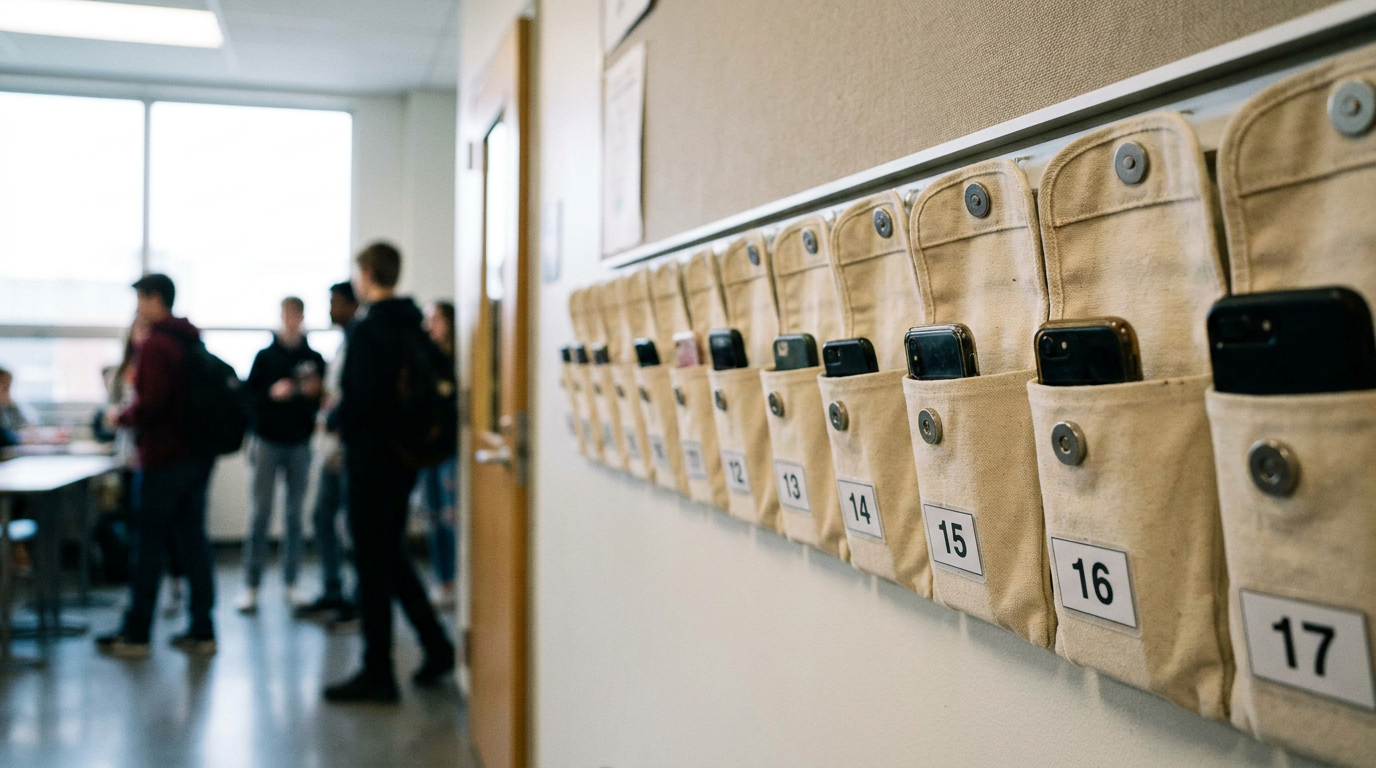
School districts worldwide are spending millions on enforcement tools like magnetic pouches to separate students from their devices. Understanding what these bans actually achieve—and where they fall short—helps parents and policymakers set realistic expectations for the post-smartphone classroom.
Key points
- Global data shows phone bans have a 'close to zero' impact on overall standardized test scores.
- Bans are highly effective at reducing in-school cyberbullying and improving social dynamics.
- Norwegian data revealed a 60% drop in psychology specialist visits among girls following a ban.
- Schools often experience an 'adjustment dip' in well-being during the first year before rebounding.
- Strict enforcement using physical pouches is required to see meaningful drops in screen time.
In 2023, UNESCO issued a stark recommendation: ban smartphones from classrooms globally to protect student well-being and restore educational focus. By 2026, the movement has shifted from a fringe pedagogical experiment to mainstream public policy.[2]
From Norway to Florida, and across vast swathes of the UK and Australia, educational authorities have mandated that devices be powered down or locked in magnetic pouches for the duration of the school day.[4][6]
The intuitive appeal of these bans is undeniable for parents and educators exhausted by the daily battle for student attention. However, as the first generation of comprehensive, multi-year data emerges, the empirical reality of phone-free schools is proving more nuanced than the political rhetoric suggests.[7]
To understand the true impact of removing devices from the educational environment, researchers have begun separating the data into two distinct categories: academic achievement and social-emotional well-being. The findings reveal a stark divergence between the two.[5]

On the academic front, the evidence that phone bans magically transform struggling students into high achievers is surprisingly weak. A landmark 2026 study published by the National Bureau of Economic Research (NBER), which analyzed nearly 1,800 US schools utilizing locked phone pouches, delivered a sobering reality check.[3]
Researchers from Stanford and Duke found that the average effects on standardized test scores were "close to zero" and precisely estimated. While the bans successfully drove down in-school phone usage, that reclaimed attention did not automatically translate into measurable improvements in reading or math proficiency for the general student body.[3][4]
A comprehensive review of 22 global studies echoed this sentiment, concluding that the evidence for banning mobile phones to boost academics remains weak and inconclusive. Simply removing a distraction, it appears, is not a substitute for high-quality instruction or systemic educational support.[5]
Yet, looking solely at standardized test scores misses the profound success these policies have achieved elsewhere. When the lens shifts from academic performance to social dynamics and mental health, the data paints a remarkably positive picture.[7]

Yet, looking solely at standardized test scores misses the profound success these policies have achieved elsewhere.
A rigorous doctoral study from the Norwegian School of Economics (NHH) examined the long-term effects of smartphone bans in Norwegian middle schools. The results were striking, particularly for female students who historically reported higher baseline usage.[1]
The Norwegian data revealed that banning phones led to a significant reduction in bullying across the board. Furthermore, it resulted in an estimated 60 percent drop in visits to psychology specialists among girls, suggesting a massive alleviation of daily social anxiety and digital peer pressure.[1][6]
Interestingly, the Norwegian study did find a clear positive effect on grades for girls. This suggests that while bans might not raise the national average overnight, they can be highly effective targeted interventions for demographics most vulnerable to digital distraction.[1][5]
A 2024 meta-analysis by German researchers quantified this divide, calculating an overall effect size of d = 0.162 for phone bans. In statistical terms, this is a modest impact, but the researchers noted that the benefits were heavily concentrated in the domain of social well-being rather than academic performance.[5]

One of the most fascinating insights from the recent wave of data is the discovery of an "adjustment dip." The NBER study observed that in the first year of a strict phone ban, schools often see a temporary rise in suspensions and a dip in students' self-reported feelings of well-being.[4]
Researchers attribute this to a withdrawal period. Teenagers accustomed to constant digital connection experience friction and frustration as they adapt to a suddenly offline school day, leading to temporary behavioral pushback.[3]
However, this turbulence is temporary. The data shows that by the second and third years of a ban, disciplinary issues fade, and student well-being rebounds, eventually surpassing pre-ban baselines. The social fabric of the school begins to heal as face-to-face interactions replace asynchronous messaging.[4]

The success of these policies also hinges entirely on enforcement. UNESCO's global monitoring report warned that partial bans—where phones are simply kept in pockets or backpacks—are frequently ineffective, as the mere presence of the device continues to drain cognitive bandwidth.[2]
Schools utilizing physical barriers, such as magnetic locked pouches, report much higher compliance and steeper drops in overall screen time during school hours. Yet, researchers caution that students often compensate by heavily increasing their screen time on evenings and weekends.[3][4][5]
Ultimately, the evidence pack on school smartphone bans suggests a need to reframe our expectations. If policymakers are implementing bans solely to reverse declining test scores, the data indicates they will likely be disappointed.[7]
How we got here
July 2023
UNESCO releases a global report calling for the restriction of smartphones in schools to protect learners.
Early 2024
Norway implements strict national guidelines restricting smartphone use in classrooms, leading to measurable drops in bullying.
Mid 2024
A comprehensive meta-analysis reveals that phone bans have a modest positive effect, driven primarily by social well-being.
May 2026
A landmark NBER study of 1,800 US schools finds that while bans reduce phone use, they have 'close to zero' impact on test scores.
Viewpoints in depth
Policy Advocates & Educators
Viewing bans as a necessary public health and social intervention.
For international bodies like UNESCO and national education directorates, the primary metric of success isn't just a math score—it's the holistic well-being of the child. This camp points to clear evidence from Norway and other early adopters showing that when phones are removed, cyberbullying plummets and students engage in more face-to-face interaction. They argue that even if academic gains are slow to materialize, protecting students from the constant anxiety of social media during school hours is a moral imperative.
Empirical Skeptics
Warning against treating phone bans as an educational silver bullet.
Data scientists and educational economists reviewing large-scale implementations caution against the hype. Looking at massive datasets from the US and Australia, this camp highlights that simply locking away a phone does not fix underlying pedagogical issues, teacher shortages, or systemic learning deficits. They argue that politicians often use phone bans as a highly visible, low-cost policy win, distracting from the harder work of actually improving educational instruction, since the test score data remains stubbornly flat.
What we don't know
- Whether the long-term academic impacts of phone bans will emerge after five or ten years of continuous enforcement.
- How the increase in at-home screen time offsets the mental health benefits gained during the school day.
Key terms
- Adjustment Dip
- A temporary period during the first year of a phone ban where student well-being drops and disciplinary issues rise due to digital withdrawal.
- Effect Size (d)
- A statistical metric used in meta-analyses to quantify the magnitude of a difference; a value of 0.162 indicates a positive but modest impact.
- Magnetic Pouches
- Physical locking cases (like Yondr) used by schools to securely store student phones during the day, preventing unauthorized access.
Frequently asked
Do smartphone bans improve student test scores?
Large-scale studies show the impact on standardized test scores is close to zero, though some specific demographics, like middle school girls, have shown modest grade improvements.
How do bans affect student mental health?
The evidence is strong that bans reduce in-school cyberbullying and lower rates of anxiety, though students may experience a temporary dip in well-being during the initial adjustment period.
Do students just use their phones more at home?
Yes, research indicates that while in-school screen time drops significantly, students often compensate by increasing their device usage during evenings and weekends.
Sources
Source coverage
7 outlets
3 viewpoints surfaced






[1]Norwegian School of Economics (NHH)Policy Advocates & Educators
Smartphones should be out of the classrooms
Read on Norwegian School of Economics (NHH) →[2]UNESCOPolicy Advocates & Educators
UNESCO issues urgent call for appropriate use of technology in education
Read on UNESCO →[3]National Bureau of Economic ResearchEmpirical Skeptics
The Educational Impacts of School Phone Bans
Read on National Bureau of Economic Research →[4]The GuardianEmpirical Skeptics
'Close to zero impact': US study casts doubt on effect of phone ban in schools
Read on The Guardian →[5]RealClearScienceEmpirical Skeptics
Smartphone Bans in Schools Don't Seem Very Effective
Read on RealClearScience →[6]TechRadarPolicy Advocates & Educators
Norway is banning younger school kids from using generative AI
Read on TechRadar →[7]Factlen Editorial TeamEvidence Synthesizers
Synthesis by Factlen editorial team
Read on Factlen Editorial Team →
Every angle. Every day.
Get opinion stories with full source coverage and perspective breakdowns delivered to your inbox.