
The Era of Local AI: How Small Language Models Are Replacing the Cloud
Massive cloud-based AI models are increasingly being replaced by highly efficient Small Language Models (SLMs) that run entirely on personal laptops and smartphones.
By Factlen Editorial Team
- Open-Source Developers
- Advocates for local AI who value privacy, avoiding API lock-in, and the democratization of compute power.
- Enterprise IT Leaders
- Corporate strategists focused on cost reduction, predictable latency, and maintaining strict data security for proprietary information.
- Frontier AI Labs
- Researchers building massive cloud models who view SLMs as useful edge routers, but maintain that true artificial general intelligence requires datacenters.
What's not represented
- · Hardware Manufacturers
- · Cloud Service Providers
Why this matters
Running AI locally on your own devices eliminates expensive cloud subscriptions and ensures your personal data never leaves your computer. This shift makes highly capable AI accessible, private, and instantaneous for everyday users.
Key points
- Small Language Models (SLMs) run entirely on local devices, eliminating the need for cloud connectivity.
- Local execution ensures complete data privacy, as prompts never leave the user's laptop or smartphone.
- Breakthroughs in training data quality allow 14-billion parameter models to rival older massive cloud models.
- Enterprises are adopting SLMs to cut AI inference costs by up to 99%.
- Zero-latency local models are enabling a new generation of fast, autonomous AI agents.
- Most modern applications now use a hybrid approach, routing simple tasks locally and complex tasks to the cloud.
The artificial intelligence revolution of 2026 is no longer defined by massive server farms in remote deserts. Instead, the most significant shift in computing is happening quietly on the devices already sitting on our desks and in our pockets. After years of chasing trillion-parameter behemoths, the tech industry has aggressively pivoted toward Small Language Models (SLMs)—highly optimized AI engines designed to run entirely locally.[7]
For the average user, this shift fundamentally changes the relationship with artificial intelligence. When AI runs locally, data never leaves the device. There are no cloud subscriptions, no network latency, and no privacy compromises. This democratization of compute power is turning smartphones and laptops into autonomous reasoning engines, capable of handling complex tasks without ever pinging a corporate server.[1][6]
To understand the breakthrough, one must look at how AI models are measured. The "brain" of a language model is quantified in parameters—the adjustable numerical weights that dictate how it processes information. Frontier Large Language Models (LLMs) like GPT-4 operate with over a trillion parameters, requiring massive arrays of datacenter GPUs just to function.[2]
In contrast, the SLMs dominating 2026 typically range from 1 billion to 14 billion parameters. A year ago, models of this size were considered toys, prone to hallucination and incapable of complex logic. Today, thanks to breakthroughs in training methodology, they are matching and sometimes beating the massive cloud models of 2024 on graduate-level benchmarks.[2][4]

The secret behind this leap in capability is data quality. Microsoft's researchers pioneered this approach with the philosophy that "textbooks are all you need." Instead of scraping the entire unfiltered internet, developers now train SLMs on highly curated, synthetic datasets—essentially feeding the AI high-density educational material rather than the chaotic noise of the web.[4]
The results in 2026 have been staggering. Microsoft's Phi-4, a 14-billion parameter model, now routinely beats older flagship models on complex mathematics and graduate-level science benchmarks. Its smaller sibling, the 3.8-billion parameter Phi-4-mini, runs comfortably on a standard smartphone while outperforming models ten times its size from just a year prior.[4][6]
Google has followed suit with its Gemma 3 and 4 families, introducing native multimodal capabilities to the small-model space. A 4-billion parameter Gemma model can now process and understand images directly on a user's device, enabling applications like real-time visual translation or offline defect detection in manufacturing, all while using less than one percent of a phone's battery.[4]
Meta's Llama 3.3 8B remains the open-weight workhorse of the developer community, while Alibaba's Qwen 3 series has cornered the market on multilingual and coding tasks. Across the board, these models share a common trait: they are "masters of one" rather than "jacks of all trades," highly specialized for specific workflows rather than trying to contain the sum total of human knowledge.[6]

Meta's Llama 3.3 8B remains the open-weight workhorse of the developer community, while Alibaba's Qwen 3 series has cornered the market on multilingual and coding tasks.
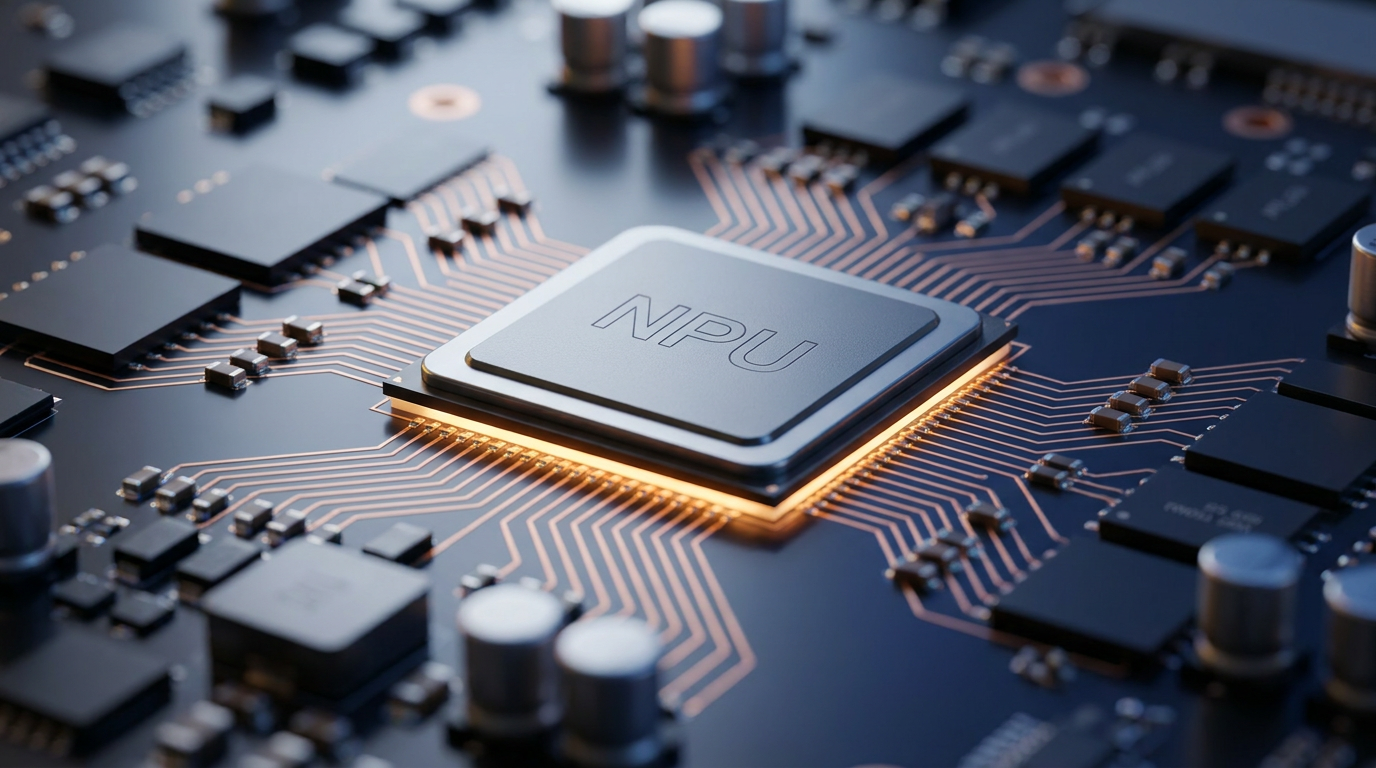
But software breakthroughs are only half the story. The local AI boom of 2026 is equally driven by hardware advancements, specifically the proliferation of Neural Processing Units (NPUs). Apple Silicon and Qualcomm's latest Snapdragon chips feature dedicated silicon designed exclusively for the matrix math required by neural networks, allowing them to run AI models without draining the battery or overheating the device.[1][3]
To squeeze these models onto consumer hardware, engineers rely on a technique called quantization. By compressing the precision of the model's parameters—from 16-bit floating-point numbers down to 4-bit integers—developers can shrink a model's memory footprint by up to 75% with minimal loss in reasoning quality. A highly capable 8-billion parameter model now fits neatly into just 4 gigabytes of RAM.[6]
The operating system layer has officially embraced this localized future. At its Build 2026 conference in June, Microsoft announced Aion 1.0, a family of SLMs built directly into Windows. Designed to run on the new RTX Spark hardware, Aion shifts a meaningful slice of daily AI inference off the cloud and into the operating system itself, handling everything from local file search to agentic automation.[3]
The economic implications of this shift are profound. Enterprise IT leaders are realizing that routing every employee query through a premium cloud API is financially unsustainable. By deploying SLMs locally or on internal edge servers, companies are seeing cost reductions of 95% to 99% compared to traditional LLM deployments, fundamentally changing the ROI of enterprise AI.[2][6]
Beyond cost, local execution solves the latency problem. Cloud-based AI inherently suffers from network round-trips, making real-time voice interactions feel sluggish and unnatural. An on-device SLM responds in milliseconds. This zero-latency environment is the critical unlock for the next generation of AI: autonomous agents.[1][5]
Agentic workflows require an AI to plan, act, observe, and adjust in a continuous loop. If an agent has to wait two seconds for a cloud server at every step, the system grinds to a halt. Local SLMs, operating at blistering speeds, can execute dozens of micro-decisions per second, seamlessly managing files, booking schedules, or writing code in the background.[5]

These local agents are increasingly connected to the user's digital life through the Model Context Protocol (MCP). Think of MCP as a universal USB standard for AI—a secure way for a local language model to access a user's calendar, emails, and local files without that sensitive data ever being exposed to the internet.[5]
Despite the massive leaps, SLMs are not a complete replacement for frontier cloud models. They still struggle with deep, multi-step reasoning, highly complex coding architectures, and obscure factual recall. Because their parameter count is small, they simply cannot memorize the vast trivia of the internet, making them prone to hallucination if pushed outside their domain.[4][7]
Instead, the industry is settling into a hybrid routing architecture. In a modern 2026 application, a local SLM acts as the frontline triage. It handles 80% to 90% of daily tasks—summarization, formatting, basic coding, and tool calling—instantly and for free. Only when a query requires deep, complex reasoning does the system seamlessly route the prompt to a massive cloud LLM.[6]
This tiered approach represents the maturation of artificial intelligence. The era of using a trillion-parameter supercomputer to summarize a grocery list is ending. By pushing compute to the edge, the tech industry is making AI faster, vastly cheaper, and fundamentally private—putting the power of the neural network directly into the hands of the user.[7]
How we got here
June 2023
Microsoft publishes 'Textbooks Are All You Need', proving small models can excel with highly curated data.
April 2024
Meta releases Llama 3 8B, setting a new standard for highly capable, open-weight small models.
February 2026
Google launches the Gemma 3 family, bringing native multimodal vision capabilities to small edge models.
June 2026
Microsoft announces Aion 1.0 at Build, integrating local SLMs directly into the Windows operating system.
Viewpoints in depth
Open-Source Developers
Advocates for local AI who value privacy, avoiding API lock-in, and the democratization of compute power.
For the open-source community, the rise of SLMs is an ideological victory as much as a technical one. By running models locally, developers break free from the API pricing and usage restrictions imposed by massive cloud providers. This camp views local execution as the only way to guarantee user privacy and ensure that the future of artificial intelligence remains decentralized and accessible to anyone with a standard computer.
Enterprise IT Leaders
Corporate strategists focused on cost reduction, predictable latency, and maintaining strict data security.
Enterprise leaders view SLMs through the lens of unit economics and compliance. Routing every routine employee query through a premium cloud model is financially unsustainable at scale. By deploying quantized SLMs on internal hardware, companies dramatically reduce their compute bills while ensuring proprietary corporate data never traverses the public internet, solving one of the biggest hurdles to enterprise AI adoption.
Frontier AI Labs
Researchers building massive cloud models who view SLMs as useful edge routers, but maintain that true artificial general intelligence requires datacenters.
While acknowledging the utility of small models for basic tasks, frontier labs emphasize their limitations. They argue that SLMs lack the vast world knowledge and deep, multi-step reasoning capabilities required for complex problem-solving. In their view, SLMs are best utilized as frontline triage agents—handling simple formatting or tool-calling locally, but ultimately routing the hardest cognitive work back to trillion-parameter cloud models.
What we don't know
- Whether hardware manufacturers will eventually charge premium licensing fees for unlocking NPU capabilities.
- How quickly the open-source community will solve the deep reasoning limitations currently holding back sub-10B parameter models.
Key terms
- Small Language Model (SLM)
- An AI model with fewer than 15 billion parameters, optimized to run locally on consumer hardware rather than in cloud datacenters.
- Quantization
- A compression technique that reduces the memory footprint of an AI model by lowering the precision of its mathematical weights.
- Neural Processing Unit (NPU)
- Dedicated hardware built into modern computer chips specifically designed to accelerate AI calculations efficiently.
- Model Context Protocol (MCP)
- An open standard that allows local AI models to securely connect to external tools, files, and data sources.
Frequently asked
Can I run these models on my current laptop?
Yes. Most modern laptops with at least 8GB of RAM can run quantized 4B to 8B parameter models smoothly using local software environments.
Is my data safe when using an SLM?
Because the model runs entirely on your local hardware, your prompts and data never leave your device, ensuring complete privacy.
Do small models hallucinate less than large models?
While highly capable at specific tasks, their smaller size means they have less general world knowledge, making them prone to hallucination if asked about obscure facts.
Sources
Source coverage
7 outlets
3 viewpoints surfaced






[1]KanerikaEnterprise IT Leaders
Small Language Models: Powering the Edge Computing Revolution
Read on Kanerika →[2]Machine Learning MasteryFrontier AI Labs
Small Language Models Complete Guide 2026
Read on Machine Learning Mastery →[3]TechJack SolutionsEnterprise IT Leaders
Microsoft Announces Aion 1.0, The On-Device SLM Family Built Into Windows
Read on TechJack Solutions →[4]Meta Intelligence TechEnterprise IT Leaders
2026 Mainstream SLM Landscape Comparison
Read on Meta Intelligence Tech →[5]MediumOpen-Source Developers
Building AI Agents with Local Small Language Models and MCP
Read on Medium →[6]Local AI MasterOpen-Source Developers
What Are Small Language Models? The 2026 Hardware Guide
Read on Local AI Master →[7]Factlen Editorial Team
Synthesis by Factlen editorial team
Read on Factlen Editorial Team →



Every angle. Every day.
Get ai stories with full source coverage and perspective breakdowns delivered to your inbox.