
The End of 'Sell By' Dates: Comparing the New Standardized Food Labels and Their Impact on Food Waste
As new 2026 state laws ban confusing 'Sell By' dates on consumer packaging, shoppers must now navigate a standardized two-label system. Understanding the trade-offs between 'Best If Used By' quality dates and 'Use By' safety dates is key to reducing household food waste.
By Factlen Editorial Team
- Zero Waste Advocates
- Environmental and consumer groups pushing for strict standardization to prevent edible food from reaching landfills.
- Food Safety Regulators
- Public health officials focused on preventing foodborne illness through clear, non-negotiable safety thresholds.
- Consumer Packaged Goods Industry
- Food manufacturers and retailers adapting to the new legal requirements while managing product quality and liability.
What's not represented
- · Small-scale farmers and artisanal food producers facing logistical challenges updating packaging
- · Grocery store inventory managers adapting to the removal of consumer-facing 'Sell By' dates
Why this matters
The average American family loses $1,500 a year throwing away perfectly safe food due to confusing expiration dates. The new 2026 standardized labels empower consumers to confidently keep food longer, saving money while drastically reducing the greenhouse gas emissions associated with food waste.
Key points
- California's AB 660 takes effect July 1, 2026, banning consumer-facing 'Sell By' dates.
- New York passed a similar mandate in June 2026, signaling a nationwide shift.
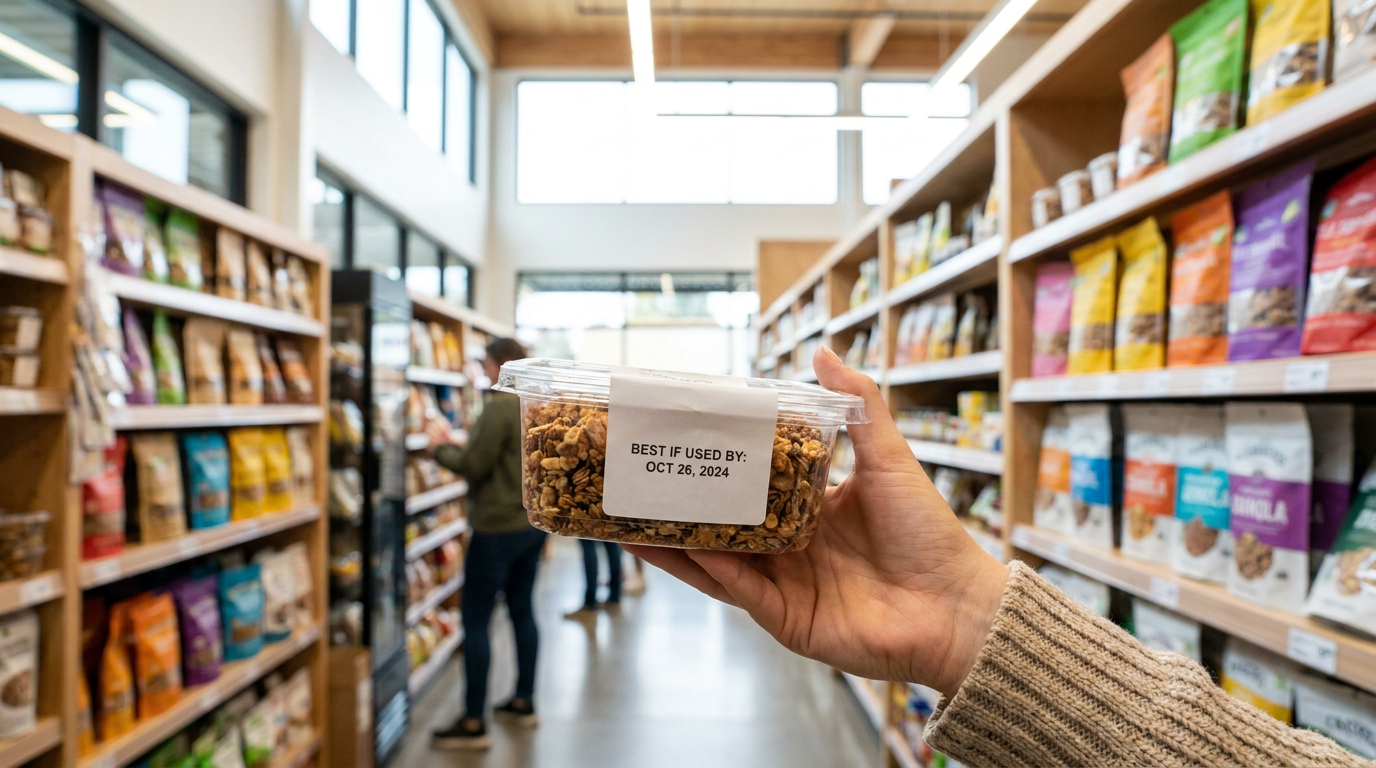
- The 'Best If Used By' label indicates peak quality; the food is still safe to eat afterward.
- The 'Use By' label is a strict safety threshold for highly perishable items like meat and formula.
- Standardizing labels is projected to save U.S. consumers $1.23 billion annually.
- Up to 90% of Americans have thrown away safe food due to date label confusion.
The era of the confusing "Sell By" date is officially coming to an end across American grocery aisles. On July 1, 2026, California’s Assembly Bill 660 takes effect, becoming the first law in the nation to ban consumer-facing "Sell By" dates and mandate a standardized two-label system for all packaged foods. The momentum is rapidly spreading eastward, as the New York State Legislature passed a nearly identical measure, the Food Date Labeling Act, in early June 2026. For decades, shoppers have navigated a chaotic wild west of over fifty different date labels—ranging from "Enjoy By" to "Freshest Before"—which communicated wildly different things about product viability. By forcing manufacturers to adopt a unified vocabulary, these new laws represent the most significant overhaul of grocery packaging since the introduction of the standardized Nutrition Facts panel in the 1990s.[1][2][7]
The prevailing wisdom of "when in doubt, throw it out" has resulted in staggering environmental and economic consequences. According to data from ReFED and the Harvard Law School Food Law and Policy Clinic, up to ninety percent of Americans occasionally throw away perfectly safe food simply because they misinterpret the printed dates. This widespread confusion costs the average American family roughly $1,500 annually and contributes to 133 billion pounds of food waste nationwide each year. When edible food is sent to landfills, it decomposes and generates massive amounts of methane, a potent greenhouse gas. The new standardized system, heavily backed by the FDA, the USDA, and the Consumer Brands Association, narrows the chaotic lexicon down to just two highly specific phrases: "Best If Used By" and "Use By."[3][4][5]
To understand the impact of this transition, consumers must recognize that the two new labels serve entirely different purposes. The "Sell By" dates of the past were only ever intended for grocery store inventory management, signaling to stockers when to rotate products, yet consumers routinely mistook them for safety expirations. Under the 2026 regulations, these internal codes are strictly prohibited on consumer-facing packaging. Instead, shoppers are presented with a binary choice that requires a shift in household kitchen management. Comparing the trade-offs of how to handle "Best If Used By" quality dates versus "Use By" safety dates reveals exactly how families can maximize their grocery budgets while protecting their health.[1][6][8]

The case for the "Best If Used By" quality indicator is rooted in massive waste reduction and consumer empowerment. Foods carrying this label—such as canned goods, dry pasta, cereal, and many shelf-stable snacks—are entirely safe to consume long after the printed date has passed. This label simply means the manufacturer guarantees peak flavor, optimal texture, and maximum nutritional value up to that specific point. By understanding that a box of crackers is not suddenly dangerous the day after its printed date, families can safely keep food in their pantries longer. This approach fundamentally shifts the power back to the consumer, encouraging them to evaluate their food rather than blindly following a printed stamp.[3][6][8]
The argument against relying heavily on quality-based dates is that it requires consumers to trust their own senses rather than a definitive printed guarantee, which can cause anxiety for risk-averse shoppers. Because the date is not a safety expiration, consumers must rely on the traditional "sniff test" or visual inspection to determine if the food has actually spoiled or gone stale. For individuals who have spent decades treating printed dates as absolute gospel, this transition requires a significant behavioral shift. Furthermore, some consumers may be disappointed by the degraded texture or faded flavor of a product consumed past its peak quality date, leading to a suboptimal culinary experience even if the food remains perfectly safe to digest.[5][6]
For individuals who have spent decades treating printed dates as absolute gospel, this transition requires a significant behavioral shift.
The evidence supporting the widespread adoption of quality-based labeling is substantial and economically compelling. ReFED, a national nonprofit focused on food waste, estimates that universally understanding and adhering to the "Best If Used By" standard for shelf-stable goods could save United States consumers $1.23 billion annually. Furthermore, standardizing these labels is projected to prevent 398,000 tons of food waste from entering landfills each year, which translates to a reduction of two million metric tons of carbon dioxide equivalent emissions. The Consumer Brands Association reports that voluntary adoption of this standard had already reached eighty-seven percent of products before the 2026 state mandates forced the final holdouts to comply, proving that the industry recognizes the financial and environmental benefits.[3][4][7]

Conversely, the case for the "Use By" safety indicator centers entirely on protecting public health and preventing foodborne illness. This label provides a clear, non-negotiable safety threshold for highly perishable items like raw meat, poultry, unpasteurized dairy, and infant formula. Consuming these specific products past the "Use By" date carries a genuine, scientifically documented risk of bacterial growth, including listeria and salmonella. For these high-risk categories, sensory testing is dangerously inadequate; harmful bacteria can multiply to dangerous levels without altering the smell, taste, or appearance of the food. The "Use By" label removes the guesswork, providing a hard stop that keeps vulnerable populations, particularly children and the elderly, safe from severe illness.[6][8]
The argument against the strict "Use By" standard is that it can still lead to premature disposal if manufacturers set overly conservative dates to avoid legal liability. Because the date represents a hard safety cutoff, consumers are instructed to discard or compost the food once the date passes, regardless of how it looks or smells. If a manufacturer builds in a wide margin of error, perfectly safe and nutritious food ends up in the trash. Additionally, the strictness of the "Use By" label means that improper storage—such as leaving meat in a warm car—can render the food unsafe long before the printed date, potentially giving consumers a false sense of security if they rely solely on the packaging rather than proper cold-chain management.[5][8]
The evidence backing the necessity of strict safety dates comes directly from federal health and agricultural agencies. The Food and Drug Administration strictly regulates the "Use By" date on infant formula to ensure that vital nutrient degradation has not occurred, making it the only federally mandated date label in the country prior to the new state laws. Similarly, the United States Department of Agriculture strongly advises against consuming raw meat or poultry past this date due to exponential bacterial growth risks. Public health data consistently shows that adhering to safety dates on highly perishable goods is one of the most effective ways to reduce the estimated forty-eight million cases of foodborne illness that occur in the United States annually.[6][8]

In practice, the "Best If Used By" standard fits well when dealing with pantry staples, snacks, and most refrigerated goods where sensory testing is a reliable and safe indicator of spoilage. It empowers consumers to save money, reduce their household carbon footprint, and confidently manage their pantries without fear. It does not fit when dealing with raw proteins or specialized medical nutrition, where a decline in quality directly correlates with a dangerous decline in safety. The 2026 legislative push ensures that this label is legally restricted to foods where quality, not safety, is the primary variable over time.[1][2][4]
The "Use By" standard fits well when handling high-risk, highly perishable proteins or specialized nutritional products like baby formula, where the consequences of spoilage are severe and invisible to the naked eye. It provides necessary peace of mind and a clear directive to discard dangerous items. It does not fit when applied to shelf-stable goods like canned beans or dry rice, which is exactly why the new 2026 laws strictly prohibit manufacturers from slapping "Use By" dates on products that merely lose their crispness. By legally separating quality from safety, the new standardized labels finally give American consumers the exact information they need to clean out their refrigerators with confidence.[1][6][7]
As the July 2026 rollout begins in California and ripples across the country through New York's impending legislation, shoppers will immediately notice cleaner, more decisive packaging on their grocery store shelves. The transition away from the confusing "Sell By" era requires a brief period of consumer re-education, but the long-term benefits are undeniable. By simply changing the vocabulary on our cartons and cans, and understanding the distinct trade-offs between quality and safety indicators, the United States is poised to keep billions of pounds of edible food on the dinner table and out of the landfill.[1][2][3]
How we got here
Feb 2017
The Consumer Brands Association launches a voluntary initiative to narrow date labels to two standard phrases.
Oct 2017
California passes AB 954, encouraging voluntary adoption of standardized labels.
May 2019
The FDA officially endorses the 'Best If Used By' phrasing for quality-based date labels.
Sep 2024
California Governor Gavin Newsom signs AB 660, making the standardized labels mandatory.
Jun 2026
The New York State Legislature passes the Food Date Labeling Act, mirroring California's mandate.
Jul 2026
California's AB 660 takes effect, officially banning 'Sell By' dates on consumer packaging.
Viewpoints in depth
Zero Waste Advocates
Environmental and consumer groups pushing for strict standardization to prevent edible food from reaching landfills.
Organizations like ReFED and the Zero Food Waste Coalition argue that the historical lack of regulation allowed manufacturers to use confusing language that drove premature disposal. They view the 2026 state mandates as a massive victory for both household budgets and greenhouse gas reduction, emphasizing that empowering consumers to trust their senses over arbitrary quality dates is essential for a sustainable food system.
Food Safety Regulators
Public health officials focused on preventing foodborne illness through clear, non-negotiable safety thresholds.
Agencies like the FDA and USDA, along with public health advocates, emphasize that while reducing waste is critical, it cannot come at the expense of safety. They strongly support the strict 'Use By' designation for highly perishable proteins and infant formula, arguing that sensory testing is dangerously inadequate for detecting pathogens like listeria or salmonella, which can multiply without altering a food's smell or appearance.
Consumer Packaged Goods Industry
Food manufacturers and retailers adapting to the new legal requirements while managing product quality and liability.
Represented by groups like the Consumer Brands Association, the industry highlights its proactive, voluntary efforts to streamline labels prior to the 2026 mandates. While they support the clarity of the two-label system, manufacturers must now carefully calibrate their 'Best If Used By' dates to ensure consumers don't experience degraded flavor or texture, which could damage brand reputation, while strictly adhering to 'Use By' safety margins to avoid legal liability.
What we don't know
- Whether the FDA and USDA will push for a federal mandate to replace the state-by-state legislative approach.
- How quickly smaller, regional food manufacturers will be able to update their packaging to comply with the new state laws.
- The exact timeline for when states outside of California and New York might adopt similar mandatory labeling requirements.
Key terms
- Best If Used By
- A standardized label indicating when a product will be at its peak flavor and quality; the food remains safe to consume after this date.
- Use By
- A standardized label indicating a strict safety threshold for highly perishable foods; products should be discarded after this date.
- Sell By
- An internal inventory management date used by retailers to rotate stock, now banned on consumer-facing packaging in states with standardized label laws.
- Sensory Testing
- The practice of using sight, smell, and taste to determine if a shelf-stable or low-risk food has spoiled, rather than relying on a printed date.
- Cold-Chain Management
- The process of maintaining a safe temperature range for perishable foods during transportation, storage, and display.
Frequently asked
Is it safe to eat food past the 'Best If Used By' date?
Yes. This label only indicates peak quality and flavor. As long as the food shows no signs of spoilage, it is perfectly safe to consume after the printed date.
Can I still eat meat if the 'Use By' date was yesterday?
No. The 'Use By' label is a strict safety threshold for highly perishable items. Consuming meat or poultry past this date carries a high risk of foodborne illness.
Why are 'Sell By' dates disappearing?
New laws taking effect in 2026 ban consumer-facing 'Sell By' dates because they were meant for grocery store inventory management, not food safety, and caused massive consumer confusion and food waste.
Do these new labels apply to all food products?
The standardized labels apply to the vast majority of packaged foods, though there are exceptions for items like alcoholic beverages and foods prepared for immediate consumption.
Sources
Source coverage
8 outlets
3 viewpoints surfaced








[1]Resource RecyclingConsumer Packaged Goods Industry
CA mandates uniform food labels starting July 1
Read on Resource Recycling →[2]National Law ReviewConsumer Packaged Goods Industry
NY Legislature Advances Bill Standardizing Date Labeling for Food
Read on National Law Review →[3]Consumer Brands AssociationConsumer Packaged Goods Industry
87% of Products Are Now Using Two Date Labels, Creating Needed Clarity
Read on Consumer Brands Association →[4]ReFEDZero Waste Advocates
Standardizing Date Labels to Reduce Food Waste
Read on ReFED →[5]Harvard Law School Food Law and Policy Clinic
Date Labels: The Case for Federal Legislation
Read on Harvard Law School Food Law and Policy Clinic →[6]U.S. Food and Drug AdministrationFood Safety Regulators
Confused by Date Labels on Packaged Foods?
Read on U.S. Food and Drug Administration →[7]Environmental Advocates NYZero Waste Advocates
Assembly Joins Senate in Passing Food Date Labeling Act
Read on Environmental Advocates NY →[8]U.S. Department of AgricultureFood Safety Regulators
Food Product Dating
Read on U.S. Department of Agriculture →
More in shopping
See all 5 stories →Console Gaming
Local Hardware vs. Cloud Gaming: The 2026 Trade-Off Analysis Following Xbox's $150 Price Hike
6 sources

Supply Chain Tech
The Digital Product Passport: How New EU and US Laws Are Forcing Total Transparency on Product Sustainability and Traceability
9 sources

Handheld Gaming
Intel Arc G3 Extreme vs. AMD Ryzen Z-Series: The 2026 Windows Handheld Trade-Off Analysis
6 sources

Every angle. Every day.
Get shopping stories with full source coverage and perspective breakdowns delivered to your inbox.