
SpaceX Completes Historic $75 Billion IPO, Igniting Space Economy Investment
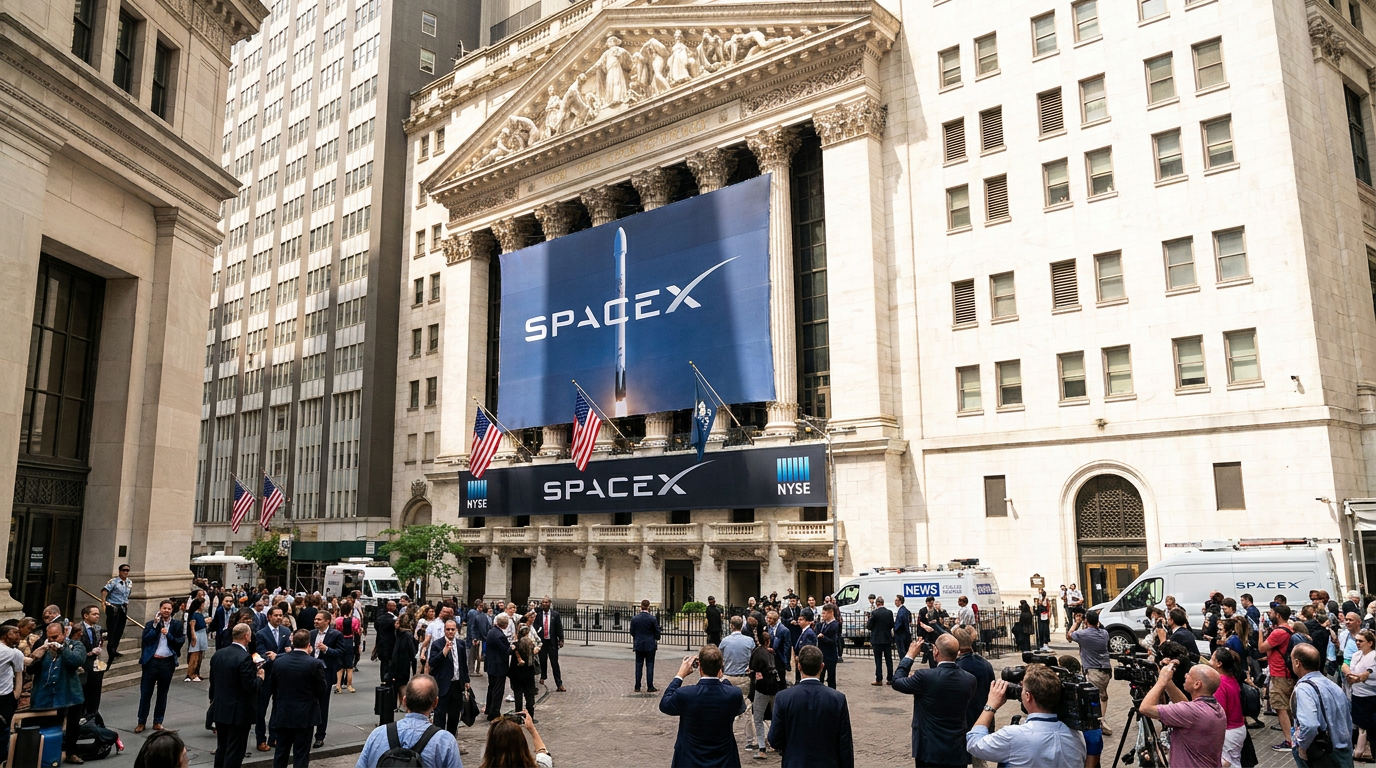
SpaceX has officially entered the public markets with a record-breaking $75 billion initial public offering, achieving a $2.2 trillion market capitalization on its first day of trading. The landmark debut validates the commercial space sector's profitability while making founder Elon Musk the world's first trillionaire.
By Factlen Editorial Team
- Space Industry Advocates
- View the IPO as the financial catalyst needed to accelerate humanity's expansion into space and validate the sector's profitability.
- Institutional Governance Skeptics
- Express concern over the concentration of power and the bypassing of traditional market safeguards for index inclusion.
- Retail Investors
- See the listing as a generational opportunity to participate in the growth of the dominant aerospace monopoly.
What's not represented
- · Competitor Aerospace Firms
- · Space Policy Regulators
Why this matters
The transition of the world's most dominant private space company to the public markets opens up direct retail and institutional investment into the broader space economy. It signals that commercial spaceflight, satellite communications, and planetary exploration are now viewed by Wall Street as viable, profitable industries rather than speculative science fiction.
Key points
- SpaceX raised a record-breaking $75 billion in its initial public offering.
- The company achieved a market capitalization of $2.2 trillion on its first day of trading.
- The surge in valuation made founder Elon Musk the world's first trillionaire.
- Industry leaders view the IPO as proof of the commercial space sector's maturity and profitability.
- Some institutional investors have raised concerns over the company's governance structure and fast-tracked index inclusion.
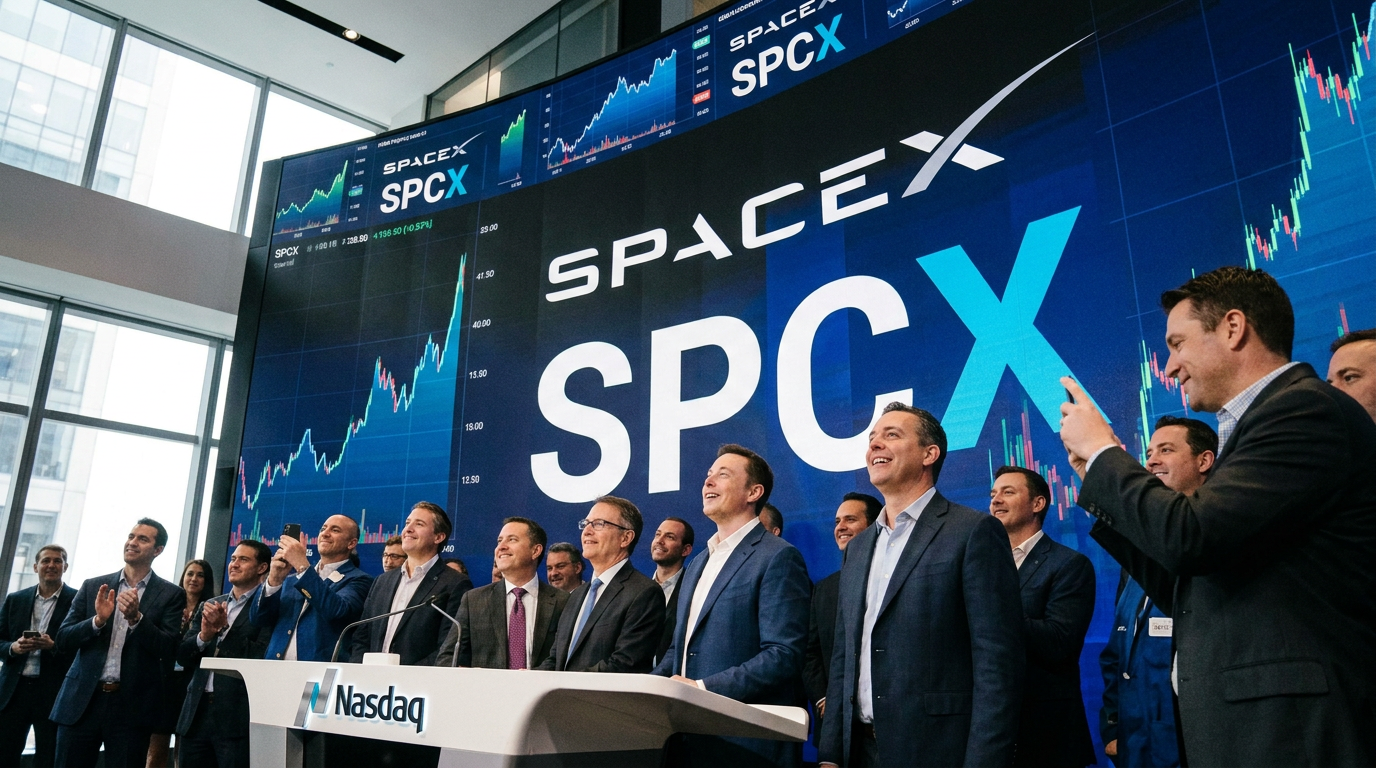
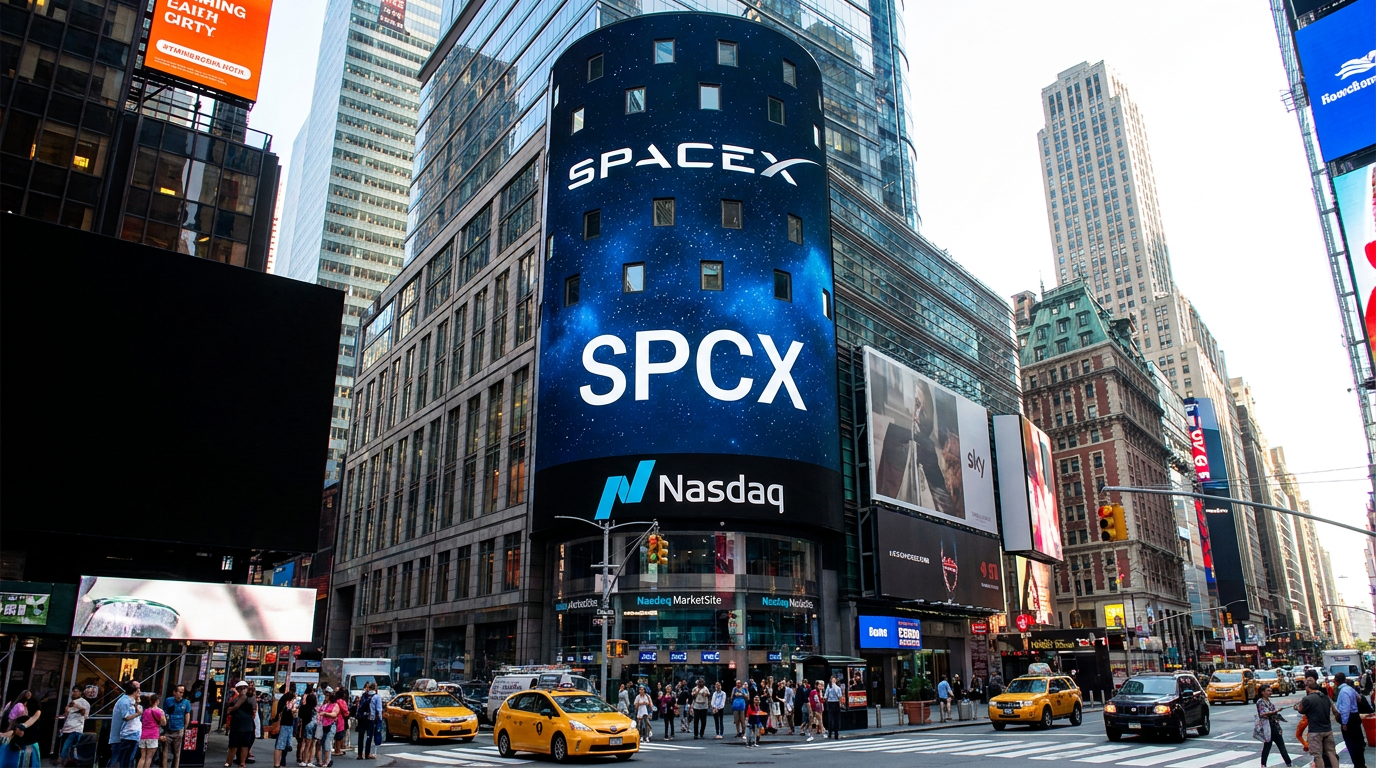
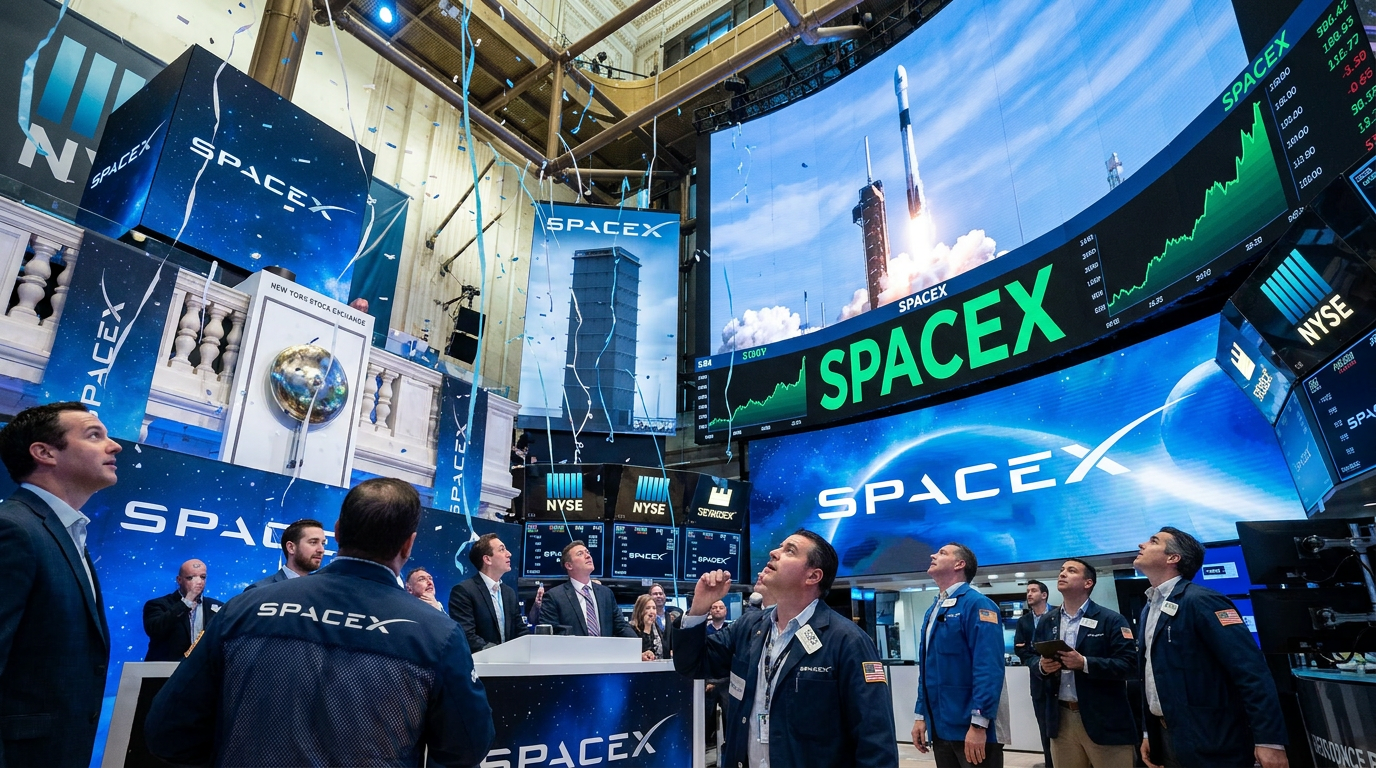
SpaceX's monumental entry into the public markets shattered historical records on Wednesday, raising an unprecedented $75 billion in its initial public offering. By the time the closing bell rang, the aerospace juggernaut had achieved a market capitalization of approximately $2.2 trillion, instantly making it one of the most valuable public companies on the planet.[1]
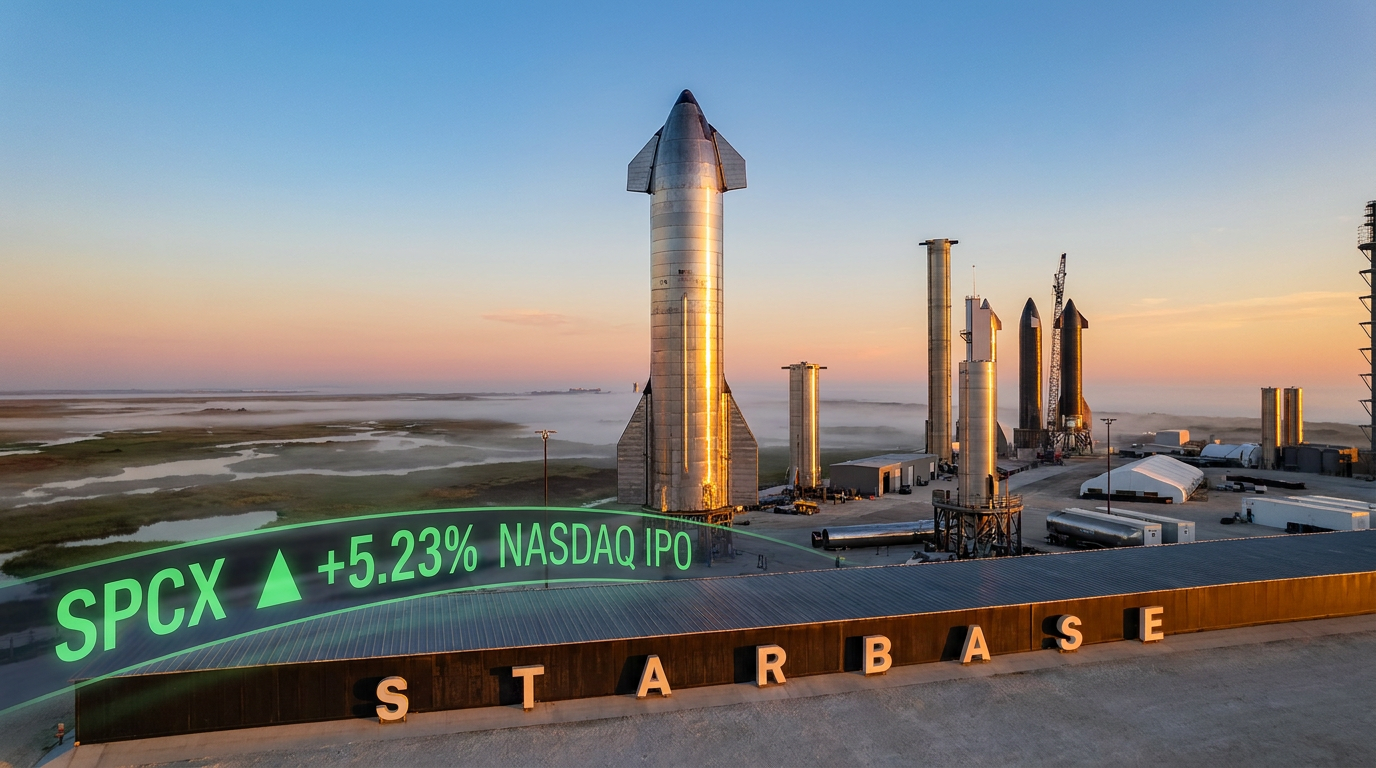
Wall Street's appetite for the commercial space leader was voracious from the opening trade. Buyers of the IPO were handed an immediate 19% return on their investment during the first day of trading, reflecting immense pent-up demand from both institutional and retail investors who had long awaited a chance to own a piece of the orbital economy.[2]
The sheer scale of the public debut had an immediate impact on the wealth of its founder, Elon Musk. The surge in the company's valuation officially pushed Musk's net worth past the thirteen-digit mark, making him the world's first trillionaire.[2][3]

The financial milestone is already drawing comparisons to the Gilded Age. Historians and financial analysts are looking back to 1916, when Standard Oil magnate John D. Rockefeller became America's first billionaire, noting that Musk's ascension is dominating global headlines in a strikingly similar fashion.[6]
Beyond individual wealth, the IPO serves as a massive validation for the broader space economy. Space Foundation CEO Heather Pringle highlighted that the public listing marks a critical maturation point for the sector, proving that communications, launch services, and navigation technologies offer viable pathways to sustained profitability.[4]
Beyond individual wealth, the IPO serves as a massive validation for the broader space economy.
Financial commentators are urging investors to look past the initial hype and focus on the company's long-term trajectory. CNBC's Jim Cramer advised that entering the stock now is justifiable, provided investors view SpaceX not as a standard tech play, but as a multi-decade bet on human space exploration and orbital infrastructure.[5]
The influx of capital isn't isolated to SpaceX alone. The record-breaking debut has sparked a broad rally across the aerospace and defense sectors, with analysts predicting that the successful IPO will unlock a new wave of venture capital for smaller, specialized space startups looking to build out the orbital supply chain.[9]

However, the historic listing has not been without its detractors. New York City Comptroller Mark Levine has publicly raised alarms regarding the fast-tracking of SpaceX into major global indices, such as the MSCI Global Standard and FTSE Russell, arguing that traditional seasoning periods and earnings track records are being bypassed.[7]
The core of the institutional pushback centers on SpaceX's unprecedented corporate governance structure. Levine and other market traditionalists have pointed out that a single individual retains dominant control over the $2.2 trillion entity, with limited shareholder voting rights and a perceived lack of independent board oversight.[7][8]

Despite the governance debates, the primary focus for the company remains its ambitious operational roadmap. Industry experts anticipate that the $75 billion raised will be aggressively deployed to accelerate the development of next-generation launch vehicles, expand the Starlink satellite internet constellation, and fund the foundational infrastructure required for crewed missions to Mars.[10]
Ultimately, the transition of SpaceX from a closely held private venture to a publicly traded behemoth fundamentally alters the landscape of commercial spaceflight. By opening its doors to public capital, the company has tethered the financial portfolios of everyday investors to the future of interplanetary exploration.[1][4]
How we got here
2002
SpaceX is founded by Elon Musk with the goal of reducing space transportation costs and enabling the colonization of Mars.
2008
The Falcon 1 becomes the first privately developed liquid-fueled rocket to reach orbit.
2020
SpaceX successfully launches NASA astronauts to the International Space Station, a first for a private company.
June 12, 2026
SpaceX goes public, raising $75 billion in the largest IPO in history and reaching a $2.2 trillion valuation.
Viewpoints in depth
Space Industry Advocates
View the IPO as the financial catalyst needed to accelerate humanity's expansion into space.
For proponents of the commercial space sector, SpaceX's public debut is the ultimate vindication of a decades-long effort to privatize orbital access. Industry advocates argue that the $75 billion raised will provide the massive capital expenditure required to build out Mars colonization infrastructure and expand the Starlink network globally. They view the market's enthusiastic response as proof that space is no longer a speculative frontier, but a foundational pillar of the 21st-century economy.
Institutional Governance Skeptics
Express concern over the concentration of power and the bypassing of traditional market safeguards.
Market traditionalists and institutional watchdogs are sounding alarms over the structural mechanics of the newly public entity. Critics like the New York City Comptroller argue that fast-tracking a $2.2 trillion company into major indices without a standard seasoning period forces passive investors to absorb outsized risk. Furthermore, they highlight that the company's governance structure leaves unprecedented voting power in the hands of a single founder, severely limiting the ability of independent boards or shareholders to provide oversight.
Retail Investors
See the listing as a generational opportunity to participate in the growth of the dominant aerospace monopoly.
For the everyday investor, the governance concerns are largely overshadowed by the sheer growth potential of the company. Retail traders view SpaceX as a generational asset—a company with a near-monopoly on global launch services and a rapidly expanding satellite internet business. The 19% pop on the first day of trading reflects a broad willingness among the public to overlook traditional corporate governance norms in exchange for a stake in humanity's multi-planetary future.
What we don't know
- How quickly the $75 billion in raised capital will translate into tangible progress on crewed Mars missions.
- Whether major index providers will adjust their inclusion rules in response to institutional pushback regarding SpaceX's governance structure.
- How the influx of public capital will alter SpaceX's historically agile and risk-tolerant engineering culture.
Key terms
- Initial Public Offering (IPO)
- The process of offering shares of a private corporation to the public in a new stock issuance, allowing the company to raise capital from public investors.
- Market Capitalization
- The total dollar market value of a company's outstanding shares of stock, calculated by multiplying the current stock price by the total number of outstanding shares.
- Index Inclusion
- The addition of a company's stock to a major financial index (like the S&P 500 or FTSE Russell), which typically forces index-tracking mutual funds and ETFs to buy the stock.
- Seasoning Period
- A required length of time a company's stock must trade publicly before it is eligible for certain financial milestones, such as inclusion in major market indices.
Frequently asked
How much did SpaceX raise in its IPO?
SpaceX raised $75 billion, making it the largest initial public offering in history.
What is SpaceX's market value after going public?
The company ended its first day of trading with a market capitalization of approximately $2.2 trillion.
Why are some investors concerned about the IPO?
Critics point to the company's governance structure, which gives founder Elon Musk dominant control with limited independent board oversight, as well as the fast-tracking of the stock into major financial indices.
Sources
Source coverage
10 outlets
3 viewpoints surfaced







[1]BloombergInstitutional Governance Skeptics
What to Know About SpaceX’s Record-Breaking IPO
Read on Bloomberg →Inside SpaceX and Elon Musk’s $75 billion IPO
Read on Bloomberg →[3]ForbesRetail Investors
How Elon Musk Just Became The World's First Trillionaire
Read on Forbes →SpaceX IPO Sparks Surge in Space Industry Investment and Market Optimism
Read on Bloomberg →[5]CNBCSpace Industry Advocates
Jim Cramer says it's not too late to buy SpaceX — under one condition
Read on CNBC →[6]NYTRetail Investors
Musk Is the World’s First Trillionaire. Who Was the First Billionaire?
Read on NYT →NYC Comptroller Raises Concerns Over SpaceX Index Inclusion and Governance Structure
Read on Bloomberg →[8]The Wall Street JournalInstitutional Governance Skeptics
SpaceX's Unprecedented Governance Tests Public Market Norms
Read on The Wall Street Journal →[9]ReutersSpace Industry Advocates
SpaceX IPO Ignites Broad Rally in Aerospace and Defense Stocks
Read on Reuters →[10]SpaceNewsSpace Industry Advocates
With $75 Billion Raised, SpaceX Sets Sights Firmly on Mars Infrastructure
Read on SpaceNews →

More in business
See all 71 stories →Space Economy
SpaceX Completes Record $75 Billion IPO, Valuing Space Giant at $2.2 Trillion
8 sources
SpaceX IPO
SpaceX Completes Record $75 Billion IPO, Making Elon Musk the World's First Trillionaire
7 sources
SpaceX IPO
SpaceX Raises Record $75 Billion in Historic IPO, Pushing Elon Musk to Trillionaire Status
10 sources
Space Economy
SpaceX Completes Record $75 Billion IPO, Pushing Elon Musk's Net Worth Past $1 Trillion
9 sources
Every angle. Every day.
Get business stories with full source coverage and perspective breakdowns delivered to your inbox.