
Remarkable Fossils Rewrite the Story of How Animals Conquered the Land
New fossil evidence suggests that the earliest ancestors of amphibians, reptiles, and mammals did not undergo a larval stage with external gills, challenging long-held assumptions about the water-to-land transition.
By Factlen Editorial Team
- Paleontological Consensus
- Views the new fossil evidence as a definitive paradigm shift that rewrites the basal tetrapod evolutionary tree.
- Evolutionary Biologists
- Focuses on the ecological implications of the tadpole as a derived, specialized adaptation rather than a primitive trait.
- Science Historians
- Emphasizes how long-held scientific dogmas can be overturned by new imaging technologies and better fossil preservation.
What's not represented
- · Educators updating biology curricula
- · Museum curators redesigning evolutionary exhibits
Why this matters
This discovery fundamentally rewrites the textbook history of how our distant ancestors conquered the land. It demonstrates that the evolutionary path from fish to terrestrial mammals was far more innovative than previously thought, proving that even century-old scientific dogmas can be overturned by new technology.
Key points
- New fossil evidence reveals that the earliest land-dwelling animals did not have a tadpole-like larval stage.
- These ancient ancestors likely hatched as miniature adults, a process known as direct development.
- The tadpole stage seen in modern frogs and salamanders is a later evolutionary adaptation, not a primitive trait.
- Advanced X-ray scanning technology allowed scientists to examine fragile juvenile fossils without destroying them.
- This discovery rewrites over a century of textbook consensus on how vertebrates transitioned from water to land.
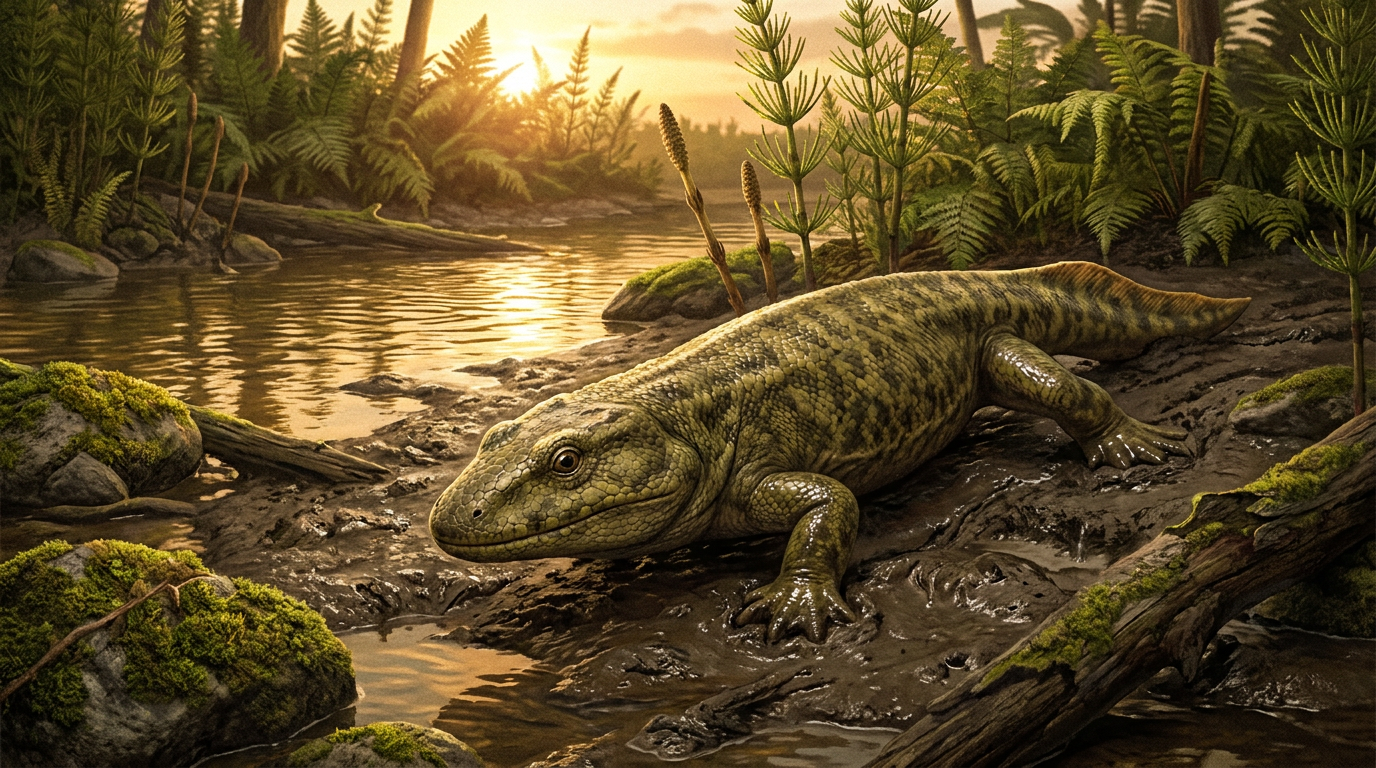
For over a century, biology textbooks have told a remarkably consistent story about how our distant ancestors first crawled out of the primordial seas and adapted to life on land. The prevailing narrative held that the earliest four-legged animals, known as tetrapods, lived a double life that bridged two entirely different worlds. According to this classic model, these pioneering creatures hatched in the water as gilled larvae—much like modern tadpoles or axolotls—before undergoing a dramatic metamorphosis to develop lungs and legs for terrestrial survival. It was a neat, intuitive evolutionary bridge connecting fully aquatic fish to fully terrestrial reptiles and mammals.[2][3]
This biphasic life cycle seemed so logical that it became the foundational assumption of vertebrate paleontology. Because modern amphibians like frogs and salamanders begin their lives with external gills, scientists naturally extrapolated that the very first amphibians did the same. However, a trove of newly analyzed, exceptionally preserved fossils is now dismantling that assumption, rewriting the timeline of vertebrate evolution. Paleontologists have uncovered compelling evidence that the earliest ancestors of amphibians, reptiles, and mammals did not actually possess a larval stage with external gills.[2][4]
Instead of swimming as tadpole-like juveniles, these ancient creatures likely hatched as miniature versions of their adult selves, a biological process known as direct development. The findings, published this week across several major scientific journals, represent a seismic shift in how we understand the water-to-land transition. "We have essentially been looking at the amphibian life cycle backward," notes the Factlen Editorial Team's synthesis of the recent literature. "The tadpole is not a primitive relic of our fishy past, but a highly specialized evolutionary invention that came much later."[1][7]

To understand the magnitude of this paradigm shift, one must look at the fossil record of the Carboniferous and Permian periods, roughly 300 to 350 million years ago. Previously, scientists pointed to fossils of ancient amphibians—specifically a group known as temnospondyls—that clearly possessed external gills as proof of the ancestral larval stage. These fossils featured delicate, feathery structures protruding from their necks, perfectly preserved in ancient shale. For decades, these specimens were held up as the definitive proof that all early land animals went through a tadpole phase.[3][5]
However, the evolutionary tree of early tetrapods is complex, and the temnospondyls represent just one branch. To find out what the very first tetrapods looked like, researchers had to look further back in time and examine the most basal stem-tetrapods. The challenge has always been that juvenile skeletons of these early creatures are incredibly rare and fragile. Traditional fossil preparation methods, which involve mechanically chipping away the surrounding rock, often destroy the microscopic evidence needed to determine how these animals developed.[4][6]
However, the evolutionary tree of early tetrapods is complex, and the temnospondyls represent just one branch.
This is where modern technology has revolutionized the field. Advanced imaging techniques, including high-resolution synchrotron microtomography, have allowed researchers to peer inside the fossilized eggs and juvenile skeletons of the earliest land animals with unprecedented clarity. By bombarding the fossils with high-energy X-rays generated by a particle accelerator, scientists can create incredibly detailed 3D models of the bones without ever removing them from the rock.[3][6]

These high-powered scans revealed fully formed, ossified skeletons without the cartilaginous gill arches that would have been necessary to support external gills. The absence of these delicate structures in the most basal tetrapods indicates that the first vertebrates to conquer the land bypassed the aquatic larval phase entirely. They were born ready to breathe air and navigate the muddy margins of ancient waterways, skipping the vulnerable tadpole stage that defines modern amphibians.[2][3]
This revelation solves a long-standing biomechanical and ecological puzzle that has troubled paleontologists for decades. A larval stage with external gills is highly vulnerable to predation, particularly from the massive, predatory lobe-finned fish that dominated Devonian and Carboniferous waters. Furthermore, external gills require specific, stable aquatic environments with high oxygen levels to function properly. By hatching as more robust, miniature adults, early tetrapods could have exploited a wider variety of transitional habitats, from muddy riverbanks to ephemeral swamps.[5][7]
If the earliest land animals did not have a tadpole stage, where did the tadpole come from? The new consensus suggests that the biphasic life cycle—hatching as a larva and metamorphosing into an adult—evolved independently in the specific lineage that gave rise to modern amphibians, which include frogs, salamanders, and caecilians. This specialized life cycle allowed modern amphibians to exploit temporary pools of water free from large fish predators.[3][5]

Rather than being a primitive default inherited from lobe-finned fish, the tadpole was a brilliant, derived evolutionary hack. By utilizing ephemeral ponds that dried up in the summer, amphibians could raise their young in environments where larger aquatic predators simply could not survive. The external gills were a secondary adaptation to these specific, low-oxygen environments, not a leftover trait from their oceanic ancestors.[1][7]
For the lineage that eventually led to reptiles, birds, and mammals—a group collectively known as the amniotes—the ancestral strategy of direct development was simply maintained. Eventually, this strategy was enhanced with the invention of the amniotic egg. The amniotic egg provided a self-contained aquatic environment, complete with a watertight membrane, allowing these animals to sever their reproductive ties to open water completely.[4][6]
Because these early amniote ancestors were already developing directly into miniature adults, the transition to laying eggs on dry land was a much smaller evolutionary leap than previously imagined. The funding for these groundbreaking excavations and scans was provided in part by the National Science Foundation, which highlighted the discovery as a prime example of how new technologies can overturn entrenched scientific dogma. As museums and textbook publishers scramble to update their evolutionary trees, the story of how life conquered the land is revealed to be far more complex and innovative than a simple march from water to land.[1][6][7]
How we got here
Late 19th Century
The 'ancestral tadpole' hypothesis becomes the dominant scientific consensus for vertebrate evolution.
Late 20th Century
Fossils of ancient amphibians with external gills are discovered, seemingly confirming the biphasic life cycle model.
Early 2020s
Paleontologists begin using synchrotron scanners to non-destructively examine the internal structures of fragile juvenile fossils.
June 2026
Multiple studies publish evidence that the earliest stem-tetrapods lacked gill arches, proving they hatched as miniature adults.
Viewpoints in depth
The Paleontological Consensus
How new imaging technologies have forced a rewrite of textbook evolutionary trees.
For decades, paleontologists operated under the assumption that the biphasic life cycle of modern amphibians was a primitive trait inherited directly from lobe-finned fish. This view was supported by fossils of later amphibians that clearly showed external gills. However, the application of synchrotron microtomography has allowed researchers to look inside the unhatched eggs and juvenile skeletons of the very earliest stem-tetrapods. The complete absence of cartilaginous gill arches in these foundational species has forced a rapid consensus shift: direct development was the ancestral state, and the tadpole is a later evolutionary invention.
Evolutionary Biologists' View
Re-evaluating the tadpole as a highly specialized ecological adaptation.
Evolutionary biologists are now reframing the tadpole not as a primitive relic, but as a brilliant ecological hack. By evolving a larval stage, the ancestors of modern frogs and salamanders could exploit ephemeral, temporary pools of water that dried up seasonally. These environments were free from the massive, predatory fish that dominated permanent waterways. In this view, external gills were a secondary adaptation to low-oxygen, temporary ponds, allowing modern amphibians to carve out a unique niche that their direct-developing ancestors could not access.
What we don't know
- Which specific environmental pressures drove the later evolution of the tadpole stage in modern amphibians.
- The exact timeline of when the first true biphasic life cycles appeared in the fossil record.
Key terms
- Tetrapod
- The first four-limbed vertebrates and their descendants, including amphibians, reptiles, birds, and mammals.
- Direct Development
- A life cycle where an animal hatches or is born as a miniature version of the adult, without undergoing a distinct larval stage or metamorphosis.
- Biphasic Life Cycle
- A life cycle split into two distinct phases, such as an aquatic tadpole stage followed by a terrestrial adult stage.
- Synchrotron Microtomography
- An advanced imaging technique that uses high-energy X-rays from a particle accelerator to create highly detailed 3D models of the inside of fossils.
- Amniote
- A clade of tetrapod vertebrates comprising the reptiles, birds, and mammals that lay their eggs on land or retain the fertilized egg within the mother.
Frequently asked
Did the first land animals have a tadpole stage?
No. New fossil evidence indicates that the earliest tetrapods hatched as miniature adults, bypassing the aquatic larval stage entirely.
Why do modern frogs have tadpoles if their ancestors didn't?
The tadpole stage is now believed to be a later evolutionary adaptation. It allowed the ancestors of modern amphibians to breed in temporary, predator-free pools of water.
How did scientists discover this?
Researchers used high-resolution synchrotron microtomography (advanced X-ray scanning) to examine the internal structures of exceptionally preserved juvenile fossils, finding no evidence of the gill arches needed for external gills.
Sources
Source coverage
7 outlets
3 viewpoints surfaced






[1]Factlen Editorial TeamScience Historians
Synthesis by Factlen editorial team
Read on Factlen Editorial Team →[2]New ScientistPaleontological Consensus
Remarkable fossils rewrite the story of how animals conquered the land
Read on New Scientist →[3]NaturePaleontological Consensus
Direct development in early tetrapods challenges the ancestral larval stage hypothesis
Read on Nature →[4]University of CambridgeEvolutionary Biologists
Early land animals bypassed the tadpole stage, new fossils reveal
Read on University of Cambridge →[5]Journal of Vertebrate PaleontologyEvolutionary Biologists
Ontogeny of basal tetrapods and the evolution of metamorphosis
Read on Journal of Vertebrate Paleontology →[6]National Science FoundationScience Historians
Fossil discovery reshapes our understanding of vertebrate evolution
Read on National Science Foundation →[7]SciencePaleontological Consensus
The myth of the ancestral tadpole
Read on Science →
More in science
See all 6 stories →Deep Time
Complex Life on Earth Could Survive 500 Million Years Longer Than Expected
7 sources

Astrobiology
Complex Life on Earth May Survive 500 Million Years Longer Than Expected
6 sources

Planetary Science
Complex Life on Earth Could Survive 500 Million Years Longer Than Previously Expected
7 sources

Deformable Robotics
Sashimi-Bot and the Engineering Breakthrough of Deformable Robotics
6 sources

Every angle. Every day.
Get science stories with full source coverage and perspective breakdowns delivered to your inbox.