
Global Remittance Fees Collapse as Stripe, Visa, and Mastercard Mainstream Stablecoin Payments
A quiet revolution in cross-border payments is saving consumers and businesses billions as stablecoin infrastructure slashes traditional wire fees from over 6% to under 1%.
By Factlen Editorial Team
- Fintech Innovators
- Argue that stablecoins are the inevitable technological upgrade to outdated correspondent banking.
- Global Regulators
- Acknowledge the benefits for financial inclusion but emphasize the need for strict oversight and monetary sovereignty.
- Everyday Consumers & SMEs
- Value the immediate financial relief of bypassing high remittance fees and multi-day settlement delays.
What's not represented
- · Traditional correspondent banks losing wire fee revenue
- · Local currency exchange operators in emerging markets
Why this matters
For decades, sending money internationally meant losing days to settlement delays and surrendering up to 7% in hidden banking fees. The integration of stablecoins by major financial networks is finally breaking the correspondent banking monopoly, allowing families and small businesses to keep billions of dollars that previously went to middlemen.
Key points
- The $150 trillion cross-border payments market is rapidly shifting from traditional banking rails to blockchain-based stablecoins.
- Traditional international wires cost an average of 6.49% and take days to settle, while stablecoins settle in seconds for under 1%.
- Major payment processors like Stripe are integrating stablecoins directly into their merchant checkouts, converting crypto to fiat automatically.
- Emerging markets, particularly in Latin America and Sub-Saharan Africa, are seeing massive adoption as consumers bypass expensive remittance fees.
- Reports indicate that Visa, Mastercard, and Stripe are collaborating on a unified stablecoin settlement network.
The $150 trillion cross-border payments market has long been defined by a glaring inefficiency: in an era where data moves globally in milliseconds, moving money still takes days. For decades, international transactions have relied on a patchwork of correspondent banks and the SWIFT messaging system, a process that costs an average of 6.49% in remittance fees and often leaves funds in transit for up to five business days. But in mid-2026, that fat margin is rapidly collapsing as a new technological standard takes hold.[6]
Rather than routing funds through multiple intermediary banks that each take a cut, a new wave of financial infrastructure is moving money over public blockchains using stablecoins. These digital tokens are pegged directly to fiat currencies, primarily the US dollar, allowing them to hold a consistent value while settling peer-to-peer in seconds. The shift is transforming cross-border commerce from a slow, opaque process into something resembling a simple email transfer.[7]
This transition is no longer a fringe cryptocurrency experiment; it is being driven by the largest institutions in global finance. In June 2026, industry reports revealed that payments giants Stripe, Visa, and Mastercard are quietly backing a unified stablecoin settlement platform. If finalized, the joint infrastructure would knit together competing blockchain efforts into a single, standardized network, signaling a massive institutional pivot toward digital asset rails.[1]

Stripe has been aggressively leading the commercial charge. Following its $1.1 billion acquisition of the stablecoin infrastructure startup Bridge, the payment processor rolled out stablecoin acceptance to merchants in over 70 countries. The company is treating digital dollars not as a speculative asset, but as a fundamental upgrade to its treasury and checkout tools, processing hundreds of millions of dollars in stablecoin volume within weeks of launch.[2][5]
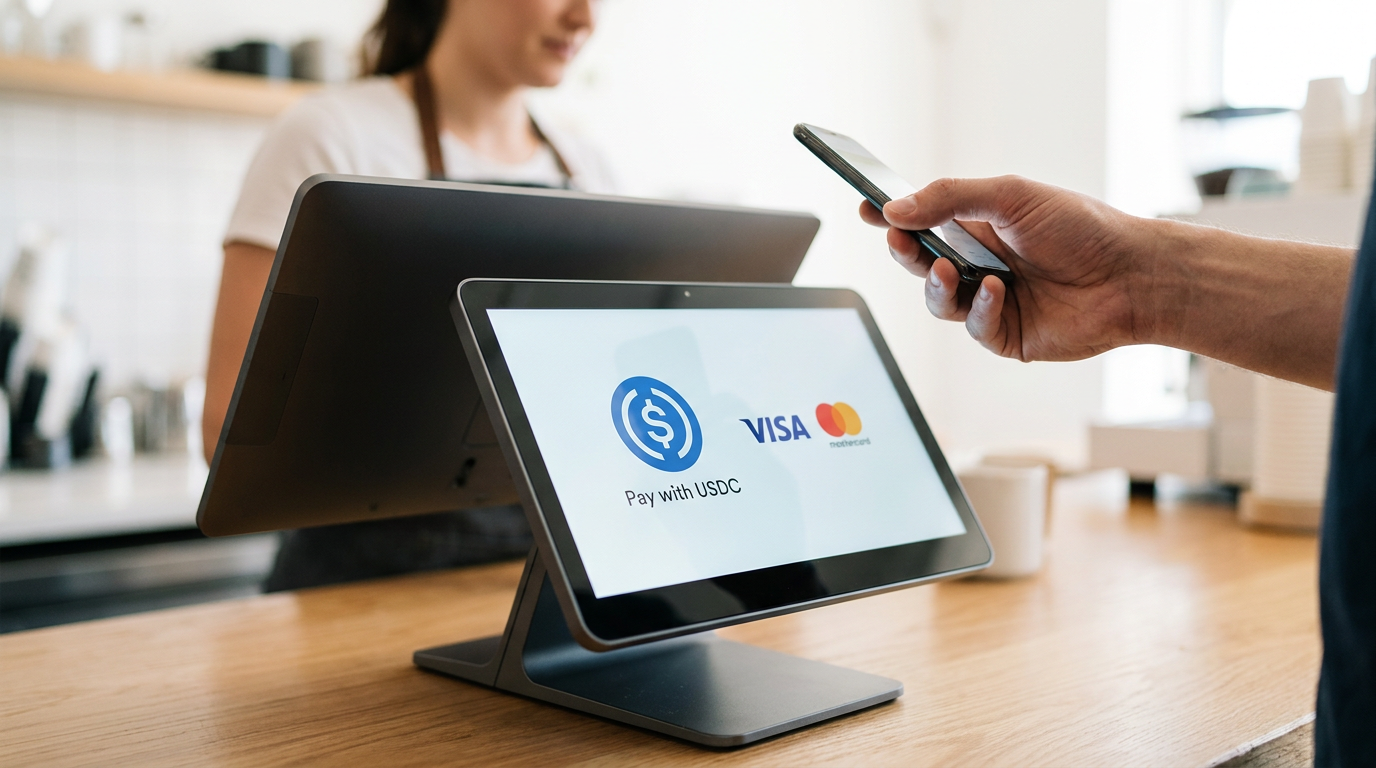
The mechanics of this new system are designed to be entirely invisible to the average business owner. When an international customer pays an invoice using a stablecoin like USDC, Stripe handles the on-chain confirmation, manages the compliance checks, and instantly settles the transaction in fiat currency. To the merchant, the payment appears on their dashboard exactly like a standard credit card swipe, completely bypassing the friction and foreign exchange spreads of a traditional wire transfer.[5]
The mechanics of this new system are designed to be entirely invisible to the average business owner.
The economic impact of this bypass is staggering. A typical international wire transfer costs a business between $40 and $80 in flat fees, plus hidden currency conversion markups. Stablecoin transfers, by contrast, settle for fractions of a cent in network fees, bringing the total blended cost of a cross-border transfer to well under 1%. For companies operating on thin margins, recovering 5% of their international revenue from banking middlemen is a transformative financial win.[6]
While enterprise adoption is surging, the most profound benefits are being felt by consumers and small businesses in emerging markets. In regions where traditional banking infrastructure is sparse or prohibitively expensive, digital wallets have become a lifeline. Families sending remittances home are abandoning legacy money transfer operators in favor of stablecoin platforms that allow them to keep the vast majority of their hard-earned money.[7]

The International Monetary Fund recently highlighted Nigeria as a prime example of this grassroots financial shift. Between mid-2023 and mid-2024, the country received roughly $59 billion in crypto-asset inflows, with stablecoins forming a vital bridge to the traditional financial system. For Nigerian households and small firms facing high inflation and constrained access to foreign exchange, stablecoins offer both a hedge against currency risk and a cheap, instant tool for paying overseas suppliers.[3]
Beyond consumer remittances, the business-to-business sector is adopting the technology at an unprecedented pace. Startups and established fintechs are converging on a single operational model: stablecoin rails underneath, automated compliance in the middle, and a seamless software experience on top. Industry analysts project that B2B stablecoin payment volume will exceed $1 trillion by 2030, driven entirely by the demand for instant, transparent settlement.[6]
A major catalyst for this institutional confidence has been the arrival of clear regulatory guardrails. The passage of comprehensive legislation, such as the GENIUS Act in the United States and the MiCA framework in Europe, has transformed stablecoins from a regulatory gray area into a recognized, regulated means of payment. By requiring issuers to hold 1:1 fiat reserves and submit to strict anti-money-laundering controls, governments have given traditional financial institutions the green light to build on blockchain infrastructure.[6]

Traditional banks and central monetary authorities are acutely aware of the shifting landscape. The Bank for International Settlements notes that while stablecoins offer clear advantages in speed and cost, they also pressure legacy systems to modernize. In response, central banks are actively exploring how to integrate distributed ledger technology into wholesale payment infrastructures, attempting to match the efficiency of stablecoins while maintaining direct control over the money supply.[4]
For everyday consumers and global merchants, the backend debate over monetary sovereignty and blockchain architecture is secondary to the immediate financial relief. As stablecoins are quietly folded into the existing interfaces of trusted payment processors, the era of the expensive, multi-day international wire transfer is rapidly coming to an end, leaving a faster, fairer global economy in its wake.[7]
How we got here
2024
Stripe restarts crypto payments and acquires stablecoin infrastructure startup Bridge for $1.1 billion.
July 2025
The US passes the GENIUS Act, providing a clear regulatory framework for stablecoin issuance and settlement.
Early 2026
Stablecoin cross-border payment volume surges, with B2B transactions leading the growth.
June 2026
Reports emerge that payments giants Stripe, Visa, and Mastercard are backing a unified stablecoin settlement platform.
Viewpoints in depth
Fintech Innovators
Argue that stablecoins are the inevitable technological upgrade to outdated correspondent banking.
Payment processors and blockchain startups view the traditional SWIFT network as an obsolete technology that artificially inflates the cost of global commerce. By replacing intermediary banks with direct peer-to-peer blockchain settlement, they argue that stablecoins are doing for money what the internet did for information: making it instant, borderless, and nearly free to transmit.
Global Regulators
Acknowledge the benefits for financial inclusion but emphasize the need for strict oversight.
International monetary authorities like the IMF and BIS recognize that stablecoins solve real frictions in the remittance market, particularly for unbanked populations. However, they caution that widespread reliance on US dollar-pegged digital assets could undermine the monetary sovereignty of developing nations. Regulators are pushing for strict 1:1 reserve requirements and anti-money-laundering controls to ensure these new networks do not become conduits for illicit finance.
Everyday Consumers & SMEs
Value the immediate financial relief of bypassing high remittance fees and multi-day settlement delays.
For families sending money across borders and small businesses paying international suppliers, the architectural debate over blockchain versus traditional banking is largely irrelevant. Their primary concern is cost and speed. By cutting remittance fees from over 6% to under 1%, stablecoins are returning billions of dollars directly to the communities that need it most, providing a tangible economic lifeline in regions plagued by high inflation and currency volatility.
What we don't know
- Whether traditional banks will lower their own wire fees in response to the competitive pressure from stablecoins.
- How the unified stablecoin platform reportedly backed by Visa and Mastercard will structure its governance and fee model.
- The long-term impact of widespread US dollar-pegged stablecoin use on the monetary sovereignty of emerging market nations.
Key terms
- Stablecoin
- A cryptocurrency designed to have a relatively stable price, typically by being pegged to a fiat currency like the US dollar.
- Correspondent Banking
- A traditional financial network where multiple intermediary banks partner to route money across international borders, often adding delays and fees.
- SWIFT
- The global messaging network that traditional banks use to securely transmit instructions for international money transfers.
- Fiat Currency
- Government-issued currency, such as the US dollar or the euro, that is not backed by a physical commodity like gold.
Frequently asked
What is a stablecoin?
A digital currency pegged to a stable asset, like the US dollar, designed to maintain a consistent value without the volatility of traditional cryptocurrencies.
How much do stablecoin transfers cost compared to traditional wires?
Traditional international wires average a 6.49% fee and take days to settle, while stablecoin transfers typically cost under 1% and settle in seconds.
Do businesses need to hold crypto to accept these payments?
No. Payment processors like Stripe automatically convert the stablecoin into fiat currency (like dollars or euros) before it reaches the merchant's bank account.
Sources
Source coverage
7 outlets
3 viewpoints surfaced







[1]CoinDeskFintech Innovators
Stripe, Visa and Mastercard Said to Back a New Stablecoin Platform
Read on CoinDesk →[2]StartupFortuneFintech Innovators
Stripe's stablecoin push is real
Read on StartupFortune →[3]International Monetary FundGlobal Regulators
Stablecoins in Nigeria: A Growing Cross-Border Channel
Read on International Monetary Fund →[4]Bank for International SettlementsGlobal Regulators
Enhancing cross-border payments step by step
Read on Bank for International Settlements →[5]StripeFintech Innovators
Stablecoin trends businesses need to understand in 2026
Read on Stripe →[6]ValueAddVCFintech Innovators
Cross-border payments startups in 2026: the market and the leaders
Read on ValueAddVC →[7]Factlen Editorial TeamEveryday Consumers & SMEs
Synthesis by Factlen editorial team
Read on Factlen Editorial Team →

More in finance
See all 6 stories →Credit Scoring
Beyond FICO: How Cash-Flow Underwriting is Rewriting the Rules of Credit Cards
8 sources

Retirement Strategy
The Evidence Behind Switching to a Roth 401(k) in Your 50s
7 sources

Student Loans
How to Get the New 1% Interest Rate Cut on Your Federal Student Loans
8 sources

Global Payments
Global Remittance Costs Plunge to Record Lows as Major Payment Networks Adopt Stablecoins
8 sources

Every angle. Every day.
Get finance stories with full source coverage and perspective breakdowns delivered to your inbox.