
The Neurological Magic of Swimming: How Aquatic Exercise Reshapes the Brain
Emerging neuroscience reveals that swimming does more than build muscle—it actively promotes neurogenesis, boosts memory, and repairs stress-induced brain damage.
By Factlen Editorial Team
- Neuroscientists
- Focuses on the molecular and cellular changes triggered by aquatic exercise.
- Developmental Psychologists
- Highlights the impact of swimming on early childhood cognitive development.
- Public Health Experts
- Views swimming as a critical tool for preventing cognitive decline in older adults.
What's not represented
- · Individuals with water phobias or limited access to safe swimming facilities, who cannot easily access these specific neurological benefits.
Why this matters
Understanding the cognitive benefits of swimming transforms a simple workout into a targeted intervention for mental health, accelerated childhood development, and the prevention of age-related cognitive decline.
Key points
- Swimming triggers the release of BDNF, a protein that promotes the growth of new brain cells.
- Children who learn to swim early reach cognitive and motor milestones up to 10 months faster.
- Water immersion increases blood flow to the brain's middle cerebral artery by 14 percent.
- Regular aerobic swimming can help prevent age-related brain shrinkage and cognitive decline.
The physical benefits of swimming are obvious—broad shoulders, cardiovascular endurance, and low-impact joint mobility. But beneath the surface, a quiet neurological revolution happens every time a swimmer enters the water. Emerging neuroscience reveals that aquatic exercise is not just a muscular workout; it is a profound catalyst for brain health, cognitive function, and emotional resilience. While all aerobic exercise benefits the brain, the unique combination of buoyancy, hydrostatic pressure, and rhythmic breathing makes swimming an unparalleled tool for neurological maintenance.[7]
Until the late twentieth century, scientists largely believed that the human brain possessed a finite number of neurons, meaning that once brain cells were damaged or lost, they could never be replaced. That dogma has since been overturned by the discovery of neurogenesis—the brain's ability to birth new neurons throughout adulthood. Researchers have found that aerobic exercise, and swimming in particular, is one of the most effective ways to trigger this regenerative process, actively repairing neural damage and forging new synaptic connections.[1]
The primary molecular driver of this regeneration is a protein called brain-derived neurotrophic factor, or BDNF. Harvard psychiatrist John Ratey famously described BDNF as "Miracle-Gro for your brain," because it supports the survival of existing neurons while encouraging the growth and differentiation of new ones. Animal studies have consistently shown that swimming protocols significantly induce the expression of BDNF in the hippocampus, the brain region responsible for learning and memory.[5]

Alongside BDNF, swimming elevates the expression of other crucial neurotrophic peptides, including neuropeptide Y (NPY) and VGF. These peptides are heavily involved in neuronal synaptic remodeling. In laboratory models subjecting animals to chronic stress, researchers found that stress severely inhibited the production of these vital peptides, leading to neural atrophy. However, introducing a regular swimming regimen not only restored these peptides to normal levels but actively reversed the stress-induced neural damage, acting as a powerful neuroprotective and antidepressant mechanism.[4]
The cognitive improvements resulting from these molecular changes are surprisingly rapid. In one study tracking the time-course effects of exercise, researchers placed rats in a radial arm water maze to test their spatial learning and memory retrieval. After just seven days of daily swim training, the animals demonstrated significant improvements in both short- and long-term memory, evidenced by a sharp reduction in navigational errors. These cognitive gains plateaued and were maintained with continued exercise, suggesting that the brain adapts quickly to the demands of aquatic exertion.[1][2]
These neurological benefits are not limited to animal models; they translate dramatically to human development. A landmark study conducted by researchers at Griffith University in Australia tracked young children who participated in early swim lessons. The findings were staggering: children who learned to swim at a young age reached major cognitive and developmental milestones up to ten months faster than the normative population. This accelerated development spanned gross motor skills, visual-motor coordination, and even mathematically related tasks.[5]
These neurological benefits are not limited to animal models; they translate dramatically to human development.
The acute cognitive boost provided by swimming is also measurable in older children. In a fascinating comparative study, researchers taught children aged six to twelve a series of unfamiliar vocabulary words. The children were then divided into three groups to perform a three-minute activity: a resting coloring task, an anaerobic CrossFit-style workout, or aerobic swimming. When tested afterward, the children who swam demonstrated significantly higher accuracy in word recall compared to both the resting and anaerobic exercise groups, highlighting a distinct cognitive advantage tied specifically to the aquatic aerobic activity.[1]

One of the mechanisms separating swimming from land-based exercise is the profound effect of water immersion on cerebral blood flow. The hydrostatic pressure of water gently compresses the body, assisting the heart in circulating blood against gravity. A 2014 study found that simply immersing a person in water up to the level of their heart increased blood flow to the middle cerebral arteries by 14 percent, and to the posterior cerebral arteries by 9 percent. This passive circulatory boost occurs even before the physical exertion of swimming begins.[6]
When this immersion is combined with the physical exertion of swimming, the cerebrovascular benefits multiply. Upright aquatic exercise and horizontal swimming both increase the mean velocity of blood in the middle cerebral artery. This enhanced circulation delivers a richer supply of oxygen and essential nutrients to neural tissues while efficiently clearing away metabolic waste products. Researchers note that even a brief, 20-minute session of moderate-intensity breaststroke is sufficient to produce an acute improvement in visuomotor performance and cognitive processing speed.[3]
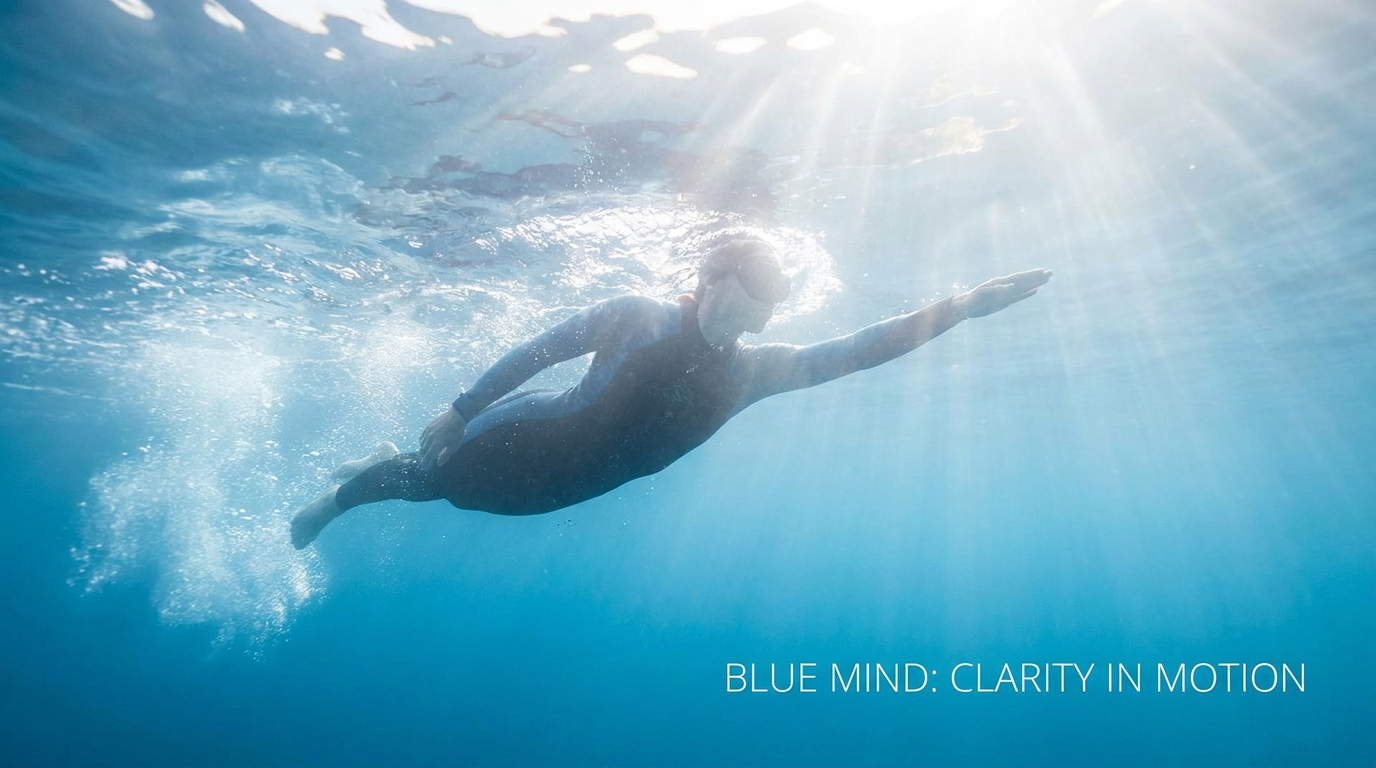
Beyond the mechanical benefits of blood flow and neurogenesis, swimming exerts a powerful psychological influence often referred to as the "Blue Mind" effect. The sensory deprivation of being submerged—muffled sounds, the rhythmic cadence of breathing, and the sensation of weightlessness—shifts the brain into a mildly meditative state. This unique aquatic environment lowers cortisol levels and mitigates anxiety, providing a vital sanctuary from the chronic overstimulation and digital fatigue of modern life. The repetitive nature of lap swimming allows the mind to disengage from active problem-solving, fostering a state of flow that is highly restorative for cognitive fatigue.[6]

This stress-reduction capability is vital because chronic stress is highly toxic to the brain, physically shrinking the hippocampus and destroying neural connections. By simultaneously lowering stress hormones and flooding the brain with endorphins and serotonin, swimming creates an optimal biochemical environment for mood regulation. Neuropsychologists frequently recommend swimming as a complementary therapy for depression, noting its dual action of elevating mood through neurochemicals while physically repairing stress-induced neural damage.[6]
As humans age, the neuroprotective properties of swimming become even more critical. Cognitive decline and brain shrinkage are common hallmarks of aging, often leading to deficits in memory and executive function. However, research presented at the American Academy of Neurology demonstrated that regular participation in aerobic activities like swimming can physically prevent brain shrinkage in older adults. Active seniors maintain larger brain volumes and exhibit enhanced neural efficiency compared to their sedentary peers.[5]

Ultimately, the pool serves as a unique laboratory for cognitive longevity. While running or cycling offer excellent cardiovascular benefits, the aquatic environment demands a complex orchestration of bilateral cross-patterning movements, breath control, and spatial awareness, all while suspended in a buoyant, pressurized medium. This forces the brain to activate all four lobes simultaneously, building a denser, more resilient neural network. The constant tactile feedback of water against the skin further stimulates the somatosensory cortex, making swimming a truly whole-brain exercise.[7]
Whether it is a toddler splashing in a shallow end, a stressed professional swimming lunchtime laps, or a senior maintaining their vitality in a water aerobics class, the neurological dividends of swimming are profound. The science is increasingly clear: every stroke taken in the water is an investment in cognitive architecture. By simultaneously building new neurons, enhancing blood flow, and washing away the toxic effects of stress, swimming proves that the fountain of youth might just be a literal pool of water.[7]
How we got here
1960s
Scientists debunk the myth of a finite brain, discovering adult neurogenesis.
2012
Griffith University publishes a landmark study showing swimming children reach milestones up to 10 months faster.
2014
Researchers quantify the hydrostatic effect, proving water immersion increases cerebral blood flow by 14 percent.
2020
Columbia University presents data showing swimming helps prevent brain shrinkage in older adults.
Viewpoints in depth
Neuroscientists' view
Focuses on the molecular and cellular changes triggered by aquatic exercise.
Researchers emphasize that swimming is a potent trigger for Brain-Derived Neurotrophic Factor (BDNF) and neurogenesis. By studying animal models, they have mapped how the physical exertion of swimming physically repairs neural damage and builds new pathways in the hippocampus, fundamentally altering the brain's architecture.
Developmental Psychologists' view
Highlights the impact of swimming on early childhood cognitive development.
This camp points to data showing that the complex motor coordination required to move through water accelerates brain development in children. The bilateral movements and sensory feedback of swimming help children reach cognitive and visual-motor milestones significantly faster than their non-swimming peers.
Healthy Aging Advocates' view
Views swimming as a critical tool for preventing cognitive decline in older adults.
Public health experts and gerontologists focus on swimming's ability to maintain brain volume and improve cerebral blood flow. Because it is low-impact, it allows older adults to sustain the aerobic intensity necessary to stave off brain shrinkage and memory loss without risking joint injury.
What we don't know
- The exact duration and intensity of swimming required to maximize long-term neurogenesis in humans remains under investigation.
- It is not yet fully understood how different water temperatures (e.g., cold water swimming vs. warm pools) independently affect BDNF release.
Key terms
- BDNF (Brain-Derived Neurotrophic Factor)
- A protein that acts like fertilizer for the brain, promoting the survival and growth of neurons.
- Neurogenesis
- The biological process by which new neurons are formed in the brain.
- Hippocampus
- A complex brain structure embedded deep into the temporal lobe that plays a major role in learning and memory.
- Hydrostatic Pressure
- The pressure exerted by a fluid at equilibrium; in swimming, it gently compresses the body to aid blood circulation.
- Blue Mind
- A mildly meditative state characterized by calm, peacefulness, and general happiness triggered by being in or near water.
Frequently asked
Does the type of swim stroke matter for brain health?
While all strokes provide aerobic benefits, complex strokes that require bilateral cross-patterning, like freestyle or breaststroke, activate more areas of the brain simultaneously.
How long do I need to swim to see cognitive benefits?
Research indicates that even a short, 20-minute session of moderate-intensity swimming can provide an acute boost to cognitive processing and attention.
Is swimming better for the brain than running?
Both are excellent, but swimming offers unique benefits due to water's hydrostatic pressure increasing cerebral blood flow, and the sensory deprivation of water reducing stress.
Sources
Source coverage
7 outlets
3 viewpoints surfaced





[1]TED IdeasNeuroscientists
Why swimming is so good for your brain
Read on TED Ideas →[2]National Institutes of HealthNeuroscientists
Time-course effect of swimming exercise on memory
Read on National Institutes of Health →Cerebrovascular and cognitive effects of swimming
Read on National Institutes of Health →Neurotrophic Effects of Swimming Exercise
Read on National Institutes of Health →[5]U.S. Masters SwimmingDevelopmental Psychologists
How Swimming Supports Brain Health
Read on U.S. Masters Swimming →[6]Women's Brain Health InitiativePublic Health Experts
The Brain Benefits of Swimming
Read on Women's Brain Health Initiative →[7]Factlen Editorial TeamPublic Health Experts
Synthesis by Factlen editorial team
Read on Factlen Editorial Team →


Every angle. Every day.
Get fitness stories with full source coverage and perspective breakdowns delivered to your inbox.