
Sashimi-Bot and the Engineering Breakthrough of Deformable Robotics
A new tri-manual robotic system capable of delicately slicing raw fish marks a major milestone in handling soft, unpredictable materials. The advance could reshape the global seafood supply chain and pave the way for autonomous surgical robotics.
By Factlen Editorial Team
- Robotics Researchers
- View deformable object manipulation as the next great frontier, essential for moving robots out of factories and into homes and hospitals.
- Seafood Industry & Supply Chain
- See automation as a critical tool to reshore processing, reduce the carbon footprint of global shipping, and improve food safety.
- Culinary Traditionalists
- Express caution over the automation of artisanal skills, though acknowledging the benefits for mass-market industrial processing.
What's not represented
- · Human Sushi Chefs
- · Surgical Robotics Developers
Why this matters
Mastering the robotic manipulation of soft, unpredictable materials is the key to automating everything from food processing to laundry. In the seafood industry alone, this technology could eliminate the massive carbon footprint of shipping fish overseas for manual filleting.
Key points
- Sashimi-Bot is a tri-manual robotic system capable of autonomously straightening, cutting, and plating raw salmon.
- The system uses tactile sensors and deep reinforcement learning to handle the unpredictable pliancy of biological tissue.
- Automating seafood processing could eliminate the massive carbon footprint caused by shipping fish overseas for manual filleting.
- The algorithms developed for handling raw fish have direct future applications in autonomous surgical robotics.
For decades, the robotics industry has operated under a fundamental rigidity assumption. Machines excel at assembling cars, welding steel, and moving heavy pallets because those objects behave predictably and maintain their shape under pressure. But introduce a soft, floppy, or slippery item—a towel, a piece of dough, or raw meat—and multimillion-dollar robotic systems routinely fail. This divide between rigid and deformable objects has kept automation largely confined to structured factories, leaving the messy, pliant reality of food processing and domestic chores to human hands.[4][6]
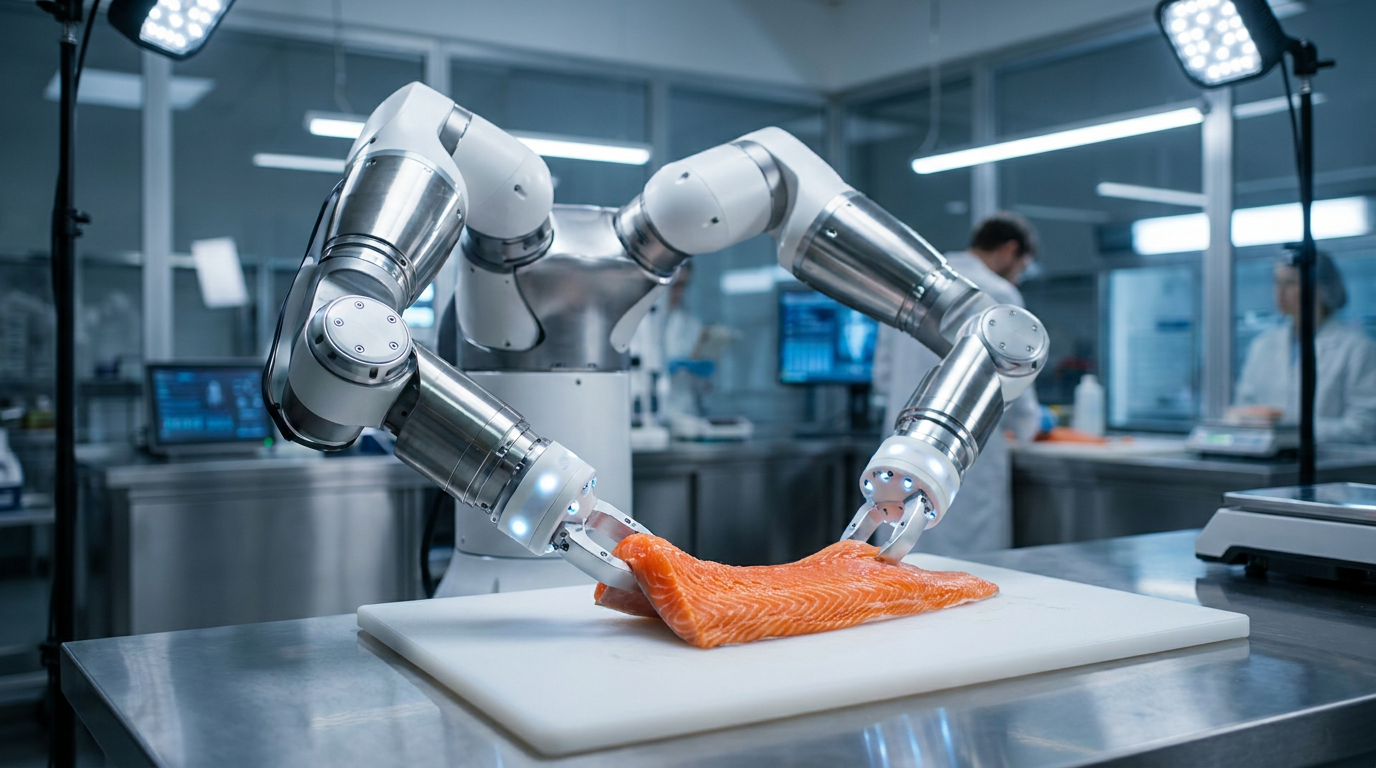
That boundary is now dissolving. In a milestone for robotic engineering, researchers have unveiled "Sashimi-Bot," a multi-armed system capable of autonomously manipulating and slicing highly deformable raw fish. Detailed in a study highlighted by Nature, the system successfully transforms a floppy, irregularly shaped salmon loin into precisely cut and plated sashimi. The breakthrough demonstrates that machines can now navigate the pliancy, frailness, and variability of natural biological materials.[1][2]
Raw fish represents a unique boss fight for roboticists. Unlike rubber or plastic, a salmon loin is elastoplastically deformable, meaning it bends and squishes under pressure but does not reliably return to its original shape. It is also wet, slippery, and highly variable from one fish to the next. Traditional robotic grippers, which rely on calculating fixed contact points and applying firm pressure, would simply crush or tear the delicate muscle tissue.[2][5][6]
To solve this, Sashimi-Bot employs a tri-manual architecture—three robotic arms, each with seven degrees of freedom, working in continuous coordination. The first arm is equipped with a compliant gripper that holds tools and gently reshapes the fish. The second arm features specialized long fingers and an elastic band to stabilize the loin without bruising it. The third arm wields chopsticks to pick up the freshly cut slices and arrange them on a serving tray.[2]

The system's success relies heavily on advanced perception. Sashimi-Bot does not merely look at the fish; it feels it. The robot integrates RGB-D depth cameras with GelSight tactile sensors, allowing it to measure the exact pliancy and resistance of the meat in real-time. If the knife encounters unexpected resistance, or if the loin shifts slightly during a cut, the system adjusts its trajectory on the fly to prevent tearing.[2]
Crucially, the robot utilizes non-prehensile manipulation for the most delicate steps. Rather than pinching or grabbing the raw fish to move it into position, the first arm uses gentle, horizontal pushes to straighten the loin on the cutting board. This technique mimics the careful nudges of a human chef, ensuring the structural integrity of the flesh remains completely intact before the blade makes contact.[2][5]
Training a robot to handle infinite biological variability required a novel approach to artificial intelligence. The researchers utilized Deep Reinforcement Learning (DRL), training the system's control policies in complex physics simulators before deploying them to the physical robot. By repeatedly practicing on simulated deformable objects, the AI developed an intuitive understanding of how soft tissues behave under various pressures, allowing it to generalize its skills to real-world salmon.[2][4]
Training a robot to handle infinite biological variability required a novel approach to artificial intelligence.
The implications of this technology extend far beyond novelty sushi. The global seafood industry currently faces a massive logistical and environmental bottleneck due to the lack of automated processing. In high-cost regions like North America and Northern Europe, the labor required to manually fillet and portion delicate fish is often prohibitively expensive.[2][5]
As a result, producers frequently freeze their catch, ship it thousands of miles to low-cost processing centers overseas, and then ship the processed fillets back to the original markets. This re-transport loop generates immense carbon emissions and degrades the quality of the food. By endowing robots with the ability to handle deformable raw materials, the industry can reshore processing directly to the point of harvest, drastically shrinking the supply chain.[2][5]

This shift is already beginning at the very start of the seafood pipeline. California-based startup Shinkei Systems recently deployed "Poseidon," an AI-driven robot designed to operate directly on the decks of commercial fishing boats. The refrigerator-sized machine automates ikejime—a traditional Japanese method of humane harvesting that preserves flavor and texture by instantly neutralizing the fish's nervous system.[3]
Backed by $30 million in venture funding, Shinkei's robots demonstrate that advanced computer vision and rapid robotic actuation can function even in the unpredictable, wet environment of a ship at sea. Similarly, the European SMARTCHAIN project is developing closed-loop robotic manipulation to handle the high biological variation of whitefish, aiming to stabilize processing capacity and reduce food waste across the continent.[3][5]
The underlying science driving these food-tech innovations is Deformable Object Manipulation (DOM), a rapidly accelerating subfield of AI. For years, progress in DOM was stalled by the sheer computational difficulty of simulating soft materials. Initiatives like PlasticineLab, developed jointly by MIT and IBM, broke this bottleneck by baking advanced physics equations into virtual environments, allowing AI agents to practice rolling dough or tying ropes thousands of times a second.[4][6]

Despite these rapid advances, transparent uncertainties remain. While Sashimi-Bot excels at handling a pre-cleaned, boneless salmon loin, dealing with the unpredictable locations of pin bones, scales, and varying skin toughness is a significantly harder challenge. Furthermore, the current iteration of the robot operates at a deliberate, careful pace that cannot yet match the rapid-fire throughput of a skilled human processor.[2]
Yet, the algorithms being perfected on raw fish will inevitably migrate to higher-stakes domains. The exact same elastoplastic physics that make a salmon loin difficult to manipulate apply to human organs and tissues. As robots learn to gently push, stabilize, and slice deformable biological materials without causing unintended damage, the technology paves the way for fully autonomous surgical robots capable of adapting to the soft, shifting environment of the human body.[6]
The era of robots being confined to rigid, predictable tasks is ending. By conquering the pliancy and frailness of the natural world, engineering is crossing a critical threshold. Whether it is preparing a delicate meal, reshoring a global supply chain, or eventually assisting in the operating room, machines are finally developing the soft touch required to operate in a human-centric world.[1][2]
How we got here
2021
MIT and IBM launch PlasticineLab to simulate deformable objects like dough and rope for AI training.
2023
Researchers begin focusing heavily on Deformable Object Manipulation (DOM) for food and textiles.
2025
Shinkei Systems deploys AI-driven robots on fishing boats to automate the delicate ikejime harvesting process.
June 2026
Nature publishes the Sashimi-Bot breakthrough, demonstrating autonomous tri-manual manipulation of raw salmon.
Viewpoints in depth
Robotics Researchers
View deformable object manipulation as the next great frontier.
For decades, roboticists have been constrained by the 'rigidity assumption,' which limited automation to highly structured environments like car factories. Researchers view the successful manipulation of elastoplastic materials like raw fish as a gateway achievement. By proving that AI can adapt to unpredictable, squishy, and frail objects in real-time, they argue that robots are finally ready to enter unstructured human environments, from domestic kitchens to hospital operating rooms.
Seafood Industry & Supply Chain
See automation as a critical tool to reshore processing and reduce carbon emissions.
Industry advocates point out that the current seafood supply chain is deeply inefficient. Because manual filleting is too expensive in high-cost countries, massive amounts of fish are frozen, shipped to Asia for processing, and shipped back. Supply chain experts argue that advanced robotics can break this cycle, allowing for immediate, automated processing near the point of harvest. This would drastically reduce the industry's carbon footprint, improve food hygiene, and lower costs.
Culinary Traditionalists
Express caution over the automation of artisanal skills.
While acknowledging the environmental and economic benefits of automating mass-market fish processing, culinary traditionalists emphasize the irreplaceable value of human intuition. They argue that a master chef does not just process a fish, but reads its unique fat content, muscle structure, and age to determine the perfect cut. For these traditionalists, robotics should remain confined to industrial supply chains rather than replacing the artistry of high-end gastronomy.
What we don't know
- How well the system can handle fish with unpredictable pin bones, tough scales, or varying skin textures.
- Whether the robotic processing speed can eventually match or exceed the rapid throughput of a skilled human worker.
- How quickly these specific algorithms can be safely adapted for use in autonomous surgical robotics on live human tissue.
Key terms
- Deformable Object Manipulation (DOM)
- The robotic science of handling items that bend, squish, or stretch, rather than remaining rigid.
- Elastoplasticity
- The property of a material to deform under stress and not fully return to its original shape, such as dough or raw meat.
- Non-prehensile manipulation
- Moving or reshaping an object without grasping or pinching it, often using gentle pushes or nudges.
- GelSight sensor
- A tactile robotic sensor that uses a deformable gel surface and an internal camera to 'feel' the shape and texture of an object.
Frequently asked
Why is handling raw fish difficult for robots?
Raw fish is elastoplastic, meaning it squishes and changes shape unpredictably under pressure. It is also slippery and delicate, making it easy for traditional robotic grippers to crush or tear the meat.
Will this technology replace sushi chefs?
No. The primary goal is to automate industrial food processing, reducing the need to freeze and ship seafood overseas for manual filleting, rather than replacing high-end culinary artisans.
How does the robot avoid crushing the fish?
It uses tactile sensors to measure physical resistance in real-time and employs 'non-prehensile' manipulation—using gentle pushes rather than hard pinches to move the meat.
Sources
Source coverage
6 outlets
3 viewpoints surfaced





[1]NatureRobotics Researchers
It slices! It dices! Sashimi-Bot handles seafood with ease
Read on Nature →[2]arXivRobotics Researchers
Sashimi-Bot: Autonomous tri-manual advanced manipulation and cutting of deformable objects
Read on arXiv →[3]Los Angeles TimesSeafood Industry & Supply Chain
A local startup is using artificial intelligence and robotics in an unlikely way
Read on Los Angeles Times →[4]MIT NewsRobotics Researchers
A new simulation environment, PlasticineLab, is designed to make robot learning more intuitive
Read on MIT News →[5]SINTEFSeafood Industry & Supply Chain
Robotic manipulation in the food and seafood industries
Read on SINTEF →Deformable object manipulation (DOM) for robots: A review
Read on arXiv →



Every angle. Every day.
Get science stories with full source coverage and perspective breakdowns delivered to your inbox.