
Heat Pumps vs. Gas Furnaces: The 2026 Home Heating Comparison
As federal incentives and cold-climate technology reshape the HVAC market, the financial math between electric heat pumps and traditional gas furnaces has shifted. Here is how the two systems compare on upfront costs, long-term savings, and climate suitability.
By Factlen Editorial Team
- Electrification & Efficiency Advocates
- Argues that the 300%+ efficiency of heat pumps and their ability to run on renewable energy makes gas furnaces obsolete in most climates.
- Economic & ROI Analysts
- Focuses purely on the math, noting that while heat pumps save money long-term, the upfront costs and local utility rates dictate the true winner.
- Climate-Specific Pragmatists
- Emphasizes that geography is destiny, advocating for dual-fuel systems in extreme northern climates where standalone heat pumps may struggle during deep freezes.
What's not represented
- · Renters who cannot choose their heating systems
- · Natural gas utility operators facing declining residential demand
Why this matters
Space heating accounts for roughly 45% of the average American household's energy bill. Choosing the right system dictates thousands of dollars in utility costs, carbon emissions, and maintenance over the next 15 years.
Key points
- Heat pumps move heat rather than generate it, achieving efficiencies of 300% or more.
- Gas furnaces max out at roughly 98.5% efficiency but offer reliable heat in extreme cold.
- Heat pumps cost more upfront but typically save $800 to $1,400 annually in operating costs.
- Federal tax credits up to $2,000 are available in 2026 for qualifying heat pump installations.
- Dual-fuel systems combine both technologies for optimal efficiency and cold-weather reliability.
For decades, the debate between electric heat pumps and gas furnaces centered largely on environmental preferences. But as the 2026 heating season approaches, the conversation has shifted entirely to hard economics. Advances in cold-climate inverter technology, volatile fossil fuel prices, and aggressive federal electrification incentives have fundamentally altered the math of keeping a home warm. Homeowners facing an aging HVAC system are no longer just choosing a piece of equipment; they are locking in a 15-year trajectory for their utility bills.[1][3]
The core difference between the two systems lies in how they source warmth. A traditional gas furnace relies on combustion, burning natural gas or propane in a chamber to heat a metal exchanger, which then warms the air blown through the home's ductwork. Because it creates heat through a small fire, a furnace is bound by the limits of physics—it can never output more energy than the fuel contains. The most advanced gas furnaces on the market today max out at an Annual Fuel Utilization Efficiency (AFUE) of 96% to 98.5%, meaning a few cents of every dollar spent on gas inevitably escapes up the exhaust flue.[2][3]
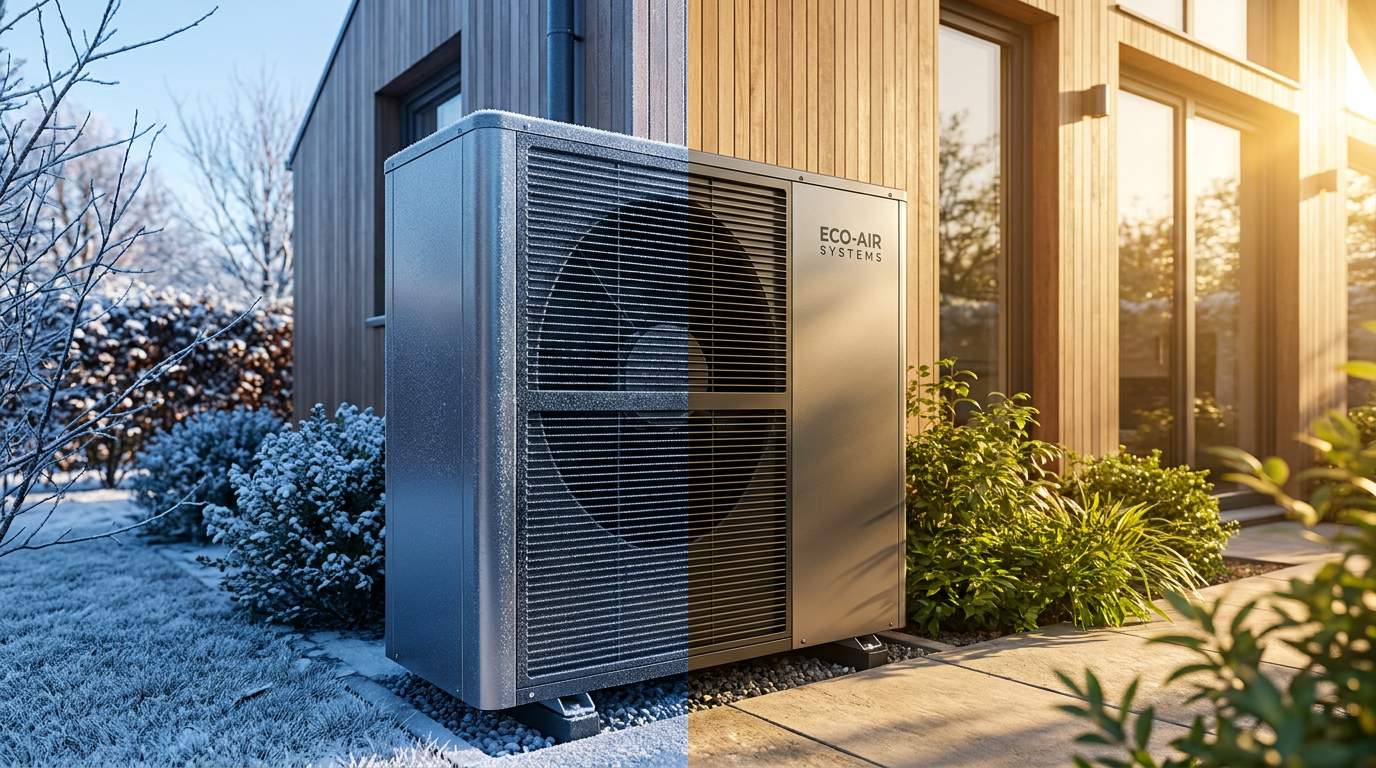
A heat pump, conversely, does not generate heat at all; it merely transfers it. Operating like an air conditioner in reverse, it uses a refrigerant cycle to extract ambient thermal energy from the outdoor air and move it inside. Because moving heat requires significantly less energy than creating it from scratch, heat pumps routinely achieve a Coefficient of Performance (COP) of 3.0 or higher. This translates to 300% efficiency, meaning the system delivers three units of heating energy for every one unit of electricity it consumes.[3][4]

The primary argument for heat pumps is this massive efficiency advantage, compounded by their dual utility. A heat pump serves as a two-in-one system, providing both heating in the winter and cooling in the summer. By consolidating two appliances into one, homeowners eliminate the need to purchase and maintain a separate central air conditioning unit. Furthermore, because they run entirely on electricity, heat pumps carry zero risk of carbon monoxide leaks and allow eco-conscious households to dramatically lower their carbon footprint, especially if the home is powered by solar panels.[1][5]
However, the case against heat pumps usually begins with the sticker shock of installation. A high-efficiency heat pump system typically costs between $5,000 and $19,000 to install, depending on the home's size and the system's capacity. This is notably higher than a standard gas furnace replacement. Additionally, homes transitioning from gas to electric heating may require an electrical panel upgrade to handle the increased load, adding thousands to the upfront bill. Heat pumps also have a slightly shorter lifespan of roughly 15 years, compared to a furnace's 15 to 20 years, simply because they run year-round rather than resting during the summer.[1][6]
However, the case against heat pumps usually begins with the sticker shock of installation.
The financial evidence for heat pumps becomes clear when analyzing long-term operating costs. Real-world data across moderate climates shows that a heat pump costs between $800 and $1,400 annually to run, compared to $1,200 to $2,200 for a gas furnace. This yields a 25% to 45% savings on heating bills. Over a 15-year lifespan, these monthly savings can total upwards of $15,000, easily eclipsing the higher initial purchase price. The math is further sweetened in 2026 by the Inflation Reduction Act, which provides a $2,000 federal tax credit for heat pump installations, often bringing the net upfront cost in line with a traditional gas setup.[2][6]

The argument for sticking with a gas furnace rests on upfront affordability and extreme-weather reliability. A new gas furnace typically costs between $2,500 and $9,000 to install. For homeowners who already have a functioning air conditioner and simply need to replace a dead heater, swapping an old furnace for a new one is the path of least resistance and lowest immediate cost. Furthermore, gas furnaces deliver consistently hot air—often blowing at 120 degrees Fahrenheit—regardless of how far the temperature drops outside, providing a deep, rapid warmth that many homeowners prefer during a blizzard.[3][5]
The case against gas furnaces centers on their singular function and reliance on fossil fuels. Because they only provide heat, homeowners must still budget for a separate AC unit, meaning the true replacement cost of a full HVAC system is often higher than a single heat pump. Gas systems also require a dedicated gas line and a clear exhaust flue; if the flue becomes blocked, dangerous combustion gases can back up into the living space. Economically, they leave homeowners vulnerable to spikes in natural gas prices, with no option to offset costs via home solar production.[1][4]
The evidence favoring gas furnaces emerges in specific geographic and economic pockets. In regions where electricity is exceptionally expensive—such as parts of New England where rates exceed 25 cents per kilowatt-hour—and natural gas remains cheap, the operating cost advantage of a heat pump narrows or disappears entirely. When the electricity-to-gas price ratio exceeds roughly 4-to-1, a high-efficiency gas furnace becomes cheaper to run during the coldest months, as heat pumps must work harder and consume more power to extract warmth from sub-zero air.[2][3]

For those caught between the two technologies, the hybrid or dual-fuel system offers a compelling compromise. This setup pairs an electric heat pump with a backup gas furnace. The heat pump handles the heating load efficiently during mild and moderate winter days, but when the temperature plummets below a certain threshold and the heat pump's efficiency drops, the system automatically switches to the gas furnace. This provides 80% of the heat pump's annual savings while retaining 100% of the furnace's extreme-cold reliability.[1][4]
Ultimately, a heat pump fits well when a homeowner lives in a moderate or coastal climate, needs to replace both their heating and cooling systems simultaneously, or wants to maximize the return on residential solar panels. It is the clear financial winner for the vast majority of the country, provided the local utility rates do not heavily penalize electricity usage. The availability of federal and state rebates makes the transition highly accessible for those willing to navigate the incentive paperwork.[5][6]

Conversely, a standalone heat pump does not fit well when a home experiences harsh, prolonged sub-zero winters and the homeowner is unwilling to invest in premium cold-climate models. It is also a poor fit for properties with outdated electrical panels where an upgrade would break the budget, or in regions where the cost of electricity is disproportionately high compared to natural gas. In these specific scenarios, a high-efficiency gas furnace—or a dual-fuel hybrid—remains the most pragmatic and cost-effective choice.[3][6]
How we got here
1970s
Gas furnaces dominate the market, though early, inefficient air-source heat pumps begin appearing in mild Southern climates.
2010s
Inverter-driven compressors revolutionize heat pumps, allowing them to operate efficiently in sub-freezing temperatures.
2022
The Inflation Reduction Act is signed, introducing massive federal tax credits for residential heat pump adoption.
2026
Cold-climate heat pumps achieve mainstream parity with gas furnaces, driven by high fossil fuel costs and improved COP ratings.
Viewpoints in depth
Electrification & Efficiency Advocates
Argues that the 300%+ efficiency of heat pumps and their ability to run on renewable energy makes gas furnaces obsolete in most climates.
This camp views the transition away from gas furnaces as both an environmental imperative and a technological inevitability. They point to the Coefficient of Performance (COP) as the ultimate trump card: because heat pumps move heat rather than generate it, they extract three to four units of energy for every unit of electricity consumed. Advocates argue that continuing to burn fossil fuels inside the home is inefficient and exposes families to carbon monoxide risks. They heavily promote pairing heat pumps with residential solar panels to achieve near-zero heating costs and a minimal carbon footprint.
Economic & ROI Analysts
Focuses purely on the math, noting that while heat pumps save money long-term, the upfront costs and local utility rates dictate the true winner.
Financial analysts and cost-conscious homeowners approach the debate strictly through the lens of return on investment. They acknowledge the operational savings of heat pumps—often $800 to $1,400 per year—but caution that the upfront installation costs and potential electrical panel upgrades can lengthen the break-even period. This perspective emphasizes the importance of the electricity-to-gas price ratio in a given zip code. If local electricity rates are exceptionally high and natural gas is cheap, they argue that a high-efficiency gas furnace remains the more fiscally responsible choice, regardless of environmental benefits.
Climate-Specific Pragmatists
Emphasizes that geography is destiny, advocating for dual-fuel systems in extreme northern climates where standalone heat pumps may struggle during deep freezes.
HVAC professionals in regions with harsh, prolonged winters advocate for a middle-ground approach. While they recognize the advancements in cold-climate heat pump technology, they note that efficiency still drops significantly when temperatures plunge below zero. Instead of relying solely on electric resistance backup heating—which is notoriously expensive to run—this camp champions the dual-fuel hybrid system. By using a heat pump for 80% of the winter and switching to a gas furnace only during extreme cold snaps, they argue homeowners get the best of both worlds: maximum efficiency without sacrificing deep-freeze reliability.
What we don't know
- How future fluctuations in natural gas versus electricity prices will alter the long-term break-even math.
- Whether state-level rebate programs will be expanded or exhausted as heat pump adoption accelerates.
Key terms
- Heat Pump
- An electric HVAC system that provides both heating and cooling by moving thermal energy between the indoors and outdoors using a refrigerant cycle.
- Gas Furnace
- A heating system that burns natural gas or propane in a combustion chamber to warm air, which is then circulated through a home's ductwork.
- COP (Coefficient of Performance)
- A metric used to measure a heat pump's efficiency, representing the ratio of heating energy produced to electrical energy consumed.
- AFUE (Annual Fuel Utilization Efficiency)
- A percentage measuring how efficiently a gas furnace converts fuel into usable heat over a typical year.
- Dual-Fuel System
- A hybrid HVAC setup that combines an electric heat pump with a backup gas furnace to optimize efficiency across all temperature ranges.
Frequently asked
Do heat pumps work in freezing weather?
Yes. Modern cold-climate heat pumps can extract heat from the air even when temperatures drop to 5°F or lower, though their efficiency decreases in extreme cold.
Can I keep my gas furnace and add a heat pump?
Yes. This is called a dual-fuel or hybrid system. The heat pump runs during moderate weather, and the gas furnace takes over during extreme cold.
How long do these systems last?
Gas furnaces typically last 15 to 20 years because they only run in the winter. Heat pumps usually last around 15 years since they provide both heating and cooling year-round.
Are there still tax credits for heat pumps in 2026?
Yes. The Inflation Reduction Act continues to offer a 25C tax credit of up to $2,000 for qualifying high-efficiency heat pump installations.
Sources
Source coverage
7 outlets
3 viewpoints surfaced







[1]EnergySageEconomic & ROI Analysts
Heat pump vs. furnace: Which should you choose?
Read on EnergySage →[2]NuWatt EnergyEconomic & ROI Analysts
Heat Pump vs Gas Furnace: Annual Running Cost Comparison
Read on NuWatt Energy →[3]AC DirectClimate-Specific Pragmatists
The Real Numbers: Heat Pump vs Gas Furnace in 2026
Read on AC Direct →[4]Zero HomesElectrification & Efficiency Advocates
Heat pump vs. Gas furnace: Installation cost and efficiency
Read on Zero Homes →[5]PalmettoElectrification & Efficiency Advocates
Is a Heat Pump or Furnace Better for Your Home?
Read on Palmetto →[6]J. Martin Indoor Air QualityClimate-Specific Pragmatists
Gas Furnace vs. Heat Pump: The 2026 Cost & Efficiency Comparison Guide
Read on J. Martin Indoor Air Quality →[7]Factlen Editorial TeamElectrification & Efficiency Advocates
Synthesis by Factlen editorial team
Read on Factlen Editorial Team →


Every angle. Every day.
Get guides stories with full source coverage and perspective breakdowns delivered to your inbox.