
The Physics of Earth's Final Eons: Why Complex Life Could Survive 500 Million Years Longer Than Expected
New climate and stellar models suggest Earth's biosphere may withstand the expanding Sun for up to 1.5 billion years, extending the window for complex life by half a billion years.
By Factlen Editorial Team
- Astrobiologists & Climate Modelers
- Focus on the atmospheric and chemical mechanisms that can extend a planet's habitable lifespan.
- Exoplanet Astronomers
- View these models as a crucial tool for identifying which distant star systems are most likely to harbor life.
- Geophysicists
- Emphasize the uncertainty of Earth's internal tectonic engine, which could halt and end life prematurely regardless of the Sun.
What's not represented
- · Philosophers of Deep Time
- · Evolutionary Biologists
Why this matters
Understanding the ultimate limits of Earth's habitability not only reframes our planet's place in cosmic time, but also expands the 'Goldilocks zone' for finding complex life on exoplanets across the universe.
Key points
- The Sun's luminosity naturally increases by about 10% every billion years, slowly heating the solar system.
- Earth regulates this heat via the carbon-silicate cycle, which draws CO2 out of the atmosphere to cool the planet.
- Eventually, CO2 levels will drop too low for plants to survive, leading to the collapse of the global food web.
- New models suggest lower atmospheric pressure could cool the Earth enough to extend the lifespan of complex life by 500 million years.
- This discovery expands the habitable timeline for Earth and increases the chances of finding life on older exoplanets.
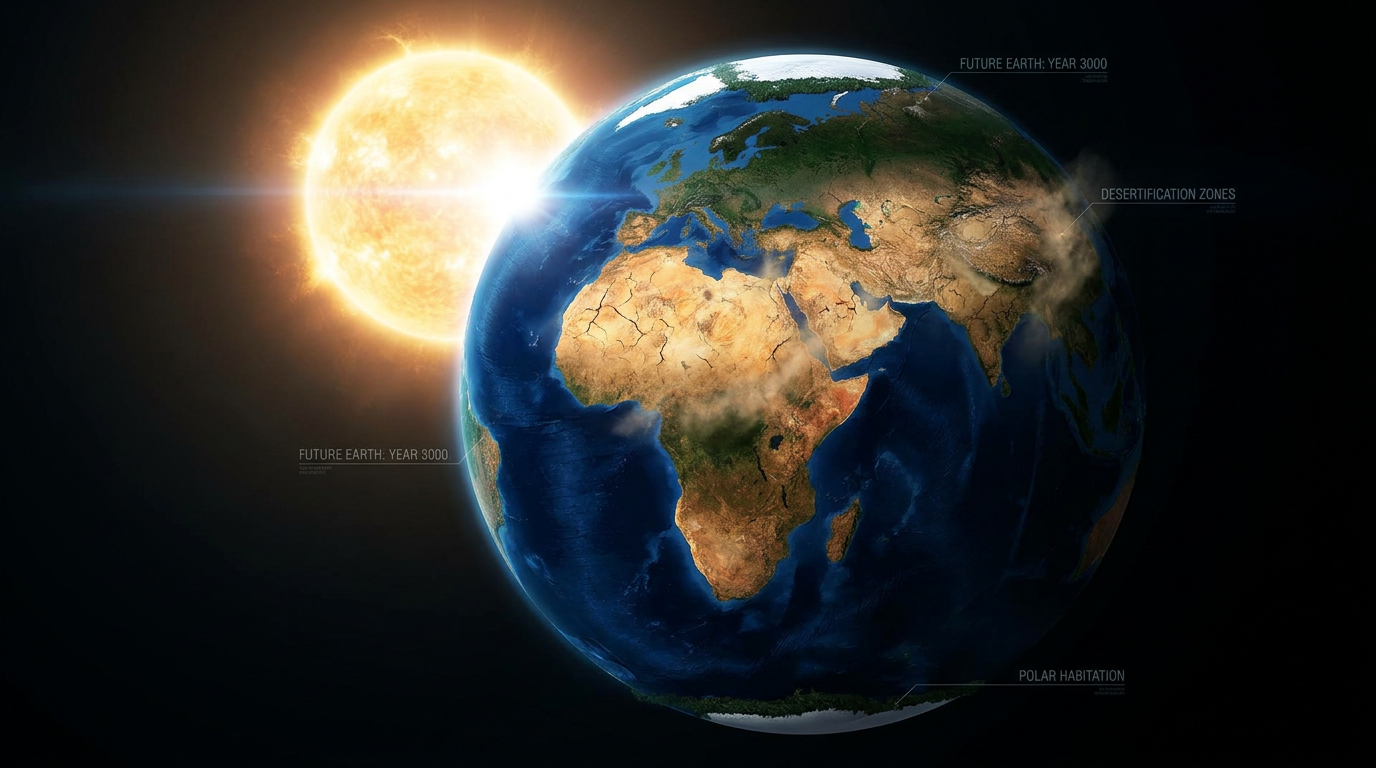
For decades, the ultimate expiration date for complex life on Earth has been etched into the bedrock of planetary science: roughly one billion years. The mechanism is not a mystery, but a fundamental consequence of stellar physics. As our Sun ages, it burns brighter, slowly turning up the thermostat on the solar system. To compensate for this increasing heat, Earth’s geological processes must draw carbon dioxide out of the atmosphere to prevent a runaway greenhouse effect. Eventually, this carbon starvation will suffocate the plant life that forms the foundation of the global food web. But new modeling of Earth's deep future suggests that this apocalyptic timeline may be premature. According to recent research, the biosphere might possess enough atmospheric and geological resilience to sustain complex life for up to 1.5 billion years—a 500-million-year extension that fundamentally reshapes our understanding of planetary habitability.[1][2]
To understand how Earth might buy itself half a billion years of borrowed time, we must first look at the engine driving the change: the Sun. Like all main-sequence stars, the Sun generates energy by fusing hydrogen into helium within its core. As helium accumulates, the core becomes denser and hotter, which in turn accelerates the rate of nuclear fusion. This is not a sudden event, but a relentless, gradual progression. Astrophysicists calculate that the Sun’s luminosity increases by approximately 10 percent every billion years. While a 10 percent increase might sound modest, on a planetary scale, it represents a massive influx of thermal energy that will eventually push Earth past the inner edge of the solar system's habitable zone.[3]
This long-term stellar brightening operates on a timescale completely divorced from modern, human-driven climate change. While anthropogenic global warming is measured in decades and centuries, the Sun's evolution is measured in eons. For the past four billion years, Earth has successfully managed this steadily increasing solar output through a natural planetary thermostat known as the carbon-silicate cycle. This geological feedback loop is the unsung hero of Earth's habitability, constantly adjusting the concentration of greenhouse gases in the atmosphere to keep surface temperatures relatively stable, allowing liquid water—and life—to persist.[4]

The carbon-silicate cycle operates through the chemical weathering of rocks. As the Sun grows hotter, evaporation rates over the oceans increase, leading to a warmer, wetter global climate with heavier rainfall. Rainwater naturally mixes with atmospheric carbon dioxide to form a weak carbonic acid, which falls onto exposed silicate rocks on the continents. This acid dissolves the rocks, washing carbon and calcium ions into the rivers and eventually the oceans. There, marine organisms use these ions to build their shells. When these organisms die, they sink to the seafloor, locking the carbon away in limestone deposits. Over millions of years, tectonic plates subduct this limestone into the Earth's mantle, eventually returning some of the carbon to the atmosphere via volcanic eruptions.[4][5]
The problem for the biosphere is that this thermostat is a victim of its own success. To counteract the relentlessly brightening Sun, the carbon-silicate cycle must pull more and more carbon dioxide out of the atmosphere to weaken the greenhouse effect and keep the planet cool. Over the next billion years, atmospheric CO2 levels will be forced into a steep, terminal decline. This creates a fatal paradox: the very mechanism that keeps the Earth cool enough to retain its oceans will eventually starve the planet's plant life of the carbon it needs to survive.[5][6]
The traditional models of Earth's demise hinge on this carbon starvation. The vast majority of the world's plant life relies on C3 photosynthesis, a metabolic pathway that begins to fail when atmospheric carbon dioxide drops below 150 parts per million. A smaller subset of plants, including grasses and corn, use the more efficient C4 pathway, which can function down to roughly 10 parts per million. However, as the Sun continues to brighten, even the C4 threshold will be breached. Once the plants die, the oxygen they produce will vanish from the atmosphere. Without oxygen and a primary food source, the global food web will collapse, leading to the rapid extinction of all complex animal life, leaving behind a barren world populated only by extremophile microbes.[4][6]

The traditional models of Earth's demise hinge on this carbon starvation.
So, how do the latest models grant complex life a 500-million-year reprieve? The answer lies in the nuanced dynamics of atmospheric pressure and ocean buffering. Previous simulations often treated the Earth's atmosphere as a relatively static blanket, focusing primarily on the raw ratio of carbon dioxide to solar radiation. But as plants die off and oxygen levels plummet, the total mass and pressure of the Earth's atmosphere will also decrease. A thinner atmosphere fundamentally alters how heat is trapped and distributed across the planet.[2][5]
Lower atmospheric pressure reduces the efficacy of greenhouse gases through a phenomenon known as pressure broadening. In a thinner atmosphere, gas molecules collide less frequently, which narrows the bands of infrared radiation they can absorb. This means that even with the Sun beating down more intensely, a low-pressure atmosphere is worse at trapping heat. This unexpected cooling effect acts as a secondary thermostat, counteracting the solar brightening just enough to keep surface temperatures within a survivable range for millions of years longer than the carbon-silicate cycle alone could manage.[1][5]
Furthermore, the new models suggest that the oceans will play a more active role in buffering the biosphere's decline. As surface temperatures rise, the oceans will absorb massive amounts of heat, but they will also undergo complex chemical changes. The deep oceans hold vast reserves of dissolved carbon. As the surface environment becomes increasingly hostile, localized upwellings could sustain isolated pockets of marine photosynthesis far longer than terrestrial plants could survive. These oceanic sanctuaries might serve as the final strongholds for complex life, harboring specialized ecosystems long after the continents have turned to dust.[2]

Despite these optimistic revisions, the ultimate fate of the planet remains sealed. The 500-million-year extension merely delays the inevitable. Once the Sun's luminosity increases by roughly 20 percent—about two billion years from now—no amount of atmospheric thinning or carbon sequestration will be able to save the oceans. Earth will enter a runaway greenhouse state. The oceans will boil, saturating the atmosphere with water vapor, which is itself a potent greenhouse gas. This will trigger a catastrophic feedback loop, baking the surface and stripping the planet of its remaining hydrogen as it escapes into space.[3][4]
There are also significant uncertainties that could cut this extended timeline short. The most critical unknown is the future of Earth's tectonic engine. Plate tectonics are driven by heat escaping from the planet's core and radioactive decay in the mantle. As the Earth ages, its interior is slowly cooling. If the mantle cools too much, the tectonic plates could lock in place, halting the volcanic activity that returns carbon to the atmosphere. Without this geological recycling, the carbon-silicate cycle would break prematurely, plunging the Earth into a deep freeze or accelerating the carbon starvation of the biosphere.[5][6]
The implications of this research extend far beyond the distant future of our own world. By proving that complex life can endure higher levels of stellar radiation through atmospheric pressure adjustments, scientists are effectively widening the habitable zone for exoplanets across the galaxy. When astronomers use instruments like the James Webb Space Telescope to scan the cosmos, they often target older star systems. If planets can remain hospitable for 1.5 billion years under a brightening star, the statistical probability of finding complex, multicellular life on those distant worlds increases dramatically.[1][2]

This paradigm shift forces a reevaluation of how we define a dead planet. A world that appears to be on the brink of a runaway greenhouse effect might actually be in a prolonged, stable twilight, harboring highly adapted ecosystems. As we refine our models of Earth's final eons, we are not just writing the obituary of our own biosphere; we are drafting a new field guide for the search for life among the stars, proving that nature's capacity for survival is far more stubborn than our equations previously allowed.[1][5]
How we got here
Present Day
Earth's carbon-silicate cycle maintains a stable climate despite the Sun being 30% brighter than it was 4 billion years ago.
+500 Million Years
Atmospheric CO2 drops below the threshold required for most plant life, triggering a slow decline in the biosphere.
+1.5 Billion Years
The new estimated limit for complex life, sustained by lower atmospheric pressure and ocean buffering.
+2 Billion Years
The Sun's luminosity increases by 20%, triggering a runaway greenhouse effect that evaporates the oceans.
+5 Billion Years
The Sun exhausts its hydrogen fuel and expands into a red giant, likely engulfing the Earth.
Viewpoints in depth
Astrobiologists & Climate Modelers
Focus on the atmospheric and chemical mechanisms that can extend a planet's habitable lifespan.
Researchers in this camp argue that previous models of Earth's demise were too simplistic, treating the atmosphere as a static blanket. By factoring in the dynamic drop in atmospheric pressure as oxygen and carbon dioxide levels fall, they demonstrate that the planet can passively cool itself. This pressure-broadening effect, combined with the deep ocean's ability to buffer chemical changes, suggests that complex ecosystems are far more resilient to stellar brightening than previously assumed.
Exoplanet Astronomers
View these models as a crucial tool for identifying which distant star systems are most likely to harbor life.
For astronomers hunting for life beyond our solar system, Earth's extended timeline is a statistical goldmine. If rocky planets can remain habitable for 1.5 billion years under a brightening star, the 'Goldilocks zone' is effectively wider in time. This encourages observatories like the James Webb Space Telescope to dedicate observation hours to older exoplanets that were previously dismissed as being too far past their habitable prime.
Geophysicists
Emphasize the uncertainty of Earth's internal tectonic engine, which could halt and end life prematurely regardless of the Sun.
Geophysicists caution that the Sun is only half of the habitability equation. Earth's ability to regulate its climate relies entirely on plate tectonics recycling carbon from the mantle to the atmosphere. As the Earth's core cools, this tectonic engine will eventually seize up. If the plates lock into place before the Sun boils the oceans, the carbon-silicate cycle will break, and the biosphere could face a rapid, premature extinction.
What we don't know
- Exactly when Earth's tectonic plates will stop moving, which would prematurely break the carbon-silicate cycle.
- How resilient deep-ocean ecosystems might be once surface photosynthesis completely halts.
- Whether extremophile plants could evolve entirely new metabolic pathways to survive on near-zero carbon dioxide.
Key terms
- Carbon-silicate cycle
- The geological process that regulates Earth's climate by transferring carbon between the atmosphere, oceans, and rocky mantle.
- Solar luminosity
- The total amount of energy emitted by the Sun, which naturally increases as the star ages.
- C3 photosynthesis
- The most common form of photosynthesis used by plants, which requires relatively high levels of atmospheric carbon dioxide to function.
- Pressure broadening
- A physical phenomenon where the absorption of infrared radiation by greenhouse gases is reduced in a thinner, lower-pressure atmosphere.
Frequently asked
Does this relate to current climate change?
No. Current climate change is driven by human-emitted greenhouse gases over decades. This research looks at natural stellar and geological processes over billions of years.
Will the Sun eventually destroy the Earth?
Yes. In roughly 5 billion years, the Sun will exhaust its hydrogen fuel and expand into a red giant, likely engulfing the Earth entirely.
What happens to the oceans?
Before the Sun becomes a red giant, its increasing heat will cause a runaway greenhouse effect, evaporating Earth's oceans in about 2 billion years.
Sources
Source coverage
6 outlets
3 viewpoints surfaced






[1]Factlen Editorial TeamAstrobiologists & Climate Modelers
Synthesis by Factlen editorial team
Read on Factlen Editorial Team →[2]New ScientistAstrobiologists & Climate Modelers
Complex life on Earth may last 500 million years longer than expected
Read on New Scientist →[3]NASAExoplanet Astronomers
The Sun's Evolution and the Habitable Zone
Read on NASA →[4]NatureAstrobiologists & Climate Modelers
The future lifespan of Earth's oxygenated atmosphere
Read on Nature →[5]arXivGeophysicists
Long-term habitability and the carbon-silicate cycle on Earth-like planets
Read on arXiv →[6]Penn State UniversityGeophysicists
Modeling the long-term carbon dioxide compensation limit
Read on Penn State University →

Every angle. Every day.
Get science stories with full source coverage and perspective breakdowns delivered to your inbox.