
A Cross-Species Cell Transplant Just Revealed How the First Animals Built Their Bodies
By transplanting embryonic cells from a comb jelly into a sea anemone, scientists have proven that the biological software for building animal bodies has remained unchanged for hundreds of millions of years.
By Factlen Editorial Team
- Evolutionary Biologists
- Focuses on the deep conservation of the body plan blueprint across hundreds of millions of years.
- Developmental Biologists
- Emphasizes the technical marvel of the micro-transplantation and the mechanical function of organizer cells.
- Science Historians
- Highlights the century-long arc from Hilde Mangold's 1924 amphibian experiments to today's breakthrough.
What's not represented
- · Marine ecologists studying the real-world environmental pressures that shaped these early body plans.
- · Computational biologists who model the genetic regulatory networks of early metazoans.
Why this matters
This breakthrough proves that the fundamental biological 'software' used to build your body is the exact same code that organized the very first animals on Earth. By demonstrating that a sea anemone can read the genetic instructions of a comb jelly, scientists have uncovered the deep, invisible thread that connects all multicellular life across hundreds of millions of years.
Key points
- Scientists successfully transplanted embryonic "organizer" cells from a comb jelly into a sea anemone.
- The transplanted cells instructed the host anemone to grow a secondary body axis, including extra mouths.
- The experiment proves that the genetic blueprint for building 3D animal bodies is deeply conserved across different phyla.
- The micro-surgery required immense precision, moving a 20-micrometer cell cluster into an embryo the width of a human hair.
- The discovery builds on the foundational 1924 work of embryologist Hilde Mangold, who first identified the organizer in amphibians.
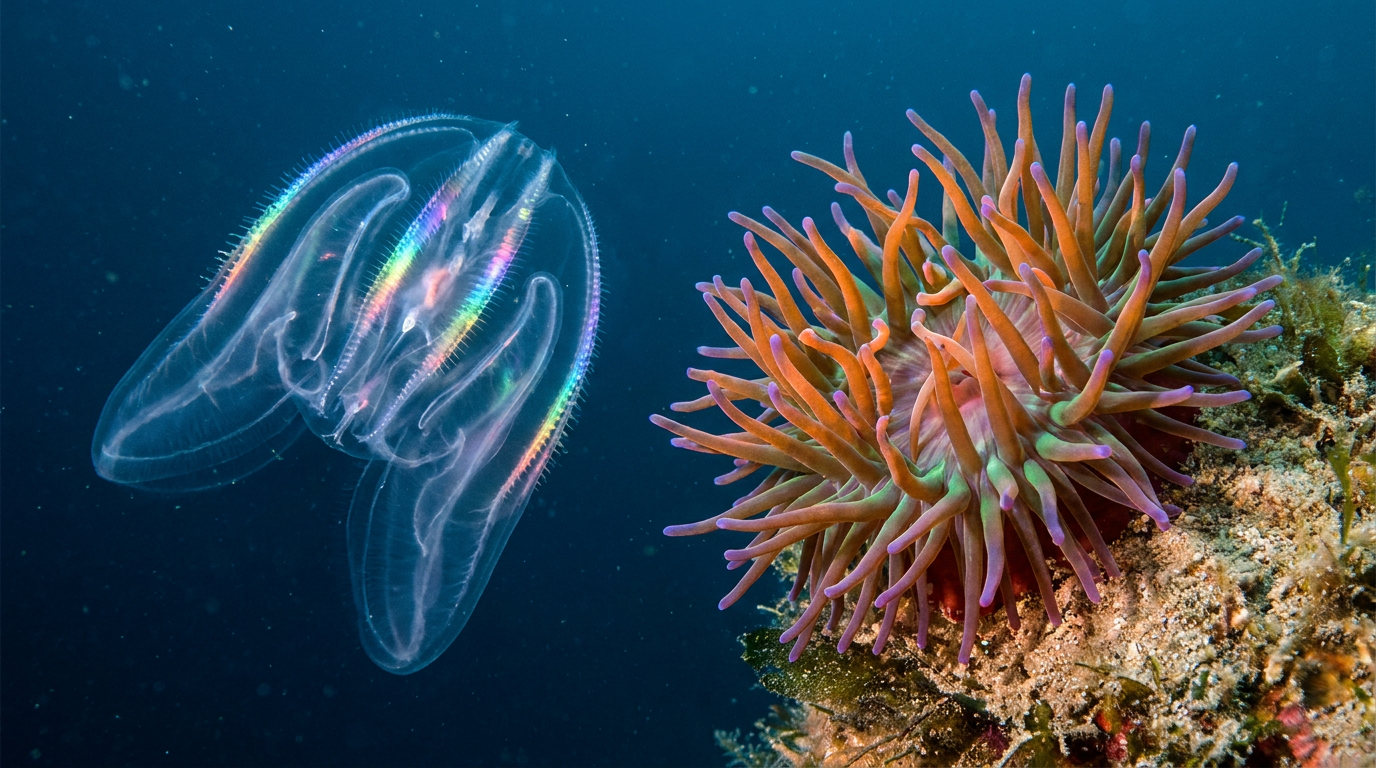
In a laboratory in Germany, a researcher recently performed a microscopic surgery that sounds like the premise of a science fiction novel: transplanting the embryonic cells of a predatory comb jelly into the embryo of a sea anemone.[1][2]
The two marine creatures belong to entirely different phyla—major branches on the tree of life—that diverged hundreds of millions of years ago. Yet, when the comb jelly cells were grafted into the sea anemone, they did not die, nor were they rejected by the host organism.[1][5]
Instead, they began to issue chemical instructions. The transplanted cells commanded the host anemone's tissue to build a secondary body axis, resulting in the formation of extra mouths and pharynxes entirely directed by the foreign graft.[1][3]
Published this week in the journal Nature, this astonishing cross-species transplant solves one of the most profound mysteries in evolutionary biology: how the very first animals learned to build three-dimensional bodies from simple clusters of cells.[1][6]

The study, led by Dr. Stanislav Kremnyov and Prof. Andreas Hejnol at Friedrich Schiller University Jena, proves that the genetic "operating system" used to coordinate a body plan is a universal, ancient mechanism that predates the explosion of complex life on Earth.[1][2]
To understand the magnitude of this discovery, one must look back exactly a century. In 1924, a young embryologist named Hilde Mangold conducted a pioneering experiment that forever changed the trajectory of developmental biology.[3][6]
Working with her supervisor, Hans Spemann, Mangold carefully sliced a tiny cluster of cells from the embryo of one newt species and grafted it onto the embryo of another amphibian.[1][3]
The transplanted cells acted as a biological foreman, directing the host's surrounding cells to construct a second spine and nervous system. Mangold and Spemann dubbed this cluster of master-builder cells the "embryonic organizer."[1][4]

The transplanted cells acted as a biological foreman, directing the host's surrounding cells to construct a second spine and nervous system.
While the discovery earned Spemann a Nobel Prize in 1935 (Mangold tragically died in a gas heater explosion before the award could be granted), scientists long assumed that this sophisticated organizer mechanism was a relatively recent evolutionary invention, exclusive to complex bilateral animals like amphibians, mammals, and humans.[2][6]
The Jena team's breakthrough shatters that assumption entirely. Comb jellies (Ctenophora) and sea anemones (Cnidaria) are among the earliest-diverging animal lineages, possessing radial symmetry and lacking a centralized brain.[1][2]
By proving that comb jellies possess an embryonic organizer—and that its chemical language is still perfectly understood by a sea anemone—the researchers demonstrated that the blueprint for 3D body architecture was written at the very dawn of animal life.[1][5]
Executing this experiment required an almost unfathomable level of manual dexterity. A comb jelly embryo measures roughly 120 micrometers in diameter, which is only slightly thicker than a human hair.[2][6]

The cluster of organizer cells that Kremnyov transplanted measured a mere 20 micrometers. Prof. Hejnol vividly described the delicate micro-surgery as being akin to "dissecting clouds."[2]
The fact that the sea anemone's cells could "read" the comb jelly's instructions highlights a remarkable evolutionary continuity. Despite hundreds of millions of years of separate evolution, the fundamental molecular vocabulary of morphogenesis remains unchanged.[1][2]

This discovery bridges the gap between developmental biology and evolutionary history. It suggests that once nature invented a successful algorithm for organizing cells into a structured body, it locked that code into the genome of nearly every animal that followed.[2][6]
Ultimately, the cross-phylum transplant is a powerful reminder of the deep, invisible threads that connect all multicellular life. From the translucent comb jelly drifting in the deep ocean to the human reading these words, we are all built using the same ancient biological software.[6]
How we got here
Precambrian Era (>600M years ago)
The lineages of comb jellies (Ctenophora) and sea anemones (Cnidaria) diverge, taking with them a shared genetic blueprint for body organization.
1924
Embryologist Hilde Mangold and Hans Spemann discover the 'embryonic organizer' by transplanting cells between amphibian embryos.
1935
Hans Spemann is awarded the Nobel Prize in Physiology or Medicine for the discovery of the organizer effect.
June 2026
Researchers at Friedrich Schiller University Jena successfully transplant an organizer from a comb jelly into a sea anemone, proving the mechanism's ancient origins.
Viewpoints in depth
Evolutionary Biologists' View
This camp views the transplant as proof that the fundamental blueprint for animal life is ancient and universal.
For evolutionary biologists, the successful communication between comb jelly cells and a sea anemone host is a revelation. Because these two phyla diverged over 600 million years ago, the fact that they share a mutually intelligible chemical language means the 'organizer' mechanism must have existed in their last common ancestor. This pushes the origin of complex, three-dimensional body patterning back to the very dawn of multicellular animal life, long before the Cambrian explosion.
Developmental Biologists' View
This perspective focuses on the mechanics of morphogenesis and the technical achievement of the experiment.
Developmental researchers are captivated by the sheer mechanical reality of the experiment. Extracting a 20-micrometer cluster of cells from an embryo barely the width of a human hair requires extraordinary precision—described by the team as 'dissecting clouds.' Beyond the technical feat, the results confirm that embryonic organizers do not just exist in bilateral animals like frogs and mice, but are a fundamental feature of radial animals, actively secreting morphogens that dictate the fate of surrounding tissues.
Science Historians' View
This camp contextualizes the discovery within the century-long legacy of embryology.
Historians of science see this breakthrough as the ultimate vindication of Hilde Mangold and Hans Spemann's 1924 work. Mangold's original discovery of the embryonic organizer in newts established the entire field of developmental biology, though her early death obscured her legacy. Seeing her exact experimental design replicated a century later—this time across entirely different phyla rather than just different species of amphibians—cements the organizer concept as one of the most important biological discoveries of the 20th century.
What we don't know
- It remains unclear exactly which specific molecular signals (morphogens) the comb jelly organizer uses to communicate with the sea anemone's cells.
- Scientists do not yet know if this cross-phylum compatibility extends to more complex, bilateral animals like vertebrates.
- The precise evolutionary moment when this organizer mechanism first emerged in the single-celled ancestors of animals is still a mystery.
Key terms
- Embryonic Organizer
- A specific group of cells in an embryo that dictates the developmental fate of surrounding tissues, effectively orchestrating the layout of the body.
- Phylum
- A principal taxonomic category that ranks above class and below kingdom, representing a major branch of the evolutionary tree of life.
- Ctenophora
- A phylum of marine invertebrates commonly known as comb jellies, characterized by their translucent bodies and rows of swimming cilia.
- Cnidaria
- A phylum of aquatic animals that includes sea anemones, corals, and jellyfish, known for their radial symmetry and specialized stinging cells.
- Morphogenesis
- The biological process that causes a cell, tissue, or organism to develop its shape and three-dimensional structure.
- Bilateral Symmetry
- A body plan in which the left and right halves of the organism are mirror images of each other, a trait shared by most complex animals including humans.
Frequently asked
What is an embryonic organizer?
An embryonic organizer is a specialized cluster of cells in an early embryo that acts as a biological foreman. It secretes chemical signals that instruct surrounding cells on how to arrange themselves into a three-dimensional body plan, such as forming a spine or a nervous system.
Why are comb jellies and sea anemones significant?
They belong to two of the oldest, earliest-diverging branches of the animal kingdom. Because they are separated by hundreds of millions of years of evolution, finding a shared mechanism between them proves that the mechanism is incredibly ancient.
Who was Hilde Mangold?
Hilde Mangold was a pioneering embryologist who, as a PhD student in 1924, first discovered the embryonic organizer by transplanting cells between different species of newts. Her work laid the foundation for modern developmental biology.
How small were the transplanted cells?
The comb jelly embryos used in the experiment were only 120 micrometers in diameter—about the width of a human hair. The transplanted cluster of organizer cells was a mere 20 micrometers across.
Sources
Source coverage
6 outlets
3 viewpoints surfaced






[1]NatureEvolutionary Biologists
Cell transplant across the tree of life hints at how animals emerged
Read on Nature →[2]Friedrich Schiller University JenaDevelopmental Biologists
Decoding the Genetic Blueprint Behind Our Three-Dimensional Body
Read on Friedrich Schiller University Jena →[3]3 Quarks DailyScience Historians
Cell transplant across the tree of life hints at how animals emerged
Read on 3 Quarks Daily →[4]CuratedSciDevelopmental Biologists
Cell transplant across the tree of life hints at how animals emerged
Read on CuratedSci →[5]ScienceX InnovationsEvolutionary Biologists
Cell transplant across the tree of life hints at how animals emerged
Read on ScienceX Innovations →[6]Factlen Editorial TeamScience Historians
Synthesis by Factlen editorial team
Read on Factlen Editorial Team →

Every angle. Every day.
Get science stories with full source coverage and perspective breakdowns delivered to your inbox.