
OLED vs. Mini-LED: The 2026 TV Display Comparison
As 2026 TV technologies push the boundaries of brightness and contrast, the choice between OLED and Mini-LED comes down to room lighting, screen size, and viewing habits.
By Factlen Editorial Team
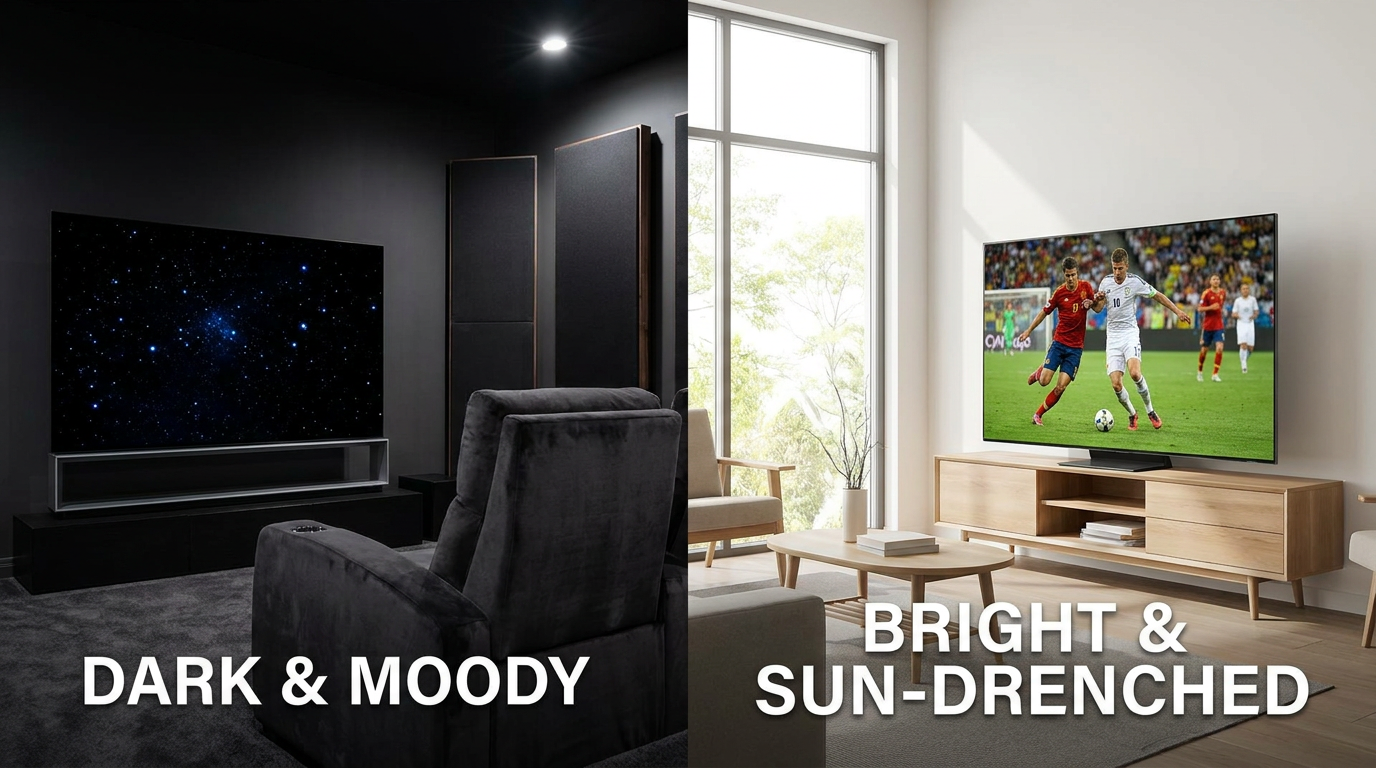
- Cinematic Purists
- Prioritize perfect black levels, infinite contrast, and pixel-level precision for dark-room movie viewing.
- Bright-Room Maximizers
- Prioritize peak brightness, glare reduction, and vibrant HDR performance in sunlit living spaces.
- Value & Scale Buyers
- Prioritize massive screen sizes (85-inch+) and zero burn-in risk at a more accessible price point.
What's not represented
- · Budget / Entry-Level Buyers
- · Projector Enthusiasts
Why this matters
A premium TV is a long-term investment that dictates your daily entertainment experience. Choosing the wrong panel technology for your specific room lighting or viewing habits can result in washed-out pictures, frustrating glare, or unnecessary burn-in anxiety.
Key points
- OLED remains the undisputed champion for dark-room viewing, offering perfect black levels and infinite contrast.
- Mini-LED dominates in bright, sunlit rooms, sustaining peak brightness levels that OLED cannot match.
- 2026 Tandem OLED panels have significantly boosted brightness, narrowing Mini-LED's historical advantage.
- Mini-LED is the only cost-effective option for buyers seeking massive 85-inch to 115-inch screens.
- OLED carries a slight risk of burn-in from static images, while Mini-LED is immune to permanent image retention.
- Competitive gamers often prefer OLED for its near-instantaneous response times and motion clarity.
The 2026 TV market has crystallized into a two-horse race that forces buyers to make a definitive choice: OLED or Mini-LED. Gone are the days when standard LED displays dominated the premium tier. Today, the decision hinges on a fundamental divergence in how screens generate light. On one side, Organic Light-Emitting Diode (OLED) technology continues to refine its self-emissive pixels, with 2026 introducing stacked architectures that push brightness further than ever before. On the other side, Mini-LED has evolved from a brute-force backlight into a precision instrument, with new RGB sub-LEDs delivering blinding peak brightness and massive screen sizes at a fraction of OLED's cost. The gap between the two has narrowed, but the trade-offs remain absolute.[1][2]
The most explicit argument for OLED remains its undisputed mastery of contrast and black levels. Because each of its eight million pixels generates its own light and can turn off completely, OLED achieves a true absolute black level. The evidence for this advantage is immediately apparent in dark-room viewing, where starfields in science fiction movies or shadows in moody video games render with pixel-perfect precision and zero light bleed. For home theater purists and professional color graders, this infinite contrast ratio provides a cinematic fidelity that backlight-driven displays simply cannot replicate.[2][3]
Against OLED's contrast dominance, Mini-LED mounts a devastating counterattack centered entirely on brightness and ambient light rejection. While 2026 Tandem OLEDs can briefly hit 2,000 nits in small highlights, they must aggressively dim full-screen bright scenes to manage heat and prevent panel degradation. Mini-LEDs, powered by thousands of microscopic backlight zones, suffer no such limitations. Flagship 2026 models routinely sustain 3,000 to 5,000 nits of peak brightness across the entire panel. The evidence here favors Mini-LED in any room with open blinds, skylights, or heavy daytime usage, where it effortlessly punches through glare and delivers vibrant sports and HDR content without breaking a sweat.[1][5]

When evaluating gaming performance and motion clarity, the trade-offs become highly specific to the user's setup. OLED holds the definitive edge for competitive gamers, boasting near-instantaneous sub-millisecond response times that eliminate motion blur during fast-paced action. However, the persistent argument against OLED in desktop or heavy gaming environments is the lingering risk of burn-in. While 2026 mitigation software is excellent, static elements like health bars, taskbars, or news tickers left on screen for thousands of hours can still cause permanent image retention. Mini-LED completely eliminates this anxiety, offering a stress-free experience for users who leave their screens on all day or use them as massive PC monitors, even if they sacrifice a fraction of motion clarity.[2][6]
The most quantifiable divergence between the two technologies in 2026 is the size-to-value ratio. At 55 and 65 inches, the pricing between premium Mini-LED and OLED is fiercely competitive, often separated by only a few hundred dollars. But as buyers demand increasingly massive screens, the manufacturing economics shift violently in Mini-LED's favor. Producing flawless OLED panels at 83 or 97 inches remains astronomically expensive, often pushing prices deep into the five-figure range. Conversely, Mini-LED has commoditized the ultra-large segment, making 85-inch, 98-inch, and even 115-inch displays accessible to standard consumers. For buyers prioritizing sheer cinematic scale over pixel-level perfection, Mini-LED provides an unbeatable mathematical advantage.[4][5]

The most quantifiable divergence between the two technologies in 2026 is the size-to-value ratio.
The introduction of RGB Mini-LED in 2026 has further complicated the color volume debate. Historically, OLED's self-emissive nature gave it a clear victory in color saturation. But by replacing traditional white backlights with dedicated red, green, and blue sub-LEDs, modern Mini-LEDs can now match and sometimes exceed OLED's color volume in highly bright scenes. The trade-off is that Mini-LED still relies on local dimming algorithms; even with tens of thousands of zones, a bright white object on a pitch-black background will still exhibit a faint halo of light, an artifact that OLED's pixel-level control inherently prevents.[3][4]
Beyond pure visual performance, the 2026 landscape has brought power consumption and thermal management into the spotlight. OLED panels are inherently highly efficient when displaying dark scenes, as turned-off pixels draw zero power. However, pushing a Tandem OLED to maximum brightness across a large white screen requires significant wattage. Conversely, Mini-LED power consumption scales directly with the intensity of the backlight. While flagship Mini-LEDs can draw substantial power to hit their 5,000-nit peaks, they generally run cooler thanks to passive heat dissipation and highly efficient LED drivers. For buyers mounting their screens in enclosed media cabinets with limited airflow, Mini-LED's thermal profile often presents less long-term stress on internal components.[4][5]

Regardless of the panel technology chosen, the smart TV ecosystem powering these 2026 displays has reached a point of near-parity. Whether a buyer opts for an OLED running webOS, a QD-OLED running Tizen, or a Mini-LED running Google TV, the underlying processors are now fast enough to eliminate the sluggish menus of previous generations. The true differentiator is no longer the software, but the AI-driven image processing chips that handle upscaling low-resolution content and mapping HDR tones. In this arena, premium models of both OLED and Mini-LED leverage neural networks to clean up compressed streaming video, ensuring that the panel's raw capabilities are not bottlenecked by a poor source signal.[1][3]
Ultimately, the OLED architecture fits perfectly when the viewing environment is controlled and the content demands precision. It is the definitive choice for dedicated, light-controlled home theaters, late-night movie enthusiasts, and competitive gamers who prioritize absolute motion clarity and infinite contrast. It fits well when the seating arrangement is wide, as OLED maintains perfect color accuracy from extreme viewing angles. However, it does not fit when the primary use case involves leaving static news channels on all day, doubling as a bright-room work monitor, or trying to overpower direct afternoon sunlight where reflections can wash out the perfect blacks.[2][3]
Conversely, Mini-LED fits perfectly when the living space dictates the terms of engagement. It is the undisputed champion for sun-drenched living rooms, weekend sports viewing with the blinds open, and households that want a massive 85-inch or larger screen without taking out a second mortgage. It fits well for users who want zero anxiety about burn-in from static user interfaces, PC taskbars, or paused video games. It does not fit when the buyer is a contrast purist who cannot tolerate minor blooming around subtitles in a pitch-black room, or when the seating arrangement forces viewers to watch from sharp off-center angles where LCD-based panels lose their color accuracy.[1][6]
How we got here
2013
The first consumer OLED TVs hit the market, introducing perfect black levels but struggling with low brightness and high burn-in risk.
2019
Mini-LED technology debuts in premium consumer televisions, offering a brighter alternative to OLED with vastly improved local dimming over standard LEDs.
2022
QD-OLED (Quantum Dot OLED) is introduced, bridging the gap by adding higher color volume and brightness to traditional OLED panels.
2024
Mini-LED zone counts cross the 10,000 mark in flagship models, nearly eliminating blooming and intensifying the rivalry with OLED.
2026
Tandem OLED and RGB Mini-LED architectures become the new standard, pushing both technologies to unprecedented levels of brightness and color accuracy.
Viewpoints in depth
Cinematic Purists
The argument for prioritizing perfect black levels and pixel-level precision.
For home theater enthusiasts and professional color graders, the conversation begins and ends with contrast. This camp argues that a display's ability to render absolute black—achieved by turning individual OLED pixels completely off—is the foundational metric of picture quality. They point to the fact that even the most advanced Mini-LEDs with tens of thousands of dimming zones still exhibit faint halos of light around bright objects on dark backgrounds. For this group, the introduction of Tandem OLED in 2026, which boosts brightness without sacrificing pixel-level control, cements OLED as the undisputed reference standard for cinematic fidelity.
Bright-Room Maximizers
The argument for prioritizing peak brightness and ambient light rejection.
This perspective reflects the reality of modern open-plan living spaces, where TVs must compete with skylights, large windows, and overhead lighting. Advocates for Mini-LED argue that OLED's perfect blacks are irrelevant if the screen is too dim to overcome daytime glare. By leveraging RGB Mini-LED backlights that can sustain 3,000 to 5,000 nits of brightness, this camp prioritizes a display's ability to deliver punchy, vibrant sports and HDR content regardless of the time of day. They also emphasize the freedom from Auto Brightness Limiter (ABL) dimming, which often darkens OLED screens during bright, full-screen scenes like hockey games or snowscapes.
Value & Scale Buyers
The argument for maximizing screen real estate and long-term durability.
As consumer preference shifts toward massive 85-inch, 98-inch, and even 115-inch displays, this camp focuses entirely on manufacturing economics and longevity. They argue that the exponential cost curve of large-format OLED panels makes them impractical for the average buyer. Mini-LED provides 90% of OLED's visual performance at a fraction of the cost in these ultra-large sizes. Furthermore, this group values the absolute zero risk of burn-in, making Mini-LED the preferred choice for households that leave news channels running all day or use their massive screens as persistent PC monitors.
What we don't know
- Whether the long-term lifespan of Tandem OLED panels will truly eliminate burn-in anxiety after 5-10 years of heavy use.
- How quickly the manufacturing costs of RGB Mini-LED will drop to make the technology standard in entry-level budget TVs.
- If MicroLED—a technology combining OLED's perfect blacks with Mini-LED's brightness—will become affordable enough to replace both within the next decade.
Key terms
- Tandem OLED
- A new 2026 panel architecture that stacks multiple light-emitting layers to significantly boost peak brightness and lifespan compared to older OLED screens.
- RGB Mini-LED
- An advanced backlight system that uses dedicated red, green, and blue microscopic LEDs instead of traditional white light, resulting in purer colors and higher brightness.
- Blooming (Halo Effect)
- A visual artifact on LED/Mini-LED TVs where light bleeds from a bright object into the surrounding dark areas of the screen.
- Nits
- A standard unit of measurement for a display's brightness; a higher number indicates a screen that can get brighter to combat glare or display vivid HDR highlights.
- Auto Brightness Limiter (ABL)
- A protective feature in OLED TVs that automatically dims the screen when a large portion of the image is bright white, preventing overheating and burn-in.
Frequently asked
Does Mini-LED still have blooming in 2026?
Yes, but it is significantly reduced. While 2026 models feature thousands of dimming zones that tightly control light, a faint halo can still appear around bright objects on pitch-black backgrounds, an artifact OLED completely avoids.
Is OLED burn-in still a real risk?
The risk is much lower thanks to improved panel cooling and pixel-shifting software, but it is not zero. Leaving static elements like news tickers or gaming HUDs on screen for thousands of hours can still cause permanent image retention.
Which technology is better for a bright living room?
Mini-LED is the definitive choice for bright rooms. Its ability to sustain 3,000+ nits of peak brightness allows it to effortlessly cut through daytime glare and direct sunlight, whereas OLED panels may struggle with reflections.
Why are large OLED TVs so much more expensive?
Manufacturing flawless self-emissive OLED panels at 83 inches and above yields higher defect rates, driving up production costs. Mini-LED relies on traditional LCD manufacturing techniques, making massive 98-inch screens far cheaper to produce at scale.
Sources
Source coverage
6 outlets
3 viewpoints surfaced






[1]CNETBright-Room Maximizers
OLED vs Mini-LED in 2026: The Ultimate TV Display Battle
Read on CNET →[2]RTINGSCinematic Purists
OLED vs. Mini LED: Which TV Technology is Right for Your Home?
Read on RTINGS →[3]Tom's GuideCinematic Purists
OLED vs Mini-LED: Which TV technology wins?
Read on Tom's Guide →[4]Data Wire SolutionsValue & Scale Buyers
Best TVs for 2026: 10 OLED and Mini-LED Picks
Read on Data Wire Solutions →[5]Eco PicksValue & Scale Buyers
OLED vs Mini LED TVs: 2026 Buyer's Guide
Read on Eco Picks →[6]100% AppliancesBright-Room Maximizers
OLED vs Mini LED: Key Differences
Read on 100% Appliances →


Every angle. Every day.
Get shopping stories with full source coverage and perspective breakdowns delivered to your inbox.