
Flu Outbreak Sickens 160 at Air Force Base Weeks After Pentagon Ends Vaccine Mandate
A major influenza outbreak has swept through basic training at Lackland Air Force Base, prompting military officials to temporarily reinstate a vaccine mandate just two months after Defense Secretary Pete Hegseth made the shots optional.
By Factlen Editorial Team
- Defense Leadership
- Argues that mandatory vaccines are an overreach that violates service members' medical autonomy and religious freedom.
- Public Health Advocates
- Maintains that mandatory vaccinations are essential to protect troop readiness and prevent outbreaks in close-quarters environments.
- Military Commanders
- Focused on the practical realities of containing outbreaks and maintaining training schedules.
What's not represented
- · Enlisted Recruits
- · Military Families
Why this matters
The outbreak serves as the first major real-world test of the Pentagon's shift toward medical autonomy. It highlights the immediate tension between protecting individual religious and medical freedoms and maintaining the operational readiness of military units living in close quarters.
Key points
- Nearly 160 recruits at Lackland Air Force Base have fallen ill with influenza during basic military training.
- The outbreak occurs two months after Defense Secretary Pete Hegseth ended the military's mandatory flu vaccine policy.
- Following the policy change, flu vaccination rates among incoming recruits at Lackland dropped to approximately 40 percent.
- The Air Force has secured an exception to temporarily reinstate the vaccine mandate at the base to contain the virus.
- The cause of death of one trainee during the outbreak remains under investigation.
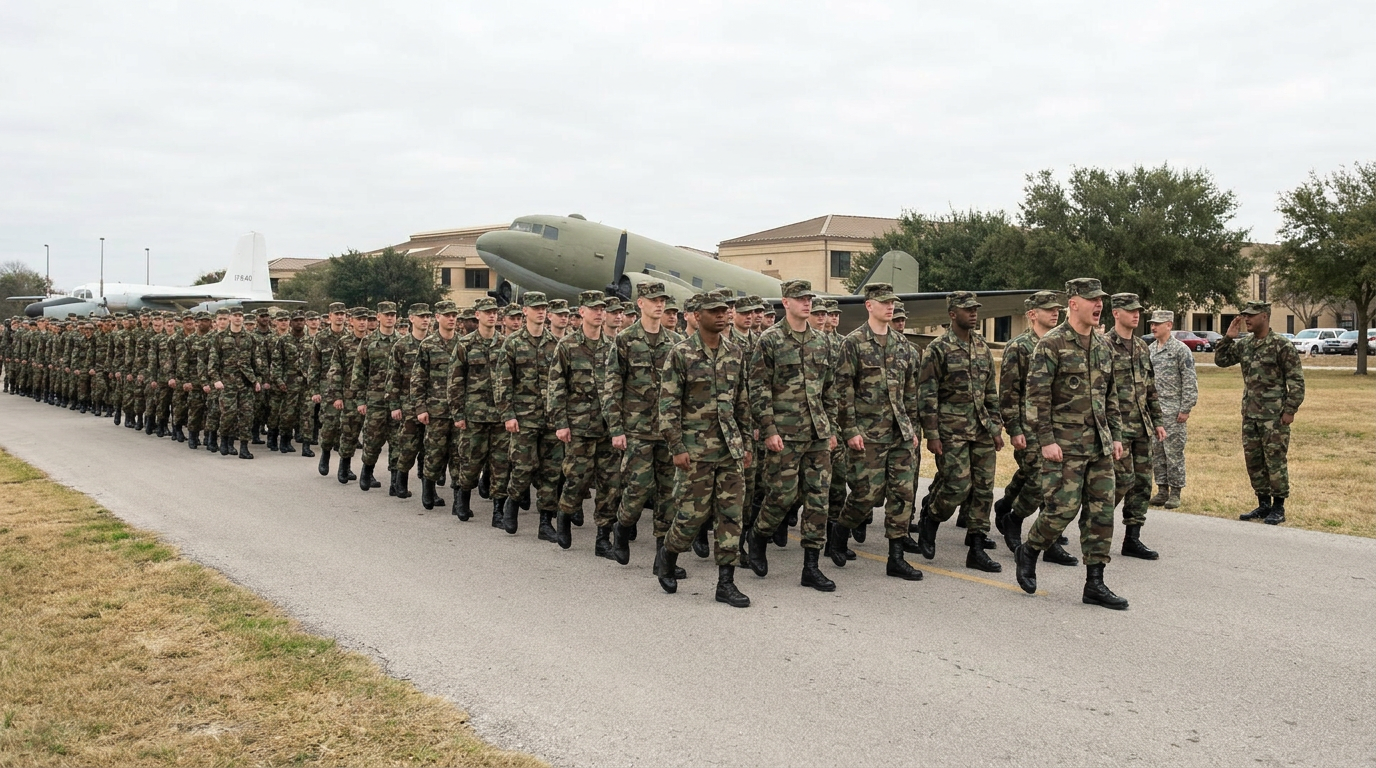
A localized influenza outbreak has sickened nearly 160 recruits at Lackland Air Force Base in Texas, creating an immediate test for a controversial new Pentagon policy. The rapid spread of the virus through the military's largest basic training hub comes just two months after Defense Secretary Pete Hegseth ended the military's decades-old flu vaccine mandate.[2][3]
The outbreak began in late May and quickly swept through the 37th Training Wing, which oversees basic military training for all enlisted Air Force, Space Force, and Air National Guard recruits. With recruits living in massive dormitories and sleeping just feet apart in open bays, the airborne illness found an ideal environment to spread.[2][5]
The situation escalated when Keon McDaniel, a trainee in his sixth week of basic training, died following a "medical emergency." While the Air Force has stated that the cause of death remains under investigation and has not definitively linked it to the flu outbreak, the incident has heightened scrutiny on the base's health protocols.[2][3]
The vulnerability of the recruit population is directly tied to a major policy shift implemented in April 2026. Defense Secretary Pete Hegseth signed a memorandum making the annual flu vaccine voluntary for all active and reserve service members, rolling back a requirement that had been standard operating procedure since the mid-20th century.[1][4]

In announcing the change, Hegseth framed the mandate as an issue of bodily autonomy and religious freedom. He described universal vaccine requirements as "overly broad and not rational," arguing that service members should not be forced to choose between their conscience and their country. The move aligned with the Trump administration's broader push to dismantle pandemic-era health directives.[1][4]
In announcing the change, Hegseth framed the mandate as an issue of bodily autonomy and religious freedom.
The impact of making the vaccine optional was immediate and stark. Prior to the policy change, the flu vaccination rate among incoming recruits was nearly 100 percent. After the mandate was lifted, Air Force officials confirmed that only about 40 percent of new trainees at Lackland opted to receive the shot.[2][3][6]
Public health experts had warned that such a drop in herd immunity would inevitably lead to outbreaks in training environments. Basic military training is a 7.5-week gauntlet where thousands of recruits share dining halls, classrooms, and high-rise Airman Training Complexes. In these close-quarters settings, contagious respiratory diseases can easily put entire units out of commission.[5][7]

Faced with a rapidly expanding cluster of cases, Air Force leadership was forced to activate a failsafe built into Hegseth's directive. The Under Secretary of Defense for Personnel and Readiness granted an "exception to policy" for Lackland, allowing base commanders to temporarily mandate the flu vaccine for all recruits in order to curb the transmission and maintain operational readiness.[2][6]
Alongside the reinstated local mandate, the 59th Medical Wing implemented strict mitigation measures. Symptomatic trainees are being isolated and treated with antiviral medications like Tamiflu, while medical personnel monitor close contacts. Trainees are only allowed to return to their rigorous physical schedules once cleared by medical professionals.[2][5]
The Lackland outbreak has crystallized the tension between the Pentagon's new emphasis on individual medical freedom and the historical military doctrine of force protection. Critics, including the American Public Health Association, argue that voluntary vaccination policies fundamentally undermine medical readiness, treating preventable diseases as an acceptable risk.[6][7]

Vaccination programs in the U.S. military date back to the American Revolution, when George Washington mandated smallpox inoculations for the Continental Army. The modern flu vaccine requirement was established to prevent the kind of mass casualties seen during the 1918 influenza pandemic, which severely impacted troop deployments during World War I.[1][7]
As the military navigates this new landscape, the Lackland exception raises questions about the long-term viability of a voluntary vaccine policy. If commanders must routinely request emergency mandates to contain localized outbreaks, the Pentagon may face mounting pressure to balance its commitment to medical autonomy with the practical realities of keeping a joint force healthy and deployable.[2][6]
How we got here
Jan 2023
The Pentagon drops the COVID-19 vaccine mandate after congressional pressure.
April 21, 2026
Defense Secretary Pete Hegseth announces the annual flu vaccine will no longer be mandatory for U.S. troops.
Late May 2026
Influenza begins spreading among recruits at Lackland Air Force Base's basic training facilities.
June 16, 2026
Trainee Keon McDaniel dies following a medical emergency; cause remains under investigation.
Mid-June 2026
Air Force officials secure an exception to temporarily reinstate the vaccine mandate at Lackland to curb the outbreak.
Viewpoints in depth
Defense Leadership
Argues that mandatory vaccines are an overreach that violates service members' medical autonomy and religious freedom.
Defense Secretary Pete Hegseth and aligned officials view universal vaccine mandates as "absurd" and "not rational." They argue that forcing service members to take vaccines against their conscience damages morale and recruitment. By making the flu shot optional, they aim to restore "freedom and strength" to the military, asserting that troops can make their own risk assessments without compromising overall national security.
Public Health Advocates
Maintains that mandatory vaccinations are essential to protect troop readiness and prevent preventable outbreaks in close-quarters environments.
Medical professionals and organizations like the American Public Health Association argue that military training environments are uniquely vulnerable to airborne illnesses. Because recruits live, eat, and sleep in massive communal bays, a drop in herd immunity guarantees rapid viral spread. They view the shift to voluntary vaccination as an "irresponsible decision" that prioritizes political ideology over the practical necessity of keeping units healthy and deployable.
Military Commanders
Focused on the practical realities of containing outbreaks and maintaining training schedules.
For base commanders and medical wings, the debate is less ideological and more operational. When vaccination rates at Lackland dropped to 40 percent, the resulting outbreak threatened to derail the basic training pipeline that produces 35,000 airmen annually. Their immediate response was to request an exception to the new policy, temporarily reinstating the mandate locally to isolate the sick, administer antivirals, and stop the virus from halting operations.
What we don't know
- Whether the recent death of trainee Keon McDaniel was directly caused by the influenza virus.
- If the Pentagon will grant similar 'exceptions to policy' for other military training bases as flu season progresses.
Key terms
- Exception to Policy (ETP)
- A formal military waiver that allows a specific unit or base to deviate from standard Department of Defense regulations, used here to reinstate the vaccine mandate locally.
- Basic Military Training (BMT)
- The rigorous initial orientation and training program for new military recruits, characterized by communal living and high physical stress.
- Medical Autonomy
- The principle that individuals have the right to make their own healthcare decisions, cited by the Defense Secretary as the reason for ending the vaccine mandate.
- Herd Immunity
- When a large portion of a community becomes immune to a disease, making its spread from person to person unlikely, which protects those who are not immune.
Frequently asked
Why did the flu outbreak happen at Lackland Air Force Base?
Lackland is the hub for Air Force basic training, where thousands of recruits live in close quarters. After the military made the flu vaccine optional in April 2026, vaccination rates dropped to 40%, creating an environment where the airborne virus could spread rapidly.
Did the military reinstate the vaccine mandate?
The Pentagon's overall policy making the flu vaccine voluntary remains in place. However, the Air Force requested and received an "exception to policy" to temporarily mandate the vaccine specifically for recruits at Lackland to contain the outbreak.
Was the death of a trainee caused by the flu?
Trainee Keon McDaniel died following a "medical emergency" during the outbreak. The Air Force is currently investigating the cause of death and has not officially confirmed whether it was linked to the influenza virus.
Why did Defense Secretary Hegseth end the mandate?
Hegseth stated that universal vaccine mandates were "overly broad" and violated service members' medical autonomy and religious freedom. He argued that troops should not be forced to choose between their conscience and their military service.
Sources
Source coverage
7 outlets
3 viewpoints surfaced







[1]AP NewsDefense Leadership
Flu vaccine no longer mandated for US troops, Hegseth says
Read on AP News →[2]CBS NewsMilitary Commanders
Air Force unit in Texas faces flu outbreak weeks after vaccine requirement dropped
Read on CBS News →[3]The GuardianPublic Health Advocates
Nearly 160 sick with flu at US air force base after Hegseth ends mandatory vaccines
Read on The Guardian →[4]The Washington PostDefense Leadership
Annual flu vaccine no longer required for U.S. military, Hegseth says
Read on The Washington Post →[5]San Antonio Express-NewsMilitary Commanders
Flu outbreak strikes recruits in basic training at Lackland Air Force Base
Read on San Antonio Express-News →[6]Rolling OutPublic Health Advocates
A deadly military flu outbreak is pointing directly at Hegseth's decision
Read on Rolling Out →[7]Genetic Literacy ProjectPublic Health Advocates
'Irresponsible decision'? On mandatory military flu shots, Hegseth chooses 'freedom' over health
Read on Genetic Literacy Project →
More in news politics
See all 7 stories →US-Iran Deal
US Lifts Naval Blockade on Iran as Vance Defends Peace Deal Against Israeli Criticism
8 sources
US-Iran Deal
U.S. Lifts Naval Blockade on Iran as 60-Day Peace Negotiations Begin
8 sources
Emissions Policy
Supreme Court Strikes Down EPA Tailpipe Emissions Rules, Upending US Transition to EVs
8 sources
US-Iran Deal
US Lifts Naval Blockade as 60-Day Iran Peace Deal Takes Effect
8 sources

Every angle. Every day.
Get news politics stories with full source coverage and perspective breakdowns delivered to your inbox.