
Japan's Largest Taxi App IPO Signals a National Pivot to Robotaxis
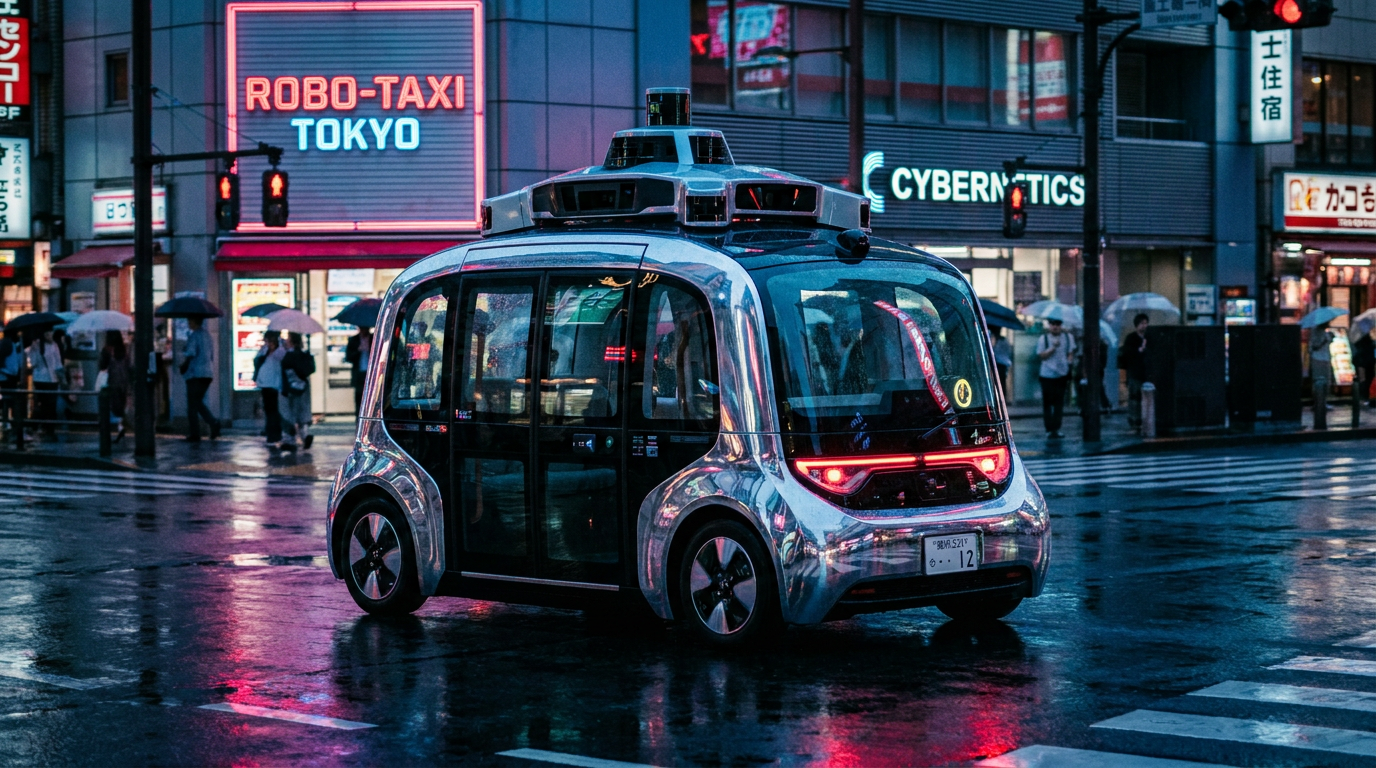
Go Inc. has raised $553 million in Japan's biggest IPO of the year, aiming to deploy autonomous vehicles to combat the country's severe driver shortage. The move highlights how demographic decline is accelerating the commercialization of robotaxis.
By Factlen Editorial Team
- Mobility Innovators
- Tech firms and automakers view autonomous vehicles as the inevitable and necessary solution to demographic decline.
- Logistics & Labor Sector
- Transportation operators are focused on immediate capacity relief and the operational realities of the '2024 Problem'.
- Institutional Investors
- Global capital allocators see a massive, high-margin total addressable market in Japanese mobility.
What's not represented
- · Rural Japanese residents lacking transit
- · Current taxi drivers facing industry transition
Why this matters
Japan is treating autonomous vehicles not as a futuristic luxury, but as an urgent macroeconomic necessity to keep its economy functioning. If robotaxis can successfully solve Japan's demographic labor cliff, it will provide a blueprint for every other aging nation globally.
Key points
- Go Inc., Japan's largest taxi-hailing app, raised $553 million in the country's biggest IPO of 2026.
- The company plans to use the capital to fund the research and deployment of a nationwide robotaxi network.
- Japan is facing a severe driver shortage, exacerbated by the '2024 Problem' which capped driver overtime.
- Estimates suggest Japan will face a 34% shortfall in transportation and logistics capacity by 2030.
- Automakers like Nissan and tech giants like Waymo are partnering with local networks to commercialize Level 4 autonomy by 2027.
- Japan is emerging as the ultimate proving ground for autonomous vehicles due to demographic necessity rather than mere technological novelty.
Go Inc., Japan's dominant taxi-hailing application, has executed the country's largest initial public offering of 2026. Debuting on the Tokyo Stock Exchange Growth Market, the company raised ¥88.6 billion—approximately $553 million—and saw its shares surge by as much as 23% in early trading.[1][2]
Backed by Goldman Sachs-affiliated funds and the telecommunications giant NTT Docomo, Go operates at a massive scale, partnering with roughly 85,000 taxis across all 47 of Japan's prefectures. The IPO was oversubscribed by more than 25 times, drawing heavy commitments from global institutional investors like BlackRock and Wellington Management.[2][3]
But the influx of capital is not merely a reward for digitizing a historically analog industry. Go has explicitly earmarked the proceeds for a much more ambitious technological leap: the research, development, and deployment of a nationwide robotaxi network.[1][4]
To understand why a ride-hailing app is pivoting so aggressively toward autonomous vehicles, one must look at the demographic reality of Japan. The country is facing an existential labor shortage, driven by an aging population and a shrinking workforce.[5][7]

This slow-moving crisis was sharply accelerated by what the Japanese logistics and transportation sectors call the "2024 Problem." In April 2024, the government implemented strict new labor regulations that capped the annual overtime for commercial drivers at 960 hours.[6][8]
While the overtime cap was a necessary step to improve grueling working conditions, it immediately slashed the operational capacity of fleets nationwide. The average age of a commercial driver in Japan is nearly 48 years old, with fewer than 9% of the workforce under the age of 30.[7]
Without the ability to rely on endless overtime from an aging workforce, the math no longer works. Government and industry estimates project that by 2030, Japan will face a 34% shortfall in its transportation and logistics capacity. The drivers simply do not exist to meet the demand.[7][8]
This is where Go's robotaxi ambitions transition from a Silicon Valley novelty to a macroeconomic necessity. Unlike in the United States, where autonomous vehicles are often viewed as a convenience or a tech-sector experiment, in Japan, they are increasingly seen as the only viable mechanism to keep the country moving.[4][7]

This is where Go's robotaxi ambitions transition from a Silicon Valley novelty to a macroeconomic necessity.
Go is positioning itself not as an automaker, but as a "Mobility OS"—an operating system that bridges the gap between autonomous hardware and the end consumer. By leveraging its existing network of 85,000 human-driven taxis, Go can seamlessly integrate driverless vehicles into its dispatch system as they become available.[1][4]
The company is not building the cars itself. Instead, it is forming strategic alliances. A notable partnership with Alphabet's Waymo aims to bring the "Waymo Driver" technology to Japanese streets, with Go handling the dispatch routing and local operators managing fleet maintenance.[1][4]
Domestic automakers are equally focused on the autonomous solution. Nissan has announced plans to roll out SAE Level 4 robotaxis in Japan by fiscal year 2027, specifically citing the driver shortage in local municipalities.[5]
Nissan's approach involves testing modified Serena minivans in Yokohama before expanding to rural areas where the lack of public transit and taxi drivers is most acute. Honda, too, has formed a joint venture with General Motors and Cruise to launch driverless ride services in the country.[5]

The push for autonomy extends far beyond passenger robotaxis. The "2024 Problem" has triggered a massive wave of automation in the logistics sector. Autonomous mobile robots are being deployed in warehouses to load and unload cargo, saving truck drivers up to 25% of their shift time.[6][8]
The Japanese government is also actively exploring the creation of dedicated automated transportation routes. These would utilize the shoulders and median strips of expressways to allow unmanned carts and autonomous trucks to move freight between major hubs like Tokyo and Osaka without human intervention.[7]
Crucially, the regulatory environment in Japan is shifting to accommodate this technological transition. While the government has historically maintained strict safety standards, the sheer economic pressure of the labor shortage is forcing a more pragmatic, accelerated approach to permitting Level 4 autonomous operations.[5][7]
Despite the momentum, significant uncertainties remain. The technological leap from controlled testing environments to the chaotic, dense, and narrow streets of Tokyo is immense. Furthermore, the unit economics of Level 4 autonomy—balancing the high cost of sensor suites and remote human monitors against the revenue of a taxi fare—have yet to be proven profitable at scale.[5]

There is also the question of public acceptance. Japanese consumers are accustomed to world-class service standards, epitomized by the white-gloved drivers of traditional taxi fleets. Transitioning that expectation of hospitality to a sterile, driverless pod will require careful brand management and flawless safety records.[1][5]
Yet, the sheer necessity of the endeavor gives it a unique resilience. Japan has become the ultimate global proving ground for commercial autonomy. If robotaxis and autonomous trucks can succeed here, driven by the absolute necessity of demographic survival, the models developed will likely serve as a blueprint for other aging economies worldwide.[4][7]
Go Inc.'s $553 million IPO is more than a successful financial exit for its early backers; it is a war chest for the next era of urban mobility. As the "2024 Problem" continues to squeeze the nation's logistics, the race to replace the missing human driver with silicon and software has officially begun.[1][2][6]
How we got here
April 2024
Japan implements strict new overtime caps for commercial drivers, officially triggering the '2024 Problem' and a nationwide capacity crisis.
December 2024
Go announces a strategic partnership with Alphabet's Waymo to bring autonomous driving technology to the Japanese market.
2025
Autonomous mobile robots see a massive surge in deployment across Japanese warehouses to offset the lack of human logistics workers.
June 16, 2026
Go Inc. executes Japan's largest IPO of the year, raising $553 million to fund its robotaxi and expansion ambitions.
Fiscal 2027
Nissan targets the commercial launch of its in-house Level 4 robotaxi service in select Japanese municipalities.
Viewpoints in depth
Mobility Innovators
Tech firms and automakers view autonomous vehicles as the inevitable and necessary solution to demographic decline.
Companies like Go, Nissan, and Waymo argue that the technology for Level 4 autonomy is maturing at exactly the right moment to intercept Japan's labor cliff. They point to the successful integration of ride-hailing software with traditional fleets as proof that Japanese consumers will adopt new mobility paradigms if they are reliable. For these innovators, the focus is now on driving down the cost of sensor hardware and proving that driverless operations can achieve profitability at scale.
Logistics & Labor Sector
Transportation operators are focused on immediate capacity relief and the operational realities of the '2024 Problem'.
For the trucking associations and traditional taxi operators, the romance of AI is secondary to the urgent math of missing drivers. They emphasize that while robotaxis are a promising future state, the immediate crisis requires hybrid solutions—such as autonomous mobile robots in warehouses and dedicated automated freight lanes. Their primary concern is ensuring that the transition to autonomy does not disrupt existing service levels or run afoul of Japan's strict safety expectations.
Institutional Investors
Global capital allocators see a massive, high-margin total addressable market in Japanese mobility.
Firms like Goldman Sachs and BlackRock are pouring capital into Japanese mobility platforms because they recognize the unique macroeconomic setup. Unlike the US market, where robotaxis face regulatory friction and public skepticism, Japan's demographic necessity provides a clear regulatory tailwind. Investors view platforms like Go not just as taxi apps, but as high-margin 'Mobility OS' monopolies that will eventually collect recurring revenue from every autonomous mile driven in the country.
What we don't know
- Whether the unit economics of Level 4 robotaxis can achieve profitability at scale in the near term.
- How quickly Japanese consumers, accustomed to high-touch hospitality from traditional taxi drivers, will adapt to fully driverless services.
- The exact timeline for when autonomous vehicles will be capable of navigating the most dense and chaotic streets of central Tokyo without remote human intervention.
Key terms
- Robotaxi
- A self-driving taxi capable of operating without a human driver, typically utilizing a suite of sensors, cameras, and artificial intelligence.
- Level 4 Autonomy
- A designation by the Society of Automotive Engineers (SAE) for vehicles that can intervene and handle all driving functions under specific conditions or in specific areas, without requiring human oversight.
- Mobility OS
- A software operating system designed to manage, dispatch, and route a mixed fleet of human-driven and autonomous vehicles across a city's transportation network.
- 2024 Problem
- A Japanese macroeconomic crisis in the logistics sector caused by a 2024 law capping driver overtime, leading to a massive drop in transportation capacity.
- Initial Public Offering (IPO)
- The process by which a private company offers shares of its stock to the public for the first time, raising capital to fund future expansion.
Frequently asked
What is Japan's '2024 Problem'?
It refers to a severe labor shortage in the transportation and logistics sectors, triggered by new government regulations implemented in April 2024 that strictly capped the annual overtime hours for commercial drivers.
How much did Go Inc. raise in its IPO?
Go Inc. raised ¥88.6 billion, or approximately $553 million, making it the largest initial public offering in Japan for the year 2026.
Will Go manufacture its own autonomous vehicles?
No. Go plans to act as a 'Mobility OS,' providing the dispatch software and network infrastructure while partnering with hardware and AI developers, such as Waymo and Nissan, to supply the actual driverless vehicles.
When will robotaxis become widely available in Japan?
While testing is ongoing, major commercial rollouts are targeted for the near future. Nissan, for example, plans to launch its Level 4 autonomous ride service in select municipalities by fiscal year 2027.
Sources
Source coverage
8 outlets
3 viewpoints surfaced






[1]TechCrunchMobility Innovators
Go eyes robotaxis and acquisitions after Japan’s biggest IPO of 2026. Here’s why it matters
Read on TechCrunch →[2]Dow Jones NewswiresInstitutional Investors
Ride-Hailing App Go Surges in Trading Debut for Japan's Biggest IPO of Year
Read on Dow Jones Newswires →[3]ReutersInstitutional Investors
Go shares jump in Tokyo debut after $552.6m IPO
Read on Reuters →[4]BloombergMobility Innovators
Japan's Go App Targets Robotaxis After Successful IPO
Read on Bloomberg →[5]AutoweekMobility Innovators
Here's Why Nissan Wants Robotaxis in Japan
Read on Autoweek →[6]International Federation of RoboticsLogistics & Labor Sector
Robots Help to Solve 'Japan's 2024 Problem'
Read on International Federation of Robotics →[7]The Road to AutonomyInstitutional Investors
Driver Shortages in Japan are Ushering in The Autonomy Economy
Read on The Road to Autonomy →[8]Assembly MagazineLogistics & Labor Sector
Robots Could Solve Japan's '2024 Problem'
Read on Assembly Magazine →

More in technology
See all 5 stories →


Every angle. Every day.
Get technology stories with full source coverage and perspective breakdowns delivered to your inbox.