
The Mechanics of Olympic Flag Football: How the 5v5 Game Will Work at LA 2028
Flag football will make its Olympic debut in Los Angeles, bringing a fast-paced, non-contact 5v5 format to the global stage. With NFL players cleared to compete and women's participation surging worldwide, the sport is undergoing a massive structural evolution.
By Factlen Editorial Team
- International Federation of American Football
- Focuses on globalizing the sport, standardizing rules, and building grassroots participation worldwide.
- National Football League
- Views the Olympics as a massive marketing vehicle to expand American football's global footprint and showcase its elite athletes.
- Grassroots & Women's Sports Advocates
- Emphasizes the sport's low barrier to entry, safety, and its role as a massive catalyst for female athletic scholarships and professional leagues.
What's not represented
- · Traditional tackle football purists
- · Olympic traditionalists
Why this matters
The inclusion of flag football in the Olympics is transforming American football from a US-centric, equipment-heavy sport into an accessible global game. It is creating unprecedented scholarship and professional opportunities, particularly for female athletes, while setting the stage for a highly anticipated 'Dream Team' of NFL stars.
Key points
- Flag football will debut at the 2028 Los Angeles Olympics with a 5v5 format.
- NFL owners have approved the participation of active NFL players in the Games.
- The sport features no linemen, no blocking, and strict 'no-run zones' near the end zone.
- Women's flag football is surging, with the NCAA designating it an Emerging Sport.
- Over 20 million athletes currently play flag football across more than 100 countries.
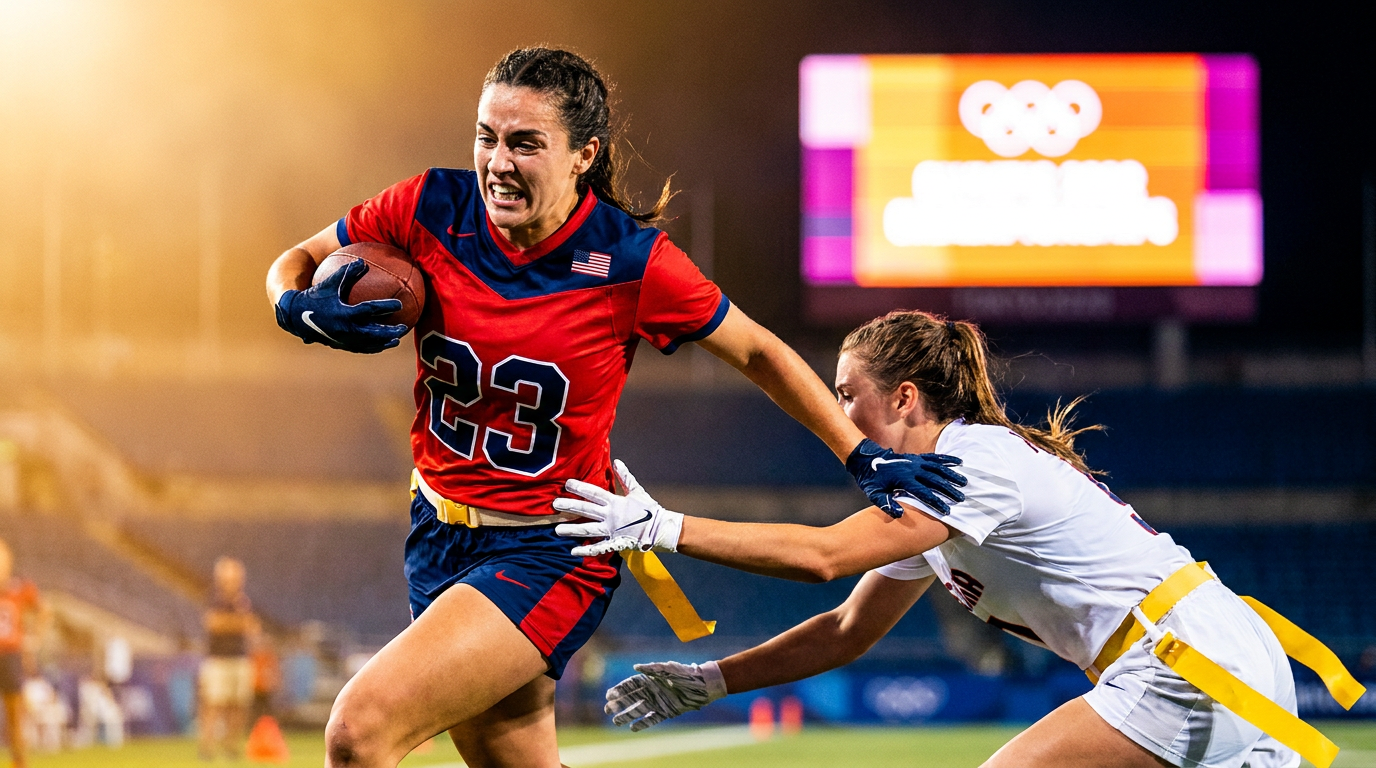
The 2028 Los Angeles Olympics will introduce a distinctly American export to the global stage, but it won't feature the armor, collisions, or 300-pound linemen synonymous with the sport. Instead, the International Olympic Committee has embraced flag football, a fast-paced, non-contact variant that is quietly engineering a worldwide participation boom.[4][6]
The inclusion of flag football represents the culmination of "Vision28," a multi-year lobbying effort spearheaded by the National Football League (NFL) and the International Federation of American Football (IFAF). For the NFL, the Olympics offer an unprecedented vehicle for international expansion, stripping away the prohibitive equipment costs and injury risks that have historically bottlenecked tackle football's global growth.[1][4]
But Olympic flag football is not simply a casual backyard game. It is a highly structured, hyper-athletic discipline governed by strict international rules designed to maximize speed, spacing, and scoring. As national federations begin scouting talent for LA 2028, understanding the mechanics of the format is essential for grasping how the game will actually look on the world stage.[2][3]
The Olympic format will be played five-on-five, with teams drawing from a strict 10-person roster. The field itself is significantly condensed compared to a traditional NFL gridiron, measuring 70 yards long by 25 yards wide. This includes a 50-yard main playing surface flanked by two 10-yard end zones.[1][2]

Play begins with the offense taking possession at their own five-yard line. From there, the mechanics of advancement diverge sharply from tackle football. Teams are given exactly four downs to cross midfield. If they succeed, the chains reset, granting them four additional downs to reach the end zone and score a touchdown. If they fail at either stage, the ball is turned over on downs, and the opposing team takes over at their own five-yard line.[2][3]
One of the most defining tactical quirks of the IFAF rulebook is the "no-run zone." Situated five yards before midfield and five yards before the end zone, these zones are designed to prevent teams from using brute-force short-yardage runs to pick up crucial first downs or touchdowns. Once an offense enters a no-run zone, every play must be a forward pass.[3]
The absence of linemen fundamentally alters the geometry of the game. The center, who snaps the ball to the quarterback, immediately becomes an eligible receiver. Because blocking of any kind is strictly penalized as an offensive foul, quarterbacks do not have a traditional "pocket" of protection.[3]
The absence of linemen fundamentally alters the geometry of the game.
Instead, pressure comes from a designated defensive "rusher." Under international rules, any defender wishing to rush the quarterback must line up at least seven yards behind the line of scrimmage at the snap. This creates a precise timing mechanism: the quarterback knows exactly how many seconds they have to release the ball before the rusher covers that seven-yard gap, placing a premium on lightning-fast processing and quick-release mechanics.[3][6]
Scoring mirrors traditional football, with touchdowns worth six points. However, there is no kicking in Olympic flag football. After a touchdown, teams must attempt a point-after conversion from the scrimmage line: a single play from the five-yard line is worth one point, while a play from the 10-yard line is worth two points.[2]
The prospect of the 2028 Games has already triggered a talent arms race, particularly following a landmark decision by NFL team owners. In May 2025, the league officially approved a resolution allowing active NFL players to participate in the Olympics.[1]
The ruling clears the path for an American "Dream Team" scenario, echoing the iconic 1992 USA Basketball squad. Under the approved framework, each NFL franchise is permitted to send one domestic player to the Games, alongside one designated international player. However, NFL superstars will not simply be handed roster spots; they must navigate a rigorous tryout and qualification process managed by USA Football and the US Olympic Committee.[1][4]
While the United States will enter as heavy favorites, the global talent pool is deeper than many American fans realize. Flag football is currently played by an estimated 20 million athletes across more than 100 countries. The IFAF has reported a 48% increase in national teams entering its world ranking system over the past three years alone.[4][5]

The women's game, in particular, is experiencing explosive growth. The Mexican women's national team, led by superstar quarterback Diana Flores, has proven to be a dominant force, famously defeating the United States to capture gold at the 2022 World Games. Japan and Austria also boast elite national programs that will contend for the podium in Los Angeles.[2][4]
Domestically, the Olympic announcement has catalyzed institutional support for female athletes. The NCAA recently designated women's flag football as an Emerging Sport, with plans to launch a National Collegiate Championship as early as spring 2028. High school participation among young women in the US surged by nearly 60% between 2024 and 2025.[5]

The commercial infrastructure surrounding the sport is also maturing rapidly. In June 2026, the IFAF announced a strategic partnership with TMRW Sports—a venture backed by prominent NFL figures—to launch a professional flag football league ahead of the LA Games. The league aims to provide a professional capstone for the sport's growing youth and collegiate tiers.[5]
As the countdown to 2028 accelerates, flag football is shedding its reputation as a mere recreational pastime. By stripping away the pads and the violence, the sport has distilled American football into a pure test of speed, spatial awareness, and schematic execution—one that is finally ready for the Olympic spotlight.[4][6]
How we got here
2022
The NFL and IFAF launch 'Vision28', a joint venture to lobby for flag football's inclusion in the Olympics.
Oct 2023
The International Olympic Committee officially approves flag football for the LA 2028 sports program.
May 2025
NFL team owners vote to permit active NFL players to compete in the 2028 Olympic Games.
Jun 2026
IFAF and TMRW Sports announce a strategic partnership to launch a professional flag football league ahead of the Olympics.
Viewpoints in depth
The NFL's Global Ambition
The league sees the Olympics as the ultimate vehicle to export American football worldwide.
For decades, the NFL has struggled to organically grow tackle football overseas due to the massive costs of equipment, the necessity of large rosters, and the inherent injury risks. Flag football solves all of these logistical hurdles. By placing the sport on the Olympic stage and allowing its brightest stars to compete, the NFL aims to hook a massive international audience on the mechanics of the game, creating a global funnel of future fans and players.
The Grassroots & Women's Movement
Advocates view the sport as a powerful engine for female athletic opportunity and inclusive play.
While the NFL's involvement grabs headlines, the true engine of flag football's growth is at the grassroots level, particularly among women and girls. Because the sport relies entirely on speed, agility, and strategy rather than sheer size and force, it has become incredibly accessible. The NCAA's move to recognize it as an Emerging Sport means thousands of young women will soon have access to collegiate athletic scholarships that previously did not exist, fundamentally altering the landscape of women's sports.
What we don't know
- Which specific NFL superstars will actually commit to the rigorous Olympic qualification process.
- How the newly announced professional flag football league will integrate with the Olympic calendar.
Key terms
- No-Run Zone
- Specific areas on the field, typically five yards before midfield and the end zone, where teams are strictly forbidden from running the ball and must execute a forward pass.
- Rusher
- A designated defensive player who lines up at least seven yards behind the line of scrimmage and sprints to pressure the quarterback after the snap.
- IFAF
- The International Federation of American Football, the global governing body responsible for standardizing the rules of flag football for international competition.
Frequently asked
Will NFL players be allowed to compete in the 2028 Olympics?
Yes. In May 2025, NFL owners officially approved a resolution allowing active NFL players to participate in the LA 2028 Games, pending national team tryouts.
How big is an Olympic flag football field?
The field is 70 yards long and 25 yards wide. This includes a 50-yard main playing area and two 10-yard end zones.
Is there blocking or tackling in Olympic flag football?
No. All forms of contact, including blocking and tackling, are strictly forbidden. Defenders stop plays by pulling a flag attached to the ball carrier's waist.
How many downs does a team get to score?
Teams have four downs to cross midfield. If successful, they earn a first down and receive four more plays to score a touchdown.
Sources
Source coverage
6 outlets
3 viewpoints surfaced






[1]NFL.comNational Football League
NFL Clubs Approve Participation of NFL Players in the 2028 Olympic Games in Los Angeles
Read on NFL.com →[2]Olympics.comInternational Federation of American Football
Flag football: Rules, format and how it works
Read on Olympics.com →[3]USA FootballGrassroots & Women's Sports Advocates
Flag Football Rulebooks and Differences from Tackle
Read on USA Football →[4]Sky SportsNational Football League
Flag Football at the Olympics: How the NFL is taking over the world
Read on Sky Sports →[5]IFAFInternational Federation of American Football
IFAF & TMRW Sports Announce Strategic Partnership to Advance Global Growth
Read on IFAF →[6]Factlen Editorial TeamGrassroots & Women's Sports Advocates
Synthesis by Factlen editorial team
Read on Factlen Editorial Team →

More in sports
See all 11 stories →Olympic Boxing
How AI and Smart Gloves Are Saving Olympic Boxing for LA 2028
6 sources
Standings
Global Skateboarding Standings: Japan Dominates Men's Street as LA28 Olympic Race Heats Up
7 sources
Injury
WSL Injury Updates: Gabriel Medina and Ramzi Boukhiam Return for 2026 Championship Tour
7 sources

Spring Football
Louisville Kings Complete Historic Turnaround to Win 2026 UFL Championship
8 sources
Every angle. Every day.
Get sports stories with full source coverage and perspective breakdowns delivered to your inbox.